Teachable and Unteachable Lessons

[Note: This is posted in my Jissen Budōka blog as well.]

Source: Wikipedia; Status:  Public Domain

Source: Wikipedia; Status: Public Domain

Miyamoto Musashi, who was undefeated in over 60 duels, claimed that he never had a teacher. Some historians refute this claim. Whether one accepts it or not, the statement astonishes.

Musashi wasn’t talking only about martial arts, but about the many areas in which he was accomplished. Not being a painter or a sculptor, I can’t say how important a teacher is in such domains. But it’s easy enough for me to imagine a successful writer who never took a formal class in writing; someone who read profusely and practiced his (or her) craft relentlessly could do it. (Certainly, one can easily imagine successful writers whose formal education was in some area other than writing because there are so many of them–probably at least as many as those whose education was in writing. Examples include: Vonnegut [Chemistry], Crichton [Medicine], Zane Grey [Dentistry], Ursala LeGuin [Anthropology], and J.K. Rowling [French]. That’s not even to start on the many literary legends who dropped out all together– e.g. Dickens, Faulkner, Twain, H.G. Wells, and Jack London.) This isn’t to say that writing teachers don’t make writing better, but just that there is a path to this skill that doesn’t involve being fed lessons.

However, I struggle to imagine a martial artist achieving so much without a teacher. Boiled down to its most workaday definition, a martial art is a collections of lessons about what works in a combative situation. This is what separates the importance of a teacher in martial arts from that of a discipline like writing. In writing, one has the leisure to make one’s mistakes, learn from them, and self-apply course corrections. Musashi was in life or death duels; he couldn’t learn lessons at such a leisurely pace and in such an iterative fashion.

A martial arts teacher has a number of roles, such as preventing inertia (slacking) from taking hold in the training hall. However, the most fundamental purpose is to pass along the collection of lessons so that a student doesn’t have to learn them all by way of personal experience. Most of us aren’t Miyamoto Musashi; we can’t survive the process of learning all our own lessons.

Needless to say, I am a firm believer in the value of a good teacher. I’ve had several over the years, and I received valuable lessons from all of them–all with different, but no less valid, points of emphasis and flavor.

Having said all that proceeds, there’s much that cannot be taught. Such lessons may be described or discussed, but they cannot be learned except through the initiative of the student. I said that most of us can’t survive the process of learning all one’s own lessons, but I’ve increasingly come to believe that one can’t survive learning none of them either. In the beginning, one must be fed the lessons from a teacher in order grow. However, as the decades pass, one increasingly needs the space to learn one’s own lessons. If one lacks said space, one will stagnate and eventually the wheels will roll off one’s training altogether.

So what are the unteachable lessons? Knowledge can be conveyed, but not everything that a martial artist must learn is knowledge. Confidence cannot be taught. A teacher may explain–or even show–how he or she became confident, but that won’t translate one iota into the student being more confident.  This is like a Buddhist monk telling one that “desire is the root of suffering.” One may understand that statement. One may believe the statement. However, one’s suffering won’t decrease because one has the knowledge.  One’s suffering will only decrease if one conscientiously does the hard work of reducing one’s desires.

Another area of unteachable lessons are the lessons that the teacher has never learned. Loyalty is a great virtue, and so there may be a tendency to restrict one’s learning to the lessons of one teacher. However, even if one has an outstanding teacher and are practicing a great lineage, blind spots happen. The only way to learn whether there is anything of value obscured in those blind spots is to throw off one’s blinders and have a look for oneself.

What blinders? An excellent and tricky  question.  It’s like when someone says, “it’s not what you said, but the way you said it.” We all understand that there is some intangible character in language that is commonly understood but not easily seen or defined. In any culture (and a dōjō contains a culture, believe me) there’s always a collection of norms, rules of thumb, ideas, beliefs, mores, credos, etc. that come to be taken so much for granted that they become an invisible filter through which one sees the world. This isn’t an inherently bad thing, and it’s probably necessary to produce sufficient order in a chaotic world in which to learn and grow. Having said that, some of the ideas and beliefs in our cultural filter may be arbitrary, or at least not universal, but yet we don’t necessarily see the potential for error because we are seeing the world through the cultural filter. We take for granted that grass is green, but what if we see it through a yellow filter? Then it’s blue. Right?

There’s No Such Thing as a Silly Question? LIAR!

I’m shocked by how easily a piece of “common wisdom” can become accepted despite being patently and demonstrably wrong. The best example may be, “There’s no such thing as a silly question.”

Oh, yeah:

“Do you wear spurs when you ride ostrich in the avian rodeo?”

“If you had to wear shoes made of cheese, of which cheese would you want them made?”

“Do you have purple-glazed doughnuts in honor of the St. Crispin’s Day unicycle rally?”

“May I twirl my way into an eternity of dandelion lunacy?”

I can do this all day.

Are you seriously going to tell me that none of the above questions is at least a little bit silly. As a person of silliness, it enrages me… well maybe not so much “enrages” as has no discernible effect… when people deny the potential for silliness. Folks, it’s all around us. So, the next time you say that there is no such thing as a silly question, my response is, “Do you really think you can make that stick like the Archbishop’s bugger to the side of an albino wino?”

Paul Brunton’s Search for Sages in India

Source: Kalyan Kumar by way of Wikipedia

Source: Kalyan Kumar by way of Wikipedia

As I prepare to move to India, I’ve begun to read up on this subcontinent about which I know too little. For example, I’d never heard of Paul Brunton before a week ago, but now I am immersed in his book A Search in Secret India. Brunton was a Brit who, like a number of his contemporaries living in the first half of the 20th century, struck out to experience the mysteries locked in the heart of India. Like many, he wanted to gain access to the country’s treasure, but the treasure he sought had nothing to do with material wealth or ancient artifacts. He sought living sages, and the lessons they could teach him. The book I’m reading tells the story of this search.

Something about India drives internal reflection and the spirituality that often accompanies it. It’s the home of Hinduism, Buddhism, Sikhism, and Jainism, as well as many non-denominational wisemen (and wisewomen) who at once can be seen as followers of no religion and believers in many religions.  Value for the unity of mind and body can be seen in the popular national practice of Yoga, which is the antithesis of mindless exercise in which one jumps on a treadmill with an i-Pod and zones out for an hour as one’s body churns through its paces. Yoga, like Tai Chi, requires one’s full attention, and that one’s movement, one’s breath, and one’s awareness are all working toward the same purpose.

So far, Brunton’s work has appealed to me not only because he is in search of wisdom, but because he goes about this pursuit as a skeptic. In the introduction he tells how he edited out the many meetings with charlatans and frauds. Charlatans always abound in the presence of sages because it’s quite lucrative to convince people that they can achieve self-improvement effortlessly through some patented approach. (I’m here to tell you that self-improvement is a struggle that requires your physical and mental energy all the way–what I cannot yet tell you is whether it is worth it or not.) If one cannot see the cloud-enshrouded destination, it’s easy to sell maps–whether one knows the route oneself or not–and many are all too ecstatic to buy a map that shows a secret route that takes them to the pinnacle by way exclusively downhill paths.  The fact that Brunton enters his quest with a degree of skepticism suggests he didn’t fall for such traps; traps that should be obvious but that appeal to those for whom the force of wanting to believe is stronger than the force of truth. [As I am only a few chapters in, I reserve the right to change this prognosis. At some point, I’ll put up a review with my final thoughts.]

I look forward to discovering whether wisdom is alive and well on the subcontinent. Hopefully, the hucksters haven’t won the war for the mind’s of seekers.

BOOK REVIEW: Zen Mind, Beginner’s Mind by Shunryu Suzuki

Zen Mind, Beginner's MindZen Mind, Beginner’s Mind by Shunryu Suzuki

My rating: 5 of 5 stars

Amazon page

This thin volume packs a great deal of knowledge about the Zen approach to the mind. It’s divided into three parts: right practice, right attitude, and right understanding. The first section is technical (e.g. posture, breathing, etc.); the second section is inspirational; and the third section is philosophical. This is consistent with the Zen priority of putting practice first and being cautious about philosophizing.

The core concept is captured by the book’s topic sentence, “In the beginner’s mind there are many possibilities, but in the expert’s there are few.” This sentence contains a valuable truth, but I can’t help but think that the related title probably hurt the book’s sales. Sadly, many people would rather read a book entitled “How to be a Zen Master in 90 Days.” Everybody wants to be an expert, and few are open to the lesson that they must look at the world through the eyes of a novice. I’ve noticed this in the martial arts. Most individuals seem to be much happier as mediocre black belts with only a few years of practice than they would be as a highly competent white belt. This, of course, is the lure of external validation, which is a weak salve for one’s private demons.

At any rate, the value of cultivating shoshin (i.e. beginner’s mind)is to avoid have one’s experience jaded or tarnished by one’s past. It’s about avoiding attachment to what one believes one knows, such that one is incapable of learning something new. It’s like that old, but popular, tale that is told in both the Zen Buddhist and Taoist traditions about a cocky, young student who comes to learn from a master and proceeds to tell the master all he has already learned. The master pours tea for the youth, and when the cup is full he continues to pour until the scalding liquid spills over into the kid’s lap. When the student angrily asks why the teacher did that, he is told, “Your cup is already full. In order to take in more you must first empty your cup.”

I enjoyed this book. It’s very readable. The chapters are concise and not the least bit arcane. The bits on practice are not bogged down in minutiae. As I indicated, this book covers a lot of ground. I would dare say that if you are only going to read one book on Zen in your lifetime, this is a suitable candidate.

View all my reviews

CLASSIC WORKS: Bushidō by Inazo Nitobe

Bushido: The Soul of JapanBushido: The Soul of Japan by Inazo Nitobe

My rating: 4 of 5 stars

Amazon page 

On the whole, people are ambivalent about feudal times. On the one hand, it was a horrible time to be alive for 99.5% of the population. Chances are that if you’d lived during that time you’d be toiling ceaselessly on the land with no hope of improving your lot in life. Everything was determined by heredity, with merit having little to do with anything. This added insult to injury because that person you’d have had to suck up to was as likely to be putz as not.

On the other hand, there is widespread nostalgia for those times because one can’t help but feel that they were the golden days of virtue. As Ralph Waldo Emerson said, we think that society is ever advancing, but, in reality, we advance like a wave–losing as much on the backside as we gain on the front.

Inazo Nitobe’s book gives us an accounting of the chivalric virtue practiced by the samurai, the warrior class of feudal Japan. Bushidō means the way of the warrior. Nitobe lived after Japan’s feudal era, in the late 19th and early 20th centuries. Nitobe was an educator, and the book has a feel of erudition. Interestingly, the author was a Quaker and received education in the West, and, therefore, is able to contrast the Japanese worldview with that of Westerners.

The book is built around discussion of the seven virtues of bushido: justice, courage, benevolence, politeness, sincerity, honor, and loyalty. Each of these virtues has a chapter devoted to it (Ch. 3 through 9.) But first the book introduces bushido as an ethical system, and then it explains the effect that Buddhism, Shintoism, and Confucianism played in the development of this system.

Later chapters outline the education and training of a samurai, the importance of stoicism, the institution of suicide (seppuku), the symbolism of the sword in Japanese society, the role of women, the role of bushido as an ethical system in the present-day (his present), and its proposed role in the future. It is interesting that the book begins by discussing those things that influenced the development of bushidō, and it ends with discussion of how bushidō influences the larger world.

Our views of virtue have changed, but at some level remain consistent. The seven virtues are all still considered virtuous, but we don’t regard them in the same way today. In some cases we are undoubtedly better off with today’s views, but that’s not always the case.

Consider the seventh precept, loyalty. We still value loyalty, but in today’s world the rule of loyalty has an ever-present Shakespearean addenda: “to thine own self be true.” In other words, we no longer believe in loyalty that is blind as was valued in the days of old.

Sincerity, by which Nitobe generally means honesty, is also seen in a different light today. As depicted in the Jim Carey movie, Liar Liar, there’s a widespread view that it’s better to fib and make someone feel better than it is to tell the truth and hurt that person’s feelings.

One of the most intriguing chapters is the one that deals with seppuku. This is a concept that has never been well-understood in the West, and it’s a major point of cultural disconnect. While the Japanese have tended to see suicide as a means to restore honor that was lost in failure, in the West we tend to see it as a more pathetic and cowardly affair. I’ve recently been reading Ian Fleming’s You Only Live Twice, and this is one of many points of diverging attitudes between “Tiger” Tanaka and James Bond.

Bushidō is definitely worth a read. It’s thought-provoking, and is one of those books to be read slowly and conscientiously.

View all my reviews

MASTER WORKS: Apology by Plato

ApologyApology by Plato

My rating: 5 of 5 stars

Amazon page

Apology is Plato’s account of the trial of Socrates. This brief work presents Socrates’ defense of himself as well as his reaction to the death sentence verdict against him. Of course, it is all through the lens of Plato, as Socrates left us no written works.

Socrates was charged with impiety and corruption of the youth. He acknowledged both that he was eloquent and that he was a gadfly of Athens (the latter being a role for which Socrates believes he should be valued.) However, he denied both of the formal charges.

Socrates refuted the charge of corrupting the youth first by denying that he had taken money in exchange for teaching. Taking money was a component of this charge. Socrates’ claim is supported later when Socrates tells the court that he can only afford a very small fine, even in the face of the alternative–a death sentence.

Socrates says that he sees nothing wrong with taking money for teaching–if one has wisdom to share. Socrates says that he has no such wisdom, and suggests the philosopher/teachers that are taking money aren’t in error for taking money, but rather because they really don’t have wisdom themselves.

This is summed up nicely by this pair of sentences, “Well, although I do not suppose either of us knows anything really beautiful and good, I am better off than he is–for he knows nothing and thinks he knows. I neither know nor think I know.”

While Socrates raised the ire of the Athenian leaders with what they no doubt believed to be his arrogance, in fact it wasn’t that he thought himself wiser than they, but that he thought they were deluded in thinking themselves wise.

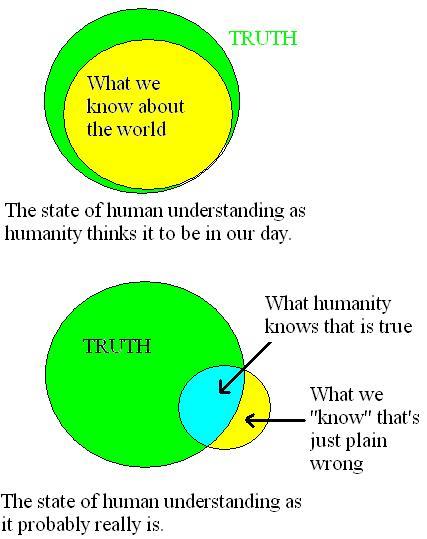
Socrates’ lesson remains valid today. It is the scourge of all ages to think that have finally attained true understanding of the world. Our posterity may know more, but we know all of the essentials and are rapidly converging on a complete picture of our world. We think our generation to be humanity’s sage elders, when, in fact, we are the impetuous teen whose growth spurt has made him cocky. I would propose to you that in all likelihood, even today, the sets of “that which is true” and “that which humanity ‘knows'” form a classic interlinking Venn Diagram. That is, some of the body of knowledge that we take to be proven true is, in fact, false. This occurs because we cannot accept that there are things we are not yet prepared to know, so we use sloppy methodology to “prove” or “disprove.” This one reason we have all these conflicting reports. E.g. coffee is good for you one week, and carcinogenic the next.

VennDiagram_WhatWeKnow

Socrates uses the method that today bears his name, i.e. the Socratic method, to challenge the arguments of Meletus, the prosecutor. The Socratic method uses questions as a device to lead the opposition to a conclusion based on premises they themselves state in the form of their answers. Socrates proposes that if it is he alone who is intentionally corrupting the youth, they would not come around–for no one prefers to be subjected to evil rather than good.

Socrates denies the suggestion that he does not believe in the gods, and in fact indicates that the very suggestion by virtue of the charges against him is a contradiction. What Socrates is guilty of is encouraging those who come around him to develop their own thoughts on god, and not to subordinate their thought to anyone–an idea the leaders found disconcerting.

Socrates goes on to say why he is unmoved by the death sentence. He wonders why it is thought he should beg and wail, when he doesn’t know for sure that an evil is being done against him.

The moral of the story is that those in power fear and will attempt to destroy advocates of free thinking.

This book should be read in conjunction with a couple other Platonic Dialogues, Crito and Phaedo.

View all my reviews

TODAY’S RANT: How’d I Get So Much Stuff?

IMG_5194I don’t  like to use words like “stuff”, “things”, or the vague but picturesque “crap.”  Such words have low information content and are thus semantic lightweights. However, there are few words for the random compilation of tchotchkes, trinkets, baubles, gewgaws, kit, tools, devices, objects, gadgets, contraptions, contrivances, gizmos, widgets, thingamajigs, and doohickeys that line the drawers, shelves, and closets of my house.

You may think I’m some sort of packrat, but the sad fact is– I’m not. I’d say our household buys  less than average for homeowners. For one thing, we have no children. For another thing, both my wife and I might be classified as, for lack of a more eloquent term, cheapskates. (She’s an accountant and I’m trained as an economist, what do you expect?)  Of course, many people, perhaps most people, organize their junk better than I.

I do have one consumption fetish, and that is books. If you live in a very small town (or a large city with many small, local libraries) I may have more volumes in my house than does your local library. However, two things have slowed me down in collecting [physical] books. First, I buy most of my books on my Kindle these days. Second, I’ve come to realize that the reason I’ve bought so many books is the hope that one of them would provide some impetus for me to say something interesting, insightful, and valuable, and the entire English language canon has failed me utterly in this regard.

Still, I have a lot of miscellaneous detritus floating around in my home. You’ve heard of the 500-year flood? I have 500-year tools; that is, tools that are specifically for some task that only comes up once every few lifetimes or so. In a reasonable world, one would rent such tools. However, most tool rental places are also tool sellers. Such businesses have learned that if the tool sells new for $60, they can rent it for $50. Most people will buy it on the principle of the matter, and if they don’t… CHA-Ching. Who would rent a tool that costs almost as much to rent as it does to buy? I’ll tell you who (you thought that was rhetorical, didn’t you?), people who have the good sense to think of every object that comes into their home as an item being warehoused at their expense. People who have garage sales are brilliant. They are getting paid to store their junk in your home.

When I’m doing spring cleaning, as I am now, I frequently find containers that contain nothing. I guess I’ve just kept them around in case some pressing containment needs pop up. I keep all sorts of things because I think one day I’ll need them. However,  I never do need such items again, except the day after I throw them out.  To avoid such a situation, I don’t pitch them. However, if I keep them I won’t need them. If Joseph Heller was still alive, he could write a novel about my life.

Of course, sometimes I do need such items, but–owing to my poor organizational paradigm–I can’t find them. I then face the ultimate dilemma. Do I put the new one that I just bought with the old one that I found after I made the purchase, or do I put it in an entirely different location in the hope that when I need it again I’ll have a better chance of finding it.

No place have I felt the weight of how much “junk”  is swirling through our planet as when I was in Bangkok’s Chinatown last fall. There are miles of cramped alleyways and corridors packed to the gills with little plastic-wrapped junk, much of which seems to serve no purpose other than to satisfy the aesthetic needs of people with really poor taste or as gifts for people to whom you really want to send a statement of loathing. I had to get out of there, owing to a fear that shelving would collapse and I would be buried alive under a pile of knock-off Hello-Kitty coin purses.  I can think of no death that is more embarrassing and yet apropos of life in the modern world than that.

Of course, one of the many downsides of an economics education is the knowledge that our high standard of living is dependent upon people making and buying ever more stuff. If you are saying “what high standard of living?” and you haven’t hand-churned your own butter, darned some socks, and killed a mastodon today, I would encourage you to look into how people lived in the past. People unburdened of an economics education can make statements like, “People shouldn’t be materialistic and everybody should have a job and all jobs should pay a living wage.” However, that is like saying, “I should be able to keep my cake and I should be able to eat it as well and somebody should pay me $100 for it.”

We are still hunter-gatherers. We just hunt for bargains, and gather up geegaws.

IMG_3804

Evangelists Meet Max Their Match

BING-BONG.

Without even looking up from his computer, Max knew it was church people. They came around trying to sell him a religion now and again. No one sold aluminum siding, encyclopedias, or ice cream door-to-door anymore. Evangelic proselytizers were the last bastion of door-to-door salesmanship. The sect varied; the approach did not. They were the only ones who ever disturbed his peace.  Well, the only ones who didn’t use the phone.

He went to the door. It was a zaftig woman and a clean-cut young man–both dressed in funeral-like attire.

“Hello!” the pair said with practiced exuberance.

“Hello,” Max parroted with a decided lack of exuberance. Then he added, “May I help you?”

Max didn’t feel like being helpful, but there was the off-chance that it was  a couple of his neighbors who were just looking to borrow a cup of sugar so they could bake cookies for whatever wake they were attending. If so, he’d help them out, but as far as he knew such a request hadn’t happened since 1955. Then he saw their name tags, and not the paper kind. These were black plastic bordered in gold with white letters.

“We’d like to talk to ya ‘bout the Bible,” the woman said.

“Unless it’s the racy bits, I don’t think you’ll hold my interest,” Max said.

“Excuse me?”

“Never mind.”

“Have you ‘cepted Jesus as your personal Lord and Savior?” the woman asked. The young man was silent, apparently just there in case the woman knocked on the door of a Jeffery Dahmer-type.

Max was distracted by the words “personal lord”, and how odd the phrase seemed. Can I get my Messiah in Mocha with a burgundy robe?

After an awkward pause, he said,  “No, I’m an atheologist.”

They gave a coordinated grimace as if he’d dropped a deuce at their feet. “You’re an atheist?”

“No. I said atheologist. An atheist is one who does not believe in God. I believe in God. I just don’t believe in religion.”

“You cain’t have Gawd without religion.” The woman said.

“I beg to differ.”

“How’d ya know Gawd, elsewise?” The woman continued.

Max swept his hand outward in a gesture meant to draw the pair’s attention to the flowering dogwood in his front yard and the sky beyond. Their forehead creases indicated that they were both perplexed. The meaning of his gesture was lost on them.

“You cain’t know Gawd without religion,” the woman repeated, as if Max just hadn’t heard her the first time and if she said it more emphatically he would get it.

“You can repeat a gratuitous assertion ad infinitum, and it will remain an assertion,” Max said.

Neither evangelist gave any indication that they understood what Max was saying.

He sighed, stepped out onto the porch with them, and said, “Look. First, let’s ask what God gives us.” He leaned out under the eaves to look at an azure sky feathered by white wisps of cirrus clouds. This time they followed his gesturing arm and looked out with him at the bounty of nature. “Now, let’s consider what religion offers us. May I?”  He said as he reached for the thin little magazine that they had prepared to leave with him.

Max was taking a risk. He couldn’t know exactly what it the magazine would contain, but he’d seen enough of them to make an educated guess. There it was, right on the cover. He didn’t even have to flip through in search of it. The cover artwork was a dark sketch of a treeless city with brooding clouds drifting at the tops of buildings. The buildings were in ruins, and there were human-shaped lumps on the ground –meant to be either corpses or homeless people. It was a story about the fall of man or the coming apocalypse or some doom upon whose cusp humanity sits.

“Here we have it. Religion doesn’t show us beauty. It wants me to be afraid. It wants to scare me. It wants carnage and chaos to be my lodestar. It shows me horrors so that it can be my life-preserver. It wants to be my life-preserver so that I’ll substitute its will and wisdom for my own. It wants me to believe its leaders are infallible so that I’ll feel good about giving up control. It wants me to behave as its people behave. Most insidiously, it wants me to hate the people who it hates… This is why I don’t believe in religion. Thank you for your time,” Max said as he handed the Doomsday Gazette back to the woman and walked back into his house, leaving the two slack-jawed proselytizers in his wake.

The Budō Fishbowl

I posted this on my martial arts blog, Jissen Budōka, but decided to re-post here.

fishbowlI’ve read and heard many quotes about the degree to which martial arts CAN’T be taught. At the extreme, there’s Miyamoto Musashi, who claimed to never have had a teacher of swordsmanship.

I recently found myself asking, “What if only 10% of budō is teachable?”

If that were the case, someone who was close to having all of the pieces that could be taught would think themselves a master–even if they were largely ignorant of the other 90%.

Such an individual would be like a fish in a fishbowl, thinking that there was nothing but emptiness above the waterline.

He would be like primitive man, thinking the stars were but pinpricks painted on a dome.

Or, in all likelihood, like the modern man who thinks that if we can just reconcile a couple sciencey bits–maybe experimentally validate string theory– that our picture of the universe would be complete.

Tulip 7

Night falls on Bangkok

Night falls on Bangkok

I’m speed-walking down the sidewalk off Sukhumvit Road like one of those elderly mall-walkers.  Like the mall-walkers, there’s an irony to my speedy step. I’m on vacation. I have no particular place to be, and no particular time by which I need to be there. Unlike the mall-walkers, my path is perilous. I have to weave around street-food vendors deepfrying springrolls or grilling satays (and fight my stomach’s urgings), evade the grasping taunts of idle tuk-tuk drivers, and wave off T-shirt vendors selling shirts featuring elephants, thaiboxers, and Singha beer.

I don’t know why I’m moving so quickly. It feels natural. It’s the pace of the city. To walk slow would be to swim against the current. If you want the truth, I walk fast because in the back of my mind, in the deep recesses of irrationality, I feel that if I slow down the city will collapse into me, forming a black-hole. It will start with a few tuk-tuk drivers, a beggar, a prostitute, and a few street vendors converging on me. They will create a gravity, attracting more vendors, beggars, drivers, and hookers. If I don’t walk fast, I fear that I will be crushed in the center of a dense mass of humanity.

Leaning against the marble wall of a bank façade, a master of timing, an Indian man blinks, touches his forehead, and grimaces–as if my approach causes him some sort of psychic pain. I brace myself for the scam. He steps away from the wall into my path, gently extending an arm.

He says, “Sometimes, you think too much.” He’s trying to convince me that he has insight into my soul by making a statement that, while perfectly correct, contains no information content whatsoever. He’s smooth in behavior and handsome of feature. I bet he makes a mint in his chosen profession.

An instantaneous battle rages inside of me. On the one hand, I’m an introvert– or perhaps a sociopath– something like that. Whatever my affliction, interacting with strangers is draining. On the other hand, I’m curious about everything. I know the man is a scam artist. It’s not that I was never on the turnip truck, but I fell off a couple of decades ago, and while it took me several bounces to come to a stop, I eventually became quasi-worldly. While I know he’s a scam artist, I don’t know what kind. I so desperately want to know that I stop.

After a greeting, he says, “I can tell your future. There are two women in your life, I can tell you how it will work out.” His speech is clear, and well-spoken, like he was born in Mumbai, but moved to Cincinnati when he was 15. He is, in all respects, a smooth operator.

However, he’s wrong already.  As I said, I’m not exactly a people person. It takes all my mental energy to even be monogamous, as opposed to nul-agamous. The idea that I’m maintaining two relationships would be a bit laughable to anyone who could really “see into my mind.” Whenever I hear about one of these guys who has two separate families, I always think, “How many hours a day did the good Lord grant you?” Because I can’t fathom living that way and not being in an utter state of exhaustion every minute of every day. I’d be a wreck.

However, I give him points for playing the odds. I’m a middle-aged man with a gray goatee walking down the street in Bangkok. I’m probably the only one fitting that description who hasn’t fallen desperately (and pathetically) in love with an “eighteen year old” bar girl who the man secretly thinks is 16, but who, in reality, is 29.

Incredulity must show in my face, because he changes tack. “Let me show you proof of my abilities.”

He extracts a flip-style pocket-notepad from the inner pocket of a tweed sport-coat that is grossly out-of-place in steamy Bangkok, but which lends credibility. He scribbles down something on a page so that I cannot see. He then tears off the strip of paper containing his writing. He wads the paper up.

“I want you to think of the English-language name of a flower. Have you got it?” he asks.

“Yeah,” I reply.

“Now think of a number between six and nine. Have you got it? Now think of them together.”

In my mind I see, Tulip 7.

He hands me the wadded up scrap. I unravel it. It reads, “Tulip 7.”

He then opens his day-planner and asks me to put in any amount that I feel is fair and he will tell me about my future.

What he doesn’t know is that I’m the exact wrong person to pitch his act to. As a skeptic, I make Descartes look like gullible. (After all, Descartes developed a “proof for the existence of God”–granted everyone deserves a nadir of thought, and that was clearly Descartes’.) The most fundamental thing that studying Economics and Political Science taught me was that humans are completely incapable of making meaningful predictions. I’d seen this guy’s act before from a guy named Professor Bruce Bueno de Mesquita, but instead of getting a few baht on the streets, the political scientist got millions of American tax dollars for convincing the CIA that he could tell the future.

As I walk away, he says, “You have an ailment. I can tell you about it.”

I think, Good one, that’s a true test of my powers of skepticism, and I continue to walk, thinking out how the mentalist scammer did his trick… and wondering if I have cancer.