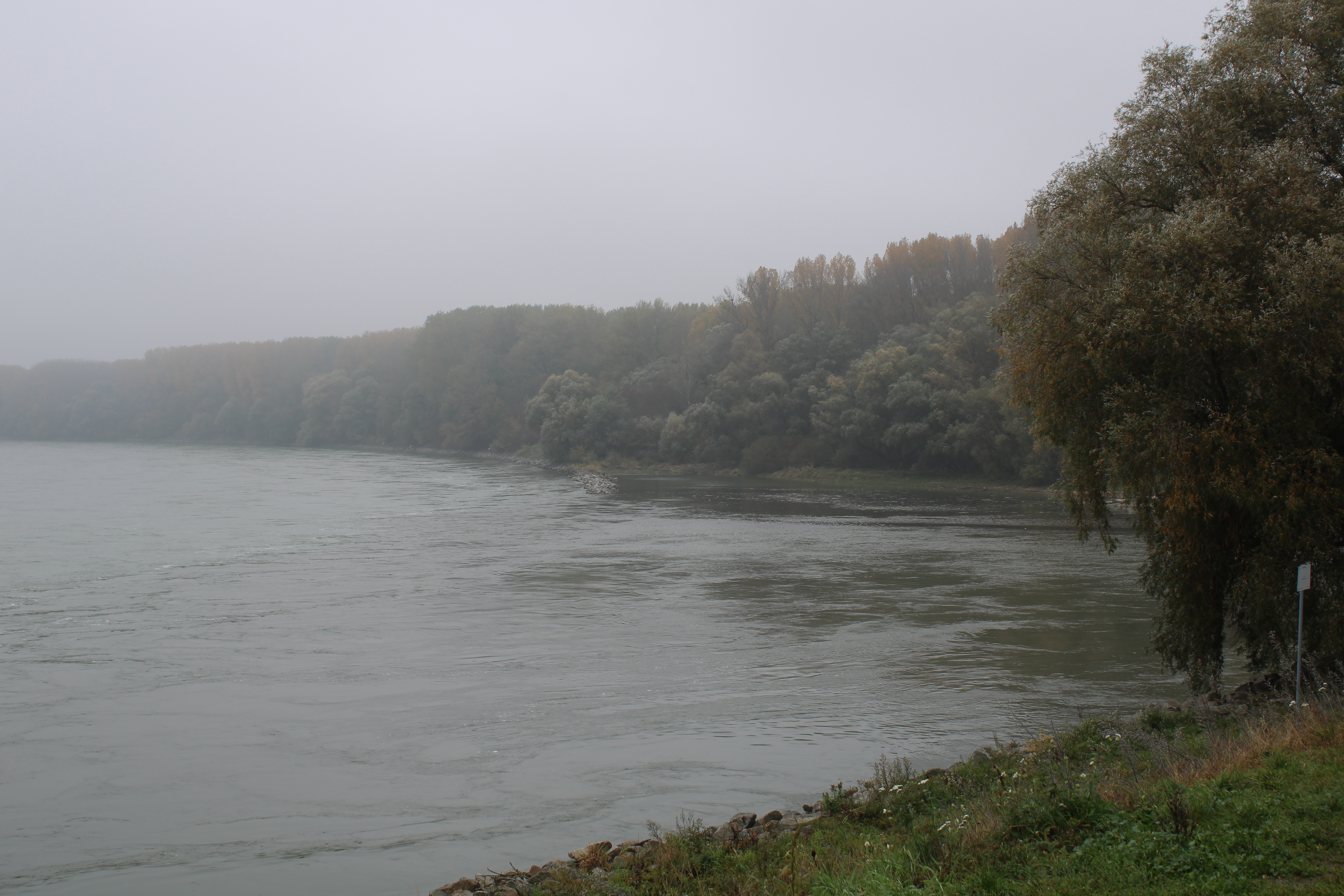
The Avian Unseen [Haiku]

sunup:
roosters crow, birds chirp -
all unseen.

“A Needle’s Eye” by William Butler Yeats [w/ Audio]

All the stream that's roaring by
Came out of a needle's eye;
Things unborn, things that are gone,
From needle's eye still goad it on.

Flower Garden [Haiku]

color clash
in the flower garden
attracts bees & me.

Nine Dragon Wall [Free Verse]

If you stare at
stone dragons
long enough
their stone-chiseled
forms will start
to glide
in tracked loops.
A steady motion of the
sinuous segments
unbroken by cloud.
They move slowly
and steadily --
never breaking off
into a new course.
Some figure-eight,
Some circle,
but never do they
come off the wall.
Their movements never
menace.

“With a Clean Heart” (Tiszta szívvel) by József Attila [w/ Audio]

Have no mother, have no dad,
have no country, have no God,
no cradle, no winding sheet,
no lover, no kisses sweet.

Haven't eaten for three days,
my head spins, the body sways...
Twenty years! My might, my gale,
twenty years are now for sale.

If there is no customer,
sell it to Devil in hell.
With a clean heart, I will steal,
If need be, I'll even kill.

They'll catch me and hang me up,
with soft earth cover me up,
and death-bringing grass will start
from my beautiful, clean heart.

Translation by Frank Veszely in Hungarian Poetry: One Thousand Years (2023) Altona, Manitoba: Friesen Press, pp. 156-157.

NOTE: This poem got Attila expelled from university and preemptively scuttled any possibility of a career in academia. (Hence, my affinity for it. Any poetry that extracts such a cost is probably excellent poetry.)

Guileless Hibiscus [Free Verse]

translucent hibiscus:
keeps its secrets
in its folds;
anywhere petals
don't double over,
the light shines through.

hanging face down --
pistil dangling --
pockets emptied by
gravity.

the jungle beyond blurs.

Winter Fields [Haiku]

tawny grain stalks,
unkempt, like mussed hair;
a bird flies out.

“Song of the Open Road” (15 of 15) by Walt Whitman [w/ Audio]

Allons! the road is before us!
It is safe -- I have tried it -- my own feet have
tried it well -- be not detain'd!

Let the paper remain on the desk unwritten,
and the book on the shelf unopen'd!
Let the tools remain in the workshop! let
the money remain unearn'd!
Let the school stand! mind not the cry of
the teacher!
Let the preacher preach in his pulpit! let the
lawyer plead in the court, and the judge
expound the law.

Camerado, I give you my hand!
I give you my love more precious than
money,
I give you myself before preaching or law;
Will you give me yourself? will you come
travel with me?
Shall we stick by each other as long as we
live?

Beautiful Menace [Haiku]

bougainvillea
spill over a wall:
beautiful menace.

BOOKS: “Hungarian Poetry” trans./ed. by Frank Veszely

Hungarian Poetry (Folk, Classical and Modern) in English: 1000 yearsHungarian Poetry (Folk, Classical and Modern) in English: 1000 years by Frank Veszely
My rating: 5 of 5 stars

Author Site

This anthology of Hungarian poetry translated into English presents some interesting and evocative examples of Hungarian poetry, ranging from anonymous folk poetry of early kingdoms to 20th century pieces by still-living poets. I can’t speak to how the translations compare to the originals, but I will say that they were a pleasure to read and employed metering and rhyme to maintain some of the feel of the originals. This book introduced me to many poets with whom I was only familiar from names on subway stations, city squares, and parks, having traveled extensively in Hungary (plus a few of whom I’m sure I’ve never heard. Note: poetry is huge in Hungary, but because the Hungarian language is not broadly spoken, it remains largely a secret to outsiders.)

That said, the anthology is not so broad ranging as one might expect from its subtitle. The nineteenth and twentieth century selections take up the bulk of the volume. It does make sense that there is a much larger (and more likely to have survived) selection from recent times. However, there also aren’t as many poets included as one might expect. Ostensibly, one reason for this is that Veszely doesn’t shy away from including lengthier pieces. Whereas an anthology like this would often favor short pieces and / or excerpts (and, thus, might include more voices,) this one contains many multi-page poems. That said, while most of the biggest names seem accounted for (e.g. Vorosmarty, Csokonai Vitez, Arany, Petofi, Jozsef Attila, etc.,) there are conspicuous absences of prominent and important poets (and, perhaps, of categories of poets as well.)

Short bios of each of the contributing poets make this an introduction to many interesting figures scarcely known to non-Hungarians, as well as it is a sampling of their poetry. Each of the four sections also has some background historical information. This history is useful because there is a lot of nationalistic / jingoistic poetry in this volume, particularly among the nineteenth century poets (as was the style of the day.)

I should point out that some will find this book excessively nationalistic. (A book titled for the state can be expected to have some superpatriotic pieces, but this goes a bit beyond that.) For my part, I was not troubled by the poetry content, knowing that nineteenth century Hungarian poetry was notoriously nationalistic. Also, once one gets into the twentieth century poetry it gains much more diversity of content, e.g. nature, art, etc. My own concern about nationalism was more about the Part Four introduction, which paints Hungary as an innocent little lamb, always being victimized. Taking history from this introduction, one might think that Hungary was forced into the Axis and struggled to get free of it from the onset. This view would be more defensible if the invasion of Nazi Germany to firm up the Hungarian alliance had occurred in, say, 1941, instead of the spring of 1944 (when everyone knew the Third Riech was on its death bed.) In point of fact, Hungary’s leadership seem to have had their own ambitions (not to mention their own rampant antisemitism) going into this alliance.

I enjoyed these translations immensely, and felt I learned about the poets and the times in which they lived. That said, while I did like that Veszely included some longer pieces in full, it might have been nice to see a bit more diversity in the selection as well.

View all my reviews