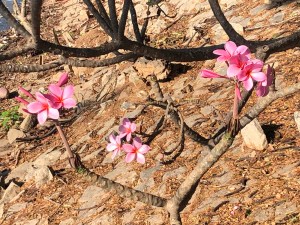
a pristine blossom falls,
 tumbling through grime & grit
  but still unsoiled.

a pristine blossom falls,
tumbling through grime & grit
but still unsoiled.

Under the wide and starry sky,
   Dig the grave and let me lie.
 Glad did I live and gladly die,
   And I laid me down with a will.

This be the verse you grave for me:
   Here he lies where he longed to be;
 Home is the sailor, home from sea,
   And the hunter home from the hill.

There once was a low-budget fortuneteller --
 So rock-bottom she worked out of a cellar.
  "Life'll be good; life'll be bad!
  Someday, you'll lose mom, or dad."
 Even playing the odds, her record wasn't stellar.

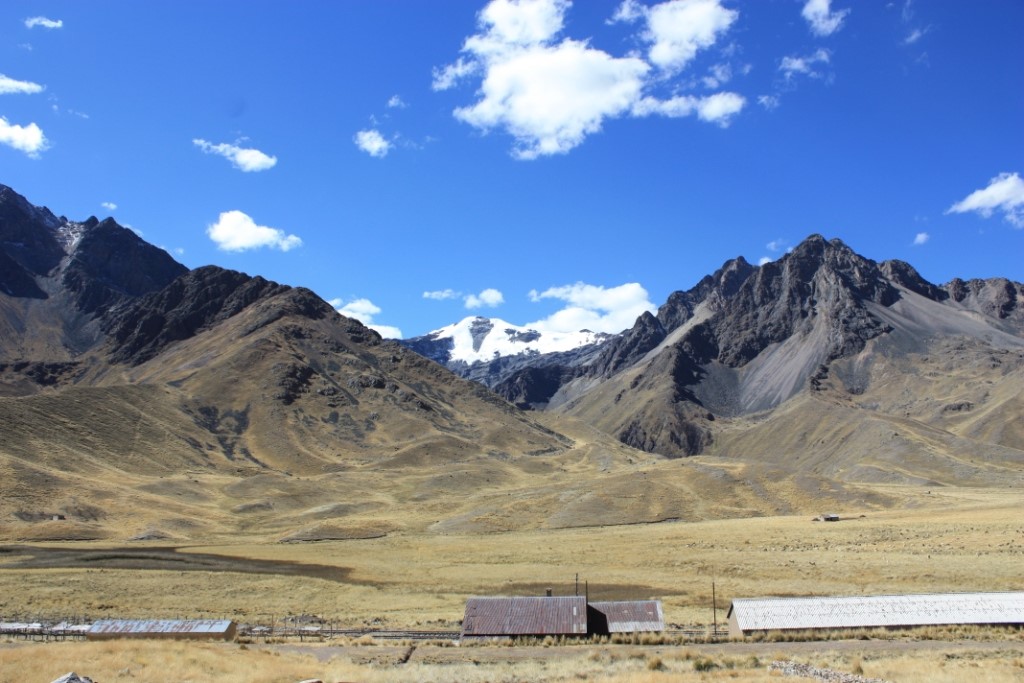
a bright winter day:
 thick clouds, in blue skies,
  scrape the mountains.
My soul runs cold, and I
   Fear it might be dying.
 It rises into the sky --
   Horrifyingly flying.

How'd it achieve liftoff,
   And race to such a pace?
 It started to just drift off...
   Now: the cold vacuum of space.

Dare I hope for a snap back
   When it reaches tether-end?
 Or intergalactic bushwhack,
   Stumbling lost with no descent.

Maybe, it'll sprawl on forever
   To the universe's edge.
 I might not be so clever,
   But I'll be a universe full-fledged.
I heard a Fly buzz - when I died -
   The Stillness in the Room
 Was like the Stillness in the Air -
   Between the Heaves of Storm -

The Eyes around - had wrung them dry -
   And Breaths were gathering firm
 For that last Onset - when the King
   Be witnessed - in the Room -

I willed my Keepsakes - Signed away
   What portion of me be
 Assignable - and then it was
   There interposed a Fly -

With Blue - uncertain - stumbling Buzz -
   Between the light - and me -
 And then the Windows failed - and then
   I could not see to see -
 A Child’s Garden Of Verses by Robert Louis Stevenson
There once was an artist, Bohemian,
 Who thought himself quite the comedian.
   Peers thought he lacked heart,
   & didn't suffer for his art,
 But they suffered the farts of that Bohemian comedian.

What a brittle metal
   That poor, old forge did make.
   He made a little kettle,
   But about the spout did break.
 And water spilled on fire,
   And clouds of steam did rise,
   And I felt I must inquire
   If he'd felt it was wise
 To settle for a kettle
 Made of such brittle metal?

Walk with a mind that's clear and unburdened,
   With life force that flares -n- flows like rainbows,
 Traversing the witch's gorge through the mountains --
   Among the floating clouds and blowing winds.
 Drink up the spiritual; dine on the real;
   Let them ever build up in your body.
 Emulate the health and might of the gods,
   Preserve your energy through harmony.
 Be one with Heaven, be one with the Earth.
   See in yourself divine transformations.
 Know all this to the utmost -- be all this,
 And hold on to it 'til the bitter end.
NOTE: The late Tang Dynasty poet, Sikong Tu (a.k.a. Ssŭ-k‘ung T‘u,) wrote an ars poetica entitled Twenty-Four Styles of Poetry. It presents twenty-four poems that are each in a different tone, reflecting varied concepts from Taoist philosophy and aesthetics. Above is a translation of the eighth of the twenty-four poems.


