


Kung Fu Panda, Kung Fu Hustle, and The Matrix. Together, they contain the sum of all wisdom.
PROMPT: Movies or TV Series
Reply

Kung Fu Panda, Kung Fu Hustle, and The Matrix. Together, they contain the sum of all wisdom.
 Funny Stuff: How Comedy Shaped American History by Laura LaPlaca
No particular order: Kung Fu Hustle, Caddyshack, Matrix, Inception, John Wick 4, Airplane, Monty Python and the Holy Grail, Blazing Saddles, Hero, and Drunken Master II.
No TV series. Though there might be episodes of “Seinfeld” that I’ve seen that many times (but others I may have never seen at all.)
Re: Movies: “Kung Fu Hustle,” “The Matrix” (the first one,) and “Kung Fu Panda” (the first one.) Nothing else comes to mind, but there probably are some. (Back from the days when cable ran the same content over and over.)
Five times is a lot of times to watch the same thing. If it’s really good, it will be too mentally / emotionally draining to watch repeatedly. And if it’s too bad, it will be tedious to do so. It needs to be in the sweet spot of light, but incredibly entertaining.
That’s trickier than it seems. I quite enjoy reading and many forms of bodily movement activities (e.g. swimming, yoga, taiji, qigong, exercise, etc.,) but I’d count them more as personal development activities than leisure activities. (Even something as seemingly non-purposeful as juggling.) I sometimes watch TV / movies, but I don’t know that I’d say I enjoy that so much as find it an opportunity to zone out.
Movies: The Matrix (1999), Kung Fu Hustle (2004), and – possibly – The Dark Knight (2008) and Inception (2010). [Really, I could watch any Christopher Nolan film more than once (and probably need to in order to fully get them.)]
TV Series: None. I can’t think of a series that I’ve watched more than once — except maybe in reruns as a kid, watching episodes out of sequence and on a hit or miss basis.
In the order in which they popped into my head: 1.) Caddyshack (1980); 2.) The Matrix (1999); 3.) Hidden Fortress (1958); 4.) Alien (1979); 5.) Casablanca (1942); 6.) Seven (1995); 7.) Kung Fu Hustle (2004); 8.) The Dark Knight (2008); 9.) Inception (2010); 10.) Unforgiven (1992)
 The Matrix and Philosophy: Welcome to the Desert of the Real by William Irwin
My rating: 4 of 5 stars
As might be expected of a collection of twenty essays that try to squeeze every drop of philosophy out of a two-hour movie (or to criticize each drop,) some of the chapters are much more compelling and pertinent than others. One could argue that some of the chapters are of sounder quality than others (and I would make that claim,) but even if you take them as a collection of high-quality philosophy essays, it’s hard to deny that some of the chapters are germane to the story the filmmakers created, while others try to use the film to get across an idea they find worthy – regardless of whether or not it has anything to do with the film, per se. More simply, the book comments on “The Matrix” through the varied lenses of a wide variety of philosophical branches and schools, most of which have something to say about the movie, and others… not so much.
Few films have achieved the mix of popularity and philosophization of 1999’s “The Matrix.” The movie imagines a world in which the simulation hypothesis is true – i.e. there are people living in a simulated / virtual world that is so convincing that they are unable to tell that they aren’t going about their lives in “base-reality.” The movie’s central question is: should one prefer an existence that is real — if grey, dismal, subterranean, and hostile – over one which is illusory — but one has all the modern comforts, delicious virtual steaks, and one isn’t being hunted by killer machines? Over the course of the story we see two divergent perspectives on this question. The lead character, Neo, chooses to leave the Matrix to enter the real world. Meanwhile, one of the crew members of the ship Neo finds himself on, Cypher, betrays his shipmates in order to get back into the Matrix. It’s clear from the fact that Neo is the lead and Cypher is portrayed as a treasonous scoundrel that opting for “the real” – warts and all – is viewed as the correct position on the matter. However, the fact that we see Cypher in relatable circumstances, ones that engender some empathy for the character, means that answer isn’t meant to be taken as a forgone conclusion.
The movie’s premise engages a couple branches of philosophy – notably, epistemology (asking what, if anything, can one know to be true?) and metaphysics (asking, what is real?) While there are a number of philosophical ideas that recur in the book, the most repeated is Plato’s cave? Based on the ideas of Socrates, Plato described a situation in which people live chained in a cave in which they can only see silhouettes moving about on the wall from a light source behind them. What happens when one becomes unchained and leaves the cave into the “real world?” How is one received by people when he returns and tells the story of what one experienced? Is anyone interested in following in one’s footsteps, or do they believe it’s a lie, or the ramblings of a madman?
The twenty chapters of the book are divided into five parts. Chapters one through four consider the epistemological questions raised by the film. Chapter one sets the scene and gives the most extensive discussion of the comparison of the movie to Plato’s cave. Chapter two takes an anti-skeptical turn. It argues that, if one isn’t a philosopher, one has little reason to view the world skeptically. The world works, why question it? The argument is both true and not particularly useful. Chapter three proposes that one cannot make sense of a world in which all or most of a person’s beliefs are false. Like the previous chapter, this one boils down to: we can’t eliminate the possibility of a Matrix-like truth, but neither do we have any good reason for giving it a second thought. Chapter four focuses on sensory perception and what it says (and / or doesn’t say) about what we know. In daily life, we intuitively (if not explicitly) base a lot of what we “know” on our sensory experience — even though most of us know it is flawed. Perhaps the most intriguing issue raised by Chapter 4’s author was about the Hmong people, and their increased incidence of dying during sleep – in conjunction with a folk belief about malevolent spirits who attack during sleep. (Thus, it’s suggested that the mental world and the physical world aren’t separated such that the former can have no influence on the latter – i.e. the materialist take.)
[Note: The reason the point about the Hmong is salient is that there is a scene in which Neo asks whether dying in the Matrix means dying in the real world. Morpheus answers “the body cannot live without the mind.” From a storytelling perspective, it’s easy to see why the filmmakers created this rule. There would be zero tension in any scene that takes place inside the Matrix (i.e. where almost all the action takes place) if it weren’t the case that people could die from what happened inside. However, from a philosopher’s (or scientist’s) point of view the statement is problematic. Every night our conscious minds go “dead” and yet we wake up just fine. However, the Hmong issue raises an interesting point, suggesting maybe we don’t understand the issue as clearly as we feel we do.]
Part two of the book (ch. 5 – 8) shift from epistemology to metaphysics. Chapter five lays out the basic metaphysical issue, asking how effective a two-category classification scheme of real and unreal is, and where it runs into problems. Chapter six shifts focus to the mind-body problem (does physical matter generate subjective experience, and – if so – how,) and asks what minds are and whether machines can have one. Chapter seven rejects the film’s notion that mental states can be reduced to physical states, but ventures into interesting territory by evaluating the ethics of “imprisoning a mind” — if it were possible. Chapter eight explores questions of fate and determinism, which is also a central premise in the film. The appeal of the real world in this film is obviously not that it’s better, bolder, brighter – it’s none of those things – a major part of the appeal is that in the real world it seems one is free (i.e. one has full free will.) Whereas inside the Matrix, a least much of one’s life is deterministically dictated by computer programs.)
Up to this point, whether or not I felt a given essay said anything interesting, I believed they were all addressing this film’s philosophical underpinnings. From part three, we see a shift. For example, chapter nine asks, is “The Matrix” a Buddhist film. Not surprisingly (given – to my knowledge – none of the filmmakers ever said it was,) the authors conclude that it’s not, but that it has touches of Buddhist influence (also not surprising, given they aren’t hidden or subtle.) Chapter ten discusses the problems of religious pluralism. Because this film presents not only the aforementioned Buddhist influence but also Christian influence (Neo as savior) and bits from all-manner of ancient mythology (starting with character names / roles, e.g. Morpheus,) it’s proposed that it’s advocating a kind of pluralism. [Given that the movie exists in a fictional world, the fact that it draws ideas and names from various sources, doesn’t seem to me to be a suggestion that the filmmakers are advocating a particular hodgepodge, pluralistic, Frankenstein’s Monster religion.] I do think the author did a fine job showing that pluralistic “religions” tend to be logically inconsistent and systemically untenable. Where he lost me was in the suggestion that individual religions are logically consistent. The one I was raised in had an all-powerful god who couldn’t contradict human free will, and one god that was simultaneously three separate and distinct entities. In short, the religion I had experience with is chock-full of logical inconsistency. I burst out laughing when I got to this statement, “Is it really the case that the evidence supporting the truth of, say, Christianity is no stronger than that supporting the truth of, say, Buddhism or Jainism?” Given that (at least the schools of Buddhism closest to what Gotama Buddha taught) pretty much only ask one to believe that if one meditates and behaves ethically one can achieve a heightened state of mind free of the experience of suffering, and Christianity asks one to believe in a God[s] and demons and miracles and sundry ideas for which there is not a shred of evidence, I’d say it really is the case.
Chapter eleven examines the question of happiness, and concludes that: 1.) happiness “is the satisfaction that one is desiring the right things in the right way”; 2.) that one can’t have happiness without a “right understanding of reality.” I don’t think its convincingly conveyed that either of those two ideas is true, but the question of happiness as it pertains to Cypher’s decision is an interesting one. I found chapter twelve to be one of the most intriguing and thought-provoking of the book. It focuses heavily on the teachings of Kant, and it discusses how important features we see with the Matrix (e.g. illusion and enslavement) aren’t features projected from an external source but are imposed by oneself. I think this is a useful way to think about how the film can be related to one’s own life – i.e. thinking about the Matrix world as symbolic for an illusory mental world.
Part IV is entitled “Virtual Themes” and it looks at “The Matrix” from the perspectives of nihilism, existentialism, and then takes a step back and asks questions about the usefulness of studying philosophy through a fictional device (i.e. film.) Chapter thirteen looks at “The Matrix” through the lens of nihilism, putting it beside Dostoevky’s “Notes from the Underground.” Chapter fourteen is similar in that it compares / contrasts “The Matrix” with another philosophical literary work, the existentialist novel by Sartre, “Nausea.”
I thought the questions taken up in the second half part IV were important ones. These two chapters (i.e. 15 and 16) deal with what is the proper relationship – if any — between philosophy and the product of storytellers. I say this is important because the discussion throughout the book is contingent on there being some value in philosophical ideas in fictional accounts that aren’t optimized to conveying philosophy, but rather are optimized to building an entertaining story. Some of the critiques lack effectiveness because they seem to accept there is value in considering philosophy in fiction, but the correction to make it more effective philosophy would make it useless as story. I would hazard to say that any film that would receive a thumbs up as a conveyor of philosophical ideas from a panel of 24 philosophers (the number involved with these chapter) would be fundamentally unwatchable. But does that mean the bits and pieces of philosophy one gets are worthless? I’d say no, but opinions may vary. Chapter fifteen asks why philosophers should engage with works of fiction, as wall as considering the value of story. Chapter sixteen focuses on genre, concluding that “The Matrix” is a work of real genre, but virtual philosophy.
That last section includes analysis from the perspective of what I would call the single-issue schools of philosophy (feminism and Marxism,) as well as postmodernism (which is said to have been a major influence on the directors) and other twentieth century philosophers. The two single-issue schools do what those schools often do, which is to myopically focus on what is interest to them (regardless of that issues importance to the film, or lack thereof) and pick and choose examples that seem to support their idea. The feminist essay reduces the story to an attempt to be un-raped (i.e. unplugged) and catalogs all the instances in which some “penetration” took place, be it characters being jacked into the Matrix hardware or shot. The author compares “The Matrix” to “eXistenZ,” a film with similar themes that she prefers (though, given the relative popularity of the two films, she may be the only one who feels that way.) The chapter on the Marxist perspective isn’t as poorly related to the film. However, I doubt the essay would exist if the Wachowskis had stuck to their original plan. I read once that the filmmakers originally had a different (and more sensible) rationale for why the machines had humans in a vat. The idea that appears in the film is that humans are used to produce bioelectricity (probably the most scientifically ridiculous idea in the film) and this forms the basis for the Marxist critique of the pod people as exploited labor.
The penultimate chapter is probably the most relevant of the last section. It discusses postmodern philosophy, notably Baudrillard’s “Simulacra and Simulation” which is said to have influenced the Wachowskis and it [the book] even had a cameo appearance in the film. The last chapter is the most convoluted read, but probably by the most prominent author in the book. It’s by Slavoj Zizek and it critiques the movie from the perspective of the ideas of Lacan, Hegel, Levi-Strauss, and Freud.
I found lots of interesting nuggets of food-for-thought in this book. As I said, the effectiveness of the chapters varies tremendously. This isn’t so much because the quality of authors varies. It’s just that some of the work gets off topic – kind of like if there was an analysis of “My Friend Flicka” and it was decided that the thoughts of a Marine Biologist were essential — you’d be like “what am I reading, and why?” That happens sometimes as one reads this book. But, if you like the movie and want some deeper insight into it, this is a fine book to check out. It’s also a good way to take in various philosophical ideas, leveraging one’s knowledge of the film.
 The Science of Monsters: Demystifying Film’s Most Notorious Vampires, Witches, Zombies, and More by Meg Hafdahl
My rating: 4 of 5 stars
Scheduled Release: October 1, 2019
Monsters, especially movie monsters, and science don’t seem like peas in a pod – one being fictitious and favoring the outlandish and the other insisting on firm roots in reality. Still, the supernatural creatures that enter folklore or mythology (and many movie monsters derive from these sources – whether loosely or closely) often arise because of some real world phenomena, e.g. genetic conditions that cause one to grow hair everywhere or – conversely – that make one pasty complected and sun-avoiding. It’s these kernels of truth as well as the limits of what is possible that form the core of this book. It considers a wide range of “monsters” from psychopathic humans to mythical monsters to ghosts to aliens to mysterious creatures of unknown origins.
The two focal points of a book like this (e.g. monsters and science) are seldom equal. A popular class of nonfiction books has arisen that exists to convey scientific ideas by exploiting pop culture for examples. This isn’t that kind of book. I don’t say that as a criticism. There is room for both types of books. But in this one, the science is secondary to giving readers interested in movie monsters some context and background. This stress can be seen in the book’s organization (i.e. each of its chapters features a different horror [or horror-adjacent] film and its monster) as well the authors’ expertise (while they consulted scientists, the authors are more knowledgeable about horror movies.) Also, the focus is tighter on the type of monster under examination, and the discussion of science roams through different scientific disciplines (including social sciences and even humanities – and, in one instance, pseudoscience) as it discusses what Hafdahl and Florence are interested in, which is any real word bases for the plausibility of these monsters.
Again, the last paragraph isn’t so much a criticism as a statement of what kind of book this is — and isn’t. (Needless to say by this point, it’s also not a book about the science and technology of making credible monsters for movies [e.g. CGI or the anatomy of a credible kaiju,] which is another worthy topic of discussion for another book.) The fact that the book is inclusive of discussions beyond biology and physics and which range into the social sciences and other disciplines offers the reader interesting insights. The exploration of what makes an entity terrifying was fascinating to me, and there is a significant art, science, and psychology to that subject, itself.
I will say that there was at least one time when I couldn’t really grasp how the science under discussion was relevant to the topic (i.e. monster) under discussion. It seemed as though the authors had succumbed to a common ailment of writing – that is, the inability to pitch material that is good, hard worked for, but ultimately irrelevant.
All in all, I enjoyed this book. I learned about how the monsters of the silver screen relate to happenings in the real world. There were several references to how quirky little news stories influenced screenwriters and directors to come up with some of the iconic horror and dark sci-fi movies. If you are interested in the origins of monsters, I’d recommend you check this book out.

5.) Po’s Wu Wei: In his fight against Tai Lung at the end of the first film, Po takes a hard hit from his Snow Leopard nemesis, and through ripples of undulating flab returns a devastating strike that sends Tai Lung flying. While I wouldn’t recommend one try it at home as demonstrated in animated form, the idea of not resisting, but rather redirecting forces is an old school approach. It also reflects the ancient Taoist wisdom of wu wei, effortless action.
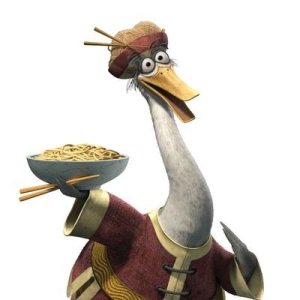
4.) “But I realized having you in Po’s life doesn’t mean less for me. It means more for Po.” In the third movie, there’s a scene in which Mr. Ping (Po’s avian dad by adoption) explains to Po’s panda dad, Li, how he came to grips with Li’s presence (which at first made Mr. Ping insecure and envious.) The lesson is to be careful in assigning a situation zero-sum status (one person’s gain requires another’s loss) without having reason to believe it reflects the reality of the situation.

3.) “There is just news. There is no good or bad.” This bit reflects an old Taoist story about a farmer and his neighbor. One day the neighbor sees the farmer has a beautiful new horse. The farmer tells the neighbor that it’s a wild horse that the farmer found at the back of his property. The neighbor says, “That’s good news.” The farmer says, “Good news? Bad news? Who’s to say?” The next day when the neighbor stops by the farmer tells him how his son got a broken arm trying to break in the wild horse. “That’s bad news,” says the neighbor. “Good news? Bad news? Who’s to say?” The next day the army comes by, conscripting young men, but the farmer’s son is not forced to go to war because the young man has a broken arm. The story goes on like that.

2.) “If you only do what you can do, you’ll never be more than you are.” In the third movie, after Master Shifu explains to Po how he knew that Po would fail on his first day as a teacher, the Master utters this bit of wisdom. It’s a warning to avoid loitering in one’s comfort zone.
1.) “The secret ingredient of my secret ingredient soup…. The secret ingredient is … nothing… To make something special you just have to believe it’s special.”: For some reason, people love to get attached to trappings and secret wisdom, even to the point of losing sight of what’s important.
It reminds me of a story about Dr. Herbert Benson. Benson famously wrote a book entitled, “The Relaxation Response“ about the effects of relaxation on health. Back in the sixties, students of the Maharishi Mahesh Yogi (famously, the Beatles’ guru) asked Benson to do a study of the health effects of their teacher’s system of meditation. The Maharishi taught transcendental meditation, an approach in which students focused on mentally repeating a mantra that is “given” to them personally by the teacher. (I put the word “given” in quotes because the Maharishi actually charged a significant amount of money for these mantras.) Anyhow, after much badgering, Benson agreed to do the study. One has to realize that, while today such a study would be considered quite respectable, in those days a study of the effect of meditation on health would have been akin to a study of voodoo.
So, Benson conducted the study and — lo and behold — he found that patients who practice meditation do have better recoveries and less ill effects. The Maharishi and his people now love Herbert Benson. They sing his praises. But Benson is interested in science and couldn’t care less whether any particular guru’s system of meditation is validated. So he repeats the study with all participants using the word “one” as their mantra, and he gets the same result. Subsequently, other forms of meditation are studied, and with similar outcomes. Needless to say, the transcendentalists love affair with Dr. Benson was short-lived.


 Tiger Riding for Beginners