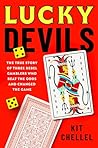
BOOK: “Lucky Devils” by Kit Chellel

Lucky Devils: The True Story of Three Rebel Gamblers Who Beat the Odds and Changed the GameLucky Devils: The True Story of Three Rebel Gamblers Who Beat the Odds and Changed the Game by Kit Chellel
My rating: 5 of 5 stars

Publisher Site — Simon & Schuster

Release Date: April 14, 2026

This book provides a fascinating look at the field of “advantage gambling” from the 1970’s through the 1990’s / early 2000’s. Advantage gambling is the use of applied mathematics and computing to snatch up part of the advantage in odds that normally accrues to “the house” (i.e. the casino / gambling establishment) to make gambling not so much a sucker’s game. Card counting is a specific variety of this undertaking. This story is largely told through the life stories of three prominent advantage gamblers, Bill Benter, Bill Nelson, and Rob Reitzen. While the book starts with card counting in blackjack, it broadens beyond that — and even beyond the casino — into horse races and online poker.

As one reads about the activities of these gamblers, one also learns about intriguing, related subjects such as the mafia’s hand in Vegas, the development of computing technology (as it applied to gaining advantage,) and even how a younger Trump managed the challenging task of losing money through casino ownership.

If you’re interested in how smart people have tried to beat the house, and the risks that that entails, I’d highly recommend this book. I found the book compelling from start to finish.

View all my reviews

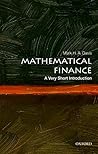
BOOK: “Mathematical Finance: A Very Short Introduction” by Mark H. A. Davis

Mathematical Finance: A Very Short Introduction (Very Short Introductions)Mathematical Finance: A Very Short Introduction by Mark H.A. Davis
My rating: 4 of 5 stars

Publisher Site – OUP

This is Oxford University Press’s Very Short Introduction to the field of the “Quants,” individuals who apply mathematics to questions of how to value financial assets and assess risks. The book begins by laying out how banking and financial markets work, then discusses how interest rates are determined, and then explores the quantification of various risks faced by lenders. The book finishes by discussing how the 2008 financial crisis impacted the field and how it operates in the wake of that event. (The 2008 crisis was described in an intriguing fashion in the book and movie The Big Short. It basically resulted from deceptive grading of mortgage-backed securities such that investors who thought they had the ultimate default-proof asset in fact had assets that not only could collapse, but — in fact — were bound to.)

Even though this book is a concise introduction, it shouldn’t be confused for a simple guide. It is not only mathematically intense but also jargon dense. It’s not a complete waste for someone without any advanced mathematics and / or economics / finance background to read, but there will be large patches that will likely be lost on one. (And if you’re not at all used to reading scholarly writing, it may be excessively daunting.)

If you want a quick guide to the field of quantitative finance, and you have an understanding of the mathematical notation used in calculus and statistics, I’d recommend this book. If you are interested in the topic but aren’t at all mathematical, you might start elsewhere (the aforementioned, The Big Short, might be a good place.)

View all my reviews

Bush Bird Math [Senryū]

a bird in a bush:
does it know it’s worth
half a bird in hand?

Statistician Limerick

The police questioned an old statistician
Whose department had suffered attrition.
"My memo was wrecked
by auto-correct:
Distribution of 'Poisson' became 'Poison.'"

PROMPT: Don’t Understand

Daily writing prompt
What’s something most people don’t understand?

I’ve often been surprised how little intuitive grasp people have of basic mathematical or statistical ideas or relationships, even when they have had the education to understand with a little effort.

One example of this is what I call “unilateral mathematics” where people fixate on one term or side of an equation while ignoring that changing a term changes the equation’s other side (or to keep the other side static, something else has to give.) For example, I hear people getting so excited by the new salary they will earn when they move to a new place. Then they get to the new locale only to find that the cost of living is so much higher that even their hefty pay boost supports only a diminished quality of life. One sees this tendency a great deal in people’s policy discussions when someone will say, “just set a maximum (or minimum) price” without understanding that shortages or surpluses will come along for the ride. [The Law of Unintended Consequences is another good answer to this prompt.]

We all saw flaws in statistical thinking during the pandemic when people said things like, “See, she got the vaccine and then she got COVID, so obviously the vaccine doesn’t work!” I’m convinced this is because people don’t have good intuition for statistical thinking and — instead — they want to treat a low probability as an impossibility and a high probability as a certainty.

By the way, you see this from people of all persuasions, including those who are highly educated, conservatives, progressives, believers, atheists, etc. One can see the universality of the flaw most commonly in climate change comments. You’ll hear one person say, “See, it’s the hottest day on record, that’s evidence global warming is real!” Another person will say, “See, it’s the coldest day on record, global warming is obviously hokum!” Somehow, even with diametrically opposed viewpoints, these two manage to both be wrong because one day’s WEATHER is not instructive of what is happening to the CLIMATE. In other words, a sample of one provides no insight into state changes in the population. [Maybe it’s more appropriate to use Wolfgang Pauli’s terms and say the two are “not even wrong.”]

BOOKS: The Second Law by Stephen Wolfram

The Second Law: Resolving the Mystery of the Second Law of ThermodynamicsThe Second Law: Resolving the Mystery of the Second Law of Thermodynamics by Stephen Wolfram
My rating: 4 of 5 stars

Amazon.in Page

This book has an intriguing premise but a bizarre organizational scheme. The book offers insight into the Second Law of Thermodynamics couched as the author’s personal journey of discovery. Put simply, the Second Law says that entropy increases, or the coffee cup next to me can fall and break into many pieces but it can’t / won’t reassemble itself, alternatively, I can mix milk into the coffee in the cup, but not unmix the milk out of it. Of course, this simplification is — in fact — a massive oversimplification and there are a number of definitions of entropy and different ideas on the conditions under which its increase holds and why. This is part of what the book investigates.

Let’s start with the book’s intriguing premise. It is that: a.) the Second Law and its implications are not as well (or fully) understood as the scientific consensus suggests, and b.) the key to understanding entropy’s increase may be found in the concept of computational irreducibility. This all ties to Wolfram’s work with cellular automata and the finding that apparent randomness can come about from a simple set of rules that are non-random. In other words, cellular automata could produce a pattern that can only be determined by re-running said simple set of rules — i.e. there would be no way to compute it. As (apparent) randomness plays an important role in the Second Law, Wolfram proposes a connection that has ramifications for critical issues like reversibility. (Remember we can’t unmix the milk out of the coffee [without expending more energy and within the confines of an open system] or so it’s believed.)

When I say the book’s organization is strange, I do so with the assumption that the intended readership includes those who are scientifically literate but not expert in thermodynamics or physics. The first part of this strangeness is that the body of the book concludes with an overview of the development of the Second Law (arguably this is information a non-expert reader might benefit from having up front.) The second element of strangeness is that much of the latter part of the book is just connective tissue between excerpts of other people’s writing on the subject. This increases the page count tremendously and doesn’t serve readability well.

The book does have a good deal of interesting and informative graphics. It also has copies of scholarly papers and relevant chapters from Wolfram’s previous book, “A New Kind of Science” for those who are capable of, and interested in, taking a deeper dive into the science and mathematics under consideration.

I found this book to be thought-provoking if a bit tedious to read in places. If you’re interested in the Second Law, it’s worth reading and may shed new light on the topic.

View all my reviews

BOOK REVIEW: Introducing Fractals: A Graphic Guide by Nigel Lesmoir-Gordon & Will Rood

Introducing Fractals: A Graphic GuideIntroducing Fractals: A Graphic Guide by Nigel Lesmoir-Gordon
My rating: 5 of 5 stars

Amazon.in Page

Fractal Geometry is a school of mathematics that contends with the kinds of shapes seen in nature, shapes which often appear irregular (at least on some scale,) but which are also frequently self-similar (i.e. the twig looks like the branch looks like the whole tree.) One problem that led to the discipline’s development was determining the distance of a coastline. The distance between measurements vastly alters the final measurement one gets. From the discipline’s origins in observation of the natural world and the problems found in nature, fractal geometry was put to use for problems in ecology, finance, technology, and art and music. The book touches upon this sprawl of the subject, as well as relating fractal geometry to Euclidian Geometry, Calculus, and theories of Chaos and Complexity.

This book offers a simple and cursory overview of the subject. A reader expecting to learn how to employ Fractal Geometry will come away disappointed, but one who just wants to know the kind of problems its useful for and get a basic and intuitive explanation of why it’s useful can gain a great deal from the book. As the subtitle suggests, the book is illustrated and the graphics are far more useful in this volume than in most of the “Graphic Guide” series. That probably comes as no surprise as the subject is inherently more visual than average.

If you’re starting from ground zero, I’d highly recommend this book. Those with a mathematical background may yearn for more depth.


View all my reviews

BOOK REVIEW: The Information by James Gleick

The Information: A History, a Theory, a FloodThe Information: A History, a Theory, a Flood by James Gleick
My rating: 5 of 5 stars

Amazon.in Page

Information is one of those topics that remains obscure not because it’s rare or hidden, but because it’s everywhere and the term is used for so many purposes it’s not thought of cohesively. It might seem like a book on this topic would be hopelessly boring by virtue of the fundamental meta-ness of the material. Instead, Gleick had a vast sea of topics and stories involving intense stakes for humanity from which to choose, e.g.: how did we learn to communicate and advance said capability until it was arguably the most important feature of our species, by what instructions are people “assembled,” might the most fundamental layer of reality be informational, and – in recent decades — will our species drown in flood of cheap information?

Given the vast sprawl of the subject matter, organization becomes a crucial question. In a sense the book is chronological, presenting humanity’s experience with information in more or less the order we came to think about the subject. I think this was a wise move as it starts from what most people think of when they think of information – i.e. language and its communication. That makes it easier to wrap one’s head around what comes later, and to see the conceptual commonalities. This approach might seem self-evident, but an argument could be made for starting with information as the word is used in Physics (as addressed in Ch. 7 – 9,) an argument that that approach is more fundamental and generically applicable, and while it might be both of those things, it wouldn’t be as easily intuitively grasped.

I found this book to be fascinating and easily followed — even though it covers some conceptually challenging topics, it does so in an approachable manner. It is over a decade old, but holds up well – though I think there is much more to say these days about the detrimental effects of information overload, a topic discussed at the end of the book. I recommend it for nonfiction readers.

View all my reviews

BOOK REVIEW: Nature’s Numbers by Ian Stewart

Nature's Numbers. Discovering Order And Pattern In The UniverseNature’s Numbers. Discovering Order And Pattern In The Universe by Ian Stewart
My rating: 4 of 5 stars

Amazon.in Page

This popular mathematics book reflects upon the ways in which patterns appear in nature and how mathematics can shed light on said patterns. It explores why tides are predictable while weather patterns are anything but. It investigates why flowers disproportionately have a number of petals that is in the Fibonacci sequence (a list of numbers in which each is formed through the addition of the previous two numbers.) It shows one how an eyeball can evolve, and how long it would be expected to take. It describes where and how we see calculus, probability and statistic, chaos theory, and complexity in nature.

It’s unambiguously a pop math book, there’s not an equation in sight. It does use diagrams and various graphics to convey ideas, and these help to simplify and visualize the topic. If anything, I would say the book could have benefited from more graphics [and might even have benefited from a less strict rule about sticking to colloquial prose.] (Meaning, some of the analogies and attempts to relate clarified ideas better than others.)

I found the book highly readable, and believe that – overall – the author did a fine job of providing food for thought without getting too complicated for the general reader. There were points at which the author seemed to lose his train. For example, he off-ramped into criticisms of the division of mathematics into applied and theoretical branches and the tendency to more greatly value the applied side of this false dichotomy. I have no doubt this is a worthwhile subject of discussion, but not necessarily in this book.

If you’re looking for a readable discussion of how mathematics is used in the study of nature, this book is worth reading – especially if you are equation-phobic.


View all my reviews

BOOK REVIEW: Introducing Chaos: A Graphic Guide by Ziauddin Sardar

Introducing Chaos: A Graphic Guide (Introducing...)Introducing Chaos: A Graphic Guide by Ziauddin Sardar
My rating: 5 of 5 stars

Amazon.in Page

This book provides a brief overview of the mathematical and scientific concept called “Chaos” (as opposed to the colloquial definition.) Chaos theory is most popularly associated with “the butterfly effect” in which small changes in initial conditions can result in large and / or unpredictable variations in outcome (e.g. the Houston butterfly that causes a typhoon in Hong Kong.) Chaos profoundly changed the landscape in many domains of science. Before Chaos, it was generally assumed that if one had a relatively simple model without random elements that one could make short work of developing predictions. Scientists working in Chaos discovered that this wasn’t necessarily the case, despite the intuitive appeal. In fact, one could have a relatively simple model without random elements that still resulted in irregular behaviors / outcomes.

Chaos overlaps with a number of subjects including the science of Complexity and Fractal Geometry. The book explores these connections, and gives the reader a basic understanding of how those subjects differ and what they share in common with Chaos. The book also draws examples from a number of different disciplines including meteorology, biology, city planning, etc. This is a beneficial way to broaden one’s understanding of this fundamentally interdisciplinary science.

I’ve read many titles in this series because they are available on Amazon Prime and provide readable overviews of subjects that are suitable for a neophyte reader. I found this to be one of the better titles in the series. I thought the author did a good job of explaining the concepts in clear, approachable language, aided by graphics. If you’re looking for a non-mathematical overview of Chaos theory, this is a fine book to consider.


View all my reviews