BOOK: “Seven Animal Postures” by Jeogun [Trans. by Dowon]

Seven Animal PosturesSeven Animal Postures by Jeogun
My rating: 4 of 5 stars

Publisher Information – Sunmudo Daegeumgangmun Foundation

I bought this book in the gift shop of Golgulsa Temple [i.e. Stone Buddha Temple,] in the countryside outside of Gyeongju, South Korea. Golgulsa is a fascinating place. It’s sort of the Shaolin Temple of Korea, teaching martial arts and qigong (energy work) alongside meditation and Buddhist philosophy. The Korean Buddhist martial art is called Sunmudo, and I’d never heard of it before traveling to Korea.

At any rate, this book is a 35-page guide to a set of qigong practices known as the “Seven Animal Postures” (or Yeongdongipgwan.) It’s a set of exercises that are similar to qigong practices like the Eight Pieces Brocade, and not greatly dissimilar to yogasana (i.e. yoga’s postural practices.) [FYI: The animals of these exercises are Tiger, Dragon, Deer, Monkey, Bear, Turtle, and Crane.]

The book offers a little bit of background on Sunmudo and the benefits of it, but is mostly a guide to the movement, breath, and postural details of these seven exercises. It has line drawings to help elaborate upon the text. My only gripe would be that the paper the book is printed on to make it more visually interesting has blocks of darker color that make it a little harder to read than is necessary.

If you are interested in qigong or yogic practices that are a bit more off the beaten path, you may find this one interesting.

View all my reviews

PROMPT: Risk

Daily writing prompt
Describe a risk you took that you do not regret.

I don’t know that I’ve ever regretted taking a risk. I’ve taken some bruises for them on occasion but not felt regret.

I did once try to block a staff strike with an ill-positioned / ill-timed wooden sword. I got a mild concussion that time, but still — I don’t think — regret (but I’m a bit fuzzy on the details, maybe it damaged the part of my brain that is capable of regret.)

I’m with Miyamoto Musashi, who wrote: “我事におゐて後悔を/せず” [“I will not regret my deeds.”] in his Dokkôdô [“Way of Walking Alone.”] Of course, he probably suffered his share of concussions as well.

PROMPT: Character

Daily writing prompt
If you could be a character from a book or film, who would you be? Why?

Wu Song (武松) from Water Margin (水浒传.)

Because he’s a traveler with zero f#&ks to give. There is no more freedom to be had than that.

PROMPT: Technology

Daily writing prompt
How has technology changed your job?

Technology has changed everything, for good and for ill. It’s the source of our vast growth in productivity, but also at the heart of our modern crises (e.g. I’m almost certain that no caveman ever experienced “imposter syndrome.” But like other crises of modernity, I suspect that technological dependence and an ever-continuing trend toward ultra-specialization are its cause.)

I count myself fortunate to be of an age to (probably) miss the (rapidly approaching) day when machines and artificial intelligence do all “productive tasks” better, faster, and with far less energy consumption than a human being. I don’t think most of humanity will be prepared for that day, and it will – in all likelihood – go down catastrophically. [I think we’re seeing the cracks in the dam already.]

I spend more and more time with the only technology-proof sector of which I’m aware: building a more capable human being.

I believe if every person spent some time learning skills like primitive living (sustainable wilderness survival skills) or unarmed martial arts (that train against armed opponents) society would be much better off. I pick these two as examples of skill sets that give practitioners a deep confidence in themselves [not in themselves + technologies that they can’t build, can’t fix, and which they don’t really understand.] I suspect that the core self-empowerment that would result would ease away much of the general shittiness of character we are increasingly prone to see in the world, shittiness that — like all shittiness — is ultimately rooted in fear.

PROMPT: Grow

What experiences in life helped you grow the most?

The ones that involved repeated non-catastrophic failures (e.g. martial arts practice.)

Also, the ones that confronted fears (e.g. open sea swimming.)

BOOKS: “Shaolin: How to win without fighting” by Bernhard Moestl

Shaolin: How to win without fightingShaolin: How to win without fighting by Bernhard Moestl
My rating: 4 of 5 stars

Publisher Site

This is a self-help book that nominally draws on the philosophy of Shaolin Kung fu and its Chan Buddhist underpinnings, but – more broadly – employs quotes and examples from many, mostly Eastern, sources. For example, the ideas and stories of Miyamoto Musashi are perhaps as common as any source (Musashi was Japanese, not Chinese, and was not noted for being Buddhist. In his own words, he respected the gods and buddhas, but didn’t expect their help.)

The book offers a fine discussion of Eastern philosophic thought in action, particularly that which arose from warrior sources, but it isn’t particularly ground-breaking in any way. For those who like homework, the book does include many exercises to make the reading a more interactive experience.

I enjoyed reading this book well enough, but it didn’t distinguish itself and will soon fall into the mind-space of a fuzzy amalgamation of similar books I’ve read over the years.

View all my reviews

BOOKS: “How to Fight Tough” by Jack Dempsey

How to Fight ToughHow to Fight Tough by Jack Dempsey
My rating: 5 of 5 stars

Read online at Archive.org

This book was put out by the Coast Guard during World War II as a commando fighting manual. The lead on the project was heavyweight boxing champion Jack Dempsey, aided by a small team of others — all with varied bona fides in Combatives.

This is a fun book to read. It’s loaded with 1940’s slang, over-the-top reminders to fight tough and mean, and jokes that — while dated — still amuse with their quirky language. Seriously, the voice in my head was playing in Trans-Atlantic dialect (1940’s radio announcer voice) or as James Cagney playing a gangster the whole time I was reading this book.

That said, while the text was campy, the actual techniques are solid. The book consists of eighteen lessons that are built on well-established grappling and submission techniques such as hadaka jime (rear naked choke.) Also, while there is often only one (or — at most — a few) photos per technique, they seemed to put some effort into doing them conscientiously. (And they are almost full-page shots, so one can actually see a bit of detail.) The techniques include: unarmed v. various unarmed attacks, unarmed v. knife, unarmed v. gun (holstered, and front and rear approaches,) and unarmed v. bayonet.

I’d highly recommend reading this book. It’s a quick and amusing read with some useful techniques inside.

View all my reviews

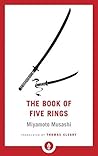
BOOKS: “The Book of Five Rings” by Miyamoto Musashi [trans. by Thomas Cleary] [w/ Yagyu Munenori’s “Book of Family Traditions”]

The Book of Five Rings: A Classic Text on the Japanese Way of the Sword (Shambhala Pocket Library)The Book of Five Rings: A Classic Text on the Japanese Way of the Sword by Miyamoto Musashi
My rating: 5 of 5 stars

Publisher Site – Shambhala Publications

This edition, i.e. The Shambhala Pocket Library edition, contains two guides to strategy, tactics, and philosophy of combat by famous early Edo Period swordsmen. The titular work is Miyamoto Musashi’s The Book of Five Rings, but the volume also contains Yagyu Munenori’s The Book of Family Traditions. The naming of the book is meant to capitalize on the continuing popularity of Musashi, who remains well-known to this day not only because of his own works and legend, but because of an afterlife in pop culture that ranges from Eiji Yoshikawa’s novel to a recent Netflix animated series. That said, one shouldn’t conclude Yagyu Munenori was some sort of slouch. He was, in fact, a martial arts teacher to the Shogun’s son, and he founded a branch of his family’s martial arts school that continues to this day.

It is interesting to see these two guides back-to-back, being by authors whose lifespans largely overlapped, though – in other ways – their lives were quite different. While there is some conceptual overlap in these guides, the two definitely show two very different minds at work, Musashi the pragmatic eccentric and Yagyu the Zen philosopher of noble standing.

Miyamoto Musashi is probably the most famous swordsman in Japan’s history. Oddly enough, he’s not known for his experience in battle (he lived at the tail end of the Warring States period and was only in a couple battles), but – rather – for his 62 duels. The Book of Five Rings and other works he left behind are certainly important factors in his continuing fame. Musashi was a bit of a renaissance man: painter, poet, and sculptor in addition to a swordsman. He also left behind a school of swordsmanship, Niten Ichi-ryū.

The Book of Five Rings is divided into five parts: earth scroll, water scroll, fire scroll, wind scroll, and void scroll.

The earth scroll provides an overview of martial science and an introduction to Musashi’s school, which is noted for its simultaneous use of both the large and short sword. A section is devoted the rhythm of martial arts, a crucial topic. It also includes what might be considered Musashi’s 9-point budō kun (a list of warrior precepts.)It’s worth mentioning a couple of these:
#7 Become aware of what is not obvious.
#9 Do not do anything useless.

The Water scroll describes Musashi’s approach to swordsmanship. It covers a range of elements of a martial art including footwork, the focus of one’s eyes, physical posture, mental posture, techniques, and approaches to cutting and thrusting.

The Fire scroll deals with the strategic or interactive aspects of the battle.

The Wind scroll explores other martial arts. Musashi discusses martial arts that use an unusually long sword, an atypically short sword, that focus on powerful strikes, and those that focus on many rapid strikes. He contrasts other martial arts with his own on subjects such as their focus with the eyes and their footwork.

The void scroll deals with, well, emptiness. It’s actually a short wrap-up.

Yagyu’s guide is much more philosophical and mind-centric. It’s not that Musashi doesn’t deal with such topics, but he also devotes considerable space to more practical nuts and bolts of swordsmanship and strategy. It’s also true that Yagyu gets into technical considerations such as control of distancing (if in a bit more poetic way than Musashi.) One can get a feel for the nature of Yagyu’s Book of Family Traditions [on the Art of War] by seeing how it is organized into three parts: “The Killing Sword,” “The Life-Giving Sword,” and “No Sword.” The latter two indicating the author’s belief in the importance of not equating warrior and killer (nor winning with killing) as well as not fixating on the sword.

These two men had great insight into strategy and the tactics of swordsmanship, their guides are worth being read and reread. And the two authors do offer two intriguingly different approaches to a similar subject.

View all my reviews

FIVE WISE LINES [November 2024]

Inspiration enters at the border between hard work and laziness.

Lu juren in “Poets’ jade splinters” [Trans. by Barnstone and Ping in The ART Of Writing]

I will not own anything that will one day be a valuable antique.

Miyamoto musashi in “My way of walking alone” [Dokkōdō] (Trans. by Teruo machida)

A house full of gold and jade can’t be guarded.

Laozi in the DAo De jing [Ch. 9]

Writing is a struggle between presence and absence.

Lu ji in The ART of Writing [Trans. by Barnstone and ping]

The best leaders remain unknown; the next best are praised; the next best are feared, and the worst are mocked.

Laozi in dAo de Jing [Ch.17]

BOOKS: “Tai-Chi Chuan in Theory and Practice” by Kuo Lien-Ying [ed. Simmone Kuo]

Tai-Chi Chuan in Theory and PracticeTai-Chi Chuan in Theory and Practice by Kuo Lien-Ying
My rating: 4 of 5 stars

Publisher Site

This brief book discusses Taijiquan primarily from a philosophical perspective. Though a significant amount of the book’s page-count consists of full-page pictures of various taijiquan movements, it isn’t so much a how-to book. Readers who enjoy an eclectic book that’s short and sweet but also kind of all over the place have a good chance of liking this book and gaining from its varied tidbits of wisdom. Readers who favor books with a clear organization and internal logic will probably find this to be an odd stew of short writings (essays, guides, poems, scriptural excerpts, etc.) It should be noted that not all of the writings are from Kuo Lien-Ying, himself. It includes a translation of a manual by Wang Tsung-Yue (13th Century) as well as an appendix consisting of writings from the Daodejing, Tang Dynasty poetry, and quotes from Mencius and Confucius. It also features a chapter on the I-Ching and Taiji philosophy by Kuo’s wife, Simmone Kuo. Besides the Wang manual, which is right up the alley of Kuo’s writings, it’s not clear why the other pieces were selected (not that they aren’t beneficial, but that they seem random.)

One thing I really liked about this book is that a lot of it is presented in bilingual format. For someone learning Chinese, this is quite beneficial. (Especially, given that it consists of short pieces that can be more easily consumed by a new reader.) That said, those who don’t read Chinese may see the translations as further indication of padding a pamphlet up to book scale. The monochrome photos are well-done and could definitely be of use to someone who practices taijiquan (though would not be of much use to someone new to it.)

This book is an insightful mess, make of that what you will.

View all my reviews