BOOKS: “Inner Space Philosophy” by James Tartaglia

Inner Space Philosophy: Why the Next Stage of Human Development Should Be Philosophical, Explained Radically (Suitable for Wolves)Inner Space Philosophy: Why the Next Stage of Human Development Should Be Philosophical, Explained Radically by James Tartaglia
My rating: 5 of 5 stars

Amazon.in Page

Release Date: July 1, 2024

This is a strange book, and I suspect it will be mostly loved or loathed, with relatively few people in that usually broad spectrum of indifference. It’s not strange in its message (which is an argument for philosophical Idealism and a metaphysics consistent, therewith,) but rather it’s odd in its delivery. It mixes fact and fiction, often in an ill-defined way, and it’s loaded with fourth wall breaking self-introspection. I enjoyed reading the book, found it amusing at times, and received a lot of food-for-thought from it (but not without some frustration, particularly around not knowing which were true stories. I suspect this was intentional. Philosophical Idealism being a notion that what matters is our internal [i.e. mental / emotional] experience and that that experience may not have much to do with any external “reality” [and, to the degree it does, that we have limited capacity to know how.] Therefore, it makes sense that a book taking such a stance would eschew the importance of external world “truths” in favor of building mental models that have pedagogic value regardless of whether the reflect external world happenings. The book boldly puts its money where its mouth is in that regard.)

It should also be said that part of the reason for the book’s unusual approach was to make a hard break from the usual mode of philosophical writing, which is often pedantic, pretentious, and elitist. That’s because, beyond the metaphysics it’s prescribing, the book is also proposing a need for philosophy to be a broadly human endeavor – approachable by all, rather than the domain of an elite who communicate in their own special jargon-laden language and argue over minutiae irrelevant to everyday living. Like a number of books of recent years, it’s proposing that we need a philosophy of life that helps us live better lives, rather than a philosophy of semantics and elaborate logic that helps “professional philosophers” score points in a game of philosophy.

A few things I liked about this book, include: a.) it didn’t treat the Western Philosophical tradition as the sum total of philosophy (as many books have.) For example, it explored Akan and Buddhist philosophy alongside the ancient and modern philosophy of the West. b.) it gives special emphasis to Cynicism, a school of philosophy that is usually disregarded as the domain of a few madmen of ancient Greece. There is a chapter imagining Trinidad’s Gambo Lai Lai as a Cynic of the modern world. c.) I liked that it used the last chapter as a way to review in a way that was fun and echoed the approach of the Socratic dialogue. It pitted a scholar in favor of the ideas of the book against what might best be thought of as a mainstream academic philosopher (though he was also an opponent of the book.) This allowed the author to review the book’s ideas in a way that can only be experienced through a clash of ideas. (And it offered some levity, as well.)

I got a lot out of reading this book. If you can cope with your belief in the importance of factual happenings being challenged, you too will probably enjoy it.

View all my reviews

PROMPT: Patriotic

Are you patriotic? What does being patriotic mean to you?

I certainly was as a young man, but increasingly I have shifted towards a more “citizen of the world” worldview. I’m no doubt influenced by my admiration for the life of Socrates (such as we know it,) who was said to have been a valiant and fearsome hoplite warrior in his youth but came to call himself a Citizen of the World. As one becomes governed less by passions and more by reason, it becomes easier to have a logically consistent ethics by doing so.

Consider the question: “Is it wrong to stab a person in the back without warning, a person who you do not know, a person who doesn’t know a thing about you and has never done you any personal wrong, a person who to your knowledge has always lived a good and virtuous life?”

Of course, the immediate impulse is to say that that act is clearly wrong. Really, the only case we can attempt to successfully counter argue would be a soldier in war or a military action acting on lawful orders against an enemy combatant. But everything becomes messy. Is it enough that the soldier is operating on “lawful orders?” In that case, is the soldier a moral individual, if he lacks agency? To what degree can a infantryman or spec ops soldier know that it is – in fact – a lawful order? Can a lawful order be morally and ethically reprehensible and indefensible? The questions abound, and that’s why I suspect Socrates – lover of questions as he might have been – had a shift in philosophy about the matter over the course of his life.

It may seem I’m arguing that this is growth or betterment, but maybe it’s just the natural progression of a life. Maybe we need more passion in our youth and more agency as we age.

Of course, in those elder / “citizen of the world years,” the Athenians straight up murdered their onetime hero, so maybe I have not picked the best role model.

Five Wise Lines (February 2024)

“If one conforms to the world,
He’s bound to suffer.
If he doesn’t,
He’s considered mad.

Kamo no Chōmei, Hōjōki; [Stavros Trans.]

But nothing ever bores me. So much the worse for those who are moulded of boredom.

Salvador Dalí, Hidden Faces

All of humanity’s problems stem from man’s inability to sit quietly in a room alone.

Blaise pascal

I am in no way interested in immortality, but only in the taste of tea.

Lú Tóng (Poet of the Tang Era)

The man who wears the shoe knows best that it pinches and where it pinches, even if the expert shoemaker is the best judge of how the trouble is remedied.

John Dewey

Bonus Quote:

If you have a garden and a library, you have everything you need.

Marcus tullius cicero

BOOKS: “Great Minds on Small Things” by Matthew Qvortrup

Great Minds on Small Things: The Philosophers' Guide to Everyday LifeGreat Minds on Small Things: The Philosophers’ Guide to Everyday Life by Matthew Qvortrup
My rating: 4 of 5 stars

Amazon.in Page

This book was inspired by Voltaire’s Philosophical Dictionary, a collection of essays by the French polymath put out in several editions and which covered topics such as: “Adultery,” “Free Will,” “Kissing,” and “Nakedness.” In some ways, the inevitable comparison that results from such a “reboot” as this proves the connection between the books to be apt. But in at least one sense, the comparison is unfortunate.

On a superficial level, comparison is apt. Not only does this book expound upon a range of alphabetized topics, often of an “everyday” nature, but it uses many of Voltaire’s topics. It should be noted that Qvortrup’s book also includes many topics that Voltaire didn’t address, notably topics such as “cars” that didn’t exist in Voltaire’s day. One difference that benefits the book greatly is that (as the title suggests,) Qvortrup’s book draws on ideas of a wide range of thinkers, mostly philosophers but also artists of a philosophical bent. [Whereas, Voltaire’s book is a single-point of view, his own.] The “great minds” in this book range from the ancient world to that of the present. While it is (by the author’s admission) Western-centric, it does reference Eastern thinkers (e.g. Taoists and Buddhists) more than many books I’ve read that weren’t as self-aware of their own Eurocentrism.

Where the comparison to Voltaire’s dictionary is not so apt is that Qvortrup’s book rarely mixes wit and stimulation in the way for which Voltaire had a genius. This doesn’t mean Qvortrup’s book isn’t witty or thought-provoking, but just that it’s rarely both, simultaneously. In dealing with a topic like flatulence it can be witty but trivial, in expounding on the ideas of Kant it is intriguing but not usually amusing. That said, the book is laden with interesting ideas and insights into seminal thinkers that most people will find unexpected, if quirky. It is also the case that the overall tone of this book is lighter and more aimed at amusement than is Voltaire.

I found this book to be compelling, readable, and well worth the time, and would recommend it for readers of pop philosophy.

View all my reviews

PROMPT: Un-invent

If you could un-invent something, what would it be?

Being acquainted with the Law of Unintended Consequences, there isn’t a thing I’d un-invent. You start arrogantly messing in the natural progression of things, and you never know what kind of monster you’ll birth.

Once upon a time, I might have said nuclear weapons (still a strong contender for ender of our species.) Then again, who knows what kind of horrific World War III we might have had, had we not been forced to sober up a little.

PROMPT: Billboard

If you had a freeway billboard, what would it say?

“If you think there’s a Hell, you’re already there.”

I think it works on two levels… at least.

PROMPT: Favorite Place

Daily writing prompt
Do you have a favorite place you have visited? Where is it?

No. I try to see wherever I’m at as being as good as any other place I’ve been. And, of course, it is — only my perceptions change and can drive value judgements. The places and the peoples are just different. If one starts ranking and rating places, one can kill the ability to see what is beautiful and spectacular about a particular place. If a place didn’t have redeeming features, people wouldn’t live there. And, by the way, if people don’t live there, that’s probably my favorite place on earth.

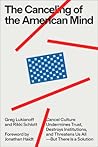
BOOKS: The Canceling of the American Mind by Greg Lukianoff & Rikki Schlott

The Canceling of the American Mind: Cancel Culture Undermines Trust and Threatens Us All―But There Is a SolutionThe Canceling of the American Mind: Cancel Culture Undermines Trust and Threatens Us All―But There Is a Solution by Greg Lukianoff
My rating: 5 of 5 stars

Amazon.in Page

This book presents an in-depth exploration of cancel culture in its many varied manifestations, from both the left and the right of the American political spectrum. The biggest part of the discussion is with respect to the educational system, and particularly higher education. Sadly, this is because the institutions that used to be among the most formidable bulwarks of free speech, expression, and academic freedom have increasingly become untenable to multiple points of view. (The authors point out that there have been more dismissals of faculty members for cancel culture speech and expression issues than there were during the McCarthy era for political stance.)

However, the book doesn’t restrict itself to education, but also investigates cancelations in journalism, publishing, the scientific community, standup comedy, and the medical and psychiatric communities. The authors also present cases of the effect that wokeness and other expression limiting activities are having in these areas. One of the most disturbing revelations to me was the role of wokeness in psychotherapy and the negative effect it may have on people getting the help they need.

The book presents a series of cases in detail to advance the discussion. It also has a couple chapters that examine the tactics that are used to apparently “win” debates by silencing / demoralizing the opposition while avoiding any actual contest of ideas. The authors go through tactics favored by the Right as well as those by the Left. (Though it’s clear that, in a race to the bottom, both sides adopt the approaches of the other side that seem to be effective. e.g. the Left is getting into book banning (historically a Conservative tactic) and the Right is getting into cancelling and shout-downs (usually Progressive tactics.)) I think it was smart to have two authors, one from the left and one from the right, in order to help ensure balance in the project. That said, as the Left has been in the cancel culture vanguard, they come up more often.

Some have called this a sequel to “The Coddling of the American Mind,” with which it shares a co-author, Greg Lukianoff. I don’t know that I’d think of it that way. While it does address some of the same issues as background, psychology and child development are not at the fore in this book (Jonathan Haidt – the other co-author of “Coddling” is a psychologist,) but rather are the legal, cultural, and political issues.  

This is probably the most important book I’ve read this year (and, being late November, it’s likely to retain that status) and I’d highly recommend it for all readers.

View all my reviews

PROMPT: Historical Event

What historical event fascinates you the most?

It varies over time. For a long time, it was the Second World War and the Holocaust. How do you get the rise of Nazis and the horrors that sprang therefrom? Sadly, I think that question has been answered to my — for lack of a better word— satisfaction.

The execution of Socrates has spurred a great deal of thought.

In terms of what is not so much a historical event, but historical processes, I’m intrigued by the life of Buddha.

Then there are a lot of explorer / adventurer travels.

Five Wise Lines from The Importance of Being Earnest by Oscar Wilde

The truth is rarely pure and never simple. Modern life would be very tedious if it were either, and modern literature, a complete impossibility!

Algernon

Oh! it is absurd to have a hard and fast rule about what one should read and what one shouldn’t. More than half of modern culture depends upon what one shouldn’t read.

ALgernon

It is awfully hard work doing nothing. However, I don’t mind hard work where there is no definite object of any kind.

Algernon

One has a right to Bunbury anywhere one chooses. Every serious Bunburyist knows that.

Algernon; [fyi: “Bunburying” is the use of appointments with ficticious individuals to get out of one’s duties and obligations.]

One should always eat muffins quite calmly.

Algernon