DAILY PHOTO: Tbilisi Scene from Queen Darejani Palace

Image

A photograph taken in Tbilisi, Georgia with Metekhi Church of the Nativity of the Mother of God in the fore (left) and Narikala Fortress in the background (probably from Queen Darejani Palace.)

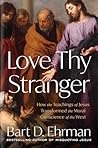
BOOK: “Love Thy Stranger” by Bart D. Ehrman

Love Thy Stranger: How the Teachings of Jesus Transformed the Moral Conscience of the WestLove Thy Stranger: How the Teachings of Jesus Transformed the Moral Conscience of the West by Bart D. Ehrman
My rating: 4 of 5 stars

Publisher Site – Simon & Schuster

Release Date: March 24, 2026

In this book, Ehrman argues that the development of Christianity started a sea change in the Western world’s approach to charity, altruism, and forgiveness. The idea is that both Greco-Roman philosophies and Judaism (Christianity’s religious precursor) were more tribal. Those systems clearly presented arguments for being charitable and kind, but in the context of those closest to you — your family and immediate neighbors — i.e. your ingroup. However, Ehrman proposes that those systems did not suggest any obligation to be charitable or kind to those who were strangers to one.

This is an intriguing book and provides many thought-provoking ideas and lessons from scripture, philosophy, and history. Ehrman definitely makes a case, but I don’t know that it is as strong as it might seem. In short, I think he did a great job of collecting stories and teachings that supported his point but showed less willingness to consider stories that might refute his thesis. I did appreciate how often Ehrman acknowledged contradictory views even when they conflicted with his own — often (appropriately) in footnotes. That said, I can’t recall seeing anything about the story of the Syrophoenician woman, a tale that seems to negate the book’s argument. In that story, a woman (of Syrophoenician origin) comes seeking Jesus’s help and is at first rebuked and turned away. Jesus says, “It is not fair to take the children’s food and throw it to the dogs.” Suggesting he neither sees her as the same species nor worthy of assistance. While it is true that Jesus does eventually assist her after she demeans herself (“Even dogs eat the children’s crumbs,) it’s still indication that he was far from advocating one behave lovingly toward all.

The book begins by dealing with broader questions, such as whether altruism actually exists (i.e. has existed) anywhere (i.e. are kind actions always self-serving?) and what the existing thinking was on the subject in Western philosophy and Abrahamic religion in Jesus’s day. I thought these first few chapters were quite beneficial for setting the stage before jumping into the building of the book’s central argument.

For those interested in what Jesus taught and what became of his teachings after his death, I’d recommend this book, or even for anyone interested in the changing shape of Western morality and ethics over time. I think the author conveys many interesting ideas in a readable and approachable way.

View all my reviews

DAILY PHOTO: Angels

Image

Two angels in St. Louis No. 3 Cemetery in New Orleans.

DAILY PHOTO: St. Louis Cathedral by Day

Image

Photograph of St. Louis Cathedral in New Orleans taken from Washington Artillery Park across Jackson Square.

FIVE WISE LINES [December 2025]

William Blake painting of Urizen praying to the world he created, an illustration from "Song of Los."
William Blake:
Urizen prays to the world he created (1795)
Song of Los

I must create a system
or be enslaved by another man’s…

william blake; Jerusalem: The emanation of the great albion

Saying Yoga exists to make one more flexible
is like saying that it exists to wring farts out of one’s body,
both will happen — neither is the primary objective.

Me

He that is without sin among you,
let him first cast a stone at her…

JESUS; John 8:7

The best government is that which governs least.

Henry david thoreau, Civil Disobedience

Gods always behave like the people who make them…

zora neale hurston; Tell my horse

DAILY PHOTO: First Evangelical Presbyterian Church, Roanoke

FIVE WISE LINES [November 2025]

Taken at Fo Guang Shan, near Kaohsiung in Southern Taiwan.

A thing is mighty big when time
and distance cannot shrink it.

Zora Neale hurston; Tell my horse

…if you want to be elected, it is better
to be Mean than to be Funny.

hunter s. thompson; Better than sex

And whosoever shall compel thee to go a mile,
go with him twain.

jesus; Matthew 5:38-40

The only gamblers who will talk openly
are the ones who don’t make money.
The successful ones keep their mouths shut.

Kit chellel; lucky devils

To live a creative life,
we must lose our fear of being wrong.

joseph chilton pearce

BOOK: “The Jefferson Bible” by Thomas Jefferson

The Jefferson Bible: The Life and Morals of Jesus of NazarethThe Jefferson Bible: The Life and Morals of Jesus of Nazareth by Thomas Jefferson
My rating: 5 of 5 stars

PDF available online [Public Domain]

Thomas Jefferson (yes, the same one who wrote the Declaration of Independence) produced this book by cutting and pasting excerpts from the Gospels so as to produce a distillation of who he believed Jesus was and what Jesus’s essential teachings were. It mixes parables and other New Testament teachings with biographical description.

There is an introduction which offers the reader more specific insight into Jefferson’s thinking than can be gleaned merely from what he includes and what he trims. The Introduction also discusses the similarities and differences between Christian philosophy and that of the Jews, the Greeks, and the Romans.

If you’re looking for a condensed version of the New Testament, I’d highly recommend this book. Jefferson was obviously a sharp guy who looked at the Bible from the perspective of Enlightenment-era thinking.

View all my reviews

DAILY PHOTO: St. Mark’s of Bangalore

DAILY PHOTO: Northern Gate Church [Nhà Thờ Cửa Bắc]