BOOK REVIEW: unMind: A Graphic Guide to Self-Realization by Siddharth Tripathi

unMind: A Graphic Guide to Self-RealizationunMind: A Graphic Guide to Self-Realization by Siddharth Tripathi
My rating: 5 of 5 stars

Amazon.in Page

This clear and concise guide uses graphics and story to make the self-realization teachings of Sri Ramana Maharshi (and those influenced by him) approachable and even entertaining. Ramana Maharshi was a Jnana yogi who advocated a single-minded path of self-inquiry as a means of coming to grips with one’s life. This book does a spectacular job of conveying the method of self-realization and exploring the philosophical ideas that inform it.

For those unfamiliar with Jnana Yoga, there can be said to be three forms of yoga. Bhakti Yoga is the devotional form practiced by those who have an affinity for worship. Karma Yoga is associated with actions and a selfless works. This leaves Jnana Yoga, which is the studious branch of Yoga. Jnana yoga is widely considered to be the most difficult path because it requires constant self-investigation, and because one is working without a net in that one takes nothing on faith, but rather one must see for oneself. This makes Jnana Yoga the least appealing “flavor” of yoga, but if one is a scientifically-minded and studious person, it offers an option that one will find far preferable. While terms like “self-inquiry” and “self-realization” may sound pretty pie-in-the-sky, the approach is really quite grounded.

I found both the text explanations and the artwork to be incredibly effective in explaining the ideas behind self-inquiry and Jnana Yoga. The artwork combines comic strip style graphics with full-page stylized images. Not all the material features graphics, but the text-only pages are concise and easy to follow.

If you are looking for insight into Jnana Yoga, self-inquiry, self-realization, or just the way the mind works, generally, I’d highly recommend this book.


View all my reviews
BOOK REVIEW: Yoga Anatomy, 3rd Ed. by Leslie Kaminoff and Amy Matthews

Yoga AnatomyYoga Anatomy by Leslie Kaminoff
My rating: 5 of 5 stars

Amazon.in Page

This book has several competitors, and so this review will focus on a few of the features that I believe make it one of the best books on yoga anatomy, and the most appropriate for many users. To clarify, H. David Coulter’s “Anatomy of Hatha Yoga” has some advantages over this book, but Coulter’s book is also denser and will send neophyte readers to the glossary / internet / library much more often. On the other hand, some of the other yoga anatomy books fixate entirely on postural yoga and treat it entirely as a matter of skeletal alignment and muscular engagement. While a lot of this book (and any such book, really) focuses on skeletal alignment and muscular engagement, I appreciated the books exploration of breath and the nervous system – topics that are often neglected. In short, this book offers a mix of reader-friendliness and detail that makes it at once approachable and tremendously informative.

One important feature of this book is that it avoids the dogmatism of some yoga texts, encouraging experimentation and recognizing that a one-size-fits-all approach to bodies is bound to fail. This can best be seen in the “Cueing Callout” boxes that explore the pithy adjustment directives for which yoga teachers are famous (and often satirized,) advice that is often misunderstood in ways detrimental to a student’s progress.

A second key feature involves keeping anatomy and physiology distinct from the folk science of yoga / ayurveda. While Kaminoff and Matthews do refer to ideas like prana and apana, they do so in a broad, conceptual way that doesn’t conflate said ideas with science. A common problem in yoga texts is conflation of science with folk science such that confused readers are left with a muddle of puzzle pieces that don’t belong to the same puzzle.

Finally, as one who’s found pranayama (breathwork) to be one of the most profoundly transformative elements of a yoga practice, I appreciated that the book not only had a chapter on breath dynamics, but that all the posture discussions included a “breath inquiry” section that encouraged readers to reflect upon the effect of the posture on breathing, as well as suggesting ways in which a practitioner might experiment to improve one’s breathing.

The only criticism I have is that many of the text-boxes in the early chapters seemed to contain random information that could have been incorporated into the text, into footnotes, or edited out altogether. [In contrast to the aforementioned “Cueing Callout” boxes that had a clear and distinct purpose.] If you’re a yoga teacher or dedicated practitioner without a deep scientific background, you’d be hard-pressed to do better than this book for learning about the anatomy of yoga.


View all my reviews

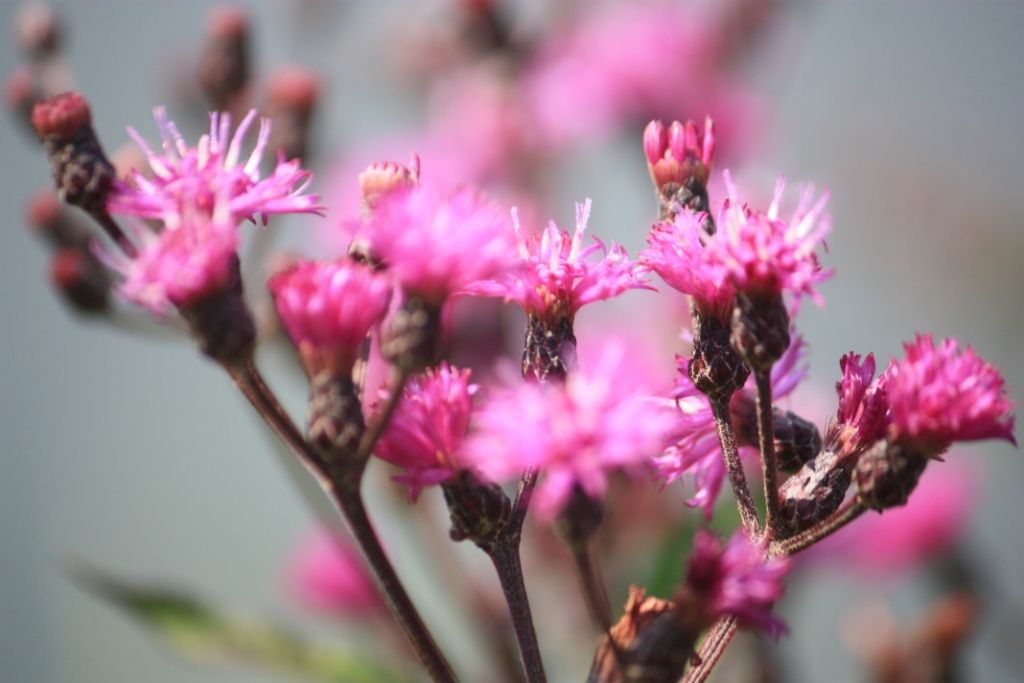
Blur [Haiku]

bright pink flowers,
staring 'til they blur -
my mind quiets

Balance & the Value of Learning to Fall

I saw something sad in the park this morning. A boy was trying to learn to ride a bicycle, but I could see that he never would — not with his present approach. Why? He had one training wheel, and the bike was leaning about 15-degrees off vertical as he struggled to use the bicycle as a tricycle. I could see that the metal arm that supported the training wheel was starting to bend from the strain — thus making the lean ever more pronounced. [Incidentally, with two training wheels, I think he might rapidly learn to ride because he’d experience tipping from one side to the other, through the balance point.]

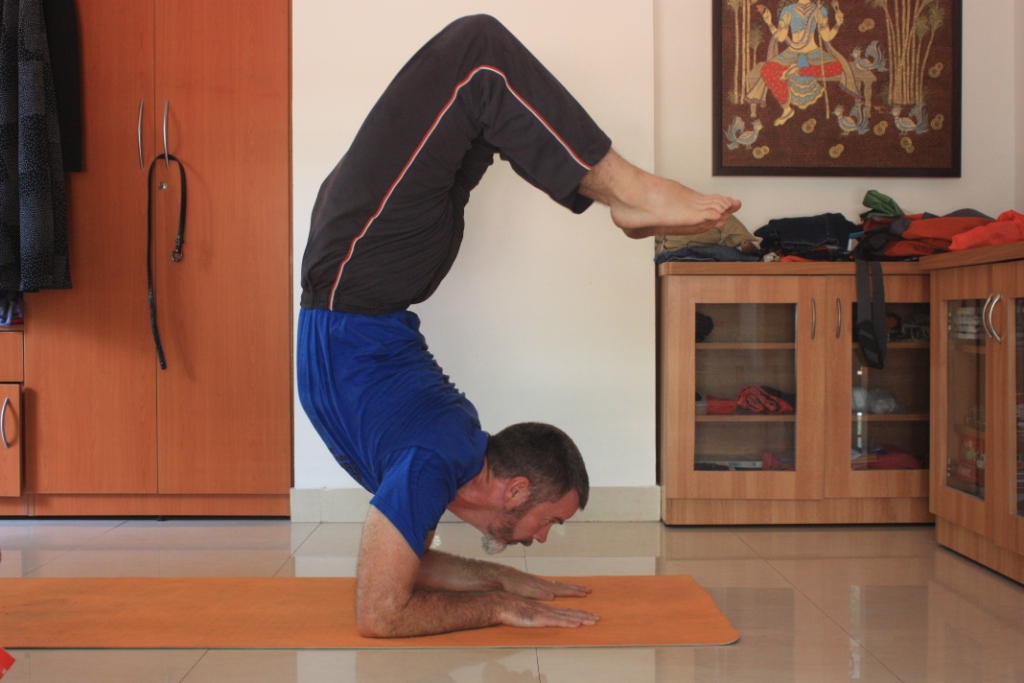
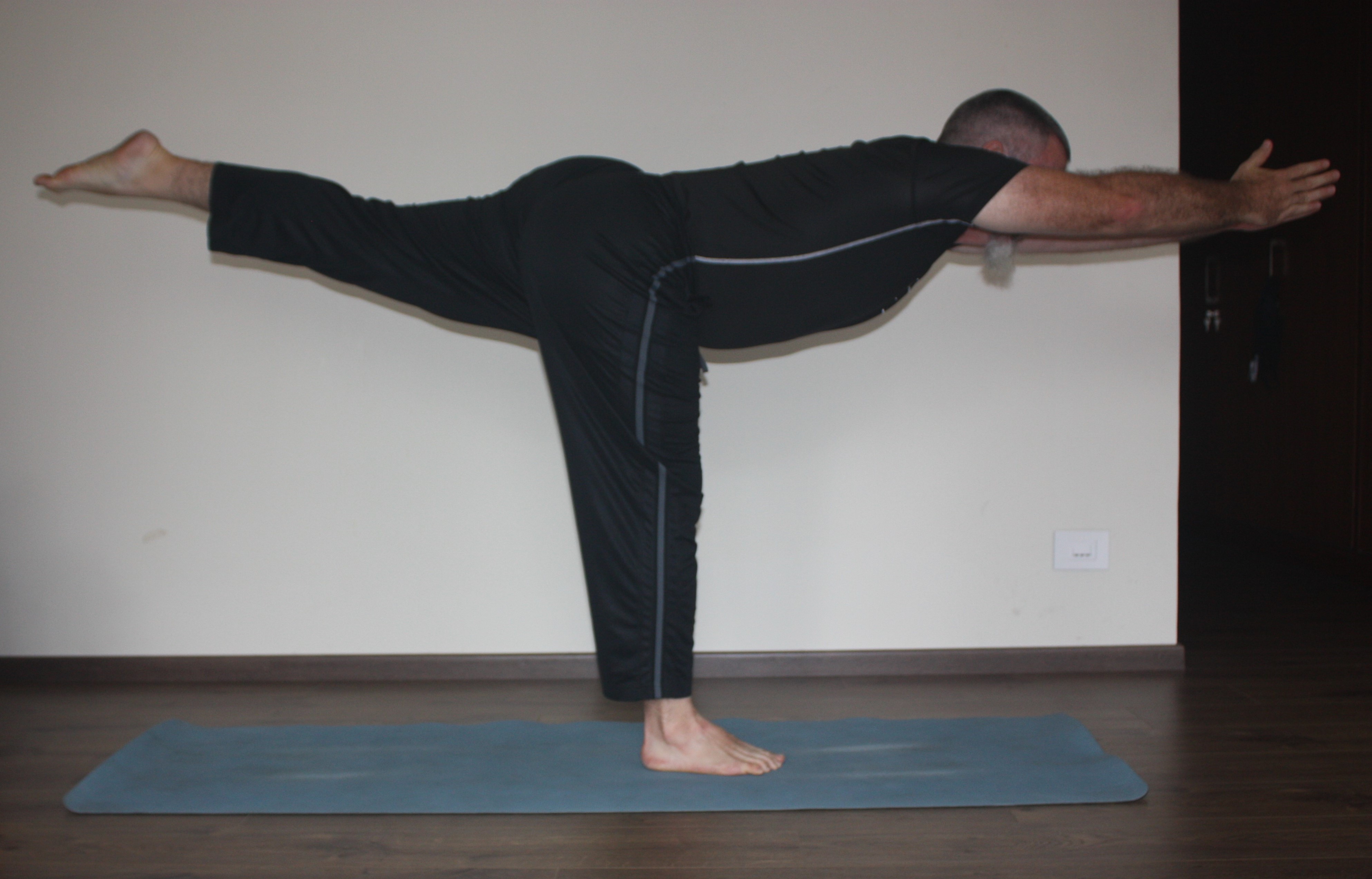
I’ve told yoga students before that there are three timelines for learning inversions (upside-down postures, which all require one’s body to learn to balance 180-degrees out of phase with the balance we all mastered as toddlers.) The first timeline is if you are willing to learn break-falls (i.e. how to safely land when — not if, it will happen — one loses balance.) If so, one can learn any inversion (that one is otherwise physically capable of performing) in an afternoon. Second, if one gets near (but not up against) a wall, and only uses the wall when one is falling towards over-rotation, then one can learn the inversion in a month — give or take. Finally, one can lean up against the wall for a million years and one will not spontaneously develop the capacity to independently do the posture. Why? Because one’s center of gravity is outside one’s body, which means one is in a perpetually unstable state, and one cannot stabilize into a balanced position from a state of falling (and leaning is just falling with a barrier in the way.)

Finding balance requires that the body be able to adjust toward any available direction to counteract the beginning of a fall in the opposite direction. I was fortunate to have studied a martial art that required learning break-falls from the outset, this made learning balances (not just inversions, but also arm balances, standing balances, etc.) much easier because there was no great concern about falling. I knew my body could fall without being injured.

Without falling there’s no learning balance, and if you only fall into the under-rotated position, you are still not learning to achieve stable balance. At some point, you will need to experience the dread fall towards over-rotation.

Time to ditch the training wheels.

Flame Mind [Common Meter]

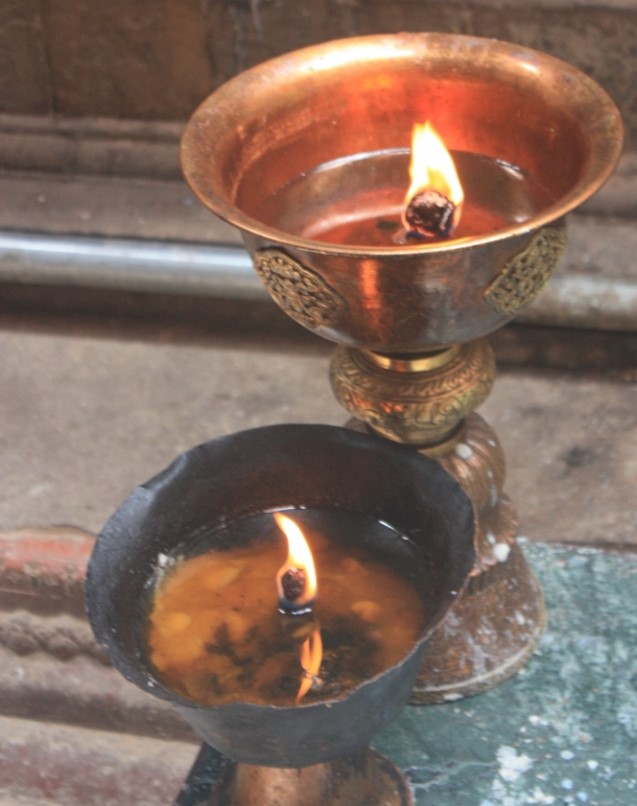
His eyes take in the dancing flame
until his mind is flame.
He anticipates its flutter,
its flareups, just the same.

There's nothing in his mind or eye
that is not set ablaze.
He knows not whether it's been like
this for hours, weeks, or days.

Others think it will devour him,
leaving a pile of ash,
taking him from this world at once,
in one big, blinding flash.

BOOK REVIEW: Indian Philosophy: A Very Short Introduction by Sue Hamilton

Indian Philosophy: A Very Short IntroductionIndian Philosophy: A Very Short Introduction by Sue Hamilton
My rating: 4 of 5 stars

Amazon.in Page

A concise guide to Indian Philosophy is a tall order. Over millennia, the discipline has had time to swell. This necessitated some careful pruning and selection on the part of the author. While the book does present key distinctions between all six of the orthodox schools of Indian Philosophy (i.e. Nyaya, Vaisheshika, Samkhya, Yoga, Mimamsa, and Vedanta,) the only one of the heterodox schools that it substantially addresses is that of Buddhism. (There are three major heterodox schools of Indian Philosophy by most accounts – Caravaka, Buddhist, and Jain, though some also include Ajivika and Ajnana to make five.)

This book focuses on the most novel ideas of each of philosophical schools under study, and it particularly focuses on points of debate where there is disagreement within or between schools. The book, therefore, moves metaphysics, ontology, and epistemology, but doesn’t explore all major philosophical questions for all the schools.

If you’re looking for a book that sums up the key points of debate between and within major schools of Indian philosophy, this is a great book. It does the job quite well and with a minimal page count. If you need a book that offers insight into more than the major points of contention, but extends into a given school’s stance on some of the less provocative questions, I’d recommend Chatterjee and Datta’s “An Introduction to Indian Philosophy” (it’s much longer and denser, but dives deeper and farms wider.)

I like how this book was organized and thought it did a good job of being both concise and clear (a duo that doesn’t play well together with regards complex philosophical subjects.)

View all my reviews

POEM: Yoga for Giraffes

Surely, I have misunderstood,
“Put my head where, you say?”
“But I have bones, don’t you know?”
“I wish I could obey.”

“Now, you say, my feet are too wide?”
“Really, what the heck!”
“You said put my head ‘tween my feet,
have you seen my frickin’ neck?”

“I wasn’t built to stand on my head!”
“What do you mean, ‘We’ll see?'”
“I’m not sure that you’re acquainted
with a thing called gravity.”

POEM: Spine

Flex forward and a row of rounded, fleshy knobs form in that muscled valley — straight and evenly-spaced.

Chest up & shoulders back and the knobs shrink, enshrouded; while those low, rolling knolls become bounded by scapular cliffs.

Dance about and a million topographies form and disband: all without a sharp corner — nothing but smooth transitions, gracefully made.

Fronts get all the attention, but backs are masters of the beauty of subtle change.

My spine bends and flexes, and I’m alive.

Sparks run in riffles down that line, and I’m alive.

POEM: Yoga

The moment when you’re everything
and are, at once, nothing.
Time exists, but is lost to you —
no lagging, nor rushing.

Space is the world that expands and
collapses with each breath —
the infinity through which you
stretch beyond life and death.

And in quiet moments of mind,
when no voices call out,
it becomes still enough to feel
something within you sprout.

BOOK REVIEW: Yoga for Sports by B.K.S. Iyengar

Yoga For Sports: A Journey Towards Health And HealingYoga For Sports: A Journey Towards Health And Healing by B.K.S. Iyengar
My rating: 4 of 5 stars

Amazon page


This is a book by the renowned Pune yoga guru who passed away in 2014, B.K.S. Iyengar, on how athletes can use yoga to build general health, prevent injuries, and combat postural misalignments that result from sporting activities that are asymmetric or unbalanced. A book on yoga for athletes might address any number of topics from core strength and stability to meditations to prevent choking under pressure, but this one focuses heavily on asana (postural yoga) – particularly – for improving flexibility and postural alignment. (It does introduce pranayama, but only the practices of viloma and ujjayi breathing.)

Iyengar is most well-known for an approach to hatha yoga that uses props to allow anyone to achieve a properly aligned posture, regardless of whether one has a yogi-level contortionist body (and most athletes don’t because of the countervailing requirements for strength necessitated by their sports.) This prop-centric approach is seen heavily in the book’s second part, which describes and demonstrates a range of basic asana (postures) along with relevant variations. I mention this because through the first part of this book, I felt it was much more of a book for yoga practitioners who might also happen to be amateur athletes than it was for athletes looking to introduce yoga into their training regimen. By that I mean that the photos of recommended poses in Part I are unlikely to be useful for athletes who have tight muscles from intense physical activity. However, if you’re feeling that way about the book, too, you may find that the second part’s variations are more reasonable for a person who doesn’t have an extensive background in yoga or stretching.

The book is divided into four parts. The first part consists of ten chapters that cover the topic of yoga for sports with broad brush strokes, covering topics like skeleto-muscular anatomy, common sports complaints, yoga for warmup, yoga for prevention and for recovery. It also deals with specialty topics like maintaining a healthy body in retirement as well as issues for women athletes (women may find this section to be a bit menstruation-heavy, as if that were the predominant challenge facing women engaged in athletics. On the plus-side there’s none of the bizarre and / or offensive notions about menstruation that have been known to presented in the context of yoga.) As I mentioned, during this first part I thought the book would not be so useful for the problems of athletes, and some may find that still seems to be the case after reviewing part two. The gulf between what is recommended and what the average practitioner can physically do is a perennial difficulty with books on yoga.

The second part discusses asana in detail, providing pictures, text descriptions, and notes on benefits and – where applicable — other considerations (e.g. contra-indications.) Here one can find prop-based variations to allow individuals who may be stiff or in recovery to perform the asana. Mostly, there is just one photo of each posture in mid-pose. However, where special guidance is needed getting into or out of the pose (which can be the case with prop yoga) there are sometimes multiple photos demonstrating a progression of movement. My major gripe with this book is that it was littered with typos (at least the e-book edition that I read on Kindle.) The typos were most notable in this section. I can’t remember if I saw any in parts I, III, or IV, but the errors stuck out in part two because there is a lot of repetitive directions for the poses that seem to have been copy / pasted such that the same missing letter typos appear many places throughout the section.

The third part is much briefer than the first two, and it simply describes props that an athlete might consider acquiring. It starts with basic kit and moves to bigger items, though it doesn’t discuss all the huge equipment that one would find in a fully equipped studio teaching Iyengar-style yoga. It provides text discussions of critical considerations as well as photos.

The last part is just a couple pages of testimonials of famous athletes saying how much yoga (in general) and Iyengar’s teaching (specifically) helped them to improve their games. These brief testimonials are presented in text-boxes and look somewhat as one might see on the opening pages of a novel.

As would be expected of a book on sports published in India, most of the examples are cricket-centric. (Again, not surprising as cricket is the 800-pound gorilla of sports on the subcontinent.)

I found this book to be quite informative. If you can bear the typos (and they may have been exorcized from the print editions,) you’ll likely find the book to be informative and well-presented.

View all my reviews