BOOK REVIEW: The Three-Cornered World by Natsume Sōseki

The Three-Cornered WorldThe Three-Cornered World by Natsume Sōseki
My rating: 5 of 5 stars

Amazon.in Page

This novel was originally entitled Kusamakura or “Grass Pillow,” and it’s the Alan Turney translation that bears the title The Three-Cornered World. Turney drew from a concept that Natsume presents in the book – i.e. that an artist lives in the triangle created by the collapse of a corner called common sense. It’s a poetic and philosophical novel that is very much character-centric. In other words, if you must have an intriguing story, this book is not so much for you. However, if you find ideas and clever use of language appealing, you’ll love it.

The premise is that an artist takes retreat in the mountain countryside, and becomes infatuated with a local woman with a storied past. As the book tells us of the artist’s experience, it discusses aesthetics, the philosophy of art, and the place of emotion in artistic experience. This book is often compared to Bashō’s travelogue (i.e. Narrow Road to the Deep North) as it involves a great deal of elegant imagery and the occasional interspersed poem.

While the book is light on story, I was wowed by the author’s thought process and his use of language. While I’ve never read the original in Japanese, Turney’s translation is beautiful writing in its own right and I suspect it captures the sparse beauty for which Natsume’s work is famed. It is definitely worth reading.

View all my reviews

BOOK REVIEW: Epicureanism: A Very Short Introduction by Catherine Wilson

Epicureanism: A Very Short IntroductionEpicureanism: A Very Short Introduction by Catherine Wilson
My rating: 5 of 5 stars

Amazon.in Page

Like all ancient schools of philosophy, Epicureanism birthed an adjectival oversimplification that has eclipsed the word’s original meaning and obscured the full story of this philosophical system. Platonic refers to the teachings of Plato, but platonic is a friends-without-benefits scenario. A Cynic is a minimalist who eschews comfort and rejects social norms, but to be cynical is to think the worst. A Stoic believes that there are things one can control and things one can’t and that one should act virtuously in the former case and indifferently in the latter, but a stoic is an emotionless automaton. Epicureans developed a comprehensive system of philosophy that included metaphysics, epistemology, ethics, and political philosophy, but an epicurean is a hedonist, probably dripping butter from his chin. The tenet that there is nothing wrong with seeking pleasure became the whole picture, and lost was the understanding that moderation is a virtue.

Being unacquainted with Epicureanism, I was surprised to learn that it was the least superstitious, as well as the most compassionate, of all the ancient Greek philosophies. Like most people studying ancient philosophies, I’m most interested in those aspects that might be called “philosophy of life” – i.e. ethics, politics, and other aspects that deal in how one should live. [As opposed to the more arcane questions of metaphysics and epistemology.] The reason is simple; the former ideas have aged better, while ancient metaphysics, for example, appears ridiculous in light of all the science that has come along. For this reason, I tend to overlook the long-discredited ideas of ancient philosophers. However, I’ve come to see that these ideas informed the life philosophy of each school (and, also, that there are degrees of wrong.) For example, the Epicureans, being atomists, were correct to a point, and in rooting their entire system in nature (rather than gods and the supernatural) they avoided preoccupation with pleasing the gods and developed an acceptance of the fact that sh!% happens (and it’s not due to angry gods.) So, while many of the details of Epicurean atomism were far from the mark, it did yield a less superstitious outlook (and was less wrong than most ancients.) My point is that I ended up benefiting from this guide’s comprehensive approach.

If you’re looking for an overview of Epicureanism, or you think the defining characteristic of an Epicurean is a love of heavy sauces, you should definitely check this book out.


View all my reviews

BOOK REVIEW: Tibetan Buddhism: A Very Short Introduction by Matthew T. Kapstein

Tibetan Buddhism: A Very Short IntroductionTibetan Buddhism: A Very Short Introduction by Matthew T. Kapstein
My rating: 4 of 5 stars

Amazon.in Page

This book outlines the philosophy, theology, history, and future prospects of Tibetan Buddhism. It’s a big topic because Tibetan Buddhism is a unique amalgam of Buddhism, indigenous beliefs (e.g. Bön,) and adapted teachings from Yoga and Tantra.

For a concise guide, the discussions of history and philosophy can get deep in the weeds. However, to be fair, Tibetan Buddhism has a long and complicated history, and has produced deep metaphysical ideas, particularly with regards to philosophy of mind. Furthermore, it’s not a unitary religion, having schismed into a number of sub-sects.

Special attention is given to Tibetan Buddhism’s teachings on Enlightenment and death. Even those who aren’t familiar with Tibetan Buddhism may have heard of the “Tibetan Book of the Dead,” and may not be surprised to learn the topic is given its own chapter. I learned that the Bardo (e.g. a lobby between death and rebirth) was in part hypothesized to help reconcile the idea of Anatta (there being no persistent self, or soul) with reincarnation. [i.e. The question arises, what’s reincarnated if there’s no persistent “I” (i.e. atman, soul, etc.?) The book doesn’t really explain how the existence of a Bardo achieves this reconciliation, but achieving accord with the two ideas appears complicated, and -arguably- spurious.]

The book ends with a look at the religion’s prospects for the future, which are darkened by the Chinese government’s desire to subvert the religion’s influence, but may also be brightened by the fact that the current Dalai Lama has been open to dialogues, and – in particular – has made Tibetan Buddhism arguably the religion with the most cordial relationship to the scientific world. (No mean feat for a religion that is as superstitious as any in the modern world.)

If you’re interested in a concise overview of Tibetan Buddhism, give it a read.


View all my reviews

BOOK REVIEW: Three Japanese Buddhist Monks by Saigyō, Chōmei, and Kenkō

Three Japanese Buddhist MonksThree Japanese Buddhist Monks by Saigyō
My rating: 5 of 5 stars

Amazon.in Page

This book collects three essays composed between the twelfth and fourteenth centuries. They are in chronological order, but also in order of increasing length, i.e. Saigyō’s piece is a short excerpt, while Kenkō’s essay makes up the bulk of the book.


An excerpt from Saigyō’s Senjūshō tells the story of the monk’s meeting with a wise reclusive meditator on Mt. Utsu. Saigyō tries to talk his way into living / meditating with the hermit, but the sage convinces him that that wouldn’t be good for either of them. The monk goes away, planning on visiting the hermit on his return, but he wistfully tells us that he took another route.


“The Ten-Foot Hut” is about the benefits of a simple, minimalist existence. It discusses Impermanence, and takes the view that having more just means one has more to lose. A quote that offers insight into the monk’s thoughts is, “If you live in a cramped city area, you cannot escape disaster when a fire springs up nearby. If you live in some remote place, commuting to and fro is filled with problems, and you are in constant danger from thieves.” The author’s solution? Build a tiny cabin in the woods and – in the unlikely event it burns or gets robbed while one is away – what has one really lost?


The Kenkō essay makes up about eighty percent of the book. Its rambling discussion of life’s impermanence delves into morality, aesthetics, and Buddhist psychology. There are many profound bits of wisdom in this piece. Though it’s also a bit of a mixed bag in that some of the advice feels relevant and insightful, while some of it hasn’t aged / traveled well.


I enjoyed this book and found it thought-provoking. Some may be disappointed by finding how little of Saigyō’s writing is included (he being the author of greatest renown,) but I found each author had something valuable to offer.


View all my reviews

BOOK REVIEW: Stoicism: A Very Short Introduction by Brad Inwood

Stoicism: A Very Short IntroductionStoicism: A Very Short Introduction by Brad Inwood
My rating: 4 of 5 stars

Amazon.in Page

Inwood provides an overview Stoic philosophy as it’s discussed in a scholarly context. To distinguish Stoicism as scholars see it from how it’s viewed by those who practice it as a lifestyle, the author differentiates “large Stoicism” from “minimal stoicism.” The vast majority of books today deal only with minimal stoicism – in other words; they exclusively explore how to lead a good and virtuous life, i.e. ethics-centric Stoicism. Scholars, however, are also interested in the physics (/ metaphysics) and the logic of Stoicism.


There are several reasons for this difference in scope. First, Stoic ethics has aged much better than its other philosophical branches. Much of Stoic logic has been improved upon or superseded, and Stoic physics is [arguably] obsolete. This means that scholars studying Stoic physics and logic are more interested in those subjects as a stage of development or a piece of philosophical history than they are as contenders for understanding those subjects. Second, prominent Stoic philosophers with surviving writings (i.e. Epictetus, Marcus Aurelius, and Seneca) have inspired many people by discussing Stoicism as a way of life – not so much as a navel-gazing endeavor.


After discussing the origins of Stoicism, the major Stoic authors, and how Stoicism relates to other philosophical schools of the ancient world, the book presents a chapter each on physics, ethics, and logic. The last chapter investigates how Stoicism is viewed today and how it might maintain relevance despite challenges to some of its metaphysical and logical underpinnings.


Having read a number of books on Stoicism, I didn’t know whether this concise book would be of much benefit. However, by describing Stoicism’s broader context and how the deterioration of much of that context influences the philosophy’s relevance, the book offered plenty of food-for-thought. If you’re interested in this broader context, you may want to give this book a look.


View all my reviews

BOOK REVIEW: Symposium by Plato

SymposiumSymposium by Plato
My rating: 5 of 5 stars

Amazon.in Page

Project Gutenberg (FREE)

Symposium is a collection of speeches in praise of Love (the Greek god and the emotional experience) given at a banquet in Ancient Greece. The participants are men of renown, including: a playwright, a physician, a philosopher, a statesman, etc. The narrative is delivered as a secondhand telling after the fact, and isn’t intended as a verbatim transcript of all the speeches.

There are seven speeches, each unique and most playing off the others. Phaedrus starts by emphasizing the underrecognized importance of the unsung god, Eros. Next, Pausanias stresses that there isn’t one kind of love, but two. Eryximachus focuses on the all-pervasive nature of love and, as a physician, mentions the bodily dimension of love. Aristophanes’s speech seems largely in jest, but stresses the fact that people don’t comprehend the power of love. Agathon rebukes the others for emphasizing love as a gift to humans, and, instead, suggests one should focus on praise of the deity. Socrates’s encomium is a departure, as one might expect given his love of questioning and hatred of speechmaking. First, he questions Agathon about whether love is really synonymous with beauty or good, as the youth’s speech had suggested. Second, he recounts his instruction on the subject from Diotima, which is mostly a recounted dialogue between her and he.

The last speech is afield. A drunken Alcibiades wanders in late. [The others decided not to drink because most drank too much the previous day.] Alcibiades gives a speech in praise of Socrates, his once lover, with whom he’s on the outs. From Alcibiades we learn not just about his relationship with Socrates, but also some interesting biographical facts about the philosopher, such as his proclivity to get lost in thought for extended periods and his bravery in combat.

This is an interesting work, and well worth reading.


View all my reviews

The Emotional Beast [Free Verse]

We laud our rational side

- The Thinking Man -

But we're emotional beasts
to the core.

To use that old
[and disparately applied]
chestnut:

Of emotions, 
better master
than servant.

Poetry is a conduit
to emotional savvy.

That's part of the reason
Plato urged poetic restraint;

he found the emotional
inferior to the rational,
and thought most youngsters 
couldn't behave responsibly
in the face of poetry's 
emotional power.

It's also where Aristotle
found virtue in poetry,
its ability to induce 
catharsis.

Could they both 
be right?

BOOK REVIEW: Zen Buddhism by Christmas Humphreys

Zen BuddhismZen Buddhism by Christmas Humphreys
My rating: 5 of 5 stars

Amazon.in Page

This overview of Zen Buddhism isn’t so much an instructional guide as a reflection upon Zen as a life philosophy and an artistic influence. While it does have a chapter on technique, it’s mostly a mile-high overview of koan (paradoxes and riddles) and mondo (a Q & A-based practice,) and doesn’t enter into the fundamentals of meditation. If you’re looking for an introduction to Zen practice, this probably isn’t your book. Even the book’s conclusion, which is meant to address pragmatic matters, does so in an abstract and philosophical way. But this isn’t meant to denigrate the book. There are plenty of books that fill that role, and this book has a couple of specialties that set it apart and make it well worth reading.

There are three areas into which this book delves that are sparsely covered in other books. First, there’s a chapter devoted to Zen in English Literature, and throughout the book there’s much discussion of how Zen influences art, more broadly. The Zen in English Literature chapter draws heavily on a work by R.H. Blyth that is hard to find these days. Second, there’s an attempt to relate how ideas of Zen Buddhism can be conveyed to a Western mind. Third, while it’s acknowledged as being futile, the author discusses Satori in great depth.

I found a great deal of food-for-thought in this book. The author draws from many and varied sources to convey his message. Though that can also be a bit problematic. For example, Humphreys sometimes launches into ideas that come from yogic or other Eastern philosophies without a great deal of elaboration. There’s a certain pretentiousness that’s not unexpected from a mid-twentieth century British writer, but the book is by no means a dense read.

If you’re looking for a philosophical look at Zen, or one which discusses Zen as an artistic influence, check out this book.

View all my reviews

BOOK REVIEW: Anecdotes of the Cynics by Various

Anecdotes of the CynicsAnecdotes of the Cynics by Robert F. Dobbin
My rating: 5 of 5 stars

Amazon.in Page

This is a collection of brief stories and sayings from famous Cynic philosophers – notably, Diogenes of Sinope, Crates of Thebes, Hipparchia, and Bion. It opens with the longest piece, a dialogue [allegedly] by Lucian the Cynic advocating the Cynic’s minimalist approach to life. [Cynics were ascetics who shunned customs and cultural conventions and thus often ran afoul of the conservative societal base / rubbed people the wrong way.] The dialogue uses Socratic method, but also contains prolonged exposition. [Not like the Platonic dialogues in which Socrates tends to ask brief questions and attempts to demand brief answers – granted not always successfully.] However, most of the pieces are just a paragraph or two brief excerpts.

Most of the entries report on what various Cynics said or did, though there are a few that are biased commentaries of non-Cynics about these “dog philosophers” – e.g. there is a Catholic tract denouncing the Cynics while talking up Paul. [It reads as though the early Christian church (which was teaching Jesus’s ideas, including: in part, the virtues of poverty, of simplicity, and of a lack of deference to the world of men) might have been concerned about being outcompeted.]

There’s not a tremendous amount that remains of direct Cynic teachings, and so a book like this is a way to get a taste of the highlights. Just as Buddha found that extreme forms of ascetism didn’t yield the optimal result, Cynicism lost ground to the upstart school Stoicism, which borrowed some Cynic ideas while jettisoning the most extreme aspects of the philosophy.

One can find these stories in old public domain sources such as Diogenes Laertius’ (no relation) “Lives of the Eminent Philosophers,” but this is a good way to get the condensed version without too much extraneous information.

View all my reviews

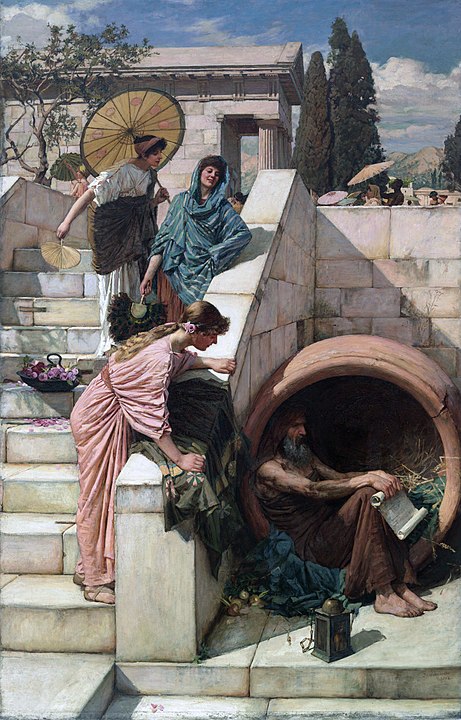
In Praise of Diogenes the Cynic [Free Verse]

Owning only a cloak, 
staff, and satchel,

he broke his bowl
after seeing a child
drink from cupped hands,

feeling the dunce 
for being out-simplified
by a mere child.

When pirates,
eager to sell him off,
asked what skill he had,

he said, "Governing men.

"If you find someone 
interested in buying 
a master,
I'm your man."

He couldn't be driven
away with a stick,
much as the downright-dog,
Antisthenes, tried.

He was expert
at adulterating the currency -
literally and figuratively.

When Alexander the Great
offered him whatever he wished,
A sunbathing Diogenes replied,
"Stand out of my sunlight."

I fear
they don't make 'em like
that anymore.