Countless Pieces of Hate [Free Verse]

Countless pieces of hate
Tumble through our days,
Clogging up our Flow --

Tiny bites of thought
Pit us against
Imagined adversaries...

But aren't all adversaries
Imagined adversaries?

Those who act badly against us
Are only adversaries
If we slide them into that
Mental basket.

BOOKS: “Teachings of the Christian Mystics” ed. by Andrew Harvey

Teachings of the Christian Mystics (Shambhala Pocket Library)Teachings of the Christian Mystics by Andrew Harvey
My rating: 5 of 5 stars

Acquired at Blossom Bookhouse

This book gathers a collection of short writings (mostly paragraph to a few page excerpts as well as a few poems) on mystic Christianity from the time of the Gospels through the twentieth century. While the bulk of the pieces are (if not from scriptures) the work of clergymen and / or theologians, there are some by individuals known elsewise (e.g. poets William Blake and Gerard Manley Hopkins.) The book is arranged somewhat, but not perfectly, chronologically — enough that all the Biblical excerpts are lumped together at the beginning to form about the first quarter of the selections. While there are a number of one-off contributors, there are several pieces from each of: Gregory of Nyssa, the Desert Fathers, Saint Symeon the New Theologian, Saint Bernard of Clairvaux, Saint Teresa of Avila, and Eckhart von Hochheim.

One nice feature of this book is that it does include selections from a wide range of sources (Roman Catholic, Orthodox Catholic, and Protestant) over a range of time periods, and from scriptures both canonical and “apocryphal.” So, there are many varied ideas of the mystical experience and the path thereto. The flipside of this fact is that there doesn’t seem to be a lot of cohesiveness to the collection. It isn’t always clear why Harvey (the editor) thought a given excerpt was representative of mystic teachings versus of mainstream Christianity. There is a substantial introduction, but otherwise the selections are left to speak for themselves.

Still, it was a quick read, dense with insights, and I found — particularly some of the scriptural selections — to be among the most profound statements of Christian philosophy that I’ve seen.

View all my reviews

“Finely Woven” [Poetry Style #14] by Sikong Tu [w/ Audio]

The building blocks of everything --
Too fine to feel or see or smell --
Dance their way into hardened shapes
Via forces, invisible.
And so water flows, flowers bud,
But - also - dew evaporates.
This expansive path stretches on --
It's slow-going through dark lands.
It can't be spoken of smartly.
It can't be pondered fruitfully.
It's Early Spring green in sunlight,
Or like the snow seen by moonlight.

NOTE: The late Tang Dynasty poet, Sikong Tu (a.k.a. Ssŭ-k‘ung T‘u,) wrote an ars poetica entitled Twenty-Four Styles of Poetry. It presents twenty-four poems that are each in a different tone, reflecting varied concepts from Taoist philosophy and aesthetics. Above is a translation of the fourteenth of the twenty-four poems. Translated titles vary: Giles calls it “Close Woven” and others have titled it, “Fine.”

BOOK: “How To Be The Best Improviser On Earth” by Will Hines

How To Be The Greatest Improviser On EarthHow To Be The Greatest Improviser On Earth by Will Hines
My rating: 5 of 5 stars

Amazon.in Page

This guide to performing improv comedy alternates chapters that explore various tenets of the art with chapters that present exercises to help one carry out said tenets in practice. So, it is both a philosophy of improv and a how-to manual. The tenets include: “be present,” “be changeable,” “be brave,” “be authentic,” and “be funny” — among others.

Being a neophyte to the subject, I knew nothing beyond the oft joked upon advice to always “Yes, and…” during a scene, a lesson intended to keep a scene moving and which also provides much material for wisecracks. This book doesn’t spend much time on that rule beyond discussing when one should break it, and how one can do so without bringing a scene to a halt. The key takeaways of the book were about pacing and the need for normality in contrast to the absurdity to make a scene funny. That is, one can’t just go to the whackiest place possible out of the gate and with all characters, instead it is the contrast between everyday conversation and the introduction of an absurd premise that makes a scene funny. As with the “straight man” of a comedic duo, one needs straight elements or characters.

I found this book to be informative. It’s a quick read and offers much food-for-thought that could benefit one offstage as well as on.

View all my reviews

PROMPT: Work / Life Balance

How do you balance work and home life?

Live in the moment.

PROMPT: Leader / Follower

Are you a leader or a follower?

That’s a tough one because I think most people who would describe themselves as followers have failed to write their story boldly enough. Yet, the majority of people who describe themselves as leaders are more full of hot-air than of the capacity to inspire others to action.

I’d say, overall, I’m neither a good follower nor a good leader, but in varied contexts – as necessary – I can pull off either.

I think it might just be a false dichotomy.

PROMPT: Improvement

What’s one small improvement you can make in your life?

Realize you have no control of what happens in the world, but complete control of your perception of it.

PROMPT: Brands

What are your favorite brands and why?

The ones that offer the best value for the money at a given time. I have no brand loyalty, and — in fact — find it to be an absurd concept. It’s corporate hacking of humanity’s proclivity for tribalism in service of profit-maximization.

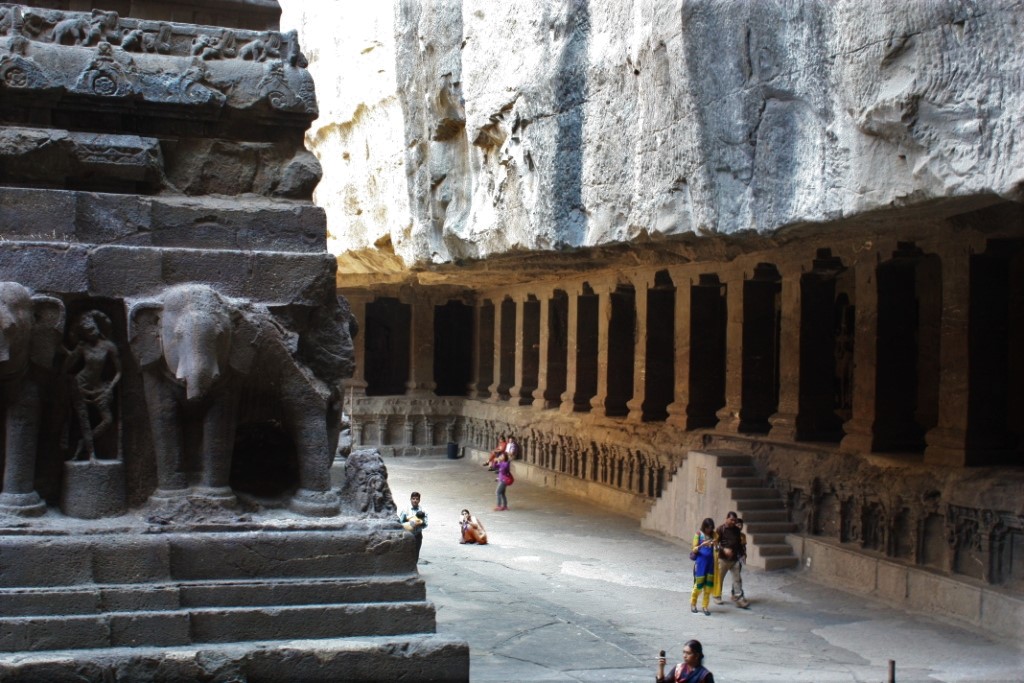
Kailasa of Ellora [Blank Verse]

They carved a temple in a mountainside,
Cutting away all rock that wasn't temple,
Chipping from the top down and outside-in,
Until some domed stone segregated sky
From inner sanctum and all its idols,
And it has stood over twelve hundred years,
And it will surely stand twelve hundred more,
But someday it'll be a mountain again.

“Tacit” [Poetry Style #12] by Sikong Tu [w/ Audio]

Without a word,
The gist is grasped.
With no wails or soft sobs,
Sadness spreads heart-to-heart.
There is an enigmatic Prime Mover
With whom each of us either sinks or floats.
Dregs of rustic wine in a fine strainer.
Buds on the cusp of bloom turned back by cold.
Dust motes spreading by Brownian motion.
Sea spume floating and tumbling onto shore.
Shallow, deep, cohering, or scattering.
Of ten thousand, any sample will do.

NOTE: The late Tang Dynasty poet, Sikong Tu (a.k.a. Ssŭ-k‘ung T‘u,) wrote an ars poetica entitled Twenty-Four Styles of Poetry. It presents twenty-four poems that are each in a different tone, reflecting varied concepts from Taoist philosophy and aesthetics. Above is a translation of the twelfth of the twenty-four poems. Translated titles vary: Herbert Giles entitled this one “Conservation,” whereas Tony Barnstone and Chou Ping called it “The Implicit Style.”