PROMPT: Lost All Possessions

What would you do if you lost all your possessions?

I’d like to think that I’d keep on keeping on, and I try to cultivate the mindset to do so, but –having never experienced it — I can’t honestly say.

PROMPT: Luxury

What’s the one luxury you can’t live without?

Luxuries, by definition, can be done without.

PROMPT: Belongings

Daily writing prompt
What personal belongings do you hold most dear?

I do have a jō (short wooden staff) of which I’m fond. I crave books, but since I could care less whether I read them as paper or on a screen and gladly give any but those with long-term reference value away after reading, I don’t think they count.

Being fonder of ideas than anything material, I like the story about Diogenes the Cynic who, upon seeing a boy drink from cupped hands, threw away his cup in self-anger for being such a hoarder.

“To Tirzah” by William Blake [w/ Audio]

Whate'er is Born of Mortal Birth
Must be consumed with the Earth
To rise from Generation free:
Then what have I to do with thee?

The Sexes sprung from Shame & Pride,
Blow'd in the morn; in evening died;
But Mercy chang'd Death to Sleep;
The Sexes rose to work & weep.

Thou, Mother of my Mortal part,
With cruelty didst mould my Heart,
And with false self-deceiving tears
Didst bind my Nostrils, Eyes, & Ears:

Didst close my Tongue in senseless clay,
And me to Mortal Life betray.
The Death of Jesus set me free:
Then what have I to do with thee?

BOOK: “The Perennial Philosophy Reloaded” by Dana Sawyer

The Perennial Philosophy Reloaded: A Guide for the Mystically-inclinedThe Perennial Philosophy Reloaded: A Guide for the Mystically-inclined by Dana Sawyer
My rating: 4 of 5 stars

Amazon.in Page

Release Date: July 9, 2024

The good news is that this book does a thorough, clear, and balanced job of discussing Perennial Philosophy along a number of dimensions including metaphysics, psychology, theology, and aesthetics. The bad news is that it can lead one to believe there IS NO Perennial Philosophy, just a hodge-podge of (often disparate) assumptions about the grand metaphysical questions of life, the universe, and everything, assumptions that are usually Eastern, mystical, or both and which appeal to the kind of person who likes to say, “I’m spiritual, but not religious,” but which are all over the place, intellectually speaking. We learn more about the varied metaphysical perspectives that can be lumped under rubric Perennial Philosophy, than we learn of any internally consistent set of beliefs which distinguish the Philosophy from others. Sawyer does acknowledge that there is not a unified worldview that is Perennial Philosophy and that, instead, one must think in terms of “family resemblance.” The problem is that Perennial Philosophy displays the kind of family resemblance seen in a foster home. One can believe in a god or not, believe in a soul / persistent self or not, one can hold any number of beliefs about time, causation, creation, and other aspects of metaphysics. Sawyer does solidly distinguish Perennial Philosophy from Materialism, but it’s not clear why we needed it, given we already had various permutations of Idealism.

The book does provide a lot of food-for-thought, if often frustratingly so. The most important thing it does is lay out the various questions at the fore of Perennial Philosophy, how they’ve been addressed by different thinkers, and the crux of discord.

I did find myself disturbed by the arguments on occasion. A prime example is when Sawyer writes about students who describe themselves as non-spiritual but who enjoy going hiking. Because Sawyer couches the experiences that are had on a good hike in spiritual terms, he believes the students are wrong to describe themselves as “non-spiritual.” However, it’s far from clear why they need to twist their interpretations into line with his worldview. I suspect that his “non-spiritual” students, like me, see in “spiritual” types a need to escape the surly bonds of nature, to have magic exist in their worlds, something above and beyond nature. I see “spiritual” people as having a craving like the proverbial true-believer / flood victim whose neighbors come by in a truck and a boat to rescue him (and then rescue services come by with a helicopter,) but he turns them all down because “God Will Save Me!” Then he dies and goes to heaven and berates God for letting him drown, to which God says, “I sent a truck, a boat, and a helicopter. What do you want from me?” Well, he wanted a divine golden light to levitate him not some mundane solution based in the natural world; he wanted magic, rapturous rescue.

If you are interested in the various debates between Materialism and Idealism, this book is well worth reading, and if you describe yourself as “Spiritual, but not religious,” you’ll probably really love it.

View all my reviews

PROMPT: Spree

Where would you go on a shopping spree?

A used bookstore is the only possible answer, but even then “spree” would generally be excessive for my volume of purchases – by common usage.

I’ve never been a recreational shopper. But, as “sprees” go, I’ve gone on more of the shopping kind than the murdering kind. Funny, those are the only kinds of sprees I’m aware of. I guess something has to die to make it a spree.

PROMPT: Shoes

Daily writing prompt
Tell us about your favorite pair of shoes, and where they’ve taken you.

Well, they were Timberland hiking boots, a pair that was comfortable and had served me well on a number of hikes in various parts of the world. Then, on the Goechala Pass Trek in Sikkim, I learned that they were only held together by some planned-obsolescent glue.
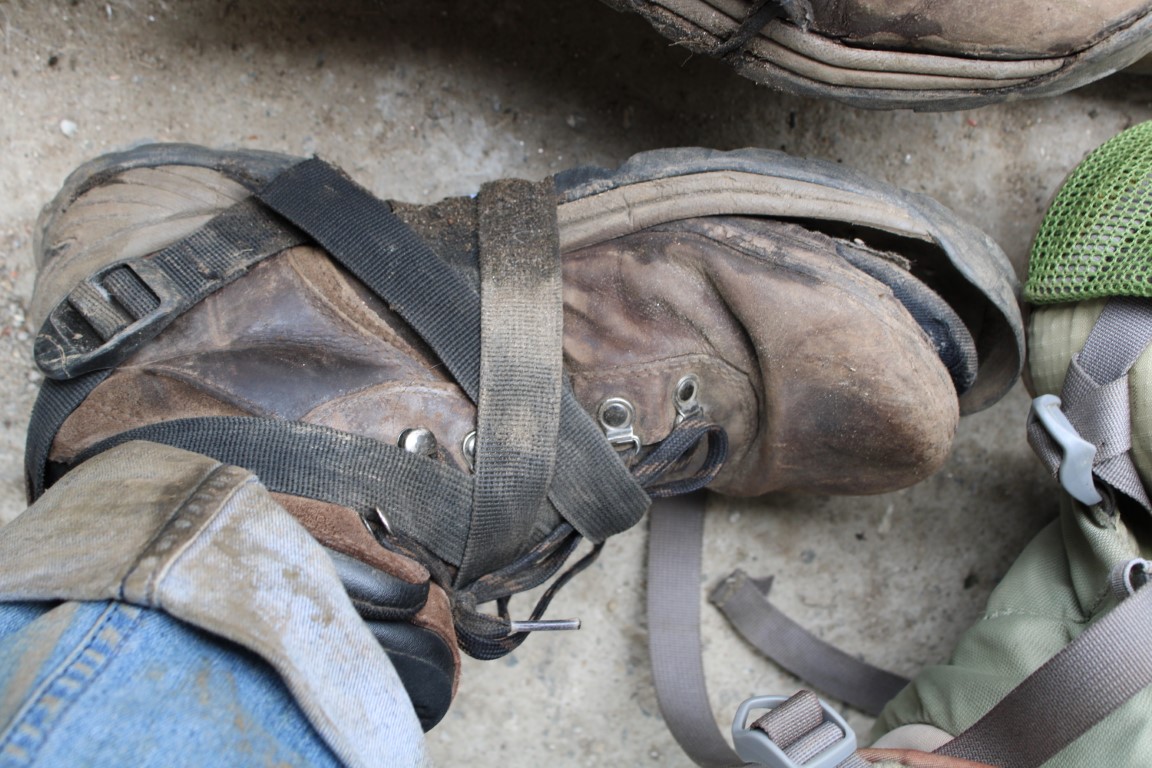
I had to hike six days with one of the soles strapped to my foot for one of the boots, and five days for the other. Yes, after so many miles of hiking in various environments, they fell apart within one day of each other. I guess the glue has a finite number of puddle steps in it, and I hit that number one day earlier with one boot than the other. That’s when I realized there’s nothing special about a shoe. It’s just a bunch of the lowest cost materials stuck together in the lowest cost assembly method and designed so you’ll have to buy a new pair every few months to years, depending upon the type of shoe, its use, and its price point. If there were a monopoly on shoe production, no pair would last more than a week. It’s only competition that allows for some halfway decent pairs to exist. I’m happy with any shoe that protects my feet, and — once it doesn’t — it’s dead to me.

BOOK REVIEW: The Transcendentalist by Ralph Waldo Emerson

The TranscendentalistThe Transcendentalist by Ralph Waldo Emerson
My rating: 5 of 5 stars

Amazon.in Page

Free Online: Emersoncentral.com

In this short essay (about ten pages,) Emerson lays out an argument for Idealism over Materialism, and then contends that it’s reasonable to excuse oneself from the economic and civic aspects of society in favor of a simple life of introspection. [e.g. As Thoreau did in his years at Walden Pond.]

Emerson opens by suggesting that Transcendentalism is just Idealism by a different name. Idealism being a philosophical stance which puts consciousness at the fore while proposing that there is something beyond [that transcends] our experience of sensory information. The arguments put forth in favor of Idealism include the fact that sensory illusions exist and the Kantian critique of Locke’s view that there’s no more to the intellect than that which is or was sensory experience; Kant argues that there’s intuition. Kant’s influence is considerable, and Emerson explains that even the term “Transcendentalism” is derived from Kant’s use of the term “transcendental.”

The latter part of the essay echoes Emerson’s masterwork, the essay “Self-Reliance.” It proposes that it’s perfectly laudable to take advantage of the greatest gift one has, one’s consciousness, to introspect and indulge one’s need to better understand.

I may have mixed views on Emerson’s ideas, but one can’t say he doesn’t use language and reason and passion to make compelling claims. I found this brief essay to be both thought-provoking and inspirational, and I’d highly recommend it.


View all my reviews

BOOK REVIEW: Expanding Consciousness by Mario Beauregard

Expanding Reality: The Emergence of Postmaterialist ScienceExpanding Reality: The Emergence of Postmaterialist Science by Mario Beauregard
My rating: 3 of 5 stars

Amazon.in Page

Beauregard aims to persuade readers that the materialist view of consciousness is irredeemably irreconcilable with observed reality. In this objective, he fails. (He’s not alone. There are too many unknowns for the rational skeptic to take a firm stance on the nature of consciousness.) What Beauregard succeeds in doing is cataloguing research findings that could be interpreted as suggesting there is more to consciousness than materialists can account for.

Cleverly, Beauregard begins with the most compelling evidence and concludes with the most audacious, controversial, and unvalidated findings. That most compelling evidence is the role of mental attitude and beliefs upon health outcomes. It’s firmly established that mind state has a huge impact on health and health outcomes. From the placebo effect to a health outcome premium to those who pray (and believe there is a god that takes requests,) thought matters. Unfortunately for Beauregard, it’s a huge leap to say this means there is some sort of spirit force that acts on the material world. If one begins from the realization that the human body (and those of other animals) is really good at self-repair within certain limits and given certain conditions (and that among those conditions is the ability to dampen the stress response and trip the rest & digest mode,) then one needn’t call on anything supernormal / supernatural to explain the influence of thoughts on healing.

I don’t have the time or inclination to systematically go through the strengths and weaknesses of all the arguments, but the one I mentioned stands as an example of what is good and bad about the book. On the positive side, I think Beauregard accurately reports on some interesting findings, but then he uses them to bootstrap the position that materialism can’t work ineffectively. I found myself thinking “that does not follow” a great deal. Either there wasn’t enough known to draw a conclusion, or – as in the case of healing – there are competing hypotheses that work as well but without the need to appeal to anything so complicated or unproven as a web of consciousness.

Beyond healing, the book goes through findings that suggest the possibilities of extrasensory perception, telekinesis, and an afterlife for consciousness (e.g. near death experiences [NDE.]) In some cases, this evidence is strong but quite limited (usually limited both in the degree of effect and in understanding of what causes said effect,) but in a few cases the evidence is anecdotal and / or completely unvalidated. The same variation exists when Beauregard takes on competing hypotheses. In a few cases, I found myself thinking his refutations had compelling elements or bases, but in other cases the refutations seemed to be – at best – big stretches. [I expected an extensive refutation of the finding that OBEs (out-of-body-experiences, a common feature in NDEs) have been found to be triggerable at will using physical processes (electrical stimulation) to material (brain tissue,) but did not get it. To my mind, this finding is a challenging – though not damning – counter to postmaterialist arguments.]

If you’re interested in a cataloging of findings that suggest the possibility that there is more to consciousness than materialists propose, this is a fine book to check out. However, don’t expect a persuasive holy grail of persuasion, but rather a mixed bag that ultimately shows no more than the fact that there is a massive amount that we don’t know about how consciousness works.


View all my reviews

BOOK REVIEW: Hipparchus by Plato

HipparchusHipparchus by Plato
My rating: 5 of 5 stars

On-line

In this Socratic dialogue about “lovers of gain,” Socrates and an unnamed friend debate whether pursuing gains can be wicked. Usually, the title of a dialogue is the name of Socrates’ philosophical sparring partner, but, herein, Hipparchus is a historical figure who Socrates cites as the reason he wouldn’t hornswoggle his friend, quoting “Walk with just intent” and “Deceive not a friend” as credos that he, Socrates, lives by.

The friend tries a number of approaches to argue the loathsomeness of lovers of gain. Recognizing the starting premise will be that a gain is a good, the friend argues that such people (presumably greedy / materialistic types) purse valueless gains. Socrates attacks that as an oxymoron. Next, the friend argues that lovers of gain seek gains that no honorable man would pursue. Again, Socrates argues that a gain is a good and all humans seek good. Since the friend doesn’t want to call the lovers of gain fools (i.e. unable to recognize a gain when they see it,) the friend is stuck. The third approach is to argue that a wicked gain could be considered a loss. This is also swiftly rebutted. The last tack is to argue that some gains are good, while some are evil, which runs afoul of the same argument.

This isn’t one of the best dialogues – in fact, many question whether it was written by Plato. That said, it brings up a few ideas that are worthy of consideration. It felt very much like a conversation I once heard in which a young woman argued, “No one should have that much more than they need.” Which drew the response, “You realize that 90% of the world would say you have tons more than you need?” Which resulted in the instigator walking off in a huff. If you want to engage in debates about the virtue (or vice) of wealth acquisition, this might be a good place to begin your reflection.

View all my reviews
