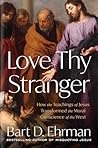
BOOK: “Love Thy Stranger” by Bart D. Ehrman

Love Thy Stranger: How the Teachings of Jesus Transformed the Moral Conscience of the WestLove Thy Stranger: How the Teachings of Jesus Transformed the Moral Conscience of the West by Bart D. Ehrman

My rating: 4 of 5 stars

Publisher Site – Simon & Schuster

Release Date: March 24, 2026

In this book, Ehrman argues that the development of Christianity started a sea change in the Western world’s approach to charity, altruism, and forgiveness. The idea is that both Greco-Roman philosophies and Judaism (Christianity’s religious precursor) were more tribal. Those systems clearly presented arguments for being charitable and kind, but in the context of those closest to you — your family and immediate neighbors — i.e. your ingroup. However, Ehrman proposes that those systems did not suggest any obligation to be charitable or kind to those who were strangers to one.

This is an intriguing book and provides many thought-provoking ideas and lessons from scripture, philosophy, and history. Ehrman definitely makes a case, but I don’t know that it is as strong as it might seem. In short, I think he did a great job of collecting stories and teachings that supported his point but showed less willingness to consider stories that might refute his thesis. I did appreciate how often Ehrman acknowledged contradictory views even when they conflicted with his own — often (appropriately) in footnotes. That said, I can’t recall seeing anything about the story of the Syrophoenician woman, a tale that seems to negate the book’s argument. In that story, a woman (of Syrophoenician origin) comes seeking Jesus’s help and is at first rebuked and turned away. Jesus says, “It is not fair to take the children’s food and throw it to the dogs.” Suggesting he neither sees her as the same species nor worthy of assistance. While it is true that Jesus does eventually assist her after she demeans herself (“Even dogs eat the children’s crumbs,) it’s still indication that he was far from advocating one behave lovingly toward all.

The book begins by dealing with broader questions, such as whether altruism actually exists (i.e. has existed) anywhere (i.e. are kind actions always self-serving?) and what the existing thinking was on the subject in Western philosophy and Abrahamic religion in Jesus’s day. I thought these first few chapters were quite beneficial for setting the stage before jumping into the building of the book’s central argument.

For those interested in what Jesus taught and what became of his teachings after his death, I’d recommend this book, or even for anyone interested in the changing shape of Western morality and ethics over time. I think the author conveys many interesting ideas in a readable and approachable way.

View all my reviews

“Song” by James Joyce [w/ Audio]

My love is in a light attire
Among the apple trees,
Where the gay winds do most desire
To run in companies.

There, where the gay winds stay to woo
The young leaves as they pass,
My love goes slowly, bending to
Her shadow on the grass.

And where the sky’s a pale blue cup
Over the laughing land,
My love goes lightly, holding up
Her dress with dainty hand.

“A Decade” by Amy Lowell [w/ Audio]

When you came, you were like red wine and honey,
And the taste of you burnt my mouth with its sweetness.
Now you are like morning bread,
Smooth and pleasant.
I hardly taste you at all for I know your savour,
But I am completely nourished.

“To the River” by Edgar Allan Poe [w/ Audio]

Fair river! in thy bright, clear flow
Of crystal, wandering water,
Thou art an emblem of the glow
Of beauty—the unhidden heart—
The playful maziness of art
In old Alberto’s daughter;

But when within thy wave she looks—
Which glistens then, and trembles—
Why, then, the prettiest of brooks
Her worshipper resembles;
For in my heart, as in thy stream,
Her image deeply lies—
His heart which trembles at the beam
Of her soul-searching eyes.

PROMPT: Romantic

Daily writing prompt
What’s your definition of romantic?

With a big-R, it’s a philosophical and artistic movement that served as a counterweight to the Enlightenment by advocating for Idealism (versus Materialism) and spirituality (if not necessarily religiosity.)

With a small-R, it’s the skill or proclivity to advance conditions for amorousness.

That’s why capitalization matters.

“To a Husband” by Amy Lowell

Brighter than fireflies upon the Uji River
Are your words in the dark, Beloved.

“Down By the Salley Gardens” by William Butler Yeats [w/ Audio]

Down by the salley gardens
my love and I did meet;
She passed the salley gardens
with little snow-white feet.
She bid me take love easy,
as the leaves grow on the tree;
But I, being young and foolish,
with her would not agree.

In a field by the river
my love and I did stand,
And on my leaning shoulder
she laid her snow-white hand.
She bid me take life easy,
as the grass grows on the weirs;
But I was young and foolish,
and now am full of tears.

PROMPT: All

Daily writing prompt
What does “having it all” mean to you? Is it attainable?

Health, food, air, water, love, and thought… that about covers it.

Sure, why not?

“I heard thee laugh” by Stephen Crane [w/ Audio]

I heard thee laugh,
And in this merriment
I defined the measure of my pain;
I knew that I was alone,
Alone with love,
Poor shivering love,
And he, little sprite,
Came to watch with me,
And at midnight
We were like two creatures by a dead camp-fire.

“I shall go back again to the bleak shore” by Edna St. Vincent Millay [w/ Audio]

I shall go back again to the bleak shore
And build a little shanty on the sand,
In such a way that the extremest band
Of brittle seaweed will escape my door
But by a yard or two; and nevermore
Shall I return to take you by the hand;
I shall be gone to what I understand,
And happier than I ever was before.
The love that stood a moment in your eyes,
The words that lay a moment on your tongue,
Are one with all that in a moment dies,
A little under-said and over-sung.
But I shall find the sullen rocks and skies
Unchanged from what they were when I was young.