PROMPT: Pet

Daily writing prompt
What is good about having a pet?

It’s a friend who may not understand what you’re going through, but who will never talk… and sometimes eagerly helps with the digging when you’re burying the body. Try finding a human friend like that.

BOOKS; “Rental Person Who Does Nothing” by Shoji Morimoto

Rental Person Who Does NothingRental Person Who Does Nothing by Shoji Morimoto
My rating: 5 of 5 stars

Publisher Site — Harper Collins

This quirky little book is the memoir of a man who formed a business lending himself out as “rental person who does nothing.” At the time the book came out, Morimoto did this without charging his “customers” anything except travel expenses and any food and beverages consumed as part of the activity in question. [As I understand it, he eventually began charging a per session fee ($85 USD at the time of the 2022 BBC piece on him that I watched.)] The book does discuss Morimoto’s thoughts about how to charge (i.e. hourly or per session,) how much to charge, whether to find a different financing model (e.g. sponsorship or patronage,) and why he ultimately rejected them all (at least for a time.) In fact, the whole penultimate chapter (ch. 4) is about the economics of his business.

The most interesting aspect of the book is the psychological insight on offer. The first question that arises is why people would use a stranger for these activities, and not a friend. One might jump to the conclusion that the people who use his service have no friends, but this is generally wrong. There are a number of reasons why people who have friends use his service. First, many times friends can’t just sit and listen empathetically, but rather they have to try to solve the problem. This can be irritating because it is often dismissive of the challenges confronting the other person. But also, as Morimoto points out, it also creates a hierarchy (a top dog) in what would otherwise be a co-equal relationship. A fascinating second factor pointed out by the author is that adults, unlike children, rarely have general-purpose friends. Adults, instead, have contextual friends. So, if one wants to engage in an activity that is outside the domain of one’s contextual (work, bar, hobby, etc.) friendship, it might not be easy. There are many other psychological insights relating to what people ask him to do, the issue of reciprocity, and what Morimoto defines as “doing nothing” for the purposes of this business.

I found this quick and simple book to be packed with insights into human nature, and I’d highly recommend it for readers interested in what makes people tick.

View all my reviews

PROMPT: Personality Trait

Daily writing prompt
What personality trait in people raises a red flag with you?

Dogmatic thinking and the humor blindspots that correspond.

“Changed” by Henry Wadsworth Longfellow [w/ Audio]

From the outskirts of the town
Where of old the mile-stone stood,
Now a stranger, looking down
I behold the shadowy crown
Of the dark and haunted wood.

Is it changed, or am I changed?
Ah! the oaks are fresh and green,
But the friends with whom I ranged
Through their thickets are estranged
By the years that intervene.

Bright as ever flows the sea,
Bright as ever shines the sun,
But alas! they seem to me
Not the sun that used to be,
Not the tides that used to run.

PROMPT: Friend

What quality do you value most in a friend?

The ability to converse intelligently on a wide range of subjects.
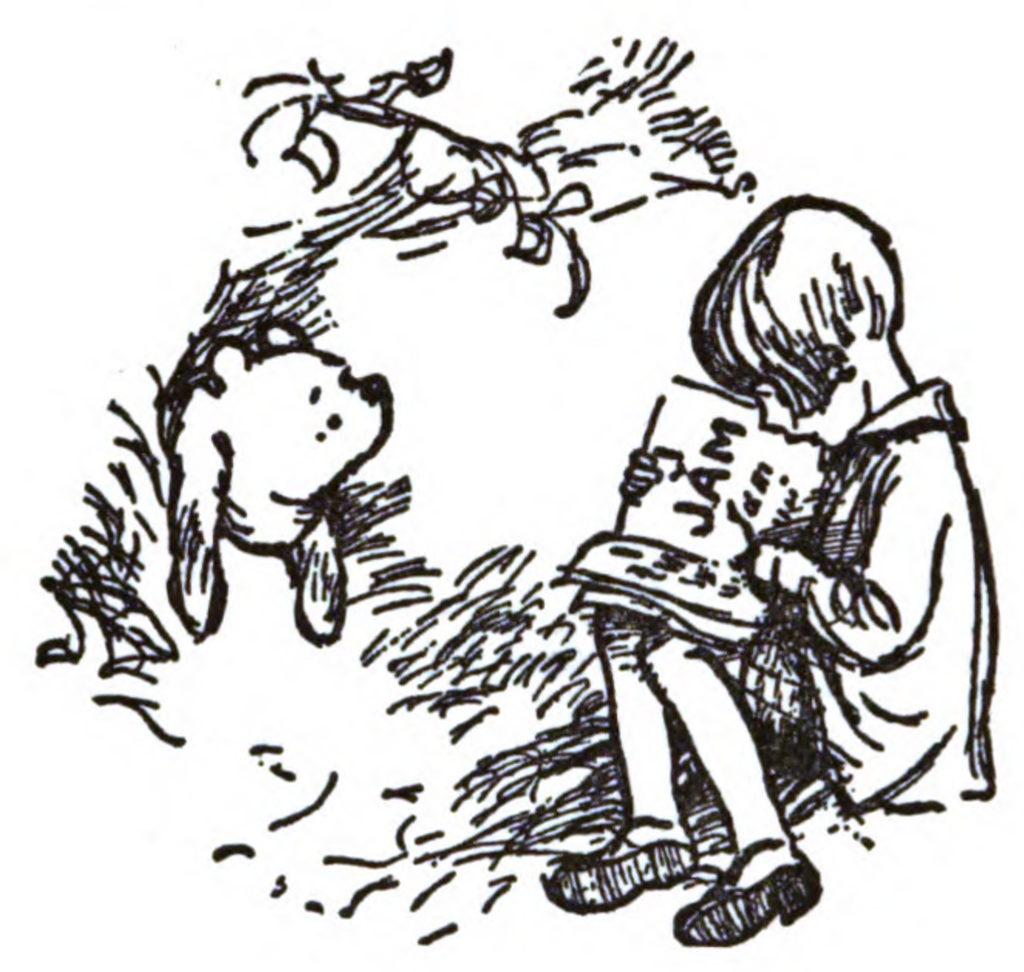
“The Friend” by A.A. Milne [w/ Audio]

By E.H. Shepard; Public Domain; Source: Wikimedia Commons
There are lots and lots of people who are always asking things,
Like Dates and Pounds-and-ounces and the names of funny Kings,
And the answer's either Sixpence or A Hundred Inches Long,
And I know they'll think me silly if I get the answer wrong.

So Pooh and I go whispering, and Pooh looks very bright,
And says, "Well, I say sixpence, but I don't suppose I'm right,"
And then it doesn't matter what the answer ought to be,
'Cos if he's right, I'm Right, and if he's wrong, it isn't Me.

BOOK REVIEW: Lysis by Plato

LysisLysis by Plato
My rating: 5 of 5 stars

Amazon.in Page

This early Socratic dialogue addresses friendship and love — philia to the Greeks. In it, Socrates questions Lysis and Menexenus (two young friends) on the basis of friendship, whether it can be unrequited, and whether like or different individuals are better matched. The interrogation of Lysis illuminates Socrates view of the basis of friendship, wisdom. He questions Lysis about those things the boy’s parents won’t allow him to do, and those things for which they’d seek him out, ultimately suggesting that one’s wisdom is what attracts others to one, as friend or otherwise.

Later, Socrates questions Menexenus about whether the good befriend the good or are better suited to befriend the neutral individual. [The presumption that the bad are friends to no one takes them out all equations.] Socrates, with Menexenus’ consent, briefly concludes that friendships develop best between good and neutral individuals, but the dialogue ends with Socrates being skeptical of his own conclusion – perhaps feeling the weight of problems that a listener might contemplate (e.g. the idea that there are good, bad, and neutral people – rather than all of us being a melting pot of good, bad, and ugly.)

It’s not dissatisfying that the dialogue ends without an answer. Its value lies in triggering readers to contemplate the question. For my part, I considered the poor analogy between how people view relationships between doctor and patient, versus between friend and friend. The doctor isn’t put off by a patient seeking a practical benefit from them (improved health,) but many a friendship has died from one side seeking personal gains. [And yet, I still draw no conclusion because clearly there is some benefit each half of a friendship perceives, if not one as coldly rational a Socrates describes.)

This dialogue is worth a read to trigger contemplation of friendship.

View all my reviews