BOOKS: “Chinese Folktales for Language Learners” by Vivian Ling and Peng Wang

Chinese Folktales for Language Learners: Famous Folk Stories in Chinese and English (Free online Audio Recordings)Chinese Folktales for Language Learners: Famous Folk Stories in Chinese and English by Vivian Ling
My rating: 5 of 5 stars

Publisher Website

As the title suggests, this is a collection of fifteen Chinese folktales presented bilingually in a manner optimized to language learners. To clarify the “optimized for language learners” comment, these stories are paced differently than they would be if the central objective was to entertain. That old writerly chestnut of “show don’t tell” is often violated and the stories are kept short and sweet in a way that can feel like they sprint through critical moments. This is not criticism. I think it is the best way to give individuals learning Mandarin (or presumably Mandarin speakers learning English) a user-friendly book that doesn’t feature dense blocks of text and overly complicated language. (Note: it’s also not bad for those who just want the quick and dirty version of these tales.)

Each of the stories includes a section with some background information on the history and cultural elements behind the stories (stories which display a range of realism and are from distant times,) a list of terms and phrases in English and Chinese, and a brief set of questions to help the reader develop deeper insight into the stories. These ancillary features are all quite useful to the student of language.

As stories, some of these folktales are more compelling than others. A number of them are dry, but what they lack in intrigue they make up for in insight into the history and culture of China. And some of the stories, e.g. “Judge Bao Takes on the Emperor’s Son-in-Law,” are fascinating.

I’d highly recommend this book for those who are trying to learn Mandarin, but it would also serve those who wish to learn some Chinese folklore in a condensed and readable format.

View all my reviews

Understory Lore [Tanka]

in a thriving wood,
 sits a barren patch of 
  understory.
 oh what tales locals tell
  about the patch that can't grow!

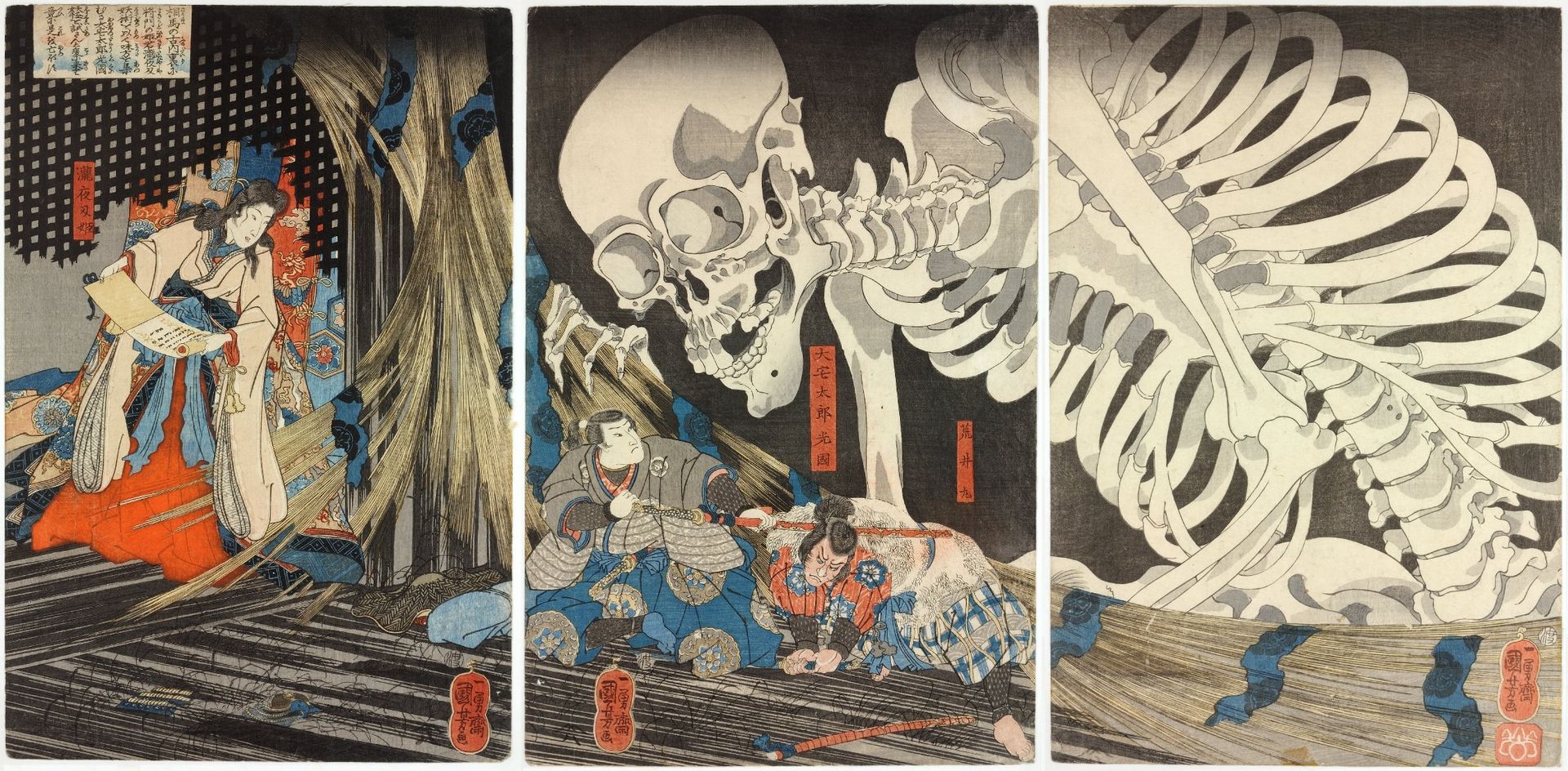
Witch & Skeleton [Free Verse / Senryū]

Takiyasha the Witch and the Skeleton Spectre; Utagawa Kuniyoshi (1844)
PREMISE:
Princess Takiyasha
 summoned a skeleton to
  kill a samurai.

MORAL?:
"Don't bring swords
 to a giant skeleton-ghost 
  fight!"

CONCLUSION:
Yet, in settled dust,
 the world was less one
  Princess-witch.

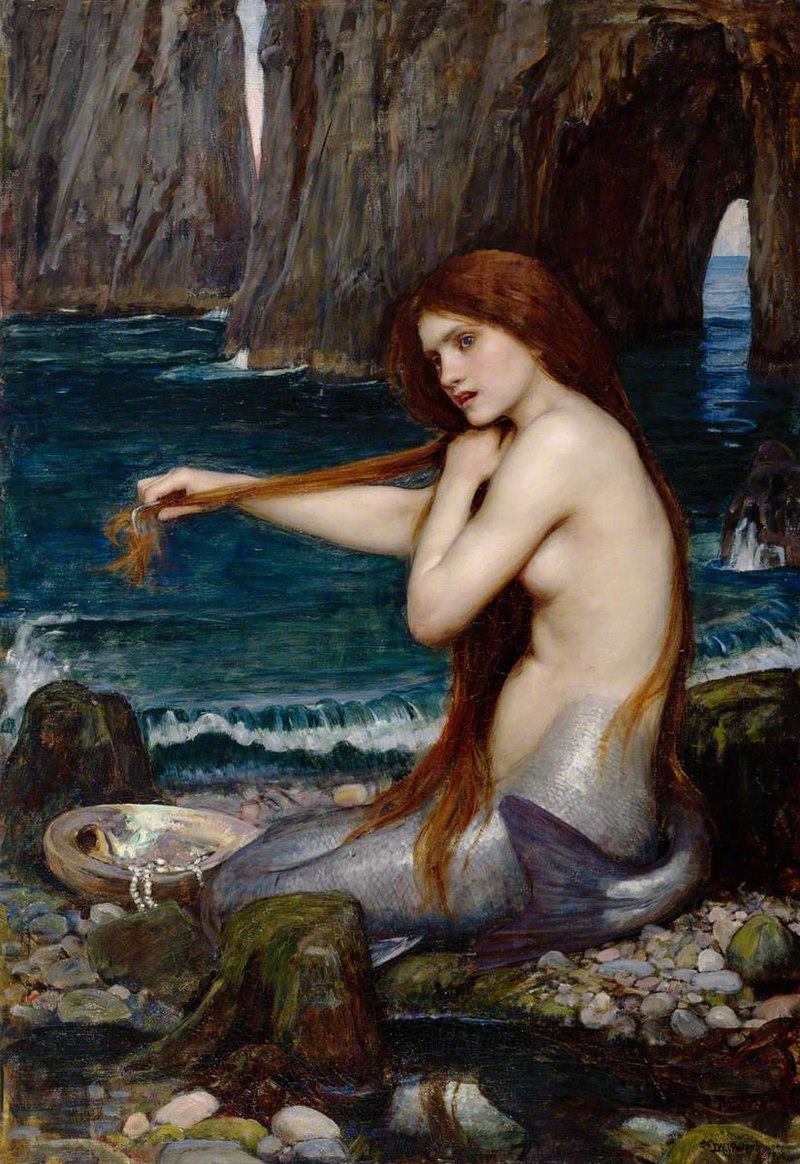
Mermaid [Lyric Poem]

Waterhouse, John William; A Mermaid; Royal Academy of Arts
So many miles of coastline,
   of rocky coves and outcrops.
 Where none can see a straight line,
   and water sloshes and slops.

Oh, might one miss a mermaid
    hidden among the inlets,
 so snug in stone palisade -
    a lair of shells and torn nets?

If you say that you've seen one,
    I'll not call you a faker.
 I rather think it's great fun
    to flirt with claims, wiseacre.

BOOK REVIEW: The Golem of Venice Beach Vol. 1 by Chanan Beizer

The Golem of Venice BeachThe Golem of Venice Beach by Chanan Beizer
My rating: 4 of 5 stars

Amazon.in Page

Release Date: November 15, 2022

The title is the premise. The Golem of Prague is now living in Venice Beach, CA. However, the protagonist is a human hipster with a sunglass kiosk near the beach named Jake. Jake is a secular Jew with a penchant for all manner of drugs who falls in love with a neighbor who is some sort of chosen one for a Santa Muerte cult that’s protected by some drug-dealing gangbangers. The connection to the Golem is that Jake’s bloodline is protected by the Golem.

This is one of those titles that’s hard to rate. The art is well done. The character development is great. And it’s a compelling premise. (Though I think we may be experiencing a Golem zeitgeist as this is the second or third Golem story I’ve read recently. But, it could also be an anecdotal coincidence.) That all sound pretty good, but I have no idea whether the story is any good because it’s one of those one-story-arc-split-over-two volumes, and so the resolution-to-cliffhanger ratio is not good. [i.e. It ends all cliffhanger and with nothing having been resolved.] To be fair, the last line does promise to conclude the story in the second (next) volume. (i.e. As opposed to: “We’ll see if it’s popular and then string it out until there’s no hope of tying up all the loose ends.”) So, I guess it comes down to whether you’re a trusting soul. I don’t think I’ve read this author previously, and thus have no basis for drawing a conclusion.

So, my recommendation is…


View all my reviews

BOOK REVIEW: He Who Fights With Monsters by Francesco Artibani

He Who Fights With MonstersHe Who Fights With Monsters by Francesco Artibani
My rating: 4 of 5 stars

Amazon.in Page

Release date: August, 30, 2022

This graphic novel tells a story featuring the Prague Golem, a mighty protector figure from Judaic folklore – formed of clay and breathed to life by magic words. The setting is Nazi-occupied Prague, and the golem is brought to life after a great period of dormancy, having been stored in the rafters of a synagogue, in order to once more act as protector to the Jewish people.

It’s a gripping tale of wartime resistance, but with a flat ending. However, I’m not sure it could have concluded in a satisfying way. That’s the challenge of writing a story of a superhero versus Nazis. The Holocaust is such a colossal tragedy that to rewrite the it resets the book into some alternate reality fantasyland, striking a raw nerve and killing any poignancy in the process.

The artwork is skillfully rendered and captures the grim nature of a city under fascist occupation quite well.

I enjoyed the story, despite not really knowing how to process the ending. Maybe that’s the point, that one can’t turn such mindless brutality into a storybook satisfying ending [by satisfying I don’t mean happy, but rather concluded in the definitive and intrinsically reasonable – if horrifying – way of tragedies.] Still, one is left wondering about apparent changes in character motivation and whether they make any sense — because they don’t feel like they do.

If you’re intrigued by a historical fiction / fantasy mashup set in Prague during the Second World War, check this book out, but expect to be left in an uneasy space at the end.


View all my reviews

BOOK REVIEW: Supernatural Shakespeare by J. Snodgrass

Supernatural Shakespeare: Magic and Ritual in Merry Old EnglandSupernatural Shakespeare: Magic and Ritual in Merry Old England by J. Snodgrass
My rating: 4 of 5 stars

Amazon.in Page

Like – I suspect – most of humanity, I’m a big fan of Shakespeare’s work, but I’m also not alone in feeling that I’ve missed a some of the depth and texture of his plays. Both language and the body of common / popular knowledge have evolved and migrated tremendously since the Elizabethan era. This makes a market for books that offer insight into the age and the role that the beliefs, norms, and daily life played in Shakespeare’s theatrical works. This book is one such work. It focuses on the role supernatural beings and various festivals play in the Shakespearean canon and why they do so.

Conceptions of the supernatural may be one of the areas in which human beliefs have changed most severely since Shakespeare’s day. The book has chapters on witches, ghosts, fairies, and enchanted forests that are interspersed among chapters that deal with various seasonal festivals of Pagan origin. I did find this leapfrogging around a bit odd, but I would speculate two possible reasons for it. First, the author may have wanted to build cyclicality into the overall organization, and thus put beings and creatures that seemed thematically related to a season near its festivals. Second, it may have seemed like a good idea to break up the festivals because that discussion could have felt tedious to a general reader if it’d been clumped together (as opposed to the “sexier” topics of witches and ghosts and the like.) This organization didn’t bother me; it just seemed a bit strange, but I could imagine it being for the best.

I learned a great deal from this book, and my newly gained knowledge wasn’t all about the supernatural elements of Shakespeare. The author dropped some fascinating facts regarding other domains as well – such as Elizabethan sexuality and lifestyles as well as biographical facts about Shakespeare. If you’re looking to expand your understanding of background information relevant to Shakespeare’s plays, this book is worth looking into.

View all my reviews

BOOK REVIEW: The Mythology Class by Arnold Arre

The Mythology Class: Where Philippine Legends Become Reality (a Graphic Novel)The Mythology Class: Where Philippine Legends Become Reality by Arnold Arre
My rating: 5 of 5 stars

Amazon.in Page

Out: August 9, 2022

Let’s call this “Breakfast Club” meets “Ghostbusters” but instead of busting ghosts this group of student-misfits is tasked with getting Filipino mythical creatures back to their home domains while saving their own city from the most villainous of the beasts. There’s a lot happening in this graphic novel — action and adventure tied to the daunting task of containing these creatures, some magical and some monstrous, but there’s also a couple love stories that play out, as well.

I enjoyed reading this graphic novel, finding it fast-paced and imaginative. The characters, both human and mythological, are distinct and face meaningful problems. It’s a story that is both lighthearted and humorous, but with the requisite tension and conflict for such a story. If you’re into mythological superhero stories, check this one out.

View all my reviews

BOOK REVIEW: Native American Literature: A Very Short Introduction by Sean Teuton

Native American Literature: A Very Short IntroductionNative American Literature: A Very Short Introduction by Sean Teuton
My rating: 5 of 5 stars

Amazon.in Page

This VSI (Very Short Introduction) stimulates curiosity from its very title. One might be interested in, but not necessarily intrigued by, titles such as: “Native American Folklore,” or “Native American Mythology.” However, when one thinks of the world of Native American story and language-centric art, one is likely to first think of oral storytelling, and then, secondarily, about the immensely popular genre / commercial fiction of someone like Stephen Graham Jones. Even if one is aware of some of the Native American literary works that got widespread attention and praise, works such as Momaday’s “House Made of Dawn” or the poetry of Joy Harajo, one may wonder whether there’s the basis for such a broad overview style book.

That’s just the notion that this book seeks to challenge. That said, until the final two chapters, it doesn’t always feel like the topic is as advertised. That is to say, with the exception of chapter two — which discusses the oral storytelling of various Native American tribes, much of chapters one through five is historical and cultural background designed to provide context for the creation of a Native American literary canon, but without talking about the canon’s components much. Some of the questions addressed include: how Native tribes came to written language, in general, and then to the English language, specifically; how self-image of tribal peoples shifted over time (and how that impacted the nature of written works;) the nature of various strains of Native literature (e.g. literature of resistance v. literature of assimilation, and so on.)

I learned a lot from this brief guide. I’m not going to lie, it does have some sections that are dry and quite scholarly, but it also raises some interesting ideas while introducing the reader to books that will be wholly unfamiliar to some and largely unfamiliar to most.

If you’re interested in how Native American literature came to be, I’d recommend one check it out.


View all my reviews

BOOK REVIEW: Jagannatha of Puri by Gayatri M. Dutt

Jagannatha of puriJagannatha of puri by Gayatri Madan Dutt
My rating: 4 of 5 stars

Amazon.in Page

I recently visited Puri, and – seeing the little, big-eyed Jagannath idols and images all across Odisha – I was curious to learn about the mythology behind the Puri temple and its tripartite deity. This 30+ page comic may not be the most scholarly or detailed account, but it may be the quickest way to get the gist of the story. And the comic does present an intriguing morality tale that includes lessons of patience and unselfishness.

The story begins with a king who is obsessed with finding a fabled cave-shrine that he was directed to in a dream. The king sends his best men out in search of the cave as its whereabouts are unknown. In time, one of the men stumbles upon a village whose chieftain is said to regularly make secretive visits to the cave and its idol. And from there, the race is on to get the king to the cave. But the deity is elusive, and insists that its followers work together harmoniously.

It’s a clear and well-developed story. It blends intriguing trippy elements like time-travel and messages in dreams with traditional religious mythology.

If you’re looking for a brief explanation of the Puri temple and the Jagannaths, it’s worth giving this short comic a look.


View all my reviews