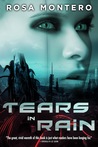
BOOK REVIEW: Tears in Rain by Rosa Montero

Tears in RainTears in Rain by Rosa Montero

My rating: 3 of 5 stars

Amazon page

The title of this book, Tears in Rain will be instantly recognizable to sci-fi fans as a reference to the Roy Batty (played by Rutger Hauer) monologue at the end of the movie Blade Runner. For those who aren’t familiar, Roy Batty is an android who is about to die as the result of a preset lifespan established in his programming, and he’s reflecting on all those unique experiences that he’s had that will be forever lost with his demise—as tears in rain.

When I picked up this book, I thought it would exist in the Blade Runner universe. It does not. However, it exists in a universe that shares several common features with the world of Blade Runner, and—in fact—it gives a nod to the film as a prescient historic work of fiction. What Montero’s novel has in common with the Ridley Scott film is a world in which there are both humans and androids that have surpassed the uncanny valley—i.e. they are generally indistinguishable from humans (if they want to be.) Furthermore, these androids (also called replicants) have a short and predictable lifespan–though it’s presented as a mysterious flaw rather than intentional programming. Further, there is a degree of tension between humans and replicants (reps.) The book also shares the movie’s film noir feel. The book’s lead character, Bruna Husky is a private dick–if you will—and a replicatant, and she is investigating a series of murders by replicants gone haywire.

The focal point of the book is something not extensively addressed in Blade Runner or that film’s point of origin, the Philip K. Dick novel Do Androids Dream of Electric Sheep, and that is the need to build memories into these androids so that they can function like humans. Reps discover at some point that all their childhood memories—good and bad—are fake, and this is a point of consternation for Husky. It is the corruption of the memories that leads the replicants to kill. That fact is established almost from the novel’s beginning. What isn’t clear is who is doing it and why, and book follows Husky through her investigation of these questions.

For the most part, I found the book to be readable. It’s a translation from the original, which was written in Spanish. It didn’t have that rare page-turning aura that made me have to find out what would happen next, but it was a good, solid science fiction work. The characters are—as one might expect from my “film noir” comment—overwhelmingly gruff and terse and / or broken people. Not that the unlikable nature of the characters is responsible for the lack of intensity of interest in what will happen to them. I recently read an article about unlikable characters, and it pointed out (correctly in my view) that Nick and Amy Dunne of Gillian Flynn’s Gone Girl are among the most detestable characters of recent literature, and yet that is a book one can’t put down. It’s difficult but not impossible to build intense interest with such characters.

Interspersed throughout the book are a few multi-page information dumps in the form of reports to an archivist who is a secondary character in the book–and who probably only exists to justify these info dumps. While the dumps aren’t excessive, neither do I think they are necessary. I don’t think there was much information in them that was necessary to the storyline, and what was could have been communicated more smoothly.

Part of Montero’s problem is that by tying her work’s title and important background details to Blade Runner, it becomes almost impossible to not compare her novel to either Blade Runner or Do Androids Dream of Electric Sheep. I might have given this work another star if I wasn’t thinking about how it was less visceral than the movie and less clever than Dick’s book. (Without the info dumps or the comparison it would have been a 4-star for me.)

This is a worthwhile read for sci-fi fans.

View all my reviews

BOOK REVIEW: The Voice of the Silence by Helena Petrovna Blavatsky

The Voice of the Silence: Being Extracts from The Book of the Golden PreceptsThe Voice of the Silence: Being Extracts from The Book of the Golden Precepts by Helena Petrovna Blavatsky

My rating: 3 of 5 stars

Amazon page

According to Helena Blavatsky, the three “fragments” that make up The Voice of the Silence are her translations of three tracts from The Book of Golden Precepts, of which there are 90 and she had memorized 39. The Book of Golden Precepts is said to include both Buddhist and pre-Buddhists views on spirituality.

Blavatsky was one of the founding members of the Theosophical Society, an organization that proposed and advanced a certain brand of mysticism. Mystic traditions are those which believe that one must look inward to find the divine, i.e. to know god. The Theosophical approach isn’t without controversy. Blavatsky’s allusion to a secret path to wisdom and the suggestion that most of the world isn’t ready for the high level teachings sits in contradiction to a Siddhartha Buddha who was transparent. Buddhists have been known to claim that in as much as an idea is a teaching of the Buddha, it wasn’t secret, and in as much as a teaching was secret, it wasn’t the work of the Buddha. But there is disagreement. Some believe that what Blavatsky is presenting is high level Mahayana Buddhism, but others think that it’s a hodge-podge of Kabbala, esoteric Buddhism, and yogic teachings.

The first “fragment” is also titled “The Voice of the Silence.” This section suggests that there are three stages to one’s journey: ignorance, learning, and wisdom. It states that one must take care to not to be distracted from the path by sensual inclinations or by desire. The path described mirrors the advanced stages of Patanjali’s eight-limbs. In other words, she discusses a progression from pratyahara (not explicitly named, but described as the withdrawal of sensory input), dharana (concentration), dhyana (meditation), and Samadhi (liberation.)

The second part is entitled “The Two Paths.” Liberation and renunciation are the two paths in question. The central topic of this chapter is Karma, and the questions of action versus inaction that are also discussed in the Bhagavad-Gita.

The third part is “The Seven Portals.” These seven doors through which one must pass on the way to wisdom are essentially the same as the six paramita of Buddhism with an additional one, Virag, inserted between the third and fourth spot. The portals are Dana (generosity), Shila (a.k.a. Sila, or virtue), Kshanti (patience / perseverance), Virag (illusion conquered), Virya (energy), Dhyana (contemplation), and Prajna (wisdom).

A nice feature is a “glossary” at the end of each of the fragment that explains some of the terminology and concepts. While this is called a glossary, it’s not one in the usual sense, i.e. it’s not in alphabetical order and is not exclusively definitions. It would better be described as chapter notes. The idea is to convey the information that a lay reader may need, but which the author / translator doesn’t want to muddle the text with.

I think this book is worth a read. It’s short, and for a work written in the 19th century it’s quite readable—that doesn’t mean that the message is always clearly conveyed—whether on purpose or accident.

Note: While I read this on Kindle for a nominal price, it’s available on the web free of charge (see here.)

View all my reviews

2014 Reads: The Most Captivating and Profound Books I Read in the Past Year

Zen in Motion: Lessons from a Master Archer on Breath, Posture, and the Path of IntuitionShantaramYogic Management Of Common DiseasesThe Strain Volume 1The Elephant Whisperer

Your Brain on YogaKalari MargamThe Heart of Yoga: Developing a Personal PracticeThe Hindu-Yogi Science Of Breath

VALISThe Essential Guide to Being Hungarian: 50 Facts and Facets of NationhoodThe AlchemistThe Golden Sayings of EpictetusMake Room! Make Room!
Sorry I Ruined Your OrgyThe Coroner's LunchNorwegian WoodThe Bhagavad Gita

I read 80-some books in 2014. A few stood out above the rest. I’d put the best of the litter in two categories: the captivating and the profound. This is a more appropriate division than fiction and nonfiction. The captivating books were the ones that I couldn’t put down because they were intriguing and intense. The profound books were the ones containing ideas that changed my approach to life. Very few–if any–of these books came out in 2014, so if you’re looking for the best books of the year you might want to look here or here.

The Captivating

1.) The Elephant Whisperer   [A wildlife preserve owner takes in an elephant herd, and learns about how the mighty animals think, feel, and communicate.]

2.) The Beach  [A traveler in search of a fabled perfect beach finds it, and ultimately wishes he hadn’t.]

3.) Shantaram [An ex-con on the lam hides in Bombay and experiences life as an ex-pat, a slumdog, a prisoner, a medic to Mujaheddin, and a gangster.]

4.) Gone Girl  [A wife goes missing, and the husband becomes the prime suspect–but nothing is as it first appears.]

5.) The Fault in Our Stars  [An ill-fated romance blossoms between two teenage cancer patients.]

6.) Norwegian Wood  [A young man’s life is shaped by his love for the girlfriend of a suicidal former best friend, and other relationships with unusual women.]

7.) History of the World in 6 Glasses  [The title says it all. How beer, wine, spirits, coffee, tea, and coca-cola shaped the world.]

8.) Dawn [A woman awakes in the custody of aliens to find that an unwanted leadership role is being thrust upon her as the Earth is to be repopulated.]

9.) Veronika Decides to Die  [A suicidal young woman is told that she has only days to live, and finds a new lease on life.]

10.) The Novice  [An old story about a young monk who stays virtuous in the face of multiple betrayals, as told by the famous Vietnamese Zen Buddhist monk, Thich Nhat Hanh.]


The Profound

1.) The Rise of Superman   [How extreme athletes are using a mental state called the Flow to achieve phenomenal feats.]

2.) Warrior Pose  [How yoga saved the life of a cancer-riddled war correspondent with a broken spine and an addiction to painkillers.]

3.) The Way of Chuang Tzu [Thomas Merton Edition- A series of Taoist stories as told by the prolific Trappist monk.]

4.) The Tao of Jeet Kune Do  [Bruce Lee’s guide to the tactics and techniques of his martial art, Jeet Kune Do.]

5.) The Introvert Advantage  [An explanation of the widely misunderstood state of introversion, and how introverts can optimize their lives in the face of their introverted nature.]

6.) The Art of Peace  [The philosophy of Morihei Ueshiba, the founder of the martial art of Aikido.]

7.) The Wild Life of Our Bodies   [We our not alone. The human body is an ecosystem, and killing off the other species that reside within us can have dire results. And a dire warning to clean freaks.]

8.) Mind Over Medicine  [A medical doctor reviews the literature 0n the body’s tremendous capacity to heal itself under the right conditions, and a discussion of how those conditions might be achieved.]

9.) The Heart of Yoga  [A guide to building a personal yoga practice by T.K.V. Desikachar, son and student of the legendary guru T. Krishnamacharya.]

10.) The Science of Yoga  [What modern science has to say about the benefits and risks of yoga.]


Bernie Gourley’s favorite books »


Share book reviews and ratings with Bernie, and even join a book club on Goodreads.

BOOK REVIEW: Zen in Motion by Neil Claremon

Zen in Motion: Lessons from a Master Archer on Breath, Posture, and the Path of IntuitionZen in Motion: Lessons from a Master Archer on Breath, Posture, and the Path of Intuition by Neil Claremon

My rating: 4 of 5 stars

Amazon page

When one thinks of Zen, one thinks of stillness. Sensory and motor deprivation is what scientists call it. But stillness is a favored term among Zen Buddhists. Being someone who is fascinated by movement and activities at the body-mind intersect, this title immediately snagged my attention despite the narrow print on this thin book’s spine. The value of a Zen state of mind in the practice of movement arts is clear and well-established. Zen in Motion recounts the lessons of the author as a student of the Japanese style of mounted archery (kyūdō.) Claremon studied with a Japanese Kyūdō master residing in New Mexico.

It will be clear to many why mounted archers might take allegiance in Zen. Charging down a trail on a horse towards a small, round target, there’s no time for conscious thought in calculating pull and release. Furthermore, there’s stillness in motion (sounds like a koan) that must be maximized because the slightest imperfection in movement can send an arrow astray.

It should be noted that this is neither the first nor the only book written on the nexus of Zen and Kyūdō. (Though it’s the first one I’ve read in full.) Probably the most famous book on the subject is Eugen Herrigel’s Zen in the Art of Archery, but there’s also a more recent book by John Stevens, entitled Zen Bow, Zen Arrow that tells the story of Awa Kenzō (who was Herrigel’s teacher.) The logical question is what is the value-added of Claredon’s book. If we have two books by more famous authors on seemingly the same subject, why should one read this one? I believe Claremon carved out a good niche with this book that makes it sufficiently different from the books of those other authors.

What is Claremon’s niche? The body portion of the mind-body equation is at the forefront in this book. Claremon directs most of his energies to topics such as breathing, posture, grounding, walking, and balance. While I haven’t read Herrigel’s book completely, I did skim through it. Zen in the Art of Archery seems to focus more heavily on the mind portion of the equation—i.e. the philosophy / psychology of Zen, if you will. This may make it sound like Claremon’s book isn’t much about Zen, which is widely considered a mental pursuit. However, one must remember that postural alignment and breath are crucial in zazen, and that Kinhin, walking meditation, is a well-established practice in Zen Buddhism. Furthermore, I don’t want to imply that Claremon leaves out the mental piece altogether, just that the balance of the discussion is toward the physical. (Whereas, it seems like the balance of Herrigel’s discussion is in the realm of the mental—but Herrigel gets into physical topics as well.) Having said all that, an argument could be made that a more appropriate title might be “Ki (Chi) in Motion” as the author devotes a great deal of space to discussing life energy (Ki in Japanese or Chi in Chinese.)

Another valuable piece of Claremon’s work is that there is plenty of value to individuals who don’t practice archery, but who are interested in discovering how these lessons might apply to other movement arts. For example, I found the topic of the 10-point “Diamond Being” that is a central concept in the book to be quite thought-provoking. The 10 points that are roughly arranged in a diamond shape (vertical alignment of 3 nodes down the left side of body, 4 nodes down the body’s centerline, and 3 nodes on the right side, and all these nodes connected by edges (line segments)) and map to the human body. While much of what Claremon said about this construct was esoteric and not of much use to the scientific-minded reader (i.e. sending ki between the various nodes), the construct had value in thinking about postural alignment, for example. There is an entire chapter devoted to healing that, of course, has a value to non-archers as well as archers.

Some of the concepts that are mentioned can be thought of in terms of the modern-day construct of “Flow,” which is related to Zen states of mind and which has gained a following among modern practitioners of high-speed / high-risk sports.) For example, the idea of perceiving time at a slower rate, which is an established part of Flow states valued by skiers and skydivers, would be a valuable state of mind for shooting an arrow from a moving horse toward a small target. Another example is discussed on the chapter of the fear of falling. Whatever one calls the mental state, avoiding an adrenaline dump and the fear associated with it is critical.

The only graphics are drawings, but they seem adequate to the task.

I enjoyed this book. For me the book’s greatest weakness was a tendency to be ethereal and esoteric. While the author denied believing in magic, there was a fair amount of explanation that no scientifically-minded person could hang his hat on. To be fair, this may in part be because the science of some of these experience isn’t yet well-established. (I recently watched a clip from a Discovery Channel program called “Human Weapon” in which there were some Chi related activities that the technicians and experts said they couldn’t explain for all of their state-of-the-art equipment.) However, it could also be that false experiences were arrived at by the leading statements of a trusted teacher.

I’d recommend the book particularly for those who have interests in activities at the intersection of body and mind.

View all my reviews

BOOK REVIEW: Shantaram by Gregory David Roberts

ShantaramShantaram by Gregory David Roberts

My rating: 5 of 5 stars

Amazon page

Shantaram is a journey through the life of a convict on the lam, a slum dweller, a prisoner in a crowded Indian jail, a de facto combat medic in the Soviet-Afghan War, and a Bombay gangster. The book is a novel, but mixes in autobiographical elements—at least in broad brush strokes. The author, Gregory David Roberts, was—as with his lead character–an escaped convict who fled his homeland of Australia to find anonymity among the Bombay (now Mumbai) masses. Roberts had taken up armed robbery of banks and institutions to support a heroine habit. However, it’s not clear to what degree the details described in the book echo reality. Roberts is adamant that the other characters in the book are completely fictional, but at least some members of this cast were recognizable as real people—some of whom disagree with the accounting of events in the book.

Most of the book is set in Bombay in the 1980s, and for many the book serves as portrait of the good, the bad, and the ugly of that city. The book picks up with the lead character’s arrival in Bombay, where the gregarious convict soon makes equally vibrant friends. There’s very little backstory, except for one chapter that details the protagonist’s escape from prison. There are occasional mentions of his heroin addiction and crimes peppered throughout the book—often delivered in doleful or apologetic moments. Also, he occasionally mentions the family that is missing in Australia—particularly a daughter—usually when the close nature of Indian familial relationships remind him of what he’s missing. This vague background makes sense as this was supposed to be book two in a quartet. Another book is supposed to be coming out called The Mountain Shadow, that I suspect would be the third book of this quartet.

The book excels at creating characters that are multidimensional in the extreme, but who one still finds engaging. The protagonist and several major characters should be unbelievable, given the degree to which they mix virtue and vice, cynicism and idealism. However, maybe they reflect human nature more than we’d like to admit.

Consider the protagonist. He is called “Shantaram” by the family of his best friend in Bombay. Shantaram means “man of peace,” and that’s supposedly what those characters saw in him, but he’s also a man of violence—by his own admission. He’s stabbed, beaten, and shot at other people, and continues to do so. It’s not just the lead character who is like this. It’s the same for his love interest, his gangster friends, his Mujahedeen friends, and his fellow prisoners. Many of them are anti-heroes, and others vacillate between hero and villain. “Doing the wrong thing for the right reason,” is a recurring theme throughout the book.

It should be noted that the anti-hero characters are also the source of loathing for those who hate the book—and there are those who hate it. It’s not just the frequent and raw violence from the “man of God’s peace,” but how the book glorifies gangsters—at least some gangsters.

There was one feature of the book that made this acceptable to me, and that’s that the character knows he’s flawed. As with any veiled autobiographical book, there’s probably some dancing events around to make the characters look more reasonable and likable than they really were. However, Shantaram does admit his mistakes and flaws. One can see how an element of self-loathing plays into these people’s behavior. The virtuous half of Shantaram can be seen as a desire for redemption.

One of the best encapsulations of his self-loathing is when Shantaram gets a promotion in the Bombay mafia, and he tries to recruit a couple of his friends from the slum. He is shocked to find that they would rather stay slum-dwellers who eke out an existence than to make good money breaking the law—even if only as document couriers (the documents being fake passports and the like.) [To be honest but non-PC, if you think Roberts glorifies gangsters, you should see how he glorifies slum-dwellers.] Shantaram also envies a man who refuses assistance to get his sentence reduced after the virtuous slum-dweller killed a horrible person in the heat of passion. In both of these cases, he has a “who must I be?” moment. Maybe that’s why we believe that this ex-junkie mobster would set up a free clinic in the slum or help his friends without question, he’s in a constant search for redemption. It could be said that the engine of this book is the search for redemption, but it’s a Promethean task because Shantaram keeps accruing karmic penalties in his tight-rope walk between good and evil—or maybe a damaged moral compass.

The book weighs in at almost a thousand pages, but it does a good job of keeping one reading. There many exhilarating and tragic events to keep one turning pages such as a fight against a cholera outbreak in the slum, torture in a Bombay prison, taking fire in the mountains of Afghanistan, the deaths of close friends, and fighting turf wars between factions of the Bombay mafia. However, the glue that binds all those climactic points together is the tension created by the various relationships from the expat community to the slums to the Mumbai mob.

Love it or loathe it, Shantaram is a powerful book. I define “powerful” as attracting love and hate at the extreme. This isn’t a book one feels indifferent about. I’d recommend it for a general audience.

View all my reviews

BOOK REVIEW: Yogic Management of Common Diseases by Dr. Swami Karmananda

Yogic Management Of Common DiseasesYogic Management Of Common Diseases by Satyananda Saraswati

My rating: 4 of 5 stars

Amazon page

The title of this book gives one a nutshell description. It’s a book that discusses what yoga practices are beneficial for various common ailments. These practices include not only asana (postures), but also pranayama (breathing exercises), shatkarma (cleansing practices), yoganidra (a relaxation technique), meditational practices, and dietary and other yogic lifestyle practices. The book also discusses both the medical and yogic explanations of various diseases, and provides enough background on the relevant anatomy and physiology to give a layperson an understanding of the basic causes of each disease (if known.)

The book covers about 37 classes of disease, and is arranged into seven parts by bodily system (head and neck, cardiovascular system, respiratory system, gastro-intestinal tract, joints and musculo-skeletal system, urogenital system, and a miscellaneous ailments section that deals with skin diseases and varicose veins.) Some chapters deal specifically with one disease, while others cover two or more related ailments (e.g. Bronchitis and Eosinophilia, Sinusitis and Hay Fever, or skin diseases.)

This book has a number of strengths. First, it’s grounded in a scientific view of these ailments and isn’t selling yoga as a panacea. As suggested above, the title was carefully chosen. It’s “Yogic Management of Common Diseases.” The word “Management” is a critical one. If you’re looking for a book about how yoga can single-handedly cure your Stage IV lung cancer, this isn’t the book for you. If you’re looking for a book on how yoga can help you live a better life if you have arthritis, diabetes, or are hernia prone—possibly in conjunction with medication or other medical treatments—this may be the book for you.

Second, the diseases covered seem to have been carefully chosen. The selection of common ailments is not just to appeal to a broad audience. Many of these ailments are caused by common lifestyle problems that offer relatively easy fixes. Other diseases may not offer any fix per se, and, therefore, the ability to live a high quality of life with the affliction may be valuable. Also, I know a number of the diseases covered are particularly promising candidates for a yogic solution / mitigation.

Having given the strong points, I will say there are a couple of weaknesses to the book as well. First, it’s not illustrated in any way. Given that there is a lot of discussion of biology and anatomy, there are places where a picture might be worth a thousand words. I will note that this isn’t a book for a yoga newbie. It uses Sanskrit names for practices without so much as a glossary. That said, yoga teachers and intermediate/advanced students will probably not find this much of a problem because they will have built an appropriate vocabulary or have the necessary reference close at hand. I didn’t deduct for the lack of explanation, because the book is clearly intended for established practitioners (the Introduction warns as much.)

The second weakness is that there’s no explanation of why the listed practices should work particularly well for the given disease. I think the book does a great job of explaining the nature of the disease for a non-expert reader. However, then it just lists practices by type (asana, pranayama, relaxation, diet, etc.) In some cases, the reader can easily make the connection, but in others it’s not so clear why one should do practice “X” for disease “Y.” I do realize that drawing these connections could be space-intensive and technical. The book is a nice slim 245 pages, and it could rapidly grow to an untenable length. However, I’m concerned that some of the recommendations might not be rooted in experience and observation.

I would recommend this book for yoga teachers and intermediate / advanced practitioners who are interested in yoga as a component of building a healthy body. If you are new to yoga, you will probably want to first familiarize yourself with many of the classic asana, pranayama, and shatkarma practices of yoga—otherwise you’ll have to look up terminology constantly.

It should be noted that this book is put out by the Bihar School (of Swami Satyananda Saraswati fame), and the same publisher has put out a number of books that delve much more deeply into specific ailments. (At least some of these are written by the same author, Dr. Swami Karmananda.) Also, let me say that while the school self-publishes through its Yoga Publications Trust, it puts out books on a large-scale, of high-quality, and they appear to be available globally through Amazon and the like. (Swami Satyananda Saraswati alone was extremely prolific and wrote the APMB, which is one of the seminal reference works on yoga.)

View all my reviews

BOOK REVIEW: Sleep: A Very Short Introduction by Lockley & Forester

Sleep: A Very Short IntroductionSleep: A Very Short Introduction by Steven W. Lockley

My rating: 4 of 5 stars

Amazon page

This is one book in a large series of books put out by the Oxford University Press. All of these “Very Short Introduction” books are brief summaries of the state of research on a given topic in the arts, sciences, or humanities. Based on this book, I’d say the series is geared toward a readership of educated non-specialists. I say “educated” because the book did get into some technical areas, and while it doesn’t presume any particular knowledge of the science of sleep, it does use a scientific vocabulary with occasional academic sentences (i.e. packed with precise detail and lacking concern about readability.) That said, I’d say the readability is higher than the journal articles from which the information for the book was drawn. I suspect I’ll read more from this series. They are cheap on Kindle, provide a concise injection of the basics for a wide range of topics, and are pleasantly readable if you’re used to reading academic literature.

This particular book is about sleep. While, on average, sleep takes up one-third of a person’s life, it’s a subject that is often taken for granted. Like water, one doesn’t really think about it until one isn’t getting enough. However, as the book discusses in detail, all sorts of problems are associated with sleep deprivation, insomnia, and parasomnias (i.e. sleep events like sleepwalking, night terrors, nightmares, bedwetting, sleep-eating, and groaning.)

The book is written in nine chapters covering: the history of sleep, sleep generation and regulation, a brain on sleep, reasons we sleep, variation in sleep throughout one’s life-cycle, the nature of poor sleep, the connection between sleep and health, and the effect of our shift to a round-the-clock society.

There are a number of fascinating questions addressed by this book including:
1.)What does sleep do for us?
2.)Have people always tended to sleep eight hours per night?
3.)Why are some people morning people and others night owls?
4.)Why does one feel drowsy after lunch, but not necessarily when it’s time to hit the sack?
5.)How long can one go without sleep?
6.)Do all animals sleep?
7.)How do sleep and hibernation differ?
8.)Why do teenagers and the elderly have such odd (but different) sleep habits?
9.)Why do people sleepwalk, sleep-eat, groan in their sleep, or have night terrors?
10.)What is the effect of long-term insomnia on health?
11.) What happens to sleep if one has no rising and setting sun cues?
12.)What is jetlag and how can one fight it?

I learned some interesting facts, such as:
1.) On average, women report more insomnia, but, paradoxically, tend to sleep better than men.
2.) Pre-industrial people slept for about 10 hours a night on average, it’s believed.
3.) Many parasomnias occur mostly during REM (Rapid Eye Movement) sleep.
4.)The government can deprive prisoners of sleep for 7.5 days without it being considered torture (then they have to allow a full 8 hours sleep before another 7.5 day period started.)
5.) Long-term insomnia has been linked to heart-disease.
6.)Shift workers have a 50% greater incidence of breast and prostate cancer than day-workers.
7.)Visiting teams win 46% of the time if they are in their home time zone, 44% if they are traveling ‘with their body clock,’ and only 37% if they are traveling against their body clock.

I found this book interesting and informative. However, there are many books on the subjects of sleep and dreams that are more catered to a popular audience. Such books delve into intriguing cases and don’t dig as deeply into the minutiae of the science of the subject. I’d recommend this book, but not for readers who get bogged down or bored with scientific and technical discussions. If you’re looking for a book that’s loaded with pithy facts and fascinating stories, you can find a book closer to the mark by journalists who focus on science writing and who’ve got more flare for creative writing.

View all my reviews

BOOK REVIEW: An Introduction to Yoga by Annie Besant

An Introduction to YogaAn Introduction to Yoga by Annie Besant

My rating: 3 of 5 stars

Amazon page

Given what the word “yoga” brings to mind these days, I’ll first note that this isn’t the book for one who’s looking to improve a stiff downward dog, or even an errant kapalbhati breath. There’s no mention of such physical practices. This is a philosophy book–or theosophy if you want to get technical about it. Besant’s definition of yoga makes this clear, “Yoga is the rational application of the laws of the unfolding of consciousness, self-applied in an individual case.” The book is actually a series of lectures by Besant delivered in 1907 at the 32nd anniversary of the Theosophical Society. If it were being released today it might be called “An Introduction to Yogic Philosophy” or “An Introduction to Jnana Yoga” to avoid confusion. Jnana Yoga is the path of knowledge, as opposed to Karma Yoga (the yoga of action) or Bhakti Yoga (the yoga of devotion,) and it’s Jnana Yoga that’s the focus of this work.

I was ignorant of who Annie Besant was when I read this book. I’d heard of the Theosophical Society, but mainly in the context of being an organization that Jiddu Krishnamurti had been a prominent member of, but then had a falling out with. (Given my respect for—and alignment with– the ideas of Krishnamurti, I must admit that this biased me a bit against the Society–perhaps unfairly.) If you’re not familiar with Theosophy, the name probably gave you a big clue about what it’s all about. The “theos” (as in theology) refers to the divine or godly, and “sophia” (as in philosophy) means wisdom or knowledge. So theosophy is knowledge of the divine and it suggests that a mystical path to knowing god can be achieved. I mention all this so that the reader will be aware that this isn’t “what is yoga?” through the eyes of a Hindu or a yogi as much as it is “what is yoga?” framed by a Theosophist. (That’s not to imply any objectionable biases in the book, just in the interest of full disclosure.)

Having clarified what the book isn’t, it’s now time to turn to what the book is. It’s divided into four lectures. The first is entitled “The Nature of Yoga” and revolves around the questions of what is consciousness, what is divine, and how do they interrelate. The second lecture puts yoga into context as one of the six Indian schools of Philosophy, mostly comparing and contrasting yoga to Samkhya and Vedanta—the schools that yoga is most closely linked to. The third lecture considers yoga as an applied science. The final lecture discusses the practice of yoga. Again this is the practice of Jnana Yoga, and not yoga as it’s practiced today. Besides some discussion of diet and vague statements about how to purify the physical body, there’s no discussion of practices other than Dharana (concentration) and Dhyana (meditation.)

In more specific detail, the book addresses the following topics: the 4 states of consciousness, the 3 aspects of consciousness, the 5 stages of the mind, the 3 gunas, the 5 functions of pain, and the 7 obstacles to yogic progress.

I don’t mean to make it sound like the book is entirely a listopia, but the author is very organized—and, to be fair, a lot of these lists are passed on from ancient works. Given this book is the product is 19th century English, its readability is tolerable—especially considering the complex and abstract concepts under consideration. That said, there’s no attempt to put the abstractions in more concrete terms by way of narrative techniques or the like.

I’d recommend this book for those who are interested in Yoga as a philosophy. If you’re interested in the philosophy of the Theosophists, all the better. Again, it’s not of much value for an individual who wants to know about yoga as an approach to fitness, or even someone who wants a balanced view of the eight limbs of yoga. This book skips straight to the last three limbs, i.e. dharana, dhyana, and Samadhi (union with the divine, liberation from the karmic cycle, etc.) In that way it’s an advanced text, and the term “Introduction” in the title may be more deceptive than the word “Yoga.”

Also, it’s free on Kindle.

View all my reviews

BOOK REVIEW: Pirate of the Far East by Stephen Turnbull

Pirate of the Far East: 811-1639Pirate of the Far East: 811-1639 by Stephen Turnbull

My rating: 3 of 5 stars

Amazon page

Unfortunately, the first thing one notices about this book is what seems like a typo in the title. Instead of “Pirates of the Far East,” it’s Pirate of the Far East, which suggests piracy wasn’t so much of a problem in the region because there was only the one pirate—and that the author isn’t a fan of either definite or indefinite articles. I’m sure this was done intentionally, but it does read oddly and sounds tinny.

This slim book is a typical edition of the Osprey military history series. All of these books are less than 100 pages, illustrated, and focus on a specific class of warfighter over a defined period. In this case, the book presents a class of pirates called wako for the period from 811 to 1639. Wako literally refers to Japanese pirates, but–in fact–these marauders of the high seas were often mixed nationality crews. The book also provides information about counter-piracy activities and those groups of warriors, such as Shaolin monks, who fought against piracy back in those days.

This book covers a range of topics including: the life of a pirate, pirate ships, strategy, tactics, and weapons—as well as the history of these groups. The book has five actual chapters, but there are short units providing important information that would usually be appendices, e.g. a chronology, a discussion of museum exhibits, and an annotated bibliography.

The illustrations are mostly drawings, but include maps and photographs as well. Some of the art is drawn in the present-day by the illustrator Richard Hook, but some are historic pieces from art collections. The photographs also include some present-day photos of locations that were once bases of piracy, as well as photos of museum exhibits (e.g. topographic and other models.) The graphics are helpful in showing how pirates dressed/armored and were armed. The maps and drawings are particularly helpful.

I’d recommend this book, but I do think it’s overpriced at full price. At a mere 64 pages—a pamphlet more than a book–paying $10 or more seems a bit pricey despite the useful graphics and the fact that the author is among the most renowned authorities on Japanese warriors and medieval military tactics. All that said, there are relatively few books on the topic, and it’s not easy to get this information from other sources.

View all my reviews

BOOK REVIEW: The Hindu-Yogi Science of Breath by William Walker Atkinson

The Hindu-Yogi Science Of BreathThe Hindu-Yogi Science Of Breath by Yogi Ramacharaka

My rating: 3 of 5 stars

Amazon page

I got this book as a Kindle freebie. It’s made available for free because it’s in the public domain, not necessarily because it was so bad that the author couldn’t even get people to pay $0.99 for it. It was written by an American named William Walker Atkinson, who also went by the pseudonym of Yogi Ramacharaka. Atkinson was an American who lived in the latter 19th and early 20th century, and authored more than 100 books. If you’re wondering why you’ve never heard of an author this prolific, it’s in part owing to his love of nom de plumes and the fact that he dodged the spotlight.

This book is short—less than 100 pages—and is organized into 16 chapters. The early chapters provide background for an audience that would’ve been fairly unaware of yogic practices, and the latter chapters are more along of a how-to book—giving instructions on various yogic breathing techniques. The first part of the book also tries to discuss the science of breath in terms of anatomy and physiology, but in layman’s terms. All in all, the book’s organization is logical.

This book’s readability is not bad, considering its era. However, it is 19th century writing, and so sentences can be long and tortuous by present-day standards. In the instructional parts, he uses bullet pointing to explain sequences.

The book runs into some problems, in my opinion, by trying to explain breath both in terms of modern science and yogic physiology. Imagine the story of the creation of the universe being told simultaneously in terms of the big bang and the Biblical account. These explanations are at odds, and any attempt to merge them into an integrated explanation will convolute the principles of one system or the other. Furthermore, explanations of respiratory and nervous system operations from Atkinson’s day are a bit out-of-date.

I would recommend this book for someone who has a scholarly interest in yoga and how it came to be introduced to the West. I can’t say that I would recommend it for its originally intended purposes of putting pranayama (breathing techniques) in the context of Western medical science or teaching the techniques of breathing. There are better books for the former (e.g. Coulter’s Anatomy of Hatha Yoga, chapter 2—though this is a much more technical account), and a teacher is needed for the latter. If one is an intermediate (or above) student of pranayama, then experimenting with Atkinson’s methods may prove interesting. However, from what I could read, it’s not clear where Atkinson learned pranayama. The fundamentals (e.g. abdominal, thoracic, and yogic breathing) seem sound, but there are other techniques that are unfamiliar to me and seem a bit unconventional. I can’t vouch for whether these are things I haven’t learned or whether Atkinson got them wrong. However, mostly there is just not enough information to communicate the fine points of the practices, and practicing pranayama is not without its risks.

View all my reviews