BOOK: “Long for this World” by Jonathan Weiner

Long For This World: The Strange Science of ImmortalityLong For This World: The Strange Science of Immortality by Jonathan Weiner
My rating: 4 of 5 stars

Author’s book site

This book considers the science around the question: will there come a day when human beings live forever (or at least considerably longer than we’ve achieved to date? — i.e. hundreds or thousands of years.) A secondary question, explored in the last of the book’s three parts, is should we want to?

It was a courageous decision to write this book because it focuses heavily on the ideas of one particularly controversial figure, Aubrey de Grey. And by “controversial” I don’t mean to the general public, a public which has limited understanding of the science involved, but rather a man who is controversial to many (perhaps, most) of his peers. Of course, with a Pulitzer under one’s belt, one can afford to take a few chances. (Weiner won in 1997 for The Beak of the Finch, a popular science work on evolutionary biology.) To be fair, Weiner does not present Grey’s ideas from the perspective of an acolyte. On the contrary, he is clearly skeptical and not shy about presenting the countervailing arguments put out by others in the gerontological field.

I can see several reasons why Weiner chose to focus on Aubrey de Grey. First, De Grey is an eccentric figure, and that makes for more interesting reading. Second, De Grey also takes the boldest possible stance on the topic (i.e. that there is no reason humanity won’t be able to overcome aging and death, given sufficient time and effort.) Finally, De Grey has a readily digestible roadmap for eliminating aging. De Grey identifies seven problems that must be solved, arguing that the last — i.e. defeating cancer — is the only one that will present a true challenge in the long run.

While I wasn’t converted to a belief that immortality is inevitable (and that wasn’t the book’s objective, though it may be de Gray’s,) the book does offer interesting food-for-thought, both on the scientific question of what it would take and on the philosophical question of whether we should want to.

If you’re interested in aging and mortality, I’d recommend reading this book.

View all my reviews

BOOK: “The Mind Electric” by Pria Anand

The Mind Electric: A Neurologist on the Strangeness and Wonder of Our BrainsThe Mind Electric: A Neurologist on the Strangeness and Wonder of Our Brains by Pria Anand
My rating: 5 of 5 stars

Publisher Site — Simon & Schuster

There are A LOT of pop neuroscience books out there that reflect upon what we know about the brain from what goes wrong with it. I thought I was done reading such books because, while the first few are fascinating, they tend to retell the same stories.

That said, I’m glad I read this one, and what made it worth reading was that the science was explored in a very personal way, and I don’t just mean that the author recited her own personal experiences or those of her patients (though she does both,) but rather that the whole book is imbued with her worldview. She relates maladies of the mind to works of literature, of Greek and Hindu mythology, and to other aspects of culture in a relatable manner.

Another factor that sets this book apart is that its author shows a passion for language. In that sense, it reminded me of the works of Oliver Sacks (who she references a number of times,) rather than your average — articulate but linguistically conservative — neuroscientist.

I’d recommend this book for any readers interested in neuroscience, particularly anyone looking for a book that sets itself apart from the crowd. (I don’t recall it even mentioning Phineas Gage, which I thought was a requirement of all such books.)

View all my reviews

Evolution [Free Verse]

Anywhere copies are made, 
but copies aren't exact,
selection will take place.

Some erroneous copies will
be more beloved than others.
Some errors will propagate.
Some errors will die out.

Thus is language,
thus is chemistry,
and thus is life.

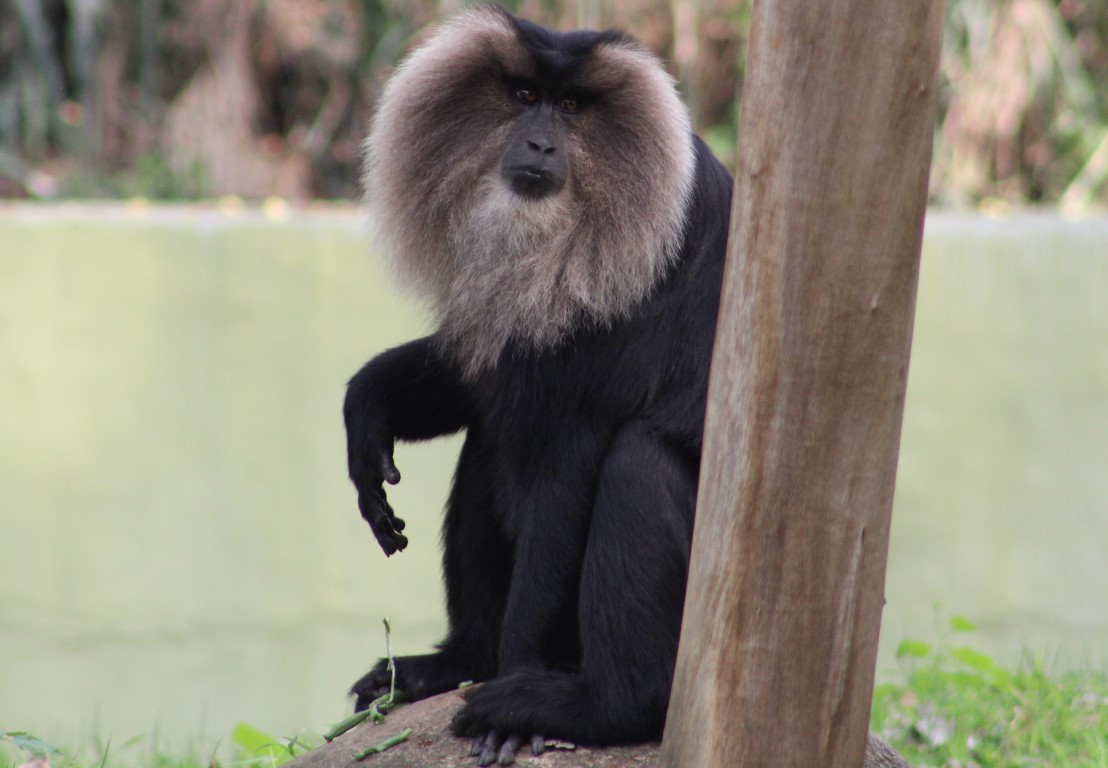
Lion-tailed Macaque [Lyric Poem]

I came upon a Lion-tailed Macaque,
And was instantly taken aback.
Sure, its tail was lion-like, but what's weird
Is that namers didn't call upon that beard!

BOOK REVIEW: A Gardener’s Guide to Botany by Scott Zona

A Gardener's Guide to Botany: The biology behind the plants you love, how they grow, and what they needA Gardener’s Guide to Botany: The biology behind the plants you love, how they grow, and what they need by Scott Zona
My rating: 5 of 5 stars

Amazon.in Page

Release Date: December 6, 2022

This beginner’s guide to botany is well conceived and executed. The photographs are beautiful and well-chosen to help the reader understand the complexities discussed in the text. The text gets definitionally dense in places, but also presents fascinating ideas in plain English. I learned a lot from the book, particularly where it was less steeped in technical terminology and details and offered intriguing ideas and examples.

While the book’s eight chapters aren’t formally divvied up, I would place them into three groups. Chapters one and two are about what plants are and how they are organized to do what they do. Chapters three through five are about what plants need to survive (water, light, and nutrients, respectively) and why. The last three chapters explore the main activities plants engage in (i.e. defense, reproduction, and seed dispersal.)

I found this book to be informative and readable, and if you’re looking for a basic guide to botany that skillfully employs photographs, I’d have a look at this one.


View all my reviews

BOOK REVIEW: Body Am I by Moheb Costandi

Body Am I: The New Science of Self-ConsciousnessBody Am I: The New Science of Self-Consciousness by Moheb Costandi
My rating: 5 of 5 stars

Amazon.in Page

In this book you’ll learn about: a man who wanted a perfectly healthy leg amputated, a fisherman who felt like his hands were crab claws, a woman who felt she wasn’t responsible for the actions of her hand, various people who’ve experienced “Alice in Wonderland Syndrome” [i.e. feeling one has shrunk or stretched,] and about many other issues stemming from the body’s sensory and motor integration with what we think of as the mind. For most of us, the most powerful take-away to be gained from this book is just how wonderful and awe-worthy it is that we have bodies that are so well integrated and coordinated that we can go about life engaging in all sorts of fascinating and productive activities.

While this isn’t the only book that addresses this subject, I think it’s a topic worth learning more about and reflecting upon in depth. We can get so out of touch with the fact that our body is integrated with our mental and sensory experiences that we take “brain in a vat” scenarios as a given for the near future, as if one is the sum of one’s neuronal connections. This book will disabuse one this notion. In fact, the final chapter (Ch. 10) questions the proposition that copying consciousness is a matter of mastering such neuronal mapping. It’s easy to miss how much of our emotional experience is rooted in what’s happening in our guts and heart, and how much all the non-central nervous system parts of the body play in our conscious experience of the world.

I learned a great deal from this book and would highly recommend it.

View all my reviews

BOOK REVIEW: Methuselah’s Zoo by Steven N. Austad

Methuselah's Zoo: What Nature Can Teach Us about Living Longer, Healthier LivesMethuselah’s Zoo: What Nature Can Teach Us about Living Longer, Healthier Lives by Steven N. Austad
My rating: 5 of 5 stars

Amazon.in Page

Release Date: August 16, 2022

This book offers a fascinating look at which animals are long-lived, and – to the extent that it’s known – why. It’s not so much, as the subtitle suggests, a book about how humans can live longer by applying understanding of other creatures of longevity. The advice for living longer would include tips such as: be a relatively large species, be a species that flies [of its own devices,] be ectothermic, be a cold-water aquatic creature, mature slowly, live underground, etc. This kind of knowledge, while interesting, isn’t really applicable to humans. Other takeaways are relevant to humanity, but still don’t change the calculus– e.g. have a relatively big brain. So, if one’s entire interest in this book is based on learning about how humans can live longer by applying ideas from other species, there is little to be gleaned, e.g. a brief discussion of antioxidants, free radicals, and metabolism. That said, it’s an excellent overview of long-lived animals and the evidence for why said creatures (including humans) live so long.

The book is divided into four parts, animals of the air, land, sea, and humans – respectively.

If you’re interested in nature and biology, I’d highly recommend this book. I learned a tremendous amount and the discussions of bats and Greenland Sharks were among the most illuminating — not to mention learning about creatures like clams and ant queens that I had no idea could live so long. Again, my only proviso would be that if you are interested in a book about what humans can do to live longer, there won’t be a great deal of information available [though, as mentioned, the last section does talk about longevity in humans, specifically, but not so much in a blue zone (this is what you should do) kind of way.] It’s more an argument for why more research is needed into animal longevity than it is a book about how to exploit the knowledge that already exists.


View all my reviews

BOOK REVIEW: The Romance of Reality by Bobby Azarian

The Romance of Reality: How the Universe Organizes Itself to Create Life, Consciousness, and Cosmic ComplexityThe Romance of Reality: How the Universe Organizes Itself to Create Life, Consciousness, and Cosmic Complexity by Bobby Azarian
My rating: 5 of 5 stars

Amazon.in Page

Out: June 28, 2022

This book presents a metaphysics based on the relatively new (but increasingly mainstream) sciences of complexity, chaos, and information. It boldly explores some of the major questions that consume both philosophers and scientists, such as: how life came to be, what life’s purpose is (to the degree it has one,) what consciousness is and does, and how come we live in a universe finely-tuned to generate and support life? (Particularly, if one doesn’t like explanations that are audacious and unprovable like “god did it” or “there are infinite parallel universes.”)

The book starts out in territory that is fairly uncontroversial among physicists, arguing that life comes about (and does so with striking speed – i.e. fast abiogenesis) by a process through which nature moves the ordered / useful energy that Earth has in abundance into disordered / useless energy (e.g. waste heat,) a process that runs on rules not unlike Darwinian evolution (molecules have an informational existence that allow something like hereditability [passing down of “blueprints”] and mutation [distortion in copies, some of which will make the molecule or organism more efficient at using energy.])

The book then ventures into territory that is quite controversial, arguing that life has a purpose (beyond the tedious one of moving low entropy energy into a high entropy state,) and that purpose is to be an observer – i.e. to be the first stage in a self-aware world. I should point out a couple things. First, when I say this part is controversial, I mean that it couldn’t be called the consensus view, but that’s not to say that these ideas don’t have a following among some high-level intellects. Second, I think we need people to consider ideas that might seem a bit “out there” because there is a danger of not progressing because we’re trapped in morass of assumptions. Science has quite a few self-appointed guardians who mock as pseudo-science any idea that strays from scientific consensus or from a rigidly reductionist / materialist / Copernican worldview. The author doesn’t abandon a scientific point of view, even though it might seem he does to some because he abandons the nihilistic view that’s taken as a given by many in the scientific community (i.e. that life is a happy accident without purpose, significance, or influence on the universe – and that life consists of automata, playing out programs — devoid of any kind of free will.)

I don’t know how much of Azarian’s metaphysics will prove true, but this book was superbly thought-provoking and opened up to me whole new vistas of possibility about the big questions of philosophy and science. I’d highly recommend it for readers interested in the meaning of life, the universe, and everything.

View all my reviews

BOOK REVIEW: Plant Science for Gardeners by Robert Pavlis

Plant Science for Gardeners: Essentials for Growing Better PlantsPlant Science for Gardeners: Essentials for Growing Better Plants by Robert Pavlis
My rating: 4 of 5 stars

Amazon.in Page

Out: June 7, 2022

This book provides a basic overview of botany for gardeners. It’s written in a way that’s readable to a science neophyte, and both uses garden-relevant examples as well as considers biological concepts primarily as is germane to the ornamental plants and vegetables gardeners tend to cultivate.

The big takeaway for me was that gardeners are being sold bogus technologies and techniques that seem intuitively sound if one doesn’t have the requisite understanding of science to see where the fallacies lie. Throughout the book, there are sections that refute common botany myths. To give some examples, there’s the idea of painting over cut limbs that can trap water and contribute to rot, and there are soil treatments that are superfluous.

There were a couple of points at which I had to re-read to make sense of what was being said, not because it was complicated but because of issues like explanations that didn’t include all the information necessary for clarity or statements being made in such a way as to mislead the mind a bit. The two cases that spring to mind dealt in physics more than biology, so I couldn’t say whether this just reflects my limited understanding of botany – relative to that of physics. At any rate, I don’t believe any wrong information was given. There were just a couple instances where information was presented in a way that could be confusing, but – for the most part – the explanations were clear and seemed consistent with my understanding of the subject.

If you want to enhance your understanding of botany and some of the myths that lead to poor practices in the garden, you may want to look into this book.


View all my reviews

BOOK REVIEW: Life at the Extremes by Frances Ashcroft

Life at the ExtremesLife at the Extremes by Frances Ashcroft
My rating: 5 of 5 stars

Amazon.in Page

Anyone interested in the limits of human physiology will find this book fascinating. Technically, its subject matter is broader than that, considering the environmental limits of living creatures, generally. However, all but the last chapter focuses on how humans react to (and adapt to) extreme conditions. Chapters one through six explore the challenges and limitations of humans under extreme conditions of elevation (ch. 1,) of pressure [underwater] (ch. 2,) of heat (ch. 3,) of cold (ch. 4,) of intense physical activity [running-centric, but deals with strength and power as well] (ch. 5,) and in space (ch. 6.) Then, each chapter reflects upon examples of species that are extremely well-adapted to said conditions, and why. (e.g. After learning about how and why humans have to acclimate to survive high elevation treks, one learns about the bar-headed goose, a bird that can go from sea level to flying over Everest – all in the same day.)

The final chapter (ch. 7) is a bit different in that it discusses extremophiles, creatures that can survive in a wide range of conditions (e.g. acidity, temperature, lack of moisture, lack of oxygen, etc.) that would be certain death not only for humans but for any animals. Most of the species discussed are either single-celled creatures or tiny multi-cellular life (e.g. Tardigrades.) With respect to humans, there is a discussion of the limits and present understanding of suspended animation.

This book offers an intriguing look at life at the extremes. While written by a Professor of Physiology, it’s highly readable for a general audience. It mixes narrative examples in with the discussion of physiology to make the material approachable and engaging. I’d highly recommend this book.


View all my reviews