Tulip 7

Night falls on Bangkok

Night falls on Bangkok

I’m speed-walking down the sidewalk off Sukhumvit Road like one of those elderly mall-walkers.  Like the mall-walkers, there’s an irony to my speedy step. I’m on vacation. I have no particular place to be, and no particular time by which I need to be there. Unlike the mall-walkers, my path is perilous. I have to weave around street-food vendors deepfrying springrolls or grilling satays (and fight my stomach’s urgings), evade the grasping taunts of idle tuk-tuk drivers, and wave off T-shirt vendors selling shirts featuring elephants, thaiboxers, and Singha beer.

I don’t know why I’m moving so quickly. It feels natural. It’s the pace of the city. To walk slow would be to swim against the current. If you want the truth, I walk fast because in the back of my mind, in the deep recesses of irrationality, I feel that if I slow down the city will collapse into me, forming a black-hole. It will start with a few tuk-tuk drivers, a beggar, a prostitute, and a few street vendors converging on me. They will create a gravity, attracting more vendors, beggars, drivers, and hookers. If I don’t walk fast, I fear that I will be crushed in the center of a dense mass of humanity.

Leaning against the marble wall of a bank façade, a master of timing, an Indian man blinks, touches his forehead, and grimaces–as if my approach causes him some sort of psychic pain. I brace myself for the scam. He steps away from the wall into my path, gently extending an arm.

He says, “Sometimes, you think too much.” He’s trying to convince me that he has insight into my soul by making a statement that, while perfectly correct, contains no information content whatsoever. He’s smooth in behavior and handsome of feature. I bet he makes a mint in his chosen profession.

An instantaneous battle rages inside of me. On the one hand, I’m an introvert– or perhaps a sociopath– something like that. Whatever my affliction, interacting with strangers is draining. On the other hand, I’m curious about everything. I know the man is a scam artist. It’s not that I was never on the turnip truck, but I fell off a couple of decades ago, and while it took me several bounces to come to a stop, I eventually became quasi-worldly. While I know he’s a scam artist, I don’t know what kind. I so desperately want to know that I stop.

After a greeting, he says, “I can tell your future. There are two women in your life, I can tell you how it will work out.” His speech is clear, and well-spoken, like he was born in Mumbai, but moved to Cincinnati when he was 15. He is, in all respects, a smooth operator.

However, he’s wrong already.  As I said, I’m not exactly a people person. It takes all my mental energy to even be monogamous, as opposed to nul-agamous. The idea that I’m maintaining two relationships would be a bit laughable to anyone who could really “see into my mind.” Whenever I hear about one of these guys who has two separate families, I always think, “How many hours a day did the good Lord grant you?” Because I can’t fathom living that way and not being in an utter state of exhaustion every minute of every day. I’d be a wreck.

However, I give him points for playing the odds. I’m a middle-aged man with a gray goatee walking down the street in Bangkok. I’m probably the only one fitting that description who hasn’t fallen desperately (and pathetically) in love with an “eighteen year old” bar girl who the man secretly thinks is 16, but who, in reality, is 29.

Incredulity must show in my face, because he changes tack. “Let me show you proof of my abilities.”

He extracts a flip-style pocket-notepad from the inner pocket of a tweed sport-coat that is grossly out-of-place in steamy Bangkok, but which lends credibility. He scribbles down something on a page so that I cannot see. He then tears off the strip of paper containing his writing. He wads the paper up.

“I want you to think of the English-language name of a flower. Have you got it?” he asks.

“Yeah,” I reply.

“Now think of a number between six and nine. Have you got it? Now think of them together.”

In my mind I see, Tulip 7.

He hands me the wadded up scrap. I unravel it. It reads, “Tulip 7.”

He then opens his day-planner and asks me to put in any amount that I feel is fair and he will tell me about my future.

What he doesn’t know is that I’m the exact wrong person to pitch his act to. As a skeptic, I make Descartes look like gullible. (After all, Descartes developed a “proof for the existence of God”–granted everyone deserves a nadir of thought, and that was clearly Descartes’.) The most fundamental thing that studying Economics and Political Science taught me was that humans are completely incapable of making meaningful predictions. I’d seen this guy’s act before from a guy named Professor Bruce Bueno de Mesquita, but instead of getting a few baht on the streets, the political scientist got millions of American tax dollars for convincing the CIA that he could tell the future.

As I walk away, he says, “You have an ailment. I can tell you about it.”

I think, Good one, that’s a true test of my powers of skepticism, and I continue to walk, thinking out how the mentalist scammer did his trick… and wondering if I have cancer.

Your Life is Hard? Try Working with Ninjas,Pirates, and Smugglers!

Ninjas, pirates, and smugglers aren’t exactly chatty. They burn, or shred, their correspondence. They sow seeds of disinformation to confuse the authorities. They lurk in the inkiest of shadow worlds behind doors we don’t even know exist. Still, who wants to do a hatchet job on a pirate? Right?

Did I mention that these are characters in the novel that I’m currently revising (or did I let you believe I was talking about in-the-flesh smugglers so that you’d keep reading.) Sorry, no one ever accused me of NOT being a deceitful bastard. Well, my friend, you’re now more than Tweet deep in this post; that’s quite an investment; it’s the modern-day equivalent of having read The Iliad, so you might as well keep reading.

Kiss the Cobra (my third working title) features a cast of characters of not only the aforementioned occupations but also monks  (both the scholarly and  kick-ass kung fu varieties), an Emperor, a muay Thai master, and a secret society that makes ninjas look like chatty Cathys. Like all good lies, this novel begins with a seed of truth. That seed is the rescue of Emperor Go-Daigo from imprisonment by an evil (ok, quasi-evil) shogun in 1337.  From that seed, it’s my wild imagination run amok… or is it? The Emperor assigns the loyalist ninja who rescued him, Korando, to travel to Southeast Asia to acquire an artifact that legend has it will help him re-consolidate power.

Cut to the present day, a linguistically-talented young man, Matsuo (a.k.a. “Matt”), comes into possession of a scroll. The scroll is Korando’s journal, written and hidden as a confessional. Matt investigates Korando’s journal on an electronic bulletin board only to find himself being chased by nefarious characters. Matt discovers that there are still people willing to kidnap, kill, or commit treason for the secrets that Korando’s journal may possess.

The novel weaves the 14th century journal with this present-day cat and mouse game between the forces of good and evil. There’s murder and mayhem, love and betrayal, victory and defeat, virtue and vice; in short everything you love in a novel is densely crammed into this book.  There’s even one character who may or may not be a Zombie–I’ll let you be the judge.

Now let me just add this screenshot of me to show you ho

Do you ever get a chill on the back of your neck?

Did you ever get an inexplicable chill on the back of your neck?

BOOK REVIEW: Smile When You’re Lying by Chuck Thompson

Smile When You're Lying: Confessions of a Rogue Travel WriterSmile When You’re Lying: Confessions of a Rogue Travel Writer by Chuck Thompson

My rating: 4 of 5 stars

Amazon page

Smile When You’re Lying gives the reader an insider’s view of the deceit rife in travel writing. In the process, Chuck Thompson tells a story of life on the vagabonding circuit. Instead of being a story of idyllic and pristine white sand beaches, it’s the story of drug- and booze-riddled expats and the prostitutes they frequent.

Thompson lived a colorful life. He tells of how his interest in Thailand began when he heard stories while in a jail in Alaska. He introduces cast of characters, such as Shanghai Bob, many of who are even more colorful than he. It’s this wild living that makes the book an interesting read, but, ironically, it also makes such stories impossible to sell to any of the travels magazines–all of which make money off of advertiser dollars, advertisers who have an interest in making travel seem safe, clean, and family-friendly.

Thompson tells of how he began teaching English in Japan, a common point of origin for expats taking to Asia. Japan has a large and well-developed program, called JET, that brings native English speakers to Japan to teach language or work in government offices as translators.

In addition to the intro on Thailand, a chapter on his Alaskan youth,and one on his JET days, there are chapters on Latin America, the Caribbean, the Philippines, and Eastern Europe. Furthermore, there is a chapter that lends travel advice for aspiring travel writers and one about what travel mags don’t want readers to know. It should be noted that besides having written for such magazines, Thompson did a stint as an editor as well.

Thompson also devotes a chapter to countering the myth that Americans are–on the whole–bigger travel bastards than the people of other Western nations.

If you are interested in travel writing or vagabonding, this is a worthwhile read.

View all my reviews

TODAY’S RANT: The War on Rhyming Verse

A fine Hungarian poet who Wrote with and without rhyme

A fine Hungarian poet who Wrote with and without rhyme

it’s my cross, my curse
this rhyme in my verse
rhymers aren’t taken seriously
and are berated furiously

“Oh, your poem is so cutsie,
like little baby bootsies.”
call it banal or call it niche
but “cutsie?”, please!, step off bitch

just because my verse ain’t free
don’t act like I’m a perp to slavery
I spare my words the sting of the rod
they’ve never tasted a cattle prod

I’ve never waterboarded my “ands” or “buts”
or kicked a pronoun square in the nuts
I don’t whip my adjectives to get ’em in line
I stand waiting patiently holding a sign

Why steer my words like some stern brigadier?
because it scratches an itch somewhere in my ear
I know my rhymes sometimes lack cachet
because they’re little too Ogden Nash-ay
but from the hilltops I sing
like that guy Rodney King
hear the words of my song
“Can’t the poets all just get along!”

Cash Cow Disease: or, I Hope The Americans Don’t Get Lost

AmericansTVIn political economy, “Dutch disease” is a term used to describe a situation in which a nation’s windfall successes in one sector lead to everything else going to crap.

Dutch disease reminds me of a phenomenon rife in television today. A series pilot is shown. It’s wildly successful. The writers came in with a clear overall narrative arc, but now the show is a cash cow and they have to extend it out indefinitely. This is a script-writing nightmare. Writers have to give the viewer a new puzzle piece each episode but they’ve got to end the episode with a cliffhanger and they’ve got to be able to tie up all their loose ends at some undefined point when the series becomes a train wreck.

I was aware of this phenomena, let’s call it “Cash Cow disease,” when Lost came on the air. I’d been through it with the X-files.  But damned if I didn’t go and get myself engrossed in Lost. Lost started out with such promise. It seduced me, and even when it became clear that the writers and director might not know where the ship was headed, they kept feeding me tasty bread crumbs.  Then the network said, “Get us off this crazy train, quickly.” So  it was that the show that began with an atomic bang ended with the whimper of one of the worst endings ever.

Having been hurt twice thusly, I’d given up on watching television serial dramas. Then I made the fatal blunder of watching the pilot of The Americans. Why did I do this? Ironically, I probably watched it because I assumed it would be bad. It was, after all, a Cold War show in a post-911 world. Oh, the thwarted expectations. Now, I’m hooked.

The Americans is about a man and wife who are Soviet sleeper spies during the early 1980’s. The couple lives in the suburbs of Washington DC with their oblivious kids, and appear to operate a travel agency (for young readers, there used to be people who booked one’s flights and hotel before the days of Kayak, Orbitz, and Travelocity.)  In reality, however, the couple are deep cover spies who are attempting to get information about America’s ballistic missile shield, Reagan’s “Star Wars”, and other strategic concerns. The show depicts the cat-and-mouse game of Cold War espionage with great tension.

In an act of coincidence that strains credulity (but which is no stranger than things that actually happened) an FBI counter-intelligence agent moves in right across the street from the couple. The KGB couple and the FBI man are working at cross  purposes without the FBI agent (played by Noah Emmerich) being the wiser. (Emmerich’s character has early suspicions that he dismisses as paranoia after a close call for the KGB couple.) The male lead KGB sleeper spy (played by Matthew Rhys) plays racket-ball with the FBI agent.  This apparent friendship is to the chagrin of the female lead (played by Keri Russell) because she’s not quite sure if her husband is working the FBI man (as he says), or whether he’s facilitating changing sides. Part of the tension of the series stems from the fact that Keri Russell’s character is a dyed-in-the-wool patriot of Mother Russia, but her husband is having second thoughts–he sees himself as a family man first and a patriot second and America is growing on him. This tension is made all the more complicated by the fact that she seems to be just starting to fall in love with him, though he seems to have loved her from the early days of their planned, forced, and in some sense fake relationship.

The signature trait of The Americans is that characters on both sides are sympathetic  but complicated. This is part of a “shades of gray” motif that informs the show. Emmerich’s character, the FBI agent, is a loyal patriot and family man trying to do his best under the pressures of a hectic and tense job. However, we see him torment and rob a suspected Soviet information trafficker. Rhys character, the KGB sleeper, is also quite likable and sympathetic. At one point we see Rhys’s character beat up a pedophile (what’s more likable than that.) Russell’s character is not so likable, but that’s good for the tension. She’s a cold, fanatical Communist, but we can see the outlines of humanity in her character. For example, despite her jingoistic nature, she refuses to report her husband’s second thoughts.   On the FBI side, the most unlikable character is the boss (played by Richard Thomas, aka John Boy.) He’s a rash hot-head who,  in last night’s episode, wrecked an operation through his knee-jerk reaction (or maybe he’ll turn out to be a mole.)

I can already imagine how the wheels may roll off. There’s a supporting character, a mole in the Soviet Embassy (played by Annet Mahendru), that I imagine they intended to kill off to add to the angst of the Emmerich character (the FBI agent cultivated her through “soft-blackmail” and acts as her handler.) However, she’s really an endearing character. In a field of patriots that sometimes approach zealotry on both the US and Soviet sides, she seems to just want to have a peaceful life, but she’s trapped. Despite being manipulated, she’s a strong character. I can imagine her becoming a more central role–not that that’s an inherently bad thing.

I’d like to recommend this show, but I face a dilemma. If fewer people watch, I think it’s more likely to end well.

TODAY’S RANT: The Lonely Omnivore

My salami has a first name, it's B-E-S-S-Y.

My salami has a first name, it’s B-E-S-S-Y.

I’m a member of a group that has long suffered the bitter pill of discrimination. How is it–you may ask–that a white, heterosexual, suburban, graduate-educated male knows the foul taste of discrimination? I love meat, but my wife is a vegetarian.  This makes me a lonely omnivore.  When I go to the market, I can’t find meat packaged for my kind. No individual could cope with such quantities of meat as packaged by supermarkets. Well, that is besides those not averse to contracting colo-rectal cancer from the rotting carcass wedged in his transverse colon, e.g. Adam Richman.

One option–the healthy option–would be for me to go vegetarian. Did I mention that I love meat? I love bacon and beef and poultry and pork and rabbit and reindeer. I would eat meat on a boat. I would eat meat with a goat, and then I’d make a stew out of the goat. Cut off the beak and the bung, and you’ve got yourself a customer. You say you got horse meat in my beef? Sounds tasty. So option one is a nonstarter. I’m out of the omnivorous closet. I’m here; I eat steer; get used to it.

Another option is to find the store butcher and ask him to wrap me a solitary steak.  The problem is two-fold. First, the butcher is never just hanging out at the counter, and so there will be a PA announcement. In the 1950’s, before computers with Facebook and solitaire, the butcher would hang out at the counter, but now he’s in the back–presumably goofing off like 90% of the workforce. The announcement will be quick and neutral, but it will sound enough like the following to garner widespread attention, “Attention in the meat department, there’s a pathetic soul with no one to love him who needs steak for one, I repeat STEAK FOR ONE.” Then everyone in the store has to take a peak at the lonely omnivore. Don’t stare, Johnny, it’s just a hobo.

The second problem is that, while the butcher is smiling and polite, I know he is thinking, We have half a mile of prepackaged meat, and you really want me to take a break from my hectic schedule of playing solitaire in the back office to cut you one steak? Haven’t you heard of a nifty invention called a “freezer?” It should be located somewhere in the general vicinity of your refrigerator  

The third option is, of course, the freezer. If you had any idea how disheveled my mind was, you wouldn’t even suggest this. Using the freezer would require that I anticipate that I will eat again in the future so that I can take the meat out to thaw. Here’s how it really works. I’m sitting here typing and think, That steak would really be good about now! However, presently it isn’t a steak, it’s a block of meatcicle. So I take it out of the freezer. I stare at it for a few minutes, hoping to use my ill-developed Superman-like powers of heat vision. Then I try running hot water on it, but it remains crystalline on the inside. Then I leave it and go back to typing. Then I check on it in three minutes. Then I go back to typing. Then I check on it after two minutes. Sensing the beef will never thaw, I break down and make myself some unsatisfying but filling Top Ramen. The next time I see the steak it’s a soggy and unappetizing lump hanging out in my sink.

Now if you’re an outline-and-note-card kind of writer, you may wonder how a writer could be so unskilled at planning. I’m not that kind of writer. If you haven’t guessed it, if it hasn’t shown through, I just make shit up as I go along. For me, writing is a process of paginated diarrhea, with an admittedly messy cleanup process.

My final option is to go to one of the huge “farmer’s markets” that we have in the area. (I use quotes because I’ve never seen an actual farmer there, and the food is as likely to be from Armenia as it is from Americus, Georgia.) These markets have heaped slabs of meat on ice, they’ll and cut it however one wants. I do this sometimes. There’s a very cool thing about these places. Because they serve such a diverse population, they hire a lot of immigrants.  However, while it’s cool that my butcher is a native Lao speaker, it can be problematic for me as a non-Lao-speaking English speaker. Inevitably, my desire for ONE PIECE of meat is translated into ONE KILO of meat or ONE CRATE of meat. I know, you’re saying that there’s one simple and obvious solution: learn the Lao language.  The problem is that the next time I go I might get the Urdu-speaking butcher.

I don’t like to complain about my plight [which is why I have a regular series of posts called TODAY’S RANT], but we should make room in our society for those of different meat needs.

Paintings Through a Writer’s Eyes: 6 of my Favorites

Let me begin by being forthright; I know almost nothing about art. If you’re thinking this post might offer you insight into what makes for a good painting, you’re in the wrong place. A few years back, I did get a couple books on “art for philistines”  (…isms: Understanding Art and 50 Artists You Should Know) Being fascinated by just about everything, I immensely enjoyed both books. However, my objective wasn’t to develop any great expertise, but simply to not be a clod. I wanted to be able to tell Monets from Manets from mayonnaise. And I did learn some nifty lessons, mostly about what art wasn’t. Did you know that Neo-impressionist art is NOT art that makes a new impression on one, as contrasted with paleo-impressionist art that makes one feel their inner-caveman. Secessionism was NOT the art of the Confederate States. Neither sensationalism nor naturalism necessarily involve nudity, darn. One the other hand, Pointillism is exactly what it sounds like, paintings made of little pointills.

As a writer, the story that I see in a painting has a lot to do with its appeal to me. That’s why there aren’t any Jackson Pollack’s or Mark Rothko’s on my list. I’m sure their work is aces in aesthetics, but I don’t get much out of it.

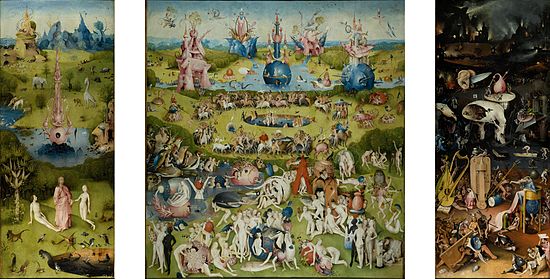
The Garden of Earthly Delights by Hieronymus Bosch, 1510

The Garden of Earthly Delights by Hieronymus Bosch, 1510

I usually don’t care for paintings that are as busy as The Garden of Earthly Delights, but I find it fascinating that an early 16th century artist could produce so much wild surrealism. I didn’t even know they had LSD in the Netherlands back then. Today we have decades of monster movies to help us think up weird and bizarre images, but Bosch had only his imagination.

There are an infinite number of stories packed into this tri-sectional painting. A question being the root of a story, a world in which some people have flowers and berries blossoming from their heinies, makes for a lot of fodder. However, the first thing that strikes the eye is that God is the only one wearing clothing. (Lets avoid a tautology. One could say that the only reason I know that that’s God is that he’s wearing clothing. If he were naked too, the viewer would just assume that he was a perv trying to horn into a menage a trois. I would say the world’s first threesome, but if you look in the middle section, you can see that about everyone is getting their freak on.) So why is God wearing robes?  We can assume that it’s not that he has shame. He’s God, you can be sure he’s sporting the perfect specimen of masculinity (if he cares about such things.)  Is it drafty in heaven? If so, doesn’t his omnipotence extend to the heavenly thermostat, or is it that the Holy Ghost likes to crank the AC? I see tension, and tension is the root of a story. (I realize that I said that a question was the root of a story. Live in the moment.)

The Sea of Ice by Caspar David Friedrich, 1823

The Sea of Ice by Caspar David Friedrich, 1823

Sea of Ice, also called The Wreck of Hope, at first looks like just a landscape. However, if one directs one’s glance to the right hand side, one can see the stern of an old sailing ship. As the alternate title suggests, it’s about a shipwreck. A shipwreck in the sailing age in the Arctic Ocean makes an outstanding setting for a story. Those men are all going to die, but not with the suddenness of drowning. They will freeze to death over the course of hours. If they can start a fire, they may have many hours, but they are not going to be rescued and they cannot walk to home. The tension between wanting to survive and knowing you are just extending your misery is good stuff for story-telling. If this image doesn’t send a shiver down your spine, nothing will.

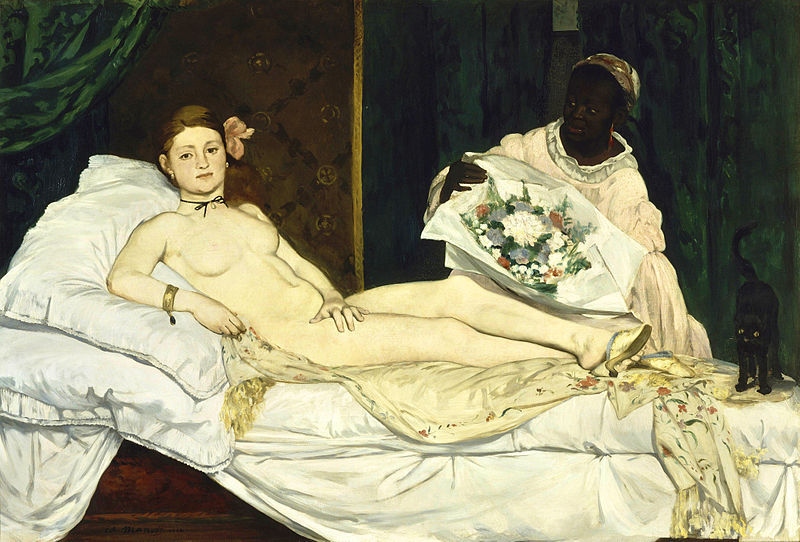
Olympia by Édouard Manet, 1863

Olympia by Édouard Manet, 1863

Olympia was a scandalous painting when Manet first revealed it. Nudity has been around for ever in paintings, right? Certainly, but it’s the context that enraged people. Society was used to characters of classical mythology being nude, e.g. Venus. They were also used to Biblical nudity (see Garden of Earthly Delights above.) However, Olympia made them think of the Parisian prostitutes that they didn’t visit, but somehow knew exactly what they looked like.  There are several stories to be told here. The one that springs to mind is why the servant is about to try to suffocate Olympia with a pillow. Will she, or won’t she, go through with it? If she does, will she prevail? Olympia looks like a fighter. If she doesn’t, will the cat?

Impression: Sunrise by Claude Monet, 1872

Impression: Sunrise by Claude Monet, 1872

In Impression: Sunrise two boats are out on the water, even though the sun has broken over the horizon.  They are rivals. The early bird got the worm, and the other will have to fish with fake lures.

Lighthouse Hill by Edward Hopper, 1927

Lighthouse Hill by Edward Hopper, 1927

Lighthouses make good settings for tragedy. They are remote. Ships depend upon them to avoid the rocky shoals. This lighthouse keeper’s family left because they didn’t like living in the middle of nowhere with a drunk. Now it’s just a man living in a big house alone. He runs out of Jack Daniels, and drives off to town at dusk. Being on the other side of the hill, he can’t see the lighthouse when he briefly glances into his rear-view mirror and wonders, “Did I turn the beacon on?”

The Persistence of Memory by Salvador Dalí, 1931

The Persistence of Memory by Salvador Dalí, 1931

The Persistence of Memory, a.k.a. Melting Time, is a dream state. It makes no sense. Nature is ordered into square edges. Watches are the only evidence of humanity’s existence. There is one creature living, or once living, that looks like the Thalidomide abortion of a three-way mating between a donkey, a Portuguese man of war, and Dalí himself.  The story is about being trapped in a dreamscape where time has become stuck.  Our protagonist must seek the wisdom of the Portuguese man-o-Dalí.

The Bullets that Bore no Name: or, the Burden we all Bear

Attribution: Bundesarchiv, Bild 192-334 / CC-BY-SA

Mauthausen                     Attribution: Bundesarchiv, Bild 192-334 / CC-BY-SA

Thanks for joining me on the veranda. If you don’t know what I’m talking about, this post flows from a book review I did on Elie Wiesel’s Night, which can be seen here. But don’t wander off just yet.

I married into a family of holocaust survivors.

Being sufficiently narcissistic, I haven’t been able to avoid thinking of the profound impact this had on my life.  I am married to the most extraordinary woman in the universe [my apologies to all other women, I’m sure you’re someone else’s most extraordinary woman] by virtue of the strength of a man who wrestled his way to the top of a pile of corpses, bleeding profusely from multiple shrapnel wounds, clawing his way out of a pit, and cleaning the gashes with his urine. That man was married to a woman, tiny of body but colossal of mind, who was in the group force marched from Budapest to Mauthausen. After the war, they had a child–my mother-in-law. Yada-yada-yada. I have marital bliss.

Not being completely narcissistic, I’m reminded that every one of our lives have been shaped by strong people who lived through close calls. Each of us comes hither as a gift from men and women who passed through a hail of bullets that bore no name. Some, like my wife’s grandfather, were riddled by bullets bearing their name, and still refused to heed their deadly whisper.  Every holocaust survivor survived by a thin margin. Every battlefield veteran’s life is an execution order rescinded. Every prisoner of war was one germ away from an unmarked grave.

No pressure or anything, but that sounds like a heavy debt we  all bear.

Telling this story in greater detail is one of my bucket list tasks. It’s a project I’ve had on the back burner for far too long. There are several reasons for this. The most feeble of which is a hope to find the right timing. Sadly, there are so many such stories that I fear it will be lost amid a sea of sorrow.  Then there is my need to develop grace with language sufficient to do the story justice. In a way the two novels I have drafted, and whose mess I am now painstakingly trying to dance into shape, are practice exercises.  Wish me luck.

On the plus side, my wife’s uncle had the foresight to have her grandfather speak his story onto about 20 tapes before he died. With today’s technology, there’s no excuse for anyone’s life-altering story to go untold.  So I guess if there is a moral to my rambling post it’s this: don’t let anyone in your life with a spectacular story pass from this world without it being heard.

Who Am I?

“I” am a collection of cells.
some  expressly invited by “my” genes
others are interlopers,  “my” guts their cross-town bus
but these interlopers defend “me”  daily
fending off worse marauders
thankfully
so “I” let them stay inside “me”
“my” greatest shame? “I” am a slave owner.
the  mitochondria in “my” cells  are trapped and  forced to serve “me”
all this begs one fundamental question,
am “I” really just a “me?”
or  a  whole society?

If “my” parts
needn’t be fully integrated
where do “I” end and “you” begin?
can “I” say that “I” have been everywhere?
well, everywhere on this tiny, spherical-ish speck of galactic dust?

TODAY’S RANT: Stuck with a Bad Ending

Bonus pages for active readers

Bonus pages for active readers

I miss the days when they put extra blank pages at the end of a book so that you could rewrite an unsatisfactory ending. (Someone once tried to tell me that the extra pages were the result of bulk paper cutting methods. They said it was cheaper to include the blank pages than to remove them. Yeah, I know. How ridiculous, right?) Of course, it wasn’t long before ads began to sully these blank pages, making them less than blank.

I’m not a fan of wastefulness, but if I have to rewrite your ending, why should I incur the cost of paper.

Being lazy, there are not many cases in which I feel compelled to rewrite someone else’s ending. Most books that manage to get published have at least a tolerable ending.

One book always springs to my mind when I think of bad endings. It’s a book called Hostage by a writer named Robert Crais. For those who saw the movie, the movie ending is vastly different–presumably because moviegoers would have insisted on their money back otherwise. While Hostage is not among Bruce Willis’s best, it’s also a prime example of the rare case when the movie is better than the book–for just this reason.

Part of the disappointment stems from the fact that the book has an outstanding premise for a thriller, and in my opinion it was carried off well until the end. (Another reason that I don’t come across too many terrible endings may be that I jettison books that aren’t so good, but this one fooled me.)  Anyway, three delinquent kids rob a house and end up with a  hostage situation with the homeowner’s two kids. The tension is ratcheted up when it turns out that the upscale home where the kids are being held up is owned by a mob accountant. Inside is evidence that could put half the mob away. The mob gets proactive by taking the police chief’s (i.e. the protagonist’s) family (ex and child) hostage and insisting that he get the evidence out before the house is stormed by the sheriff’s department and falls into an evidence locker.

SPOILER ALERT: Ultimately, our hero has no agency in the survival of himself or his family. It’s purely the decision of a mob enforcer that leaves them alive.  I guess it could have been worse. It could have ended with him awaking from a dream.

What book gets your award for “worst-ending-ever”?