Drunk, Narcissist, or Buddha: What Kind of Writer Are You?

IMG_0173I read a story in The Guardian the other day entitled “What drives writers to drink?”  It was actually an edited excerpt from a book by Olivia Laing entitled The Trip to Echo Spring: Why Writers Drink.

I found this piece fascinating despite the fact that the title question seemed readily answered with another question, “In what other occupation must one regularly, repeatedly, and thoroughly get punched in the soul in order to succeed?” Writing is a personal act, and no piece of writing that is read escapes the assault of criticism, invited and uninvited, which ranges from sagacious to ridiculous.

One somehow has to find the courage to wade through what feels a lot like attacks on one’s intellectual self in order to discover what is useful and what is not. If one summarily rejects all criticism and advice, one will neither grow nor is one likely to be published. If one accepts all criticism as having merit, one may find a psychiatric ward in one’s future–and one is likely to remain unpublished. So the trick is to be able to answer the question, “What within this writing is genuinely bad?”

The problem is that it feels like the question is, “What about me is flawed?” It’s like holding a mirror up to the core of one’s being and noticing that you have some rot.

How do writers do this? There are probably innumerable approaches, but three common ones come to mind. The first is the one thoroughly addressed in Laing’s book; that is, some writers self-medicate. The article references a quote by Tennessee Williams, “…you felt as if a new kind of blood had been transfused into your arteries, a blood that swept away all anxiety and all tension for a while, and for a while is the stuff that dreams are made of.”

A second unhealthy approach is to reject any assertion that contradicts one’s perfection. In other words, be a narcissist. These are the writers who meet each and every piece of criticism with statements like, “you just don’t understand what I was trying to do there, my misspelling was actually a clever commentary on the zeitgeist of 20th century Armenia.”

The narcissists have the advantage not becoming clinically depressed by the constant rejection and criticism that is a life of writing. The downside is that they have to live in a world in which everyone else on the planet is ignorant and incapable of recognizing brilliance when it’s shining in their faces, and that is depressing in its own way. Only a few in this group manage to get published, and they do so through a combination of being truly great and, at least early on, being willing to tarnish their awesomeness by accepting some editorial suggestions.

The third approach is the one that we should all aspire to, but it’s a bitch getting there. In the title I used “Buddha” as a code word for the enlightened approach. What is the enlightened approach to dealing with rejection and criticism? First, one must realize that equating one’s writing and one’s self is illusory, and that criticism of one’s work isn’t criticism of self. Before any writer gets to the point of submitting works to agents, editors, or publishers someone along the line has told one that one’s writing is good. This fatal compliment causes one’s self-worth to become entangled in one’s writing.

Second, one must develop a confidence that isn’t rooted in external validation. In less pretentious words, one mustn’t feel it necessary to be loved by everyone with whom one comes into contact. This is hell if one’s entire life is writing. The value of published writing is inseparable from how it’s received. My only suggestion on this point is to find something else in one’s life that allows one to build self-confidence. For me, this has been martial arts. Sure there are usually rank tests, which are about validation from one’s teacher. However, what it really comes down is whether one experiences success in training and sparring. If one sees some success, the rank starts to be irrelevant to one’s confidence. I think outdoorsmanship is another such skill– for those less scared of bears than being beaten ugly with a stick. There are few activities in which other’s evaluation of one is ultimately irrelevant, but those are the activities with which one should seek to balance one’s writing.

If anyone needs me I’ll be guzzling Bourbon and contemplating how the publishing industry is run by poop-weasels.

Transmigration of Blog

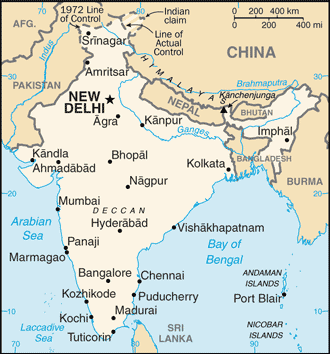
india_sm_2012We’re down to about a month until our move to India.

The house is largely in order with only a few odds and ends remaining.

Most of our worldly possessions are in storage, and I haven’t really missed any of it. (A lot of “moss” collects when your stone stops rolling for a few years.) The house now echoes. Movers will be coming to get the small amount of stuff we’ll ship to India in the next couple weeks. Then we’ll really be living minimalist.

We’ve got all our shots with the exception of the final doses for Hepatitis. We’ll get those in country. With respect to shots, when moving to India, one has to get… well,  all of them.

Visas are in the works though we’ve had some delay on that front. However, fortuitously, the local Indian Consulate is beginning to take applications, and so I won’t have to send my application off to another city and can eliminate the time and risk of postal transit.

My list of things to do consists of fewer large, all-consuming tasks and more quick and easy jobs.

All of this means that I’m getting back to writing.  This is a bit like getting a corroded junk-yard jalopy running again. It’s remarkable how much the creative juices curdle when one spends a few months focusing on home repairs, monitoring contractors, getting shots, and other mundane tasks of international relocation. I worked almost exclusively on drafting two novels for a period of a little over a year, and now–as I resume writing and revisions–I’m having to re-read just to figure out what they’re about. On the bright side, I sometime surprise myself with what I wrote. For me, there’s definitely economy of scale in long writing  projects. Writing eight hours a day yields a lot more than eight times writing for one hour a day. I lose voices, character idiosyncrasies, and plot detail so easily unless I’m immersed in them.

As for this blog, I think a rebirth is in order. Since I’m moving to India, I’ve invoked the concept of transmigration of soul. In Hinduism, some sects of Buddhism, as well as a few lesser known religions, there’s a belief in reincarnation in which the soul may be reborn into an altogether different type of container. For example, if you were good in your last life, you might come back as a lama or a lap cat. If you were bad in your last life, you might come back as a slug or a Congressman. So the question of the moment is what this blog will be reborn as when  it sputters up from out of the ashes.

I would like the site to remain (or, perhaps, become)  humorous, but I’d like the humor to be less curmudgeonly. This presents a challenge because I’m not sure that I know how to be funny without being a curmudgeon. In point of fact, I’m not sure I know how to not be a curmudgeon–funny or otherwise.

I want this site to be reflective of my new life. I’ll continue posting photos, though after the move they will be disproportionately from Bangalore, India, and a few adjacent countries to which I will be traveling. So it’ll remain part travel site. I’m sure I’ll have plenty of lessons learned about travel in India to share.

When I’m not writing or sleeping, I’ll be engaged in a quest of self-improvement. The development of mind and body have been raised to high art in India, and I hope to  find some of those individuals with that knowledge.

Expanding my abilities and understanding of martial arts is one of my goals for this period. It’ll be a challenge to keep from becoming rusty in the jissen kobudō (Japanese old school martial arts that emphasize pragmatic skills) that I have been studying my entire adult life. However, in addition to working on what I know, there are other activities that I think will help expand my understanding while keeping me suitable limber and conditioned. I would like to learn  a little about indigenous Indian martial arts such as kalaripayattu, silambam, and–if time permits–gatka. Furthermore, I would like find a place to train in Bangalore where I can do some training in what I’d call general jissen (practical fighting) skills.

However, my attempts to improve myself will not be limited to martial arts alone. India might be cursed with plagues of poverty, pollution, and–well–plague, but they have no shortage of gurus–whether I can find one that’s reputable and willing is another matter. The older I’ve gotten, the more I’ve realized that I don’t have a firm grasp of my mind. My mind runs and I don’t pay enough attention to what it is telling me; I don’t put enough effort into fixing what is broken. I read a quote recently about people who put great effort into studying the external world, but who remain ignorant of themselves.  This struck close to home, but it’s not just me–it’s widespread. People study psychology in school and learn about cognitive biases, but they don’t put the information to use in becoming more virtuous people. For example, a person might learn about the “self-serving bias” –whereby people claim responsibility for successes but place blame for failures on external factors–and say, “yeah, it’s funny that other people totally do that.”

Part of practicing martial arts is keeping one’s self healthy, against all odds. While I’ve never practiced yoga, I appreciate the belief that mind and body are inseparable. I would like to work on building a body that is less likely to be crippled by the practice of martial arts as I age. I intend to study Thai yoga massage, which incorporates stretching and pressure point massage. There’s an interesting connection between India and Thailand with respect to this form of bodywork. While it’s most closely associated with Thailand, some claim that its roots are in Northern India with a master called Guru Jivaka. While visiting Thailand, I developed an appreciation for the health benefits of this type of massage–particularly for one prone to have things out of whack. However, I didn’t have the time to study it during that visit. There is also the more distinctly indigenous holistic healing system of India, Ayurveda, and I would like to learn more about it as well.

In short, I intend to have a pretty full agenda while living in India, and I hope readers will find my posts about these experiences interesting and worthwhile.

Teachable and Unteachable Lessons

[Note: This is posted in my Jissen Budōka blog as well.]

Source: Wikipedia; Status:  Public Domain

Source: Wikipedia; Status: Public Domain

Miyamoto Musashi, who was undefeated in over 60 duels, claimed that he never had a teacher. Some historians refute this claim. Whether one accepts it or not, the statement astonishes.

Musashi wasn’t talking only about martial arts, but about the many areas in which he was accomplished. Not being a painter or a sculptor, I can’t say how important a teacher is in such domains. But it’s easy enough for me to imagine a successful writer who never took a formal class in writing; someone who read profusely and practiced his (or her) craft relentlessly could do it. (Certainly, one can easily imagine successful writers whose formal education was in some area other than writing because there are so many of them–probably at least as many as those whose education was in writing. Examples include: Vonnegut [Chemistry], Crichton [Medicine], Zane Grey [Dentistry], Ursala LeGuin [Anthropology], and J.K. Rowling [French]. That’s not even to start on the many literary legends who dropped out all together– e.g. Dickens, Faulkner, Twain, H.G. Wells, and Jack London.) This isn’t to say that writing teachers don’t make writing better, but just that there is a path to this skill that doesn’t involve being fed lessons.

However, I struggle to imagine a martial artist achieving so much without a teacher. Boiled down to its most workaday definition, a martial art is a collections of lessons about what works in a combative situation. This is what separates the importance of a teacher in martial arts from that of a discipline like writing. In writing, one has the leisure to make one’s mistakes, learn from them, and self-apply course corrections. Musashi was in life or death duels; he couldn’t learn lessons at such a leisurely pace and in such an iterative fashion.

A martial arts teacher has a number of roles, such as preventing inertia (slacking) from taking hold in the training hall. However, the most fundamental purpose is to pass along the collection of lessons so that a student doesn’t have to learn them all by way of personal experience. Most of us aren’t Miyamoto Musashi; we can’t survive the process of learning all our own lessons.

Needless to say, I am a firm believer in the value of a good teacher. I’ve had several over the years, and I received valuable lessons from all of them–all with different, but no less valid, points of emphasis and flavor.

Having said all that proceeds, there’s much that cannot be taught. Such lessons may be described or discussed, but they cannot be learned except through the initiative of the student. I said that most of us can’t survive the process of learning all one’s own lessons, but I’ve increasingly come to believe that one can’t survive learning none of them either. In the beginning, one must be fed the lessons from a teacher in order grow. However, as the decades pass, one increasingly needs the space to learn one’s own lessons. If one lacks said space, one will stagnate and eventually the wheels will roll off one’s training altogether.

So what are the unteachable lessons? Knowledge can be conveyed, but not everything that a martial artist must learn is knowledge. Confidence cannot be taught. A teacher may explain–or even show–how he or she became confident, but that won’t translate one iota into the student being more confident.  This is like a Buddhist monk telling one that “desire is the root of suffering.” One may understand that statement. One may believe the statement. However, one’s suffering won’t decrease because one has the knowledge.  One’s suffering will only decrease if one conscientiously does the hard work of reducing one’s desires.

Another area of unteachable lessons are the lessons that the teacher has never learned. Loyalty is a great virtue, and so there may be a tendency to restrict one’s learning to the lessons of one teacher. However, even if one has an outstanding teacher and are practicing a great lineage, blind spots happen. The only way to learn whether there is anything of value obscured in those blind spots is to throw off one’s blinders and have a look for oneself.

What blinders? An excellent and tricky  question.  It’s like when someone says, “it’s not what you said, but the way you said it.” We all understand that there is some intangible character in language that is commonly understood but not easily seen or defined. In any culture (and a dōjō contains a culture, believe me) there’s always a collection of norms, rules of thumb, ideas, beliefs, mores, credos, etc. that come to be taken so much for granted that they become an invisible filter through which one sees the world. This isn’t an inherently bad thing, and it’s probably necessary to produce sufficient order in a chaotic world in which to learn and grow. Having said that, some of the ideas and beliefs in our cultural filter may be arbitrary, or at least not universal, but yet we don’t necessarily see the potential for error because we are seeing the world through the cultural filter. We take for granted that grass is green, but what if we see it through a yellow filter? Then it’s blue. Right?

Blatant Blog Post Theft by Martial Arts Outfitters

In all my years of blogging, I haven’t caught any incidents of blatant plagiarism of my posts… until now.  I was looking  through the martial arts posts and saw this post on the MartialArtsOutfitters.com blog posted Thursday.  It immediately seemed to me that it looked just like a post that I had posted a year and a half ago. (See: Yoroi Kumiuchi.) Then I realized that they were the same word-for-word.

This is blatant plagiarism. I mean they copied everything including the photo (granted that was public domain and not mine) and title, and then published them on the same platform (i.e. WordPress.) This wasn’t reblogged, which is a function that I allow because it comes with attribution and a hit to one’s site. The fact that reblogging would have been easier for them to do means that this company was outright trying to steal content.

What’s particularly sad to me is that the thief is an organization that is involved with martial arts. The martial arts should be about advancing virtue not practicing vice. I guess they are targeting those scheezy pedophile “teachers” one hears about in the news, and not high-caliber martial artists.

What is doubly disappointing is that this is a business, and, thus, one would expect that they would be in favor of people paying for what they take in principle.

If you are a WordPress blogger and write martial arts posts, you might want to look at the feed of http://www.martialartsoutfitters.com to make sure they aren’t ripping you off.

If you are a supplier of http://www.martialartsoutfitters.com, be warned they don’t feel obliged to pay for what they take.

Why I’m a Slacker Lately: or, Mysterious India

What's this India I hear so much about?

What’s this India I hear so much about?

I haven’t been writing, editing, or conducting research much as of late. This has probably gone unnoticed in the vastness of the cyberspace, but in the spirit of blogging I thought I’d answer a question that no one asked. I recently learned that my wife and I will probably be moving to Bangalore, India later in the year. This has kept me physically occupied with home repair and boxing up the house. In my non-labor moments, my mental faculties are largely devoted to understanding the country in which I will be living. I’ve never been there before.

India is a harder nut to crack than one might think. Yes, there is the obvious. At 1.2 billion people, it has the world’s second largest population and is screaming up on China for number one. It’s the seventh largest country by land area. It’s the birthplace of that most excellent yoga that keeps all the twisty people twisty. It’s home of tandoori chicken and naan bread, both of which I love.

However, that’s all superficial. I must sadly admit that–until recently–my in-depth knowledge has come from three sources:

1.) The Jungle Books by Rudyard Kipling

2.) A junior high school field trip to see the film Gandhi, which I had been under the impression was six hours long, but, according to Wikipedia, is only a little over three hours long. I guess that, just as kids think everyone is taller, a kid’s perception of Oscar-winning motion picture run times is greatly distorted.

3.) A ton of reading about the Indo-Pakistani rift and its strategic implications as a graduate student studying International Affairs with a focus on Strategic Studies.

With respect to number 3, the amount of study of this region was not commensurate with the fact that the Indo-Pakistani border region is generally voted “Most Likely Point of Origin for Global Nuclear Winter.” I’m not suggesting that the relationship between India and Pakistan is any more dysfunctional, unstable, or rooted in irrationality than other relationships between nuclear powers. However, the adjacency of the two countries is a problem from the perspective of strategic stability.  When alarms went off in the U.S. or the U.S.S.R. back in the day, there was at least a little time to evaluate and communicate. Being next-door neighbors makes the Indo-Pakistani conflict particularly troubling. That said, they’ve had some pretty big strain tests on their relationship without blowing up the world, so that’s a positive sign.

So why does this country, which should be so front and center in the global consciousness, remain so mysterious? One way we know countries is by those grand competitions through which nations–friends and enemies alike–interact.   In this domain, India really hides its light under a bushel. India has won 26 Olympic medals in 23 games, this is fewer than either Kenya or Jamaica–and both of those countries did it in fewer games. Yesterday, in a post about a book by Nobel Prize-winning Hungarian, Imre Kertész, I may have mentioned that Hungarians have won 12 Nobel Prizes–that’s more than India by a large margin.  Now, while India has had its problems, it’s 100 times more populous than Hungary, and has a history of publishing scientific literature in English (an undeniable advantage in this domain.) Depending upon which country Rudyard Kipling is counted toward, India has either eight or nine Nobel Prize wins. Of course, it would be ridiculous to think that India doesn’t have the human capital to excel in such domains.  While I realize it may not be a representative sample, I think almost every Indian I’ve met in person has had an advanced degree and has been smart as a whip. So it’s certainly NOT true that this is a country that undervalues education.  With a third of the world’s population, statistically speaking, they must be home to physical and mental specimens of humanity that are as impressive as any, but somehow either the will or ability to convert that human capital into winners on the global stage is missing.

I do know a little more about India. It’s the birthplace of both Hinduism and Buddhism, as well as a bunch of other religions. As a martial artist, I’ve heard that  many believe most Asian fighting systems could trace their origins back to India. I don’t know how much truth there is to this belief. Martial arts always evolve into optimization with the local conditions and culture, and, therefore, a lack of superficial similarities doesn’t discount the possibility of such a connection. One of the origin myths the Indo-centric martial arts is the story that Bodhidharma brought a fighting style to China that would be the stepping off point for most of the myriad Asian martial arts. The current consensus among historians seems to be that this part of the Bodhidharma story is not true (See: Meir Shahar’s The Shaolin Monastery.) However, that being said, there is an odd but clear connection between this most pacifistic of world religions, Buddhism, and some of the world’s most kick-ass martial arts. Whether one is talking about China’s Shaolin monks or Japan’s legendary warrior-monk Benkei, it’s clear that some exceptional martial arts have developed in tandem with the spread of Buddhism. Of course, even this just creates more questions, namely: Why should a pacifist religion have legendary fighters sprouting up anywhere near it?

I’m looking forward to getting to know more about India than that it’s huge and its Chicken Vindaloo is scrumptious. It’s a country with a long and intriguing history. I want to see its jungles, its deserts, its mountains, and its beaches. I want to visit its temples and learn from its sages. I’m eager to see its vivid colors and smell [at least some] of its pungent scents. At some point I expect to have some awesome posts about my time there, and hopefully some bold pictures as well. In the mean time, please forgive my slacking.

Early Spring Haiku

IMG_5325

stalwart Beech tree
still gathering sunlight
on last year’s leaf

IMG_5315

dandelion
arrives to party first
eager flower

IMG_5346

a bud breaks open
its tiny leaf waves hello
welcoming the spring

IMG_5350

spring’s urgent leisure
flowers drop a fine pollen
to ride listless winds

POEM: Do They Really Sleep?

Are these sleepy  little villages and hamlets really tucked into bed by eleven?

When my train rolls by and there is nothing on display to my bleary eye

except vacant roads, dark shadows, and the dim glow of night-lights.

Cars are still; people are absent; time is frozen but for the wind-blown hedges.

But do these villages go to sleep, or do they just turn off the lights

and do those things which should not be subjected to the light?

POEM: Overcast Day

Clouds tugged themselves over the city like a thick quilt
adding to the gritty gray inner-city nightmare.
I rode through this monochrome madness
without seeing a person on the sidewalks.
I felt their eyes peer down through ash-covered windows,
like a hand running over the tips of tiny hairs on my back
A high-pitched tone sounded in my ears
filling the void of chirpless birds and dumbstruck relicts

It can’t be long now.

WRITING DEVICES: The Author Cameo in A Dead Hand

I’ll soon finish reading a novel by Paul Theroux called A Dead Hand. I won’t get into the details of the book in this post because I’ll do a review later, but there’s a writing device in it that really intrigued me. Theroux inserts himself into the novel in a cameo role as a competitor to the protagonist. That is to say, the main character is a traveling writer who writes mostly magazine articles, while Theroux a prolific writer famous for travelogues such as The Great Railway Bazaar and Ghost Train to the Eastern Star,  as well as for many novels which are written with a travel writer’s sensibility for location. (A Dead Hand takes place in and around Calcutta, India.)

I enjoyed the author cameo. It would only work well for a writer like Theroux, one who is both well-known and, because of his nonfiction work, who readers have a feel for as a person. Still, I couldn’t think of another novel I’ve read in which this has been done. I’ve only read Theroux’s nonfiction so far, so maybe this is a running gag with him.

Inserting himself offers some opportunity for adding humor. For example, there’s a part in which the main character’s friend, who is also a go-between who introduces the two writers, says, “He [Theroux] said he wanted to take the train from Battambang to Phnom Penh.”

To which the main character replies, “He would. The bus is quicker!”

This technique also gives one the impression that we are getting some inside insight into the writer. When the main character mistrusts the author, how are we to process that?

Granted it’s a little like an actor looking into the camera and talking straight to the audience.

I’m interested to hear if this is a more widespread technique than I’m aware of? Who else does this?

Life by Lists

I remember when I could remember,
but these days I invariably forget.
My life isn’t even in its September
but by absent-mindedness I’m beset.

My keys? My keys? Where are they please?
I’ve searched from ceiling to floor.
My keys? My keys? Where are they please?
No, I’m certain I didn’t ask that before.

Once I juggled a hundred tasks right within my mind.
Now I need write a list if they number more than two.
Buy stock in the makers of legal pads, if you’re so inclined
What were we talking about? There’s something I need to do…

Daily list

Daily list