BOOK REVIEW: Living Your Yoga by Judith Hanson Lasater

Living Your Yoga: Finding the Spiritual in Everyday LifeLiving Your Yoga: Finding the Spiritual in Everyday Life by Judith Hanson Lasater
My rating: 4 of 5 stars

Amazon page

If you’re the average joe, you probably think of yoga as a series of stretchy postures–many or most of which seem physically impossible for a run-of-the-mill human. If you’re a little more sophisticated on the subject–perhaps you’ve even done a few yoga classes–you realize that breathing exercises (pranayama) and meditation (dhyana) are also an essential part of the practice. However, if you’re hardcore, you realize that there is an entire moral, ethical, spiritual, and philosophical approach to life embodied in yoga.

Lasater’s book is aimed at the latter group or people who plan to one day be in that group. You will not find out how to do a single posture (asana), and you won’t learn how to do breathing exercises or meditation. So, the book might sound like one of those navel-gazing, pie-in-the-sky, philosophical tomes. But it’s not. On the contrary, the chapters are short and readable, and each one ends with exercises to put that chapter’s lesson into practice. Now, it probably sounds more like a how-to workbook. It is, but the exercises can only be carried out in everyday life.

Admittedly, I don’t know that much about yoga, but I suspect such a book is much-needed. I do know that in the martial arts there is also a rich and well-defined moral, philosophical, and–for lack of a better term–spiritual component, and that it gets lost much of the time by a large percentage of students as soon as they step out the door of the dōjō. I suspect this is true of yoga practitioners as well. I imagine that as yoga has spread globally many of the less visible and tangible aspects of the system get left behind. I know this happens in the realm of martial arts–sometimes these elements even get lost in the homeland. It’s a natural side-effect of busy lives; people take on what they can grasp and don’t go looking for the rest.

Living Your Yoga is divided into three parts of seven chapters each (21 chapters in total.) The social circle widens as one goes through the parts. Part I deals with the yoga practitioner as an individual. Part II considers the practitioner’s relationships with others in their immediate domain–family, friends, co-workers, etc. The final part looks at the practitioner in the global context.

Each chapter focuses on a particular virtue or vice and how to cultivate it or mitigate against it, respectively. All of the chapters begin with a quote, most from the Yoga Sutras of Patanjali or the Bhagavad Gita, then there is the body of the chapter, followed by a practice on that particular theme, supplementary practices, and a few mantras.

The chapters in the first part are: spiritual seeking, discipline, letting go, self-judgment, faith, perspective, and courage. The second part deals with compassion, control, fear, patience, attachment / aversion, suffering, and impermanence. And the final part considers greed, service, connection, truth, success, nonviolence, and love.

While I suggested this book is for the hardcore yogi/yogini, it has value for a more general readership than that. It’s really for anybody interested in working on self-improvement on a daily basis, as opposed to those who restrict their development pursuits to inside the yoga studio (or dōjō or ashram.) The advice is sound, regardless of whether one ever practices an asana or not.

View all my reviews

In [Atheological] Praise of Grace & Fasting

IMG_1214Those who’ve read my posts, or who know me, probably know me to be areligious, which–contrary to popular belief–isn’t necessarily the same as being atheist. Personally, and on the whole, I’ve never found enough virtue in religion to outweigh what I believe to be its vices. That being said, I do find behaviors to applaud among the faithful.

First and foremost among these commendable activities is the practice of saying grace before each meal. Of course, what appeals to me isn’t the notion of saying, “Hey, God, you are really groovy for laying this food upon my plate, and it’s my most heartfelt wish that you’ll keep up the good work. Thank you ever-so-much,  and YEEAAAH, God!” [Though if a less borderline-sacrilegious version of this kind of grace is your bag, more power to you.]

What I commend is the taking of a moment to be still and introspective before eating, of taking time to recognize the importance of our food. Of course, one can do this same sort of thing without invoking a God or gods–and some people do so.

One can take a moment to remind oneself to be mindful of how one eats, to not eat too quickly, and to recognize when one is full. (Bodily full not mentally satiated, the two are often not the same and the former will usually arrive first.)

One can take a moment to remember a time in one’s life when one was hungry or thirsty and concerned about whether one would have enough calories or safe drinking water to get through.  In our modern age, I suspect many have never been in a situation to experience such a thought, and are the poorer for it.

One can recollect the image of some hungry soul,  scraping to gather enough food to survive.

One may simply say, hara hachi bu, as Okinawan people do to remind themselves to eat only until they are 80% full.

Whatever you think or say, the goal is to keep eating from being a mindless activity, done on automatic pilot. Failure to be cognizant of what one puts in one’s mouth is the number one killer among human beings–and not just the obese. OK, I admit that I made that statistic up. But of how many statements can it be said that one is better off behaving as if it’s true–regardless of whether it is or not.

On a related note, I also applaud the act of periodic and/or partial fasting as carried out by many religions, as long as the safety of the individual is put before religious dogma, which–to my knowledge–it usually is. One shouldn’t be what my father called a Red Lobster Catholic, the kind who went to Red Lobster on Fridays during Lent and ordered the most sumptuous seafood feast they could afford–missing the point entirely by treating themselves. One also shouldn’t fast to the point that one feels starvation, and then binge and gorge.  One should cut one’s intake in a safe and reasonable manner in order to observe what it’s like to feel biological hunger (as opposed to cravings of the mind,  or boredom hunger.) Then take advantage of the fact that one’s stomach capacity shrinks surprisingly rapidly, allowing one to control one’s intake much more easily.

One needn’t believe that one has to make oneself suffer as a sacrifice to a higher being to see the value of fasting. Fasting done mindfully, and not dogmatically, increases one’s bodily awareness, one’s thankfulness, and one’s pleasure in eating.


Training the Mind


IMG_0520Left to its own devices, the mind is like Indian traffic: chaotic, noisy, slow-moving, relentless, and brimming with latent rage. Meditation is a tool to help unsnarl the traffic jams so that one can observe the mind as something other than indecipherable chaos.


Meditation isn’t the end game. If one goes to the gym daily to lift weights, but one has no interest in–or use for–putting one’s muscles to practical use, one is engaging in an act of vanity more than one of personal development. In the same way, if one builds one’s awareness of the mind, and doesn’t use it for betterment in one’s daily life, what is the point? What do I mean by betterment? I mean defeating the petty elements of one’s nature that cause oneself and others suffering and that keep one living in a world of delusion.


Meditation trains one to take note of the daydreams and obsessive thoughts that run through one’s mind, and to do so progressively sooner—before they can coalesce into a full-blown avalanche of negativity and delusion. In meditation, we observe these errant thoughts and then let them float on down the river. As one lives one’s waking life, however, one may take time to consider what these thoughts and daydreams are doing for one. Often one can remain ignorant of the purposes these thoughts serve, realizing only that they make one feel better temporarily.


A few of the purposes that these errant thoughts may serve are:

martyrdom (i.e. thinking the world is against one so whatever goes wrong is the result of outside forces)

-ego-boosting (imaging one has the confidence to do something one doesn’t in reality)

-empowerment (fantasizing one has power in the face of feelings of powerlessness)

-wishful thinking (imagining a perfect life just a PowerBall ticket away)


So, if these thoughts make one feel better, why shouldn’t one let them fly? For one thing, they keep one from seeing the situation as it is. The fantasy or obsessive thought becomes one’s reality and one remains ignorant of what is real. The problem is that if one wants to fix the problem, one must know what it is (i.e. have a true view of it.) If one imagines that one has no role in the problem, then how can one fix the problem? If the problem is one’s unhappiness, one can always do something—even if one can’t change the external situation.  One’s unhappiness is a function of one’s mind, and is, therefore, under one’s control.


Second, by giving into obsessive thoughts and fantasies, one becomes dependent upon them as crutches, and becomes stuck in a cycle of helplessness.


Third, when one removes oneself from the problem, one denies one’s power to change the situation—or the emotional result. One makes oneself vulnerable to manipulation. If one doesn’t recognize the ability of another person to “make one mad,” one denies them that power. (But this requires accepting that one has a responsibility for one’s emotional state, a sometimes uncomfortable proposition.)


I have a theory that the steadfast pursuit of an enlightened mind will either result in enlightenment or insanity. Why should it result in insanity? Because, the process involves stripping away the coping mechanisms that got one through each day. If one has the internal confidence (i.e. fudōshin, or immovable spirit) to stare in the mirror and see one’s flaws and weaknesses, one may achieve an enlightened state. If one lacks such confidence, seeing those flaws and weaknesses may be depressing. Of course, fudōshin  is just one side of the coin, it also matters whether one has the relative freedom from stress to lead an introspective life or whether one feels the constant pressure that propels most people back into old habits. It’s easier to make positive changes when one’s life radically changes, then the power of routine and habit lose hold.


The challenge is that the pursuit of an enlightened state of mind is a constant job. Some branches of Buddhism and other mystic religions suggest that enlightenment is a tipping point, and that once one achieves that state one is forever enlightened. I’m not in a position to refute such beliefs, but it seems that it’s more like being a sober AA member–there is an ever-present potential to revert to old habits of the mind. So, one must be ever vigilant. There’s no rest until one is dead… as far as I know.

BOOK CHAT: Walking by H.D. Thoreau

WalkingWalking by Henry David Thoreau

My rating: 5 of 5 stars

Amazon page

Thoreau paints a portrait of walking in such grandiose terms that one will cease to think of putting one foot in front of the other as one of life’s mundane tasks. He’s not talking about just any walking, however. He’s not talking about the mall walkers who briskly exercise in temples of consumerism. He’s not talking about those who walk through the park with top 40 hits blaring from their iPod ear buds.

Thoreau is talking about those individuals he calls saunterers. To saunter, as to stroll, is to walk in a leisurely and aimless fashion. Thoreau’s walking is that which:
-takes place in nature.
-leaves worldly worries behind.
-is not a trivial time commitment.
-is more an exercise of the mind and spirit than of the body.

To the mall walker, Thoreau would point out the error of a missed opportunity to get away from mankind’s chaos and enjoy nature. As he puts it, “The most alive is the wildest.” and “…all good things are wild and free.” He’s also clear in that walking for exercise misses the point by injecting hurriedness into a time that should be about slowing down.

On those with iPods, cellphones, or other contrivances that distract one from the environs, Thoreau is equally clear, “What business have I in the woods if I am thinking of something outside the woods?”

Thoreau’s essay broadens as it progresses. From a commentary on the virtues of sauntering, the essay turns to the glories of nature, the character of America, and the state of thought in his contemporary society. These may seem like unrelated concepts, but there is a string of logic that connects them.

The connection to nature and the virtue of wildness should be clear. It’s nature that is the optimal backdrop of sauntering. It’s in nature that one can be set free from the troubles of the world of man and obtain a glimpse of god. It’s in nature where creativity breeds with chaos turned down and native brilliance turned up.

Thoreau’s discussion of America is tied to the theme of walking in a couple of ways. The first is as a land made for walkers. For example, he points out that a man could pitch a tent almost anywhere in North America without great risk of becoming a meal. The same couldn’t be said of India or Africa or Siberia, where man isn’t the sole predatory creature. The second is America as a place with room to venture out into uncharted territory. Thoreau points out that we may look to the East for the lessons of our predecessors, but a person should look West for opportunities to grow in one’s own right. Of course, Thoreau’s America was different from today’s America.

The end of the essay broadens out even further. Thoreau comments upon mankind and the state of ideas and thought. He echoes Socrates when he talks about that age-old question of whether it’s better to be ignorant (to know one knows little) or deluded (to think one knows a lot, but be drowning in false knowledge.) A reader may suggest that this is a false dichotomy. Why can’t one know most everything and not have a one’s body of knowledge rife with false knowledge? I can’t say, but all of the evidence suggests that if such a state exists, it’s the domain of God or gods (if such entities exist.)

Thoreau also bemoans what he sees as the decline of thinking man. What does this have to do with walking? I think Thoreau answers in the following quote:
“So it would seem few and fewer thoughts visit each growing man from year to year, for the grove in our minds is laid waste—sold to feed unnecessary fires of ambition, or sent to mill—and there is scarcely a twig left for them to perch on.”

I think that everyone should read this thin book–really an essay and not a full-scale book. The problems Thoreau notes have only gotten worse in our modern age. Far too few take the time to walk, and to acquire the benefits of sauntering.

View all my reviews

BOOK REVIEW: How to Meditate by Lawrence LeShan

How to Meditate: A Guide to Self-DiscoveryHow to Meditate: A Guide to Self-Discovery by Lawrence LeShan

My rating: 3 of 5 stars

Amazon page

LeShan’s book offers a secular and scientific guide to meditation. By secular, I don’t mean to suggest that it’s devoid of mention of religion. On the contrary, How to Meditate delves into a wide variety of meditation styles that have roots in religion, and it quotes from spiritual teachers across a range of religions–including the mystic branches of Christianity and Islam. I mention the latter because the book seems tailored to bringing individuals into meditation that do not normally think meditation as being their bag, which could include atheists, secular humanists, or those whose religious practices don’t involve a mystical component. I just mean that the book is secular in that it doesn’t advocate a specific religion or suggest that one needs to hold any particular spiritual beliefs to benefit from meditation.

Also, by scientific I don’t mean to suggest that the book gets bogged down in the minutiae of EKG’s or the like. How to Meditate is readable to the general reader, except perhaps for chapter 11, which deals with using meditation in psychotherapy. [However, by the author’s own admission, one can skip that chapter with no great loss if you aren’t a therapist.] What I do mean to say is that LeShan takes an approach to meditation that is grounded in real-world, observable results. He tells the reader of the mental and physical benefits of meditation as they are discussed in the scientific literature.

In other words, if you think that meditation is only for hippie-types who believe in auras and astral planes, this book may convince you otherwise. On the other hand, if you’re one who believes in auras, astral planes, or the idea that only one true guru / path exists, you’ll probably be miffed by this book. There are a couple of chapters devoted to ideas that people believe that both have little evidence of grounding in reality and which detract from meditation. This includes ESP, auras, strange maps of reality, and guru-worship.

The core of the book is chapter 8, which explains how to do meditations of eleven different kinds. The book addresses single-point awareness, breath counting, thought watching, bodily awareness (specifically, Theravada Buddhist style meditation), word association (1,000-petaled lotus), mantra meditation, meditation on “I”, movement meditation (particularly Sufi-style), sensory awareness, safe harbor meditation, and unstructured meditation. The first ten are all types of structured meditation, and an earlier chapter is devoted to distinguishing structured from unstructured approaches to meditation. There is also an earlier chapter that discusses a broad taxonomy of meditation and sub-classes of meditation.

The book is logically arranged for the most part. It begins with a chapter on why one should meditate. This first chapter sets up two chapters that deal with the psychological and physiological effects of meditation. There is one oddity of organization. The core “how-to” chapter is bookended by a chapter on ESP and one on various pitfalls of spiritualism. It would seem these two chapters should go together as they both deal with things that detract from meditative practice, and not with the central chapter wedged between them.

The last couple chapters and the Afterword aren’t as beneficial for the general reader as the first 3/4ths of the book or so. One of those chapters is the aforementioned chapter for psychotherapists and the other deals with the social significance of meditation. The last chapter before those that I found superfluous, however, is one addressing the question of whether one needs a teacher to learn meditation. This pro and con discussion seems like a good way to end this book.

There is a long afterword by Edgar N. Jackson that adds a perspective on what we should take from LeShan’s book. I suspect that if page count were not a concern the book would have ended on the chapter that talks about decisions about a teacher. The last two chapters and the Afterword seem to have been added for the twin-fold purpose of hitting a target page count and to add a couple of niche audiences—namely students of psychology and fans of Edgar N. Jackson (i.e. Christians with an interest in mystical approaches to their religion.)

Overall, I’d recommend this book for those who are new to meditation, those who are seeking to expand their practice to new types of meditation, and those who are interested in the mind in general. As I mentioned, if you think of meditation as a route to see the glow of chakras or to commune with the dead, this probably isn’t the book for you—you’re likely to find its disregard for such otherworldly endeavors to be unappealing.

View all my reviews

BOOK REVIEW: Seven Spiritual Laws of Superheroes by Deepak Chopra

The Seven Spiritual Laws of Superheroes: Harnessing Our Power to Change the WorldThe Seven Spiritual Laws of Superheroes: Harnessing Our Power to Change the World by Deepak Chopra

My rating: 3 of 5 stars

Amazon page

This is Deepak Chopra’s attempt to capitalize on society’s fascination with superheroes. By “capitalize” I’m not necessarily saying to “make money off of,” but perhaps to “use to his advantage in conveying his lessons.” [I’ll leave it to the reader to make judgments about the former.] There are books on the physics of superheroes, the philosophy of superheroes, and the mythology of superheroes, so why shouldn’t there be a book on the spiritual life of superheroes?

The book uses both the superheroes of mythology—i.e. Indian, Greek, Judeo-Christian, Muslim, and others—as well as the superheroes of comic books. While Chopra’s knowledge of the former is considerable, he enlists the co-authorship of his son Gotham (not named after Bruce Wayne’s hometown) to offer insight into the latter.

This book is also intended to capitalize (again, take that as you see fit) upon Chopra’s best-selling book, The Seven Spiritual Laws of Success, but without rehashing the same laws. The Seven Spiritual Laws of Superheroes format is as straightforward as its title. There are seven chapters, each corresponding to one of Chopra’s laws. Said laws address balance, transformation, power, love, creativity, intention, and transcendence.

As I read the book, there was something that rubbed me the wrong way about the writing. It wasn’t that I had major disagreement with Chopra’s ideas, but rather the way he was stating them. At first I thought this was the use of gratuitous assertion. He often began chapters with detailed statements about what superheroes are, do, believe, and understand without much—if any–substantiation of these claims. However, as I got into the first chapter I noticed that he would put one section in each chapter that discussed an example in-depth, offering at least anecdotal support for his claims.

This still left a bit of a bad taste in my mouth. It was because he used general statements like “superheroes know…” and “superheroes understand…,” and then provided a solitary example that fit his statement well, but leaving a vast cast of heroes that didn’t. It seemed a low form of inductive reasoning. In other words, he was attributing an enlightened way of thinking and acting to characters like Hulk and Wolverine.

Chopra and his supporters might make the claim that saying, “The Hulk understands X [insert any of the laws here]” doesn’t necessarily mean he understands them as an intellectual exercise, but rather that he shows this understanding through his behavior. Let me give a story that may make my meaning clearer.

An economist is giving a lecture on consumer behavior. Someone in the audience says, “Professor, how could consumers possibly behave in the way you suggest? Your theory requires complex Lagrangian optimization mathematics, which very few of them understand?”

The Professor replies, “Most of them don’t understand Newton’s work either, but they obey the Law of Gravity without fail.”

I thought about Chopra’s statements from this perspective, but concluded that his point was probably something entirely different. As an author of self-help books about the mind, when Chopra says “Superheroes understand X,” he’s not saying “Each and every superhero understands X,” but instead he’s saying, “If you want to be a superhero, you need to understand X.”

Accepting that that’s what Chopra meant, only one more qualm with the book remained. Laws can be clearly stated (OK, perhaps not tax law, but laws of physics—which seem to be more the kind of law he seeks to emulate), but Chopra’s discussion of his “laws” is vague and ill-defined. Each chapter begins with a large-font italics statement. I don’t know if this is supposed to be “the law” or not. It usually begins with a definition (some vaguely stated) and then statements that superheroes comport themselves in accordance with said definition. Maybe the unstated laws are supposed to be, “Superheroes live a life of balance,” and so on for the other chapters. As one trained as an economist, I’m well-aware of the wide-spread overuse of the term “law,” and maybe the ill-defined nature of Chopra’s laws is a recognition of this.

This book is written for Chopra’s usual audience of seekers of enlightenment. I don’t know that it’ll do well with hard-core science fiction or comic fans, and I don’t know that the Venn intersect of “spiritual self-help readers” and “comic book fans” is as big as Chopra would like. (But, I could be wrong.) Some of Chopra’s ideas about the potential spiritual ramifications of “quantum entanglement” are quite popular with sci-fi fans, but I’m not sure that that offers this book a clear audience. (It might. Chopra is a trained physician, and has some scientific bona fides—unlike many who share shelf space with him and who exist in a spiritual plane entirely unrelated to the world as we know it.)

All this being said, there are some thought-provoking ideas in this book, and the superhero and mythological examples help entertain and—in doing so—become the spoon of sugar that makes the medicine go down. Another testimonial is that I read most of this book in a single sitting, and I tend to jump from a chapter in one book to another book unless something really holds my interest.

View all my reviews

9 Nights at an Ashram

Taken October 20, 2013 at Fireflies Ashram.

Taken October 20, 2013 at Fireflies Ashram.

Indian cities don’t whisper. They are often lovely, always lively, but offer little relief from bombardment of the senses. Horns are relentless. Bus and truck air-horns can make a person jump from one’s skin. The smells may be pleasing or putrid, but they’re never faint. There is sign pollution, wherein it’s often impossible to find what one is looking for in the sea of signage–even when it lies right in front of one’s face. Colors pop and glow, not smooth pastels, but oranges and purples that you can practically taste.

It shouldn’t have surprised me when I got to the southern edge of the city to find one of the major land uses was Ashrams. Ashrams in all shapes and sizes, from the small but authentic Narayana Gurukula (mentioned a few DAILY PHOTO installments back) to the massive Art of Living International Center–headed by Bangalore’s most famous guru, Sri Sri Ravi Shankar. Out Kanakapura Road, where monkeys sling through trees and fields of corn remind me of my own Hoosier upbringing, lies a diverse collection of houses of spirituality and reflection. They offer a much-needed island of tranquility amid a sea of chaos.

I stayed for nine nights at one of the most singular of these ashrams, Fireflies. One way in which it’s unique is that it’s a “guruless” ashram. That may seem oxymoronic. The terms “guru” and “ashram” seem to go hand in hand. Guru means teacher. My dictionary defines ashram as, “the home of a small community of Hindus.” [I think this definition could be challenged both on the necessity of “smallness” and “Hindu-ness.” As indicated, there are some pretty massive ashrams and there are ones that are associated with non-aligned spiritual groups.] It’s true that the typical ashram has a spiritual leader or yogi as its head. At Fireflies the gurus come and go with the groups that visit. While I was there, besides our group of Thai Yoga Bodywork practitioners, there was a group of psychotherapists and an organization of past life regressionists. Rather than housing a single unified set of beliefs, at this ashram a diverse and sometimes conflicting set of beliefs are harmoniously housed.

As I have little experience with ashrams, I can’t speak authoritatively about other differences. However, it’s my understanding that one other difference between Fireflies and many–more typical–ashrams is that the latter often have limited or non-existent staff. This means that the visitors may do much, if not the bulk, of the work. Fireflies has a staff that does the cooking and takes care of many needs of the visitors. This isn’t to suggest that it’s like a hotel stay. There’s somewhat of an expectation that visitors will take care of the things that they can do for themselves, and the accommodations are basic.

I found the experience of my stay to be beneficial, if not always stress-free. The main source of my stress had little to do with the Ashram. I received my phone sim card right before I left. After a couple of days I got my phone working for a day or two only to have the phone company turn it off because no one was home when they randomly dropped by to verify my address. [Showing up unannounced in the middle of the day and then treating you as non-existent if no one is home is one of the annoying little hallmarks of Indian institutions (corporate and government) that I’ve experienced on more than one occasion.] I will admit that it is a mark of both society’s and my own wussification that we can’t go a few days without being in contact with home and news of the world. Twenty years ago no one would have expected to have such constant verification that all was well in the world. People could go days back then without worrying that the sky was falling. While it wasn’t pleasant to be cut off, it was an eye-opening experience. [I will note that the Ashram property is on a slope and at the low end I got no reception at all, but on the high end I’d get a bar or two–enough to do the job if the phone company wasn’t screwing me over.]

It was also useful to go without brain candy for a while–that is without television and related entertainment. Part of what I hoped to learn from my stay was whether I was prepared to take the 10-day Vipassana meditation course in the spring. The Vipassana course is considerably more spartan level of existence than that of Fireflies.

On some levels, I proved ready, and on others I have yet to do so. I did just fine eating two vegetarian meals and a snack for dinner each day. (I could have had three full meals per day, but I wanted to make sure I was ready to cut my intake adequately. Therefore, I stuck with a snack in the evening and ate reasonable portions for breakfast and lunch.) I found the meals at Fireflies to be quite good, and I had no complaints in that regard. It should be noted that the ashram is not an easy walk to any restaurants or substantial stores (there are a couple small shops up on the corner, but they’re geared toward locals and don’t necessarily have what a traveler needs) so it’s not easy to go out for something–though I did see one auto-rickshaw around the premises at times.

The true test of preparation for the Vipassana course is that there are no books or notebooks allowed. This will be my greatest challenge. I finished two novels and two nonfiction books on Kindle during my stay, plus probably another 100 pages of other books, and I filled 2/3rds of a journal–mostly with notes from the TYB workshop.

Also, at the Vipassana meditation course one is not allowed to speak to anyone but the instructor at a specific time when they take questions about the course. I wasn’t nearly so cut off from humanity at Fireflies. The workshop participants and teachers were around all day and I had occasional conversations in the evening with others at the ashram. Furthermore, I’m a fairly solitary creature.

It was interesting that during the weekends there were so many people around, but during the middle of the week there were few. For a while I thought I was the only non-staff member person at the ashram—though I later found that to be incorrect.

So my time at the ashram was Spartan, but that’s part of the beauty of it.

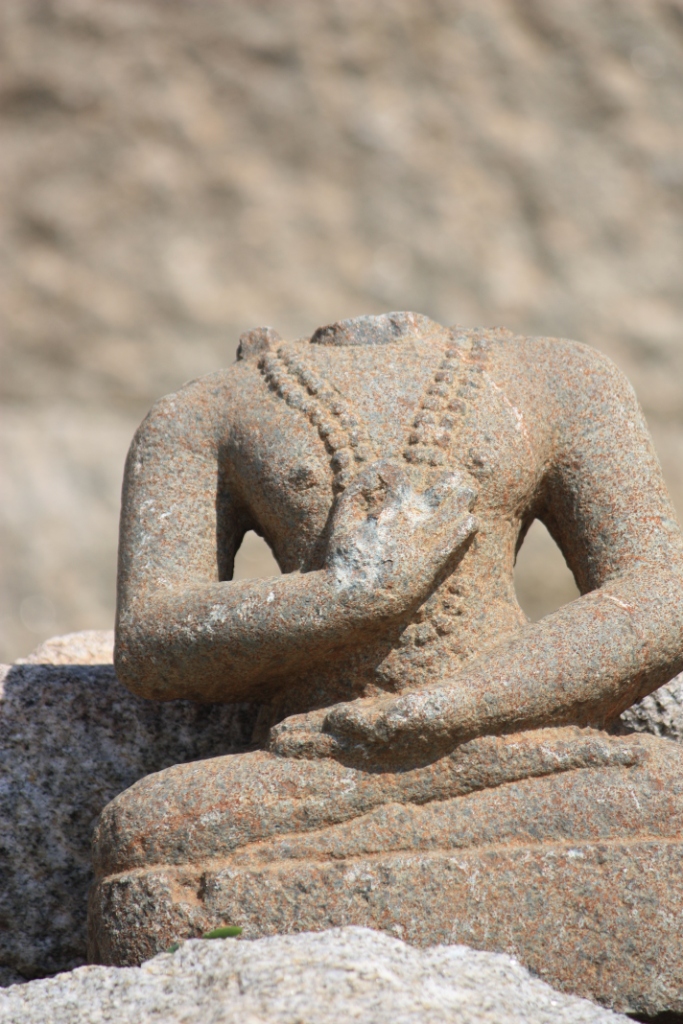
I should point out that there are some impressive stone carvings located throughout the property. The artists are international in scope. Each of these carvings or sculptures offers its own story. I’ll attach a few pics for your edification.

20120101_16151920120101_16142320120101_155241

Why I Study Thai Yoga Bodywork

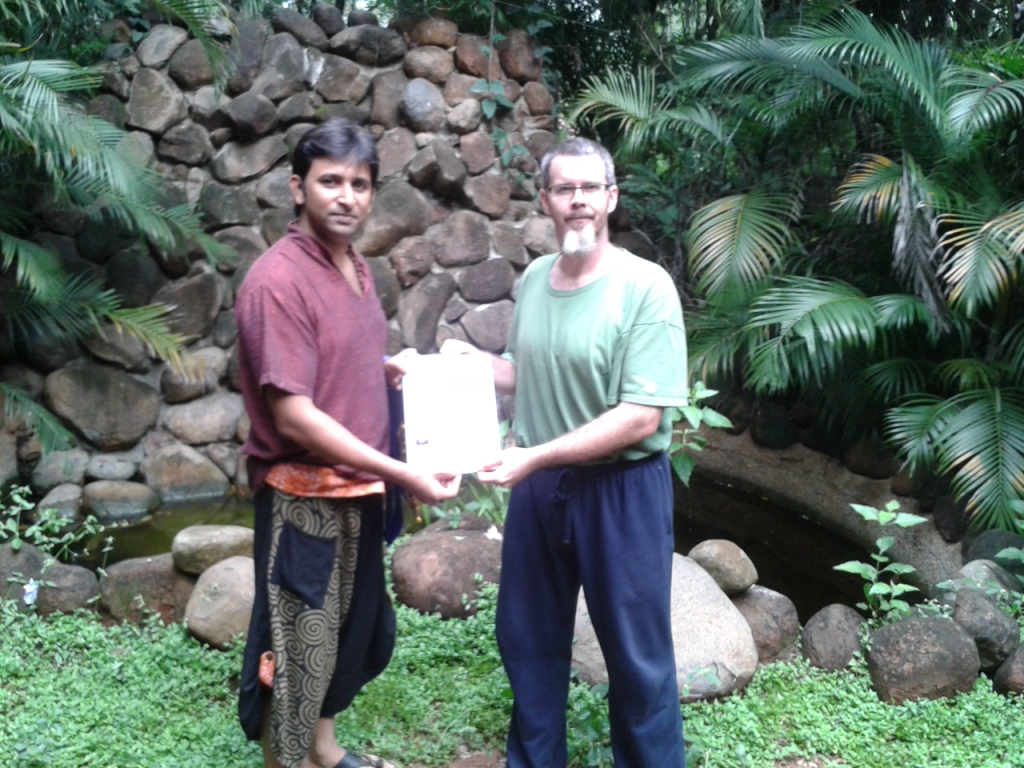
Receiving my 60 hour course certificate from the teacher.

Receiving my 60 hour course certificate from the teacher

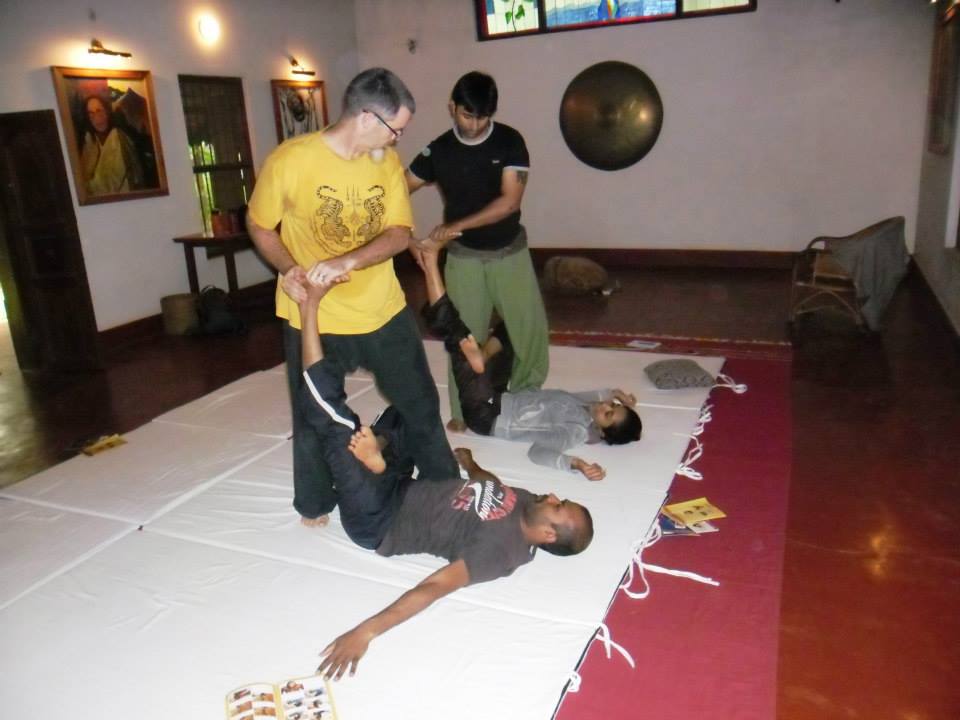
Thai Yoga Bodywork (TYB), also called Nuad Boran (ancient bodywork) or Thai Massage, is a system that integrates assisted yoga-style stretching, reflexology, acupressure massage, and elements of Ayurvedic healing to stretch and massage the body. Its history is believed to date back 2,500 years to Northern India, where its roots lay with Jivaka Kumar Bhaccha–a physician in Buddha’s community. However, the art reached its perfection in Thailand, the nation with which it remains most closely associated.

I recently completed an introductory course in this system in Bangalore through the Inner Mountain School of Healing Arts.

Before I moved to India, I thought a lot about what I would like to learn while I was on the other side of the planet. There’s a great deal of expertise on subjects sparsely taught in the US, and it can often be had at a bargain in comparison to American prices.

Some of the skills I wanted to foster were to be expected. I wanted to learn more about meditation and the ways of living in the moment and with a quieter mind. I’ve played with such practice for a long time, and I came to believe that becoming a better martial artist  and person depended upon cultivating fudōshin— an immovable spirit. I’ve seen no route to that state that circumvents quieting the mind, and that requires observing and training the mind. One can only become more physically capable for a time, then growth depends upon the mind, on shedding petty impulses, on being incapable of manipulation, and on being unswayed my the vagaries of emotion. I’ve begun working on this objective through visits to meditation centers and by making my own practice more regular.

I also want to learn about other martial arts, besides the one I’ve been learning my entire adult life. It makes sense to learn something about the indigenous martial arts of the places I visit. I want to experience the similarities and differences of these arts, and to learn about the cultural elements that shape those differences and elements of uniqueness.

However, one of the biggest surprises has been my new-found interest in studying Thai Yoga Bodywork (TYB.) When I visited Thailand last fall I studied Muay Thai (Thai kickboxing) for a week and Thai cooking for a day, but it didn’t occur to me to take one of the many Thai Massage short courses until I was back home. My interest in TYB is reflective of a broader desire to learn more about the indigenous healing methods of Asia, and that goes back a few years.  I developed a vague feeling that I wanted to study such things a couple of years back when I realized my body was deteriorating too fast for comfort, and Western medical treatment consisted of advising me to stop doing a number of the activities that I love.  Still, I must admit that I didn’t really give  a lot of thought to this interest until I started this course.

Having now thought about it, my interest in studying TYB is closely linked to my interest in martial arts. This notion might seem hard to reconcile.  TYB is a healing art, and martial arts, while they should be grounded in a sound moral philosophy, are essentially about inflicting damage on a body. The  two disciplines seem to be at odds. Still, they have a great deal in common. In each, mindfulness is key. Control of the breath is a common element of both. In Japanese martial arts there is a word, taijutsu, which means body skills, but which implies efficient use of the body. This means favoring bigger muscle groups over smaller ones where possible and taking advantage of the body’s natural alignment (e.g. straight spine) and body weight. These concepts that I had long practiced in budō were also ubiquitous in TYB. Furthermore, a number of the points that I had learned to attack, were now targeted to heal.

Still, some of these same points could be said to be common to any system of movement done properly, be it dance or exercise. So why I was drawn to TYB in particular? The most direct reason is to learn how to fix the failings of my body, and those that I’ve witnessed in others. I experienced these methods as a recipient in Thailand, and could see their value at once.

There’s also a benefit from increased understanding of anatomy and bodily awareness. One learns about how the musculature works to move the body in a way that isn’t easily picked up from textbooks. One begins to read bodies like others read books. One gains insight into the bodily deficiencies that one has taken on without even being cognizant of them. A martial artist may, on average, be a hundred times more bodily aware than the average person, but that doesn’t mean there isn’t great room for growth. (It speaks to how sadly lacking in bodily awareness most people are as much as anything.)

Still, this isn’t the full story of why I wanted to learn this art. Another reason came to mind in the introductory session, before we even began learning the technique. The teacher was talking about how TYB teaches humility, and how one has to learn to touch a stranger’s feet with compassion and devotion to that person’s well-being–an act that doesn’t come naturally to most of us.  Admittedly, this isn’t a level of humility and compassion that I have developed in life to date. Though I am the son of a mother who–as a nurse as well as a mother–was probably more at ease with putting the well-being others above her own comfort than anyone else I’ve ever met, for me this is a struggle outside my comfort zone. The martial arts teach a kind of humility (a lesson that all too many practitioners find a way to make an end run around), but if one’s practice is separate from one’s career field it’s easy for the notion of service to be so abstract as to lose meaning.

This, of course, returns back to my earlier mention of the mind. One’s ego is the biggest barrier to personal growth. Ego makes one easily manipulated. Ego makes one subject to petty impulses. Ego makes one give into fear and anger.

Learning a stretch

Learning a stretching technique

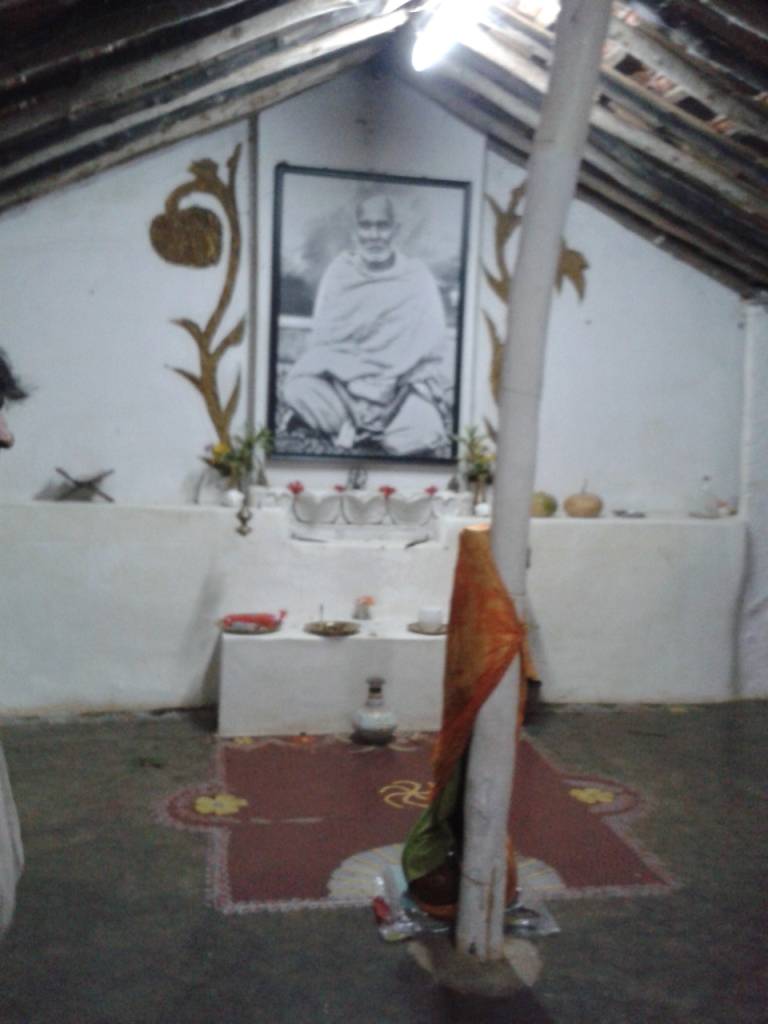
DAILY PHOTO: Narayana Gurukula Bangalore

Taken on October 25, 2013.

Taken on October 25, 2013.

Well I’m back from my 10-day Thai Yoga Bodywork course, and will resume a normal posting schedule.

While I was gone I visited a couple  interesting places. One of which was the Narayana Gurukula Bangalore location. This small and simple ashram is watched over by a sweet lady known to visitors as “Ma”… and some really menacing looking dogs. Above is the interior of what might be called the main hall. There are some interesting stone carvings and artworks across the property as well as a little stone temple and a lilliputian book house.

I wasn’t familiar with Narayana Guru before my visit. There have been so many gurus in India, and it’s hard to know of them all. However, this particular guru and his disciples (one of whom, Nataraja Guru, started the Gurukulam) held forward-thinking views on society and spirituality. A Hindu, Narayana guru advocated unity between traditions and a focus on introspection as the route to betterment.

BOOK REVIEW: The Mind of the Guru by Rajiv Mehrotra

The Mind of the Guru: Conversations with Spiritual MastersThe Mind of the Guru: Conversations with Spiritual Masters by Rajiv Mehrotra

My rating: 3 of 5 stars

Amazon Page

The Mind of the Guru is a compilation of 20 interviews with various teachers and spiritual leaders. While most of the individuals are from Indian spiritual traditions or offshoots thereof, the author makes concerted efforts to represent a range of religious and spiritual traditions.

The list of interview subjects is impressive and includes: The Dalai Lama (Tibetan Buddhism), Thich Nhat Hanh (Zen), S.N. Goenka (Vipassana), BKS Iyengar (yoga), Deepak Chopra (medical doctor and spiritual pundit), Sri Sri Ravi Shankar (Art of Living founder), Desmond Tutu (Christianity), and The Aga Khan (Islam.)

The book is at its best when these gurus are discussing their thoughts on development of the mind and spirit. Obviously, there is a lot of this type of discussion as that is the expertise of most all of the assembled teachers.

A brief forward by The Dalai Lama sets the theme of the discussion. His Holiness states that in Buddhist tradition one becomes a teacher because one has students. Consider this in contrast to traditions that fallaciously believe the title of teacher is granted from above. A master teacher may grant a teaching licence, but that’s just a piece of paper unless someone shows up to one’s lessons. He then goes on to say that one should abandon teachers who act in an unwholesome manner. This, too, is an important point. Having invested oneself in loyalty, it can feel like betrayal to leave a teacher who no longer suits one.

His Holiness is the lead chapter interviewee. In the early part of the chapter, he presents many thoughts on Tibetan mind science. “Mind science” may seem like a strange term, but there’s an important part of Tibetan Buddhism that deals not with deities and conceptions of morality, but with understanding and improving how the mind operates.

If one comes from a tradition in which science and religion are in tension, this may seem unusual, but there is a definite scientific approach (observing the mind and playing out experiments with it.) One doesn’t see a rift between science and religion in Tibetan Buddhism. In fact, His Holiness says that if certain parts of the religious tradition were proved not to exist, they would have to be abandoned. (For those beginning to raise objections, shown to be unlikely and disproven are two different things.)

A second Tibetan Buddhist, Sogyal Rinpoche, addresses the topic of death, and lends the book one of my favorite quotes: “If you are worried about dying, don’t worry, you will all die successfully.”

The first part of this five part book also includes interviews with Thich Nhat Hanh and S.N. Goenka. The former talks about mindfulness and the “interbeing,” and the latter describes the Vipassana approach to meditation and its development. Interbeing is a term coined by Hanh to address a being who is connected to all things. For those unfamiliar with Vipassana, it’s a meditation practice that emphasizes 10-day intensive meditation retreats. There are many retreat centers where this is practiced around the world, including one in the city in which I currently live, Bangalore.

The second part deals with the unity of mind and body. BKS Igenyar, head of a self-named branch of Hatha yoga, opens the chapter with discussion of his background and approach to yoga. Deepak Chopra talks about the intersection of science and spirituality. David Frawley talks about Ayurvedic medicine as well as some more “out there” subjects, such as astrology.

I hadn’t heard of two of the three interviewees in part three, Swami Ranganathananda and Mata Amritanandamayi. However the third interview was Sri Sri Ravi Shankar, a guru well-known internationally for his soft-spoken teachings that combine yoga with a secular spiritualism rooted in Hinduism but not explicitly advocating it. Swami Ranganathananda is from Ramakrishna’s order, which was a secular spiritualism movement rooted in Vedantic traditions but embracing diversity of belief. Mata Amritanandamayi is one of only two women interviewed for the book, indicating women haven’t achieved equality in guru-hood just yet–for all the talk of enlightened thinking. (This is not a dig at the author, who probably went out of his way to include these two to have diversity in gender as well as diversity of tradition.)

The fourth part adds to the diversity by opening with an interview with Sufi Muslim, Pir Vilayat Inayat Khan. Sufi is the mystical branch of Islam. (Mysticism meaning a belief structure in which God is considered to be part of one and is accessed by mindfulness and introspection. This in contrast to the largest strands of the world’s major religions in which God is conceptually something distinct from the self and is an entity to be worshiped. Most major religions have mystical elements or a mystical branch, including Christianity and Islam.) This interview eases us away from the traditions that are either of India or have their roots in India. (By that I mean that Buddhism has its roots in India, though, for example, Zen is different from Buddhism as practiced in India today.)I say “eases us away” because the mystical nature of Sufi would not create much cognitive dissonance in yoga practitioners, Hindu spiritualists, or Zen monks, but, instead, shares much common ground.

The second chapter in part 4 is that by the other female guru, Radha Burnier, who is a practitioner of Theosophy, which means “divine wisdom.” This modern development is secular in that it doesn’t advocate a particular religion, but rather engagement to fix societal problems and eliminate biases and divisions. In the interview we get a hint of the divides that plagued this organization.

Part four is rounded out by interviews with Swami Parthasarathy and U.G. Krishnamurti (not to be confused with Jiddu Krishnamurti, who probably would have been included in this book if he hadn’t died in the 1980’s.)The former speaks about the end of knowledge and the latter about his role as an anti-guru, rejecting traditional approaches to thinking about spirituality.

The fifth part of the book is entitled “The Ethics of Engagement” and I’m afraid it’s where the wheels roll off. It has six excellent authorities, Desmond Tutu, Baba Amte, Ajarn Sulak Sivaraksa, Swami Agnivesh, The Aga Khan, and Karan Singh.I don’t criticize the selection of interviewees, but what happens here is that the chapters predominantly become about politics and policy. Some of this discussion is present throughout the earlier chapters, it’s a point that the author/interviewer finds either intriguing or salable. For example, he asks The Dalai Lama about the politics of Tibet and China, but only after much wisdom is shared.

Here is my–sure to be highly controversial–view on the subject. Wise people show the least wisdom when they’re speaking of politics and policy. I understand why readers may want to hear their thoughts, and I know that as leaders they shape movements in these domains. However, their thoughts on such subjects rarely pack the wallop of value they do when they are talking about subjects like improving one’s mind or living a moral life–subjects on which they have great authority.

What happens when the wise talk about policy is the same thing that happens when most people do, they fail to understand the complexity of the issues and they end up making a lot of “have our cake and eat it too” statements. The most common of these is that we need to: a.) raise all the poor to a certain standard of living (a noble cause), b.) eliminate attachment to materialism and consumerism (also a fine cause, no one should be addicted to “stuff.”)

As one trained as an economist, however, when I see these statements issued by the same person in the same interview, I laugh. We have no idea how to achieve these two things simultaneously; anybody who tells you they do is living in a dream world or is deceiving you. If everybody decided tomorrow that they didn’t need a bunch of new gadgets and widgets, this wouldn’t help pull the poor out of poverty. On the contrary, it would lessen their opportunities to raise their quality of life. Conversely, if you want to pull people out of poverty, they have to produce and sell things that other people want. Rising incomes result from rising productivity, and rising productivity comes with rising production–but someone has to buy that increased production. If you have a way to truly get around this dilemma and it’s one that economist haven’t thought of before and which hasn’t either been proved wrong or internally inconsistent, I will personally lobby for you to be nominated for next year’s Nobel Prize in Economics, and would place a bet on you to win.

I will say that some of the authors seem more savvy of the political and societal domain than others. For example, Mata Amritanandamayi says, “Even if we remove all nuclear weapons from our armories and transfer the to a museum [that last bit is, admittedly, a really bad idea], it wouldn’t bring an end to war. The real nuclear weapons, the negative thoughts in our mind, should be eliminated.” In other words, you can’t fix society’s problems through dictates, particularly when those dictates are in contradiction.

One of my lesser complaints with the book is that the author sometimes asks leading questions (i.e. he subsumes a conclusion in the way he forms the question.) However, almost invariably the speaker sets the record straight, but it makes one wonder about how the message is shaped by the interviewer.

There may be a little too much cultural self-congratulation going on throughout the book for some. There’s a primacy fallacy theme throughout the book that India had everything perfect until it was infected by Western ideas. This isn’t to imply there aren’t fantastic ideas and cultural developments that have come out of India. I wouldn’t have read the book if I didn’t believe there were, but there was also the caste system and some other fairly giant issues of institutionalized injustice like women essentially being sold off into marriage.

An example of this bias can be seen in the talk of Swami Ranganathananda. He says of Socrates, “Had he been in India, he would have been honored and worshipped.” Yeah, if he were of the right caste, maybe, but he also might have been bludgeoned to death in a fashion far more brutal than having to drink hemlock.

Overall, I would recommend the book. It is an impressive collection of teachers and all of them have something intriguing to offer in food for thought. One just needs to go back to The Dalai Lama’s Forward and not be so awe-inspired that you fail to look critically at the message of each.

View all my reviews