“Untitled” [Pronunciation Poem] by Anonymous* [w/ Audio]

I take it you already know
Of tough and bough and cough and dough.
Others may stumble, but not you,
On hiccough, thorough, lough and through.
Well done! And now you wish, perhaps,
To learn of less familiar traps.

Beware of heard, a dreadful word
That looks like beard and sounds like bird.
And dead -- it's said like bed, not bead.
For goodness sake, don't call it deed!
Watch out for meat and great and threat.
They rhyme with suite and straight and debt.

A moth is not a moth in mother,
Nor both in bother, broth in brother,
And here is not a match for there,
Nor dear and fear for pear and bear.
And then there's dose and rose and lose
Just look them up -- and goose and choose.

And cork and work and card and ward.
And font and front and word and sword.
And do and go, then thwart and cart.
Come, come I've hardly made a start.

A dreadful language? Man alive,
I'd mastered it when I was five!

* This poem has come to be attributed to a T.S. Watt with a date of 1954. However, the broad divergence of titles and lack of other publication information suggest the alternate possibility that attribution was invented after the fact and has just been mindlessly copied across the internet. I don’t wish to cheat T.S. Watt, if he or she was an actual person who wrote this clever poem, but I also don’t wish to contribute to the spread of false information that happens regularly across the internet. Hence, this note.

“A Poison Tree” by William Blake [w/ Audio]

I was angry with my friend;
I told my wrath, my wrath did end.
I was angry with my foe:
I told it not, my wrath did grow.

And I watered it in fears,
Night & morning with my tears:
And I sunned it with smiles,
And with soft deceitful wiles.

And it grew both day and night.
Till it bore an apple bright.
And my foe beheld it shine,
And he knew that it was mine.

And into my garden stole,
When the night had veild the pole;
In the morning glad I see;
My foe outstretched beneath the tree.

“Swordsman” by Jia Dao [w/ Audio]

Ten years honing this fine blade,
And it has not drawn blood.
Now, you'll see of what we're made:
Who, wronged, is owed in blood?

The Original: 劍客: 十年磨一劍, 霜刃未曾試. 今日把示君, 誰有不平事.

“The Rainy Day” by Henry Wadsworth Longfellow [w/ Audio]

The day is cold, and dark, and dreary;
It rains, and the wind is never weary;
The vine still clings to the mouldering wall,
But at every gust the dead leaves fall,
And the day is dark and dreary.

My life is cold, and dark, and dreary;
It rains, and the wind is never weary;
My thoughts still cling to the mouldering past,
But the hopes of youth fall thick in the blast,
And the days are dark and dreary.

Be still, sad heart, and cease repining;
Behind the clouds is the sun still shining;
Thy fate is the common fate of all,
Into each life some rain must fall,
Some days must be dark and dreary.

“Slender” [Poetry Style #3] by Sikong Tu [w/ Audio]

Picking, picking where water flows
From a distant fountainhead.
Moving up the narrow valley,
One may see a stunning beaut.
Peachtrees laden with ripe fruit
As breezes blow by the water
And willows wind along the stream,
While warblers consult with branch-mates.
The more one walks, the more Truth joins,
And more Truth may reveal the Way.
If this world is without end,
The old must be made new again.

NOTE: The late Tang Dynasty poet, Sikong Tu (a.k.a. Ssŭ-k‘ung T‘u,) wrote an ars poetica entitled Twenty-Four Styles of Poetry. It presents twenty-four poems that are each in a different tone, reflecting varied concepts from Taoist philosophy and aesthetics. Above is a crude translation of the third of the twenty-four poems. This poem’s Chinese title is 纤秾. Giles translated the title as “Slim — Stout” and it’s also been translated as “Delicate – Rich.”

“Success is counted sweetest” (112) by Emily Dickinson [w/ Audio]

Sucess is counted sweetest
By those who ne'er succeed.
To comprehend a nectar
Requires sorest need.

Not one of all the purple Host
Who took the Flag today
Can tell the definition
So clear of victory

As he defeated -- dying --
On whose forbidden ear
The distant strains of triumph
Burst agonized and clear!

“If thou must love me” [Sonnet 14] by Elizabet Barrett Browning [w/ Audio]

If thou must love me, let it be for nought 
Except for love's sake only. Do not say,
"I love her for her smile -- her look -- her way
Of speaking gently, -- for a trick of thought
That falls in well with mine, and certes brought
A sense of pleasant ease on such a day" --
For these things in themselves, Beloved, may
Be changed, or change for thee -- and love, so wrought,
May be unwrought so. Neither love me for
Thine own dear pity's wiping my cheeks dry:
A creature might forget to weep, who bore
Thy comfort long, and lose thy love thereby!
But love me for love's sake, that evermore
Thou mayst love on, through love's eternity.

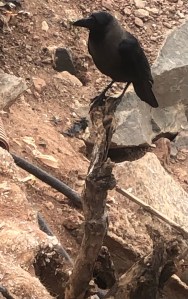
“Raven at Dusk” by Matsuo Bashō [w/ Audio]

on a barren branch
a raven has perched —-
autumn dusk

“Second Fig” by Edna St. Vincent Millay [w/ Audio]

Safe upon the solid rock the ugly houses stand:
Come and see my shining palace built upon the sand!

“An Akan Lullaby” by Anonymous [w/ Audio]

Someone would like to have you for her child
but you are mine.
Someone would like to rear you on a costly mat
but you are mine.
Someone would like to place you on a camel blanket
but you are mine.
I have you to rear on a torn old mat.
Someone would like to have you as her child
but you are mine.

NOTE: I have no specific author or translator information for this poem. (The former may not be surprising as it may be lost to history.) At any rate, my source is Classic Poems to Read Aloud, an anthology selected by James Berry (1995; Kingfisher Publications,) and it was titled “Lullaby.” That book cites a Cambridge University Press volume entitled African Poetry, edited by Ulli Beier, as its source.