It's as if ones gone mining --
   From lead, silver refining.
 That's how one cleanses a heart:
   With pure love, not pining.

Like a pond from Spring rainfall:
   Mirror to heavens and all,
 Without defect of image --
   True as the moon's bright, white ball.

Stargazing across night skies;
   Singing songs of hermits, wise;
 The water flowing today
   Will know that bright moonrise.
NOTE: The late Tang Dynasty poet, Sikong Tu (a.k.a. Ssŭ-k‘ung T‘u,) wrote an ars poetica entitled Twenty-Four Styles of Poetry. It presents twenty-four poems that are each in a different tone, reflecting varied concepts from Taoist philosophy and aesthetics. Above is a crude translation of the seventh of the twenty-four poems. This poem’s Chinese title is 洗炼, and it has been variously entitled: “Clean,” “Refining,” and “Wash — Smelt.”
A glimpse through an interstice caught,
 Of a crowd of workmen and drivers in a bar-
   room around the stove late of a winter night,
   and I unremark'd seated in a corner,
 Of a youth who loves me and whom I love,
   silently approaching and seating himself near,
   that he may hold me by the hand,
 A long while amid the noises of coming and
   going, of drinking and oath and smutty jest,
 There we two, content, happy in being together,
   speaking little, perhaps not a word.
One's-Self I sing, a simple separate person,
 Yet utter the word Democratic, the word En-masse.

Of physiology from top to toe I sing,
 Not physiognomy alone nor brain alone is
      worthy for the Muse, I say the Form complete
      is worthier far,
 The Female equally with the Male I sing.

Of Life immense in passion, pulse, and power,
 Cheerful, for freest action form'd under the laws
      divine,
 The Modern Man I sing.
Immortals ride truth
   With lotus in hand,
 As chaos unfolds
   Unlogged above land.

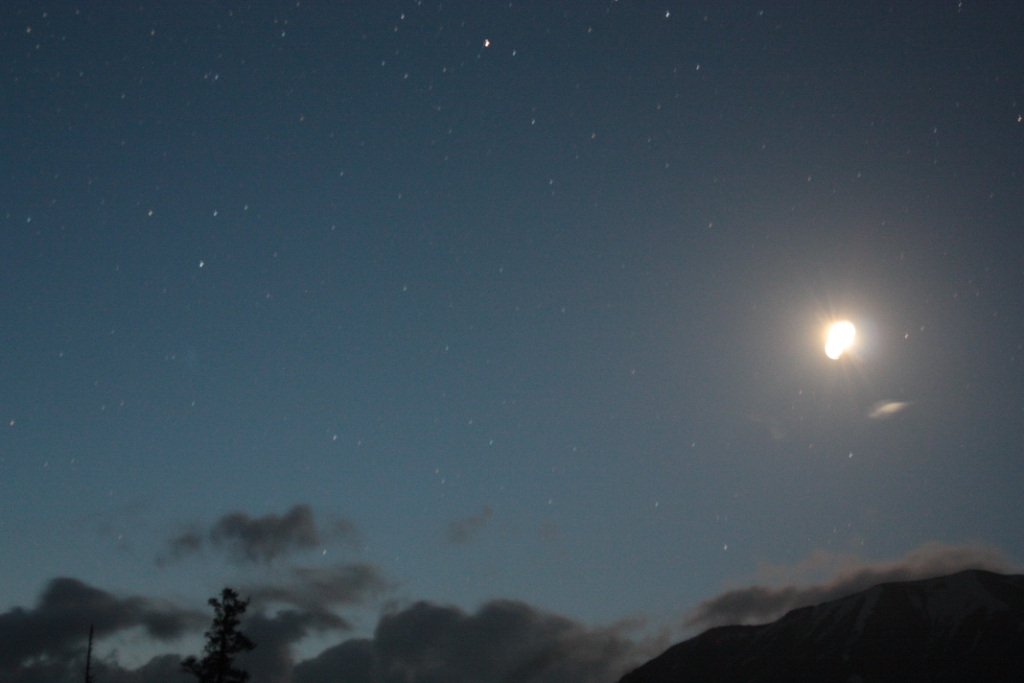
Moonrise in the East
   As good winds are fanned.
 Hill shrine in blue night,
   Bell rings clear and grand.

The god is now gone
   Beyond border lands
 Huangdi* is not there
   Great Age to wasteland.
NOTE: The late Tang Dynasty poet, Sikong Tu (a.k.a. Ssŭ-k‘ung T‘u,) wrote an ars poetica entitled Twenty-Four Styles of Poetry. It presents twenty-four poems that are each in a different tone, reflecting varied concepts from Taoist philosophy and aesthetics. Above is a crude translation of the fifth of the twenty-four poems. This poem’s Chinese title is 高古 (Gāo Gǔ,) and it was translated as “Height – Antiquity” by Herbert Giles.
*Huangdi is a name for the Yellow Emperor that is more syllabically friendly than “Yellow Emperor.” In a great oversimplification for the sake of speed and alignment of context, the Yellow Emperor was China’s King Arthur — a mythical leader of great virtue and heroism. The Tang emperors tried to trace lineages back to the Yellow Emperor, but such imagined linkages to the perfect leader are hard to maintain when an Emperor like Xuanzong crashes the ship of state.











 Tiger Riding for Beginners