BOOKS: The Importance of Being Earnest by Oscar Wilde

The Importance of Being EarnestThe Importance of Being Earnest by Oscar Wilde
My rating: 5 of 5 stars

Amazon.in Page

This play is an amusing cautionary tale on the dangers of “Bunburying” and / or leading a double life. “Bunburying,” a term coined by Wilde in this play, is the act of concocting meetings with a fictitious friend to get out of tedious familial (and other social) obligations. Don’t want to go to Aunt Bessie’s potluck? Tell her that your friend with a plausibly absurd name (e.g. Bunbury) has ruptured a disc in his back and desperately needs your assistance. Bunburying is the specialty of one of the two bachelor characters this story is built around, a man named Algernon. The other, Jack, goes by the name Ernest when he is in London, and has to invent the story that he has a brother when his town and country dichotomy of personalities starts to be seen through by those other than Algernon.

This humorous tale revolves around both Algernon and Jack finding desirable fiancés while being tangled in the web of their own duplicity. Much of the humor comes from the interactions of Algernon and Jack, two men who are quite alike, though Jack thinks himself more respectable. Algernon is more at ease with his own scamp-like nature and plays a role similar to that played by Lord Henry in Wilde’s novel, The Picture of Dorian Gray. That is, Algernon offers many a quotable line that at least has the appearance of wisdom — if, often, a kind of nihilistic wisdom.

This play is definitely worth reading.

View all my reviews

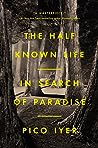
BOOKS: The Half Known Life by Pico Iyer

The Half Known Life: In Search of ParadiseThe Half Known Life: In Search of Paradise by Pico Iyer
My rating: 5 of 5 stars

Amazon.in Page

The subtitle to this collection of travel essays might suggest Iyer intends to write about the most idyllic places on Earth. In a way, he does, but he’s also revealing the conundrum of “paradise” by showing the reader places that have been called “paradises,” but which are also some of the furthest places from serenity imaginable. I wouldn’t say that the author is revealing the concept of paradise to be an illusion, but rather that he’s showing that there is an inextricable tangle of dark and light in any earthly paradise. I think the idea is best expressed in a quote from the book, “A true paradise has meaning only after one has outgrown all notions of perfection and taken the measure of the fallen world.” [FYI: the main title is from a quote from Moby Dick.]

From my experience with some of the places that Iyer covers (e.g. Kashmir, Sri Lanka, Varanasi, etc.) I can glimpse the substance that started him digging. It isn’t just that these places are superficially paradisaical (though Kashmir and parts of Sri Lanka are definitely scenically idyllic,) but there is some other (deeper) quality by which these places feel fantastical. Of course, the examples that I mentioned (as well as others: e.g. Jerusalem) are simultaneously examples of the antithesis of paradise. These are troubled places with histories of violence and dysfunction. I even learned that Bali (which doesn’t have its own chapter but is discussed) has barbarity in its own history, and it seems as likely a candidate for true paradise as any.

I enjoyed reading this book. I must admit that part of my fascination with it derived from the fact that I’d tread much of the same ground that Iyer covers. I’d highly recommend the book for readers of travel writing.

View all my reviews

Reviewer Limerick

There once was a prolific reviewer
 who reviewed everything from shipyards to sewers.
   With great dispassion,
     he reviewed an assassin,
  and wished he'd written one review fewer. 

Grave Reviews [Free Verse]

I click on Google Maps;
 a pin highlights for a cemetery,
  and, here, I stumble upon 
   graveyard reviews.

These reviews intrigue me because
 it seems to me that if one is capable 
  of writing a cemetery review,
    then one is unqualified.

And, if one is qualified to comment
 on the caliber of an eternal resting place,
  then one is unlikely to be capable of 
   posting a review.

I read one of the one-star reviews
 and see that the reviewer's principal complaint
 is an overabundance of "pocong."

"What is a 'Pocong?'" you may ask.
 It is a Javanese ghost that takes up
  occupancy in death shrouds.

Why is there a Javanese ghost
 infestation in a cemetery 4000 kilometers
  from Java, and -- as near as I can tell --
   with zero Javanese occupants?

The review does not say,
 but I love that someone panned 
  a cemetery based on the presence 
   of foreign ghosts

[and not because it is simultaneously
 phasmophobic and xenophobic.]

But because it shows an unbridled commitment 
 to one's imagination that is usually 
  only seen among children. 

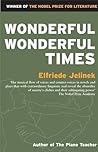
BOOKS: Wonderful Wonderful Times by Elfriede Jelinek

Wonderful, Wonderful TimesWonderful, Wonderful Times by Elfriede Jelinek
My rating: 5 of 5 stars

Amazon.in Page

If I said this book was A Clockwork Orange meets A Midsummer Night’s Dream it would be in some ways deceptive but in other ways, accurate. The book has none of the otherworldliness of those other stories and, instead, is set in a realistic 1950’s Vienna. Furthermore, those comparisons might confuse readers into not realizing this book is unambiguously a tragedy.

The book is set around four kids (Rainer, Anna, Hans, and Sophie) who like to beat up and rob adults, usually using a kind of catfishing scheme where they trick a middle-aged man into thinking he is about to have a getting lucky with Lolita moment before the other three gang up on the man in a moment of shock and awe. Here lies the “Clockwork Orange” comparison: youths enamored of violence as a means to combat the boredom and meaninglessness of their lives — possibly while passing on the abuse they receive in their own lives.

The “Midsummer Night’s Dream” part comes in with the book’s love geometry. Like that Shakespearean play, there are two boys and two girls and both boys are in love with the same girl (Sophie,) leaving the other girl (Anna) in a sad unrequited territory.

The book won’t be everyone’s cup of tea, and not only because it deals heavily in sex and violence. There are a couple factors that make the book feel strange. First of all, it is written in present tense. Secondly, it spends a lot of time in the minds of the characters and relatively little time with the action. Thirdly, the pacing of the conclusion and resolution of the book is abrupt and might feel forced — like the author was 245 pages in when the publisher told her that she had 250 pages, maximum, and that she’d better be wrapping it up. I didn’t find any of these factors to be problematic, but I can see how they would rub some readers the wrong way.

If the premise intrigues, you should definitely read this book – particularly if the previous paragraph’s warning didn’t turn you off.

View all my reviews

BOOKS: The Picture of Dorian Gray by Oscar Wilde

The Picture of Dorian GrayThe Picture of Dorian Gray by Oscar Wilde
My rating: 5 of 5 stars

Amazon.in Page

This is a book about what happens when you hollow out a person of all the complexity of the human condition and idealize them. At the beginning of the story, Dorian Gray is young, attractive, and preternaturally likable in a naïvely innocent kind of way. Almost to the novel’s end, through the magic of a wish made upon a portrait, Gray is still young and beautiful, though that naive innocence cracks under the strain of the impossible bifurcation of man and his soul. The artist, Basil Hallward, and Lord Henry (a man who will become a mutual friend of Gray and Hallward) cannot see Gray as a fully formed human being, but rather see him as an emblem of youth and beauty. But this unnatural ideal cannot hold, and a string of tragic deaths will be left in its wake.

The book is full of clever witticisms, albeit often of a nihilistic nature. These are almost all spoken by Lord Henry, who is the Polonius of the story – but a hipper kind of Polonius than Hamlet‘s. That said, it’s telling that toward the end of the book Gray does some of this epigrammatic philosophizing. (e.g. Such as when Gray tells Hallward, “Each of us has heaven and hell in him…”) One might dismiss this as Gray parroting Lord Henry, but I think that life has defrocked him of his naïveté, and he begins to think in ways that were impossible in his [true] youth.

This is a must-read. It’s interesting, thought-provoking, and well worth the time.

View all my reviews

BOOKS: How Long Can the Moon Be Caged by Suchitra Vijayan & Francesca Recchia

How Long Can the Moon Be Caged?: Voices of Indian Political PrisonersHow Long Can the Moon Be Caged?: Voices of Indian Political Prisoners by Suchitra Vijayan
My rating: 4 of 5 stars

Amazon.in Page

It’s no secret that the Gandhian pluralistic vision for India has been taking some hard knocks under the current administration (and the rise of Hindu nationalism that it represents,) but it’s also not as widely and intensely discussed as it could be. This book represents an attempt to make the stories of dissident political prisoners more widely heard.

For that attempt, I would give it high marks, but the execution is problematic. The middle part of the book does a reasonably good job of telling the stories of these individuals. However, the book comes across far too much like a reference book than a journalistic account for much of its length — particularly in the beginning and at the end. The beginning has a long bullet point account of relevant events that I’m sure is meant to give readers an idea of the scope of the problem, but it also sterilizes the information. At the end there are letters and a chapter that consists entirely of data. Letters can be fine, but they aren’t the most evocative way to convey these stories because they contain a good deal of information that is extraneous to the author’s point, and thus the message is diluted.

I do wish supporting evidence was turned up and gratuitous statements turned down a bit. In other words, I assume the government could present a counter-narrative that these are not just dissenters voicing unpopular opinions but rather individuals actively engaged in subversive operations. Granted, the prominence of poets, the ill, and the elderly does make it hard to believe these are some sort of guerrilla warfare masterminds. True, there is a challenge in disproving a negative that makes it hard to prove a person has done nothing wrong.

At any rate, it’s a book I’m glad I read, and I did learn about the issue, but I wish the execution had been better. Maybe that’s for another book.

View all my reviews

BOOKS: A Double-Barreled Detective Story by Mark Twain

A Double Barrelled Detective StoryA Double Barrelled Detective Story by Mark Twain
My rating: 5 of 5 stars

Amazon.in Page

This novella is Mark Twain’s satirical jab at the whole Sherlock Holmes concept. In particular, it pokes fun at a detective who eschews everything supernatural in favor of cold rationality, but who produces results so impossible that they are themselves supernatural.

The story has two temporally disjointed parts that almost seem like independent stories until the very end when all is tied up. (Holmes only appears in the second part.) This works nicely for parody of Holmesian detective fiction as it’s an approach that was used by Sir Arthur Conan Doyle on occasion — e.g. in A Study in Scarlet. The first part tells the tale of a woman who is treated foully by Jacob Fuller, the husband she eloped with but who harbored resentment towards her father, a man Fuller believed felt wasn’t good enough for his daughter. The woman makes her son, named Archy Stillman, promise that he will track down Fuller and make the man’s life a living hell.

The second part revolves around a murder that seems to be independent of the case described above, the killing of a man named Flint Buckner. Here Sherlock Holmes, who happens to be in town visiting his nephew – Fetlock Jones, “solves” the case only to be shown to be entirely and humiliatingly wrong by Archy Stillman using only a superior sense of smell and basic observation of the facts (with no elaborated inductions.)

While I never had anything against the Sherlock Holmes stories — in fact, I enjoyed them all — I did find Twain’s satire amusing and compelling as a story. [And it’s true that Arthur Conan Doyle did regularly strain credulity — that’s what made Holmes an intriguing character.]

Well worth reading.

View all my reviews

BOOKS: Hadaka-Jime by Moshé Feldenkrais

Hadaka-Jime: The Core Technique for Practical Unarmed CombatHadaka-Jime: The Core Technique for Practical Unarmed Combat by Moshé Feldenkrais
My rating: 5 of 5 stars

Amazon.in Page

This is an interesting little book. I’m not sure how much stock I put in its utility, but the idea of it intrigues me. That idea is a system of self-defense built around a single technique, in this case hadaka-jime — i.e. the rear naked choke. (For non-martial artists, the “naked” is based on the fact that it works with or without a gi [coat] — i.e. it doesn’t require gripping the lapels or other cloth as many chokes in jiu-jitsu do. So, get your mind out of the gutter.) When I say “a single technique,” I’m talking about that technique being applied against a variety of unarmed, knife, and bayonet attacks — hence this being a book-length endeavor. Another way of looking at this central idea is an attempt to maximize muscle memory building efforts — i.e. by having a less extensive body of techniques one can more heavily drill a few basics rather than an elaborate set of complicated moves. As Bruce Lee said, “I fear not the man who has practiced 10,000 kicks once, but I fear the man who has practiced one kick 10,000 times.”

I should point out that the version of hadaka-jime that Feldenkrais uses isn’t the one that I was taught, and I suspect that will be true for most readers. If you learned to have the crook of the choking arm in line with the opponent’s windpipe and have that arm’s hand tucked into the crook of the opposite hand (forming a triangular choke,) then Feldenkrais’s variation will seem strange. Feldenkrais’s variation seems to be both more brutal (because it drives the bone of the forearm against the windpipe) and more vulnerable (because one’s hands aren’t as well tucked in and the structure isn’t as self-reinforcing as the triangular variant, which is quite difficult to contend with even for a recipient who is much stronger.) All that being said, one could easily apply the same set ups for the more popular variant, one just has to move a little deeper.

As I say, I have mixed feelings about this single technique approach. On the one hand, one can see successes like Ronda Rousey had while using juji-gatame (a cross-body ground-based armbar) repeatedly. On the other hand, everyone had to suspect the days of that success were numbered as other fighters knew exactly for what they needed to prepare.

It’s a short and simple book, the chapters arranged by types of attack. It has adequate pictures to get across what Feldenkrais is trying to convey. Those interested in martial arts and self-defense may want to check it out.

View all my reviews

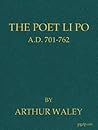
BOOKS: The Poet Li Po AD 701-762 Trans. & Ed. by Arthur Waley

The Poet Li Po       A.D. 701-762The Poet Li Po A.D. 701-762 by Arthur Waley
My rating: 5 of 5 stars

Available online at: Project Gutenberg – The Poet Li Po

Li Po, also Romanized “Li Bai,” is one of China’s most famous poets, the prolific Tang Dynasty poet wrote extensively at the nexus of intoxication and the beauty of the natural world. His well-loved and evocative poem, “Drinking Alone by Moonlight,” is a prime example [and is included in this selection.]

The selection consists of a small number of translations by [20th-century Orientalist] Arthur Waley. It’s only 20-some of the 1,000-ish extant poems of Li Bai, but it does offer variety in form and subject matter. It doesn’t include all of Li Bai’s most anthologized poems, which I consider a plus — i.e. Waley didn’t just assemble a greatest hits album.

The Waley translations aren’t as sparse as many that one will read. That offers the advantage of being clearer in meaning while losing some of the feel of the original. That said, I enjoyed this group of translations and didn’t feel they were too verbose – for the most part. It’s a selection well worth reading for those who enjoy poetry.

View all my reviews