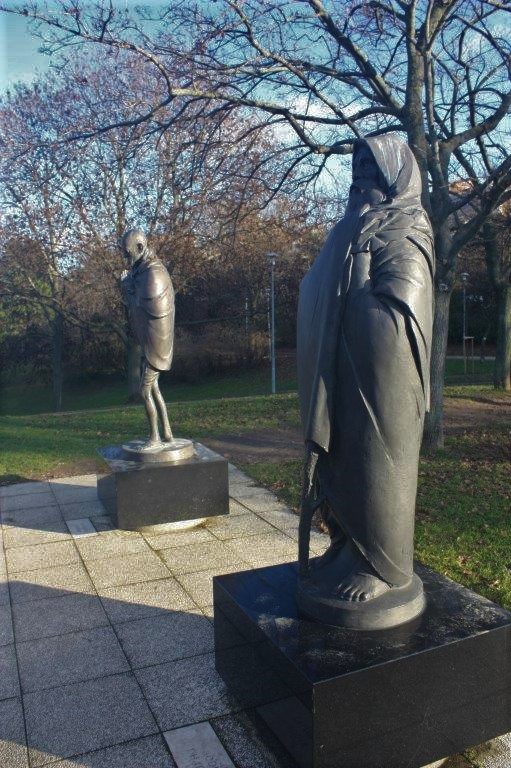
Self-Aware World [Free Verse]

I am a witness 
for a self-aware world,

a world that's not just 
chunks of matter,
but an organism that dances
 matter into 
an entity that can know.

It can know truth
and fiction 
and the truth of fiction
and the fiction of truth.

It turns order into disorder,
but with knowledge salad
on the side.

I'm a compartmentalized agent
 of a super-organism that is 
beyond my capacity
to understand
or speculate the purpose of.

I am a lonely witness.

BOOK REVIEW: Ashtavakra Gita Trans. by Bart Marshall

Ashtavakra Gita: (bootleg version)Ashtavakra Gita: by Bart Marshall
My rating: 4 of 5 stars

Amazon.in Page

There are many translations of this Hindu classic of Advaita Vedanda, a non-dualist school that teaches the oneness of all things and the illusory nature of the universe that we think we know. “The Song of Ashtavakra” explores self-realization and the path to liberation (i.e. Moksha.) [Ashtavakra was a sage with birth defects from which the name “8 angles” derives. Yoga practitioners will know the name from an arm balance pose that involves balancing the kinked body on bent arms in a manner that was apparently reminiscent of the look of this sage’s body.]

The translation that I read, one by Bart Marshall, is clearly written in readily understandable language. It’s presented as a series of short-form poems arranged into twenty chapters that also form a dialogue between Ashtavakra and Janaka. This version doesn’t contain commentary and analysis as some translations do. Because it’s both highly readable and inexpensively acquired, I’d recommend one give it a chance. If you later decide you’d benefit from commentary, you’ll not be at a loss by having read this version first.

As is common enough in such tracts, the book can be repetitive as it reiterates ideas like the need to avoid desire and aversion and the nature of oneness. That said, there were some quite powerful statements that genuinely expanded on the ideas of the work. (e.g. 18.100: “One of tranquil mind // seeks neither crowds nor wilderness. // He is the same wherever he goes.” Or 3.12 “Why should a person of steady mind, who sees the nothingness of objects, prefer one thing over another?”)

If you’re a student of philosophy or of yoga as a philosophy, I think this is well worth a thoughtful read.


View all my reviews

BOOK REVIEW: The One-Straw Revolution by Masanobu Fukuoka

The One-Straw RevolutionThe One-Straw Revolution by Masanobu Fukuoka
My rating: 5 of 5 stars

Amazon.in Page

I kept running into references to this book in my readings about food and farming, and, eventually, I figured it must be a must-read. One topic that’s of interest to me (and should be of interest to everyone) is how [or, perhaps, whether] humanity can be sustainably fed, given the realities of human nature. Fukuoka (d. 2008) was at the vanguard of what’s been called the “natural farming” movement (a term he admitted he didn’t love.) He spent decades growing rice, other grains, and fruits in rural Shikoku, Japan, using a minimalist approach.

The book mixes philosophy, biography, commentary on food / nutrition, and instruction in Fukuoka’s approach to agriculture. Guided by a philosophy of “wu wei” (i.e. “effortless action,”) Fukuoka figured out how to reduce the amount of effort and resources put into farming, while maintaining crop yields that were competitive with the standard farming model. His approach appears backwards, lazy, and unlikely to succeed. He didn’t plow his fields. He planted by casting seed into the previous crop before harvesting it (note: he alternated rice with winter grains.) He didn’t weed, but rather let white clover grow freely and used the stalks and chaff from one harvest as cover for the next (again, rotating crops,) a cover that biodegraded into nutrients. He used no chemicals, neither fertilizer nor insecticide. And yet, important details of his approach kept his yields up while using minimal resources to maximum effect by operating in accord with nature (e.g. no insecticides seems to risk infestation, but it also means that you haven’t killed the creatures that eat pests.)

Fukuoka’s philosophy combines the principles of nature, Buddhist & Taoist concepts, and – believe it or not — something reminiscent of Nihilism (without calling it such.) There are parts of the book that some might find disagreeable. For example, Fukuoka uses an analogy that draws on the Mahayanist view of the distinction between Mahayana and “Hinayana” that Theravadins may find offensive (fyi: the older branch of Buddhism considers “Hinayana” to be derogatory and believes it’s a label based on a mistaken belief.) [To be fair, Fukuoka explicitly stated that he belonged to no religion and he claimed no expertise on the subject.] More likely to take offense are scientists and agricultural researchers, a group who takes it from both barrels. [Fukuoka says his opposition to scientists is that they fill the same role in society as the discriminating mind plays in mental activity, and he values the non-discriminating mind.]

I found this book to be loaded with food-for-thought. It raises a number of questions that aren’t answered inside (e.g. is Fukuoka’s approach scalable?,) but it’s a fascinating and highly readable introduction to natural farming. I’d highly recommend it for those interested in the subject.


View all my reviews

Enlightenment in Four Bits of Shakespearean Wisdom

If you’re looking to attain Enlightenment, you may have turned to someone like the Buddha or Epictetus for inspiration. But I’m here to tell you, if you can put these four pieces of Shakespearean wisdom into practice, you’ll have all you need to uplift your mind.

There is nothing either good or bad, but thinking makes it so.

william Shakespeare, Hamlet

Through Yoga, practitioners learn to cultivate their inner “dispassionate witness.” In our daily lives, we’re constantly attaching value judgements and labels to everything with which we come into contact (not to mention the things that we merely imagine.) As a result, we tend to see the world not as it is, but in an illusory form.

The fault, dear Brutus, is not in our stars, but in ourselves.

William shakespeare, julius caesar

In Psychology class, you may remember learning about the self-serving bias, a warped way of seeing the world in which one attributes difficulties and failures to external factors, while attributing successes and other positive outcomes to one’s own winning characteristics. Like Brutus, we need to learn to stop thinking of our experience of life as the sum of external events foisted upon us, and to realize that our experience is rooted in our minds and how we perceive and react to events.

The fool doth think he is wise, but the wise man knows himself to be a fool.

william shakespeare, as you like it

A quote from Hamlet also conveys the idea, “There are more things in heaven and earth, Horatio, than are dreamt of in your philosophy.” If you grasp this idea, you may become both humbler and more readily capable of discarding bad ideas in favor of good. It’s common to want to think of yourself as a master, but this leads only to arrogance and to being overly attached to ineffective ideas. Be like Socrates.

Cowards die many times before their deaths; The valiant never taste of death but once.

william shakespeare, julius caesar

Fears and anxieties lead people into lopsided calculations in which a risky decision is rated all downside. Those who see the world this way may end up living a milquetoast existence that’s loaded with regrets. No one is saying one should ignore all risks and always throw caution to the wind, but our emotions make better servants than masters. One needs to realize that giving into one’s anxieties has a cost, and that that cost should be weighed against what one will get out of an experience.

There it is: Enlightenment in four bits of Shakespearean wisdom.

The Raging River of Human Nature [Free Verse]

Human nature is a raging river
which a few shitty sandbags of common sense
will not detour. 

Some people stand on the bank
and shout at the river.
I will admit, I've done the same.

But those words neither soak in
nor bounce off that raging river --
they're made silent,
dying in air. 

Some people try to steer
the river by splashing at the lapping waters
near its edge,

But none of them is Moses,
not one can dam a river by force of will.

And - even if one could --
eventually, that person would have to let go,
leaving a backed up and angry river
to rage onward. 

Four Aphorisms

1.) If you spend more time each day faultfinding than feeling grateful, your philosophy is fucked.

2.) Drop useless ideas as one would drop a flaming marshmallow. 

3.) If you shop recreationally, consider square dancing or kung fu.

4.) No idea should be beyond critique, but you don't have to be an ass about it.

Slant [Free Verse]

They told it slant,
but not all the truth,
and it rolled into the ears
of the willing
and into the minds
of the faithful.

And in those minds
it was built into 
a swift machine,
one of great power -- 
if little reality.

But deaths never required
reality of motive,
only 
reality of matter.

So, the wild stories
became wild ideas
that were the bane
of us all. 

BOOK REVIEW: Romanticism: A Very Short Introduction by Michael Ferber

Romanticism: A Very Short IntroductionRomanticism: A Very Short Introduction by Michael Ferber
My rating: 4 of 5 stars

Amazon.in Page

Romanticism was a literary, artistic, and philosophical movement of the late 18th and early 19th century. It’s commonly believed to have been a response to the Enlightenment, a desire to not throw out the baby with the bathwater as the influence of religion waned. In this book, we learn that that’s a misleading oversimplification, but not one completely devoid of truth.

Like a lot of “movements,” Romanticism is a fairly loose set, containing a disparate band of entities. This is exacerbated because it’s not just, say, a style of painting or of music, but rather it cuts across a diverse range of activities. Because of that, the book offers the least clarity in the opening chapters (ch. 1&2) and in the last one (ch. 6.) The first two try to rope in Romanticism and to differentiate it from “sensibility,” a movement oft-confused for Romanticism. The last chapter attempts to show the commonality that cuts across different domains, e.g. how are Romantic paintings similar to Romantic novels, or – for that matter – Idealist philosophy.

However, starting with chapter three, the book provides clear insight into the nature of Romanticism. Chapter three investigates poetry. Chapter four examines philosophy and Romantic attitudes towards religion and science. This was quite eye opening to me because I’d previously contrasted Romanticism with the Enlightenment, and here I learned that the Romantics’ views on religion and science were far from the opposite end of a spectrum. Chapter five shines light on the social context of Romanticism, focusing on politics, the French and the Industrial Revolutions, and War, but also evaluating what influence, if any, Romanticism had on changing views toward women.

I feel I came away from the book with a better understanding of Romanticism, and so I’d recommend it for others interested in learning more.

View all my reviews

Thoreau’s Wish [Free Verse]

Caspar David Friedrich, Arctic Shipwreck (1824)

“I desire that there may be as many different persons in the world as possible”

Henry david thoreau, Walden

Too many people wish that the world consisted
of those who held the same views as they -

who loved what they loved,
who believed what they believed,
who would do what they would do.

I can't imagine a more boring world than that.

If there aren't those with different:

ideas,
desires,
beliefs,
and values, 

then who will show me something new:
something that -- for good or for ill --
will change my world 
and advance my understanding.

If truth be told,
I'd just as soon spend time 
among the crazy sages who --
having rejected all programming --
will not be made prisoner to a train schedule,
let alone to a norm or convention or protocol.

The madmen who shaman one 
out of all mental conventions.

But such as they are hand forged,
each vibrating at his or her own wavelength --
hard to see and
 not easily found.

BOOK REVIEW: Introducing Wittgenstein: A Graphic Guide by John Heaton

Introducing Wittgenstein: A Graphic GuideIntroducing Wittgenstein: A Graphic Guide by John Heaton
My rating: 4 of 5 stars

Amazon.in Page

This concise guide offers a sketch of the life of the early twentieth century philosopher, Ludwig Wittgenstein, focusing on the evolution of his philosophical thought. As with other volumes in the series, it begins with biographical background of ancestry and youth before turning its focus to the ideas for which the subject gained fame, occasionally shifting back to more biographical focus to discuss impactful moments from his life. Wittgenstein served in World War I and had a somewhat strange academic career.

Wittgenstein had his hands in a lot of pots, studying the philosophy of logic, ethics, science, mathematics, language, and the mind. The book provides brief summaries of key ideas such as language games, family resemblances (as applied to groupings other than families,) philosophy as a form of therapy, the ubiquity of tautology in logic, the illusion of self, etc. In many cases, the ideas cut across neat boundaries as where questions of language, perception, and the nature of the self may overlap. I found I got the most out of Wittgenstein’s thinking on language and its limits. While some of the ideas were strange, others were illuminating.

This book provides a fine guide for the neophyte looking to be introduced to Wittgenstein’s work. Philosophers will likely find it lacking in depth, but few will find it too complicated or arcane. If you wish to learn more about the life and philosophy of Wittgenstein, it’s worth checking out.


View all my reviews