PROMPT: Traits

What personality trait in people raises a red flag with you?

When a “grown man” makes life / wellbeing decisions based on what others will think of him, one of the words in quotation marks is in question. So, I guess… conformity.

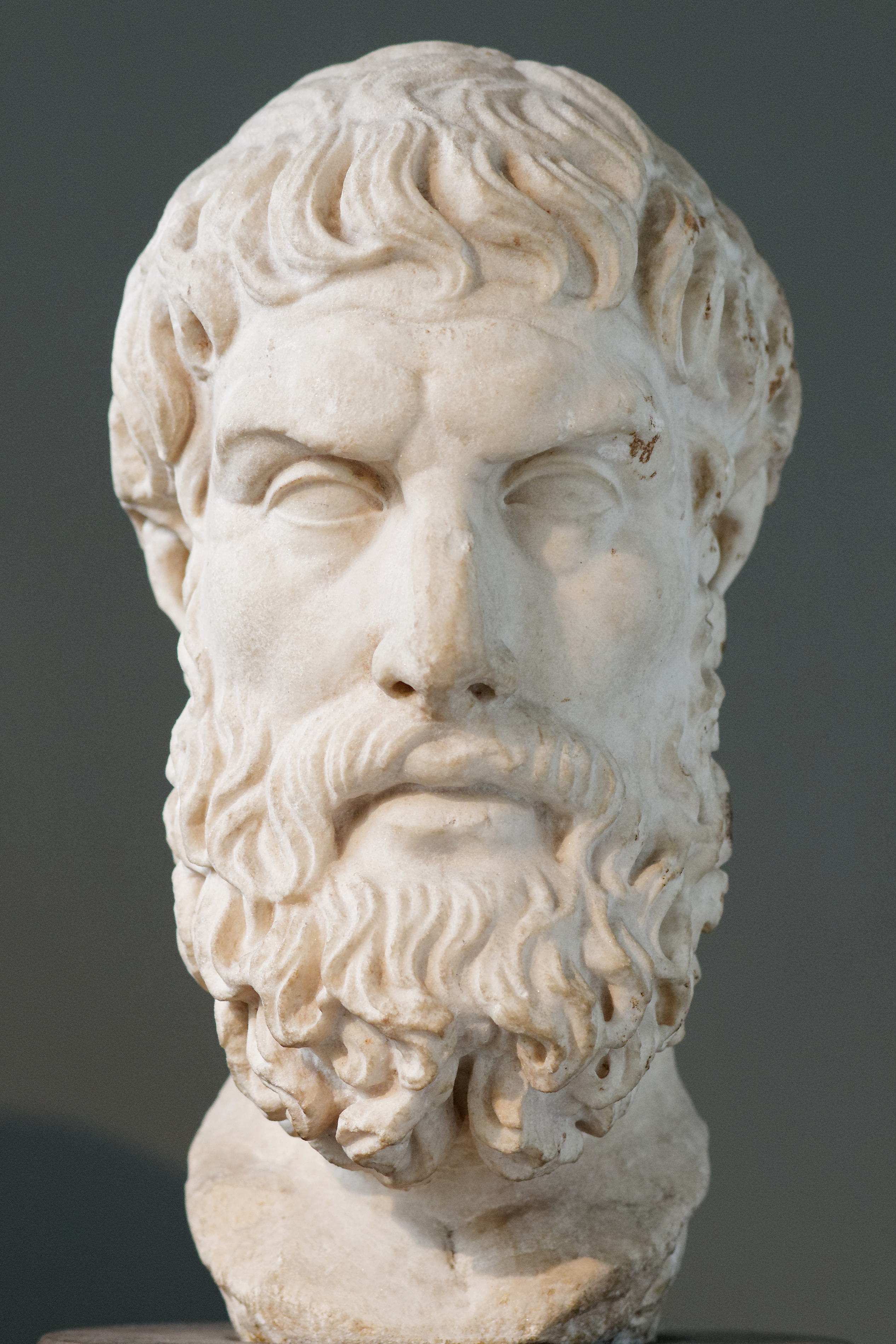
BOOKS: Travels with Epicurus by Daniel Klein

Travels with Epicurus: A Journey to a Greek Island in Search of a Fulfilled LifeTravels with Epicurus: A Journey to a Greek Island in Search of a Fulfilled Life by Daniel Klein
My rating: 5 of 5 stars

Amazon.in Page

With the wave of renewed interest in Philosophies of Life lately, it’s nice to see a book that puts Epicurus at the fore. In a number of ways, I believe Epicurus was the most advanced of Ancient Greek philosophers, and yet he doesn’t get much attention compared to Plato, Aristotle, and the Stoics. (In part this is because the vast majority of Epicurus’s writings were lost, and in part it’s because little-“e” epicureanism [i.e. being culinarily hedonistic] has become much more familiar to people than big-“E” Epicureanism [i.e. a materialist philosophy that values pleasure, but not in so hedonistic way as to lose sight of virtue and the countervailing costs of pursing pleasure.] While adjectival forms have done a number on Cynicism and Stoicism as well, the former is – for all intents and purposes – dead and the latter has become much more well-known to present-day people from a pile of podcasts, books, and vlogs.)

I should point out that Klein doesn’t solely focus on the philosophy of Epicurus, he also tells readers what other schools of philosophy teach us about how to age well (and to not turn into a curmudgeon) — most notably: Buddhism, Stoicism, and Existentialism. That said, it’s fair to call Epicureanism the backbone of this book.

One who reads the title might wonder whether this is a pop philosophy book on aging or a travelogue. It’s definitely both, but the philosophy part dominates. I would call it 70/30 pop philosophy to travelogue (maybe 65/35.) The book uses the individuals Klein interacts with on Hydra (and elsewhere in Greece) as examples of how people age well, and in the process shows the reader [textually] a beautiful part of the world. But the core of the book is about philosophy as it pertains to such topics as play, perception of time, idleness, and changing views of spirituality.

I will warn the reader that, while the book offers many great thoughts for a philosophy of aging well, I didn’t agree with everything in the book. Klein contrasts his philosophy for living well into old age and for adapting one’s life to changing roles to the people he calls the “forever young” crowd. I wouldn’t put myself in the “forever young” category as I don’t believe I’m grasping at youth and all its blessings and pains. However, I suspect Klein would put me in that group because I work out intensely, watch what I eat / manage my vices, and am trying to work things so that my heart explodes while I’m still physically and mentally capable — i.e. before I become decrepit or senile. My point is, I’m not sure Klein’s dichotomy is that useful or reflective of reality, and that being health-conscious should necessarily be contrasted with enjoying the pleasures of age. [Truth be told, I’d say the biggest driver for people being more health-conscious into old age is seeing earlier generations live longer, but with a decreased quality of life through that period of increased longevity — See: Being Mortal by Atul Gawande.]

Still, overall, the book is quite readable and offers much excellent food for thought, and I’d recommend it for anyone who is interested in moving into advanced age in a way that isn’t misery filled.

View all my reviews

PROMPT: Ideal Home

Daily writing prompt
What does your ideal home look like?

It should be small enough that I won’t acquire new things without asking whether they are necessary, and whether their value exceeds their spatial cost. [And, also, such that it encourages spending time outside.] Besides that, it should be an environment within which one can live healthily.

BOOKS: The Creative Act by Rick Rubin

The Creative Act: A Way of BeingThe Creative Act: A Way of Being by Rick Rubin
My rating: 5 of 5 stars

Amazon.in Page

This book offers Rick Rubin’s philosophy of creativity and art. For those unfamiliar with Rubin, he’s a ZZ Top-looking music producer who contributed to a lot of successful albums, ranging from hip hop to the rock-n-roll of Tom Petty. He was a major player behind the Run DMC cover of Aerosmith’s “Walk This Way” that blew peoples’ minds in the 80’s. Interestingly, Rubin is neither a musician nor a technologist, and I heard him say in an interview that his great value-added was having an extremely high level of confidence in knowing what he liked. Rubin has a persona that is as much guru as music producer, and this book reflects this broad insight and wisdom.

In the book, Rubin lays out his view of the creative process and the mistakes people make with it, but along the way he offers insight into such interesting questions as why some artists only seem to have one major work in them. While Rubin’s experience is mostly with music (though he also worked with comedian Andrew Dice Clay on Clay’s albums,) his book is broadly targeted towards all artists, and he seems to use as many examples from literature and graphic arts as he does from music.

Rubin does sound a bit woo woo here and there, but I found that many statements — e.g. those that spoke of the universe’s role in artistry — could be interpreted in a way that wasn’t necessarily superstitious. While woo woo sounding statements often get on my nerves, I felt Rubin’s use was poetic and spoke to a broader truth.

I’d highly recommend this book for artists and creative types, regardless of field.

View all my reviews

Buds & Blossoms [Haiku]

buds & blossoms,
in vibrant red, gussy up
a dreary cityscape.

Five Wise Lines from Fireflies by Rabindranath Tagore

In the drowsy dark caves of the mind / dreams build their nest with fragments / dropped from day’s caravan.

From the solemn gloom of the temple / children run out to sit in the dust, / God watches them play / and forgets the priest.

The wind tries to take the flame by storm / only to blow it out.

The same sun is newly born in new lands / in a ring of endless dawns.

When death comes and whispers to me, / “Thy days are ended.” / let me say to him, “I have lived in love / and not in mere time.” / He will ask, “Will thy songs remain?” / I shall say, “I know not, but this I know / that often when I sang I found my eternity.

Fireflies by Rabindranath Tagore is in the public domain and can be read at sites such as:

Fireflies is available at PoetryVerse

PROMPT: Peace

What brings you peace?

Being in the now, and feeling – but not feeding – emotional sensations.

PROMPT: Curiosity

What are you curious about?

Everything. But I have learned to be less obsessed with the grand metaphysical questions for which no one has any defensible answers – just rank speculation. Socrates convinced me it’s not worth worrying about abstractions while one is still struggling with fundamental questions of how to be human.

Flat Fog [Free Verse]

Stationed in East Anglia,
   I remember layered fog,
     fog so thick one couldn't
     see past the hood's end,

but, given a slight rise, 
   one could see all the way
   down the runway -- as if
   it was a cloudless full moon eve.

As one might expect of an airbase,
   (having been built around a flat runway)
   there wasn't much topography.

But sometimes life is like that:
   a tiny rise in perspective 
   allows one to see the world clearly,
 
but a minor dip puts one in a
   soup of unfathomability.

PROMPT: Certainty

Daily writing prompt
List 10 things you know to be absolutely certain.

Every source of information is flawed and / or of limited value as a source of truth.

There is beauty everywhere (but to see it one has to let go of one’s compulsion to attach value judgements to everything.)

People who know more things for certain are wrong about more things.

A better life comes of being content with less than of having more.

There is a force, we’ll call it gravity, that keeps my feet to the floor (or insists that I either fall or expend energy to break the surly bonds.)

With respect to that which one can’t know for certain, it’s closer to truth to remain ignorant than to be deluded.

The world that I perceive isn’t the world, itself.

All else being equal, a diverse group of people is stronger, smarter, better looking, and more effective than a homogenous one.

If the same level of effort were put into fostering emotional intelligence as is put into mental intelligence… what a wonderful world it would be.

One who hands you knowledge but tells you to drop it like a hot rock if it doesn’t stand up to your own experience and rationality is more trustworthy than one who hands you knowledge and insists you hold onto it with white-knuckled intensity.