Heavy Indian Club movement patterns and the core tenets of Perennial Philosophy.
Category Archives: Epistemology
PROMPT: Fate / Destiny
Do you believe in fate/destiny?
No. Life would be hard to bear if one believed one were just playing out a program, and was not a free agent.
That said, I can’t say I have enough information to have a strong belief in the opposite (i.e. free will.)
So, like a number of other big philosophical questions, it is one for which I prefer ignorance over delusion.
PROMPT: Fantastic News
You get some great, amazingly fantastic news. What’s the first thing you do?
Fact check

Five Wise Lines (Jan 2024)
Every so often I run into a sentence that blows my mind a little bit. Here are a few recent examples:
We may be in the universe as dogs and cats are in our libraries, seeing the books and hearing the conversation, but having no inkling of the meaning of it all.
William james
One must read ten thousand books and travel ten thousand miles to be an educated man.
Old chinese adage (As Translated by ha jin in The Banished Immortal)
Poetry is an echo asking a shadow to dance.
Carl Sandburg
Distrust of grammar is the first requisite of philosophizing.
Ludwig wittgenstein
He who knows only his own side of the case knows little of that.
John stuart mill
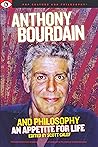
BOOKS: “Anthony Bourdain and Philosophy” ed. by Scott Calef
Anthony Bourdain and Philosophy by Calef ScottMy rating: 5 of 5 stars
Amazon.in Page
Release Date: December 26, 2023
These pop philosophy books that examine philosophical ideas through the lens of a particular pop culture personality or entity have become, well, popular. It’s not hard to see why; it’s an easy way to take your medicine, your medicine being to learn philosophical concepts. And, let’s face it, scholarly philosophical books are often nigh unreadable, being laden with jargon and having a tendency to get so lost in the minutiae of razor fine points that they display no relevance to the human experience. I am not immune to the appeal of such books, though when I see a book like “Miranda Sings and Philosophy” I figure I can take a hard pass. But this one caught my eye because Anthony Bourdain did live a life shaped by his own particular philosophy, and an intriguing one at that.
Like most of these books, this is a collection of essays written by different authors. As such, the quality and relevance of the included chapters does vary somewhat.
The book is divided into four parts. The first part looks at the subject of the work for which Bourdain was best known — i.e. at the intersection of food and travel. In these four chapters, authors explore the aesthetics of food and questions like: Do “expert” views on food matter? What is disgusting? And what role does culture play in the culinary experience?
The second part is entitled, “life,” and these five chapters look at Bourdain, the man. That is, they shift away from his work, and look at Bourdain as a martial arts student, a storyteller, and -generally – as a person. These chapters also offer insight into his epistemological perspective — i.e. how he viewed (and engaged in) the pursuit of truth, as well as touching upon his philosophical views more broadly.
The third part takes another turn to examine Bourdain’s addiction and his death by suicide. The chapters present broader philosophical frameworks on suicide and freedom, as a means to put Bourdain’s experience in perspective.
The final part is really kind of a grab-bag of subjects that don’t fit neatly into the other sections. Probably not coincidentally, this is where most of the book’s rough spots are located. It sometimes seems that Bourdain’s philosophy is not so much the subject anymore, and some authors convey their ideas more clearly and effectively than others. This is not, by any means, to say that any of the chapters are completely stinkers, nor to say that all of the chapters are defective. Chapter 13 [which, BTW, I think could have found a spot in Part II] does an interesting job in clarifying Bourdain’s approach to ethics, no easy task as it can seem like an odd mix of spiteful nihilistic impulses and compassionate humility (and it certainly evolved over time.) But even Chapters 14 and 15, which are not only the least flattering discussions of Bourdain but also the most didactic, have something to offer. The first lays out the scandal involving Bourdain’s girlfriend who was a MeToo leader but who also paid off a young actor who accused her of statutory rape, a pay-off made by Bourdain and which seems to be a factor in his suicide. Chapter 15 offers examples of what the author believed Bourdain did right and wrong in discussing the historical context of the places he visited that had been colonized. Ch. 16 was a discussion of the ethics of engaging in luxuriant fine dining in a world with starving people. I thought this chapter would stay the course set by the previous two, but it did shift back into academic objectivity by producing a more complete discussion of competing viewpoints. The penultimate chapter goes more niche than the others, but is a fascinating look at the ethics of AI generated voicework for the “Roadrunner” documentary — i.e. using AI to make it sound like Bourdain said things that he wrote in emails or books but never said [at least not into a recording device.] The last chapter involves climate change and episodes Bourdain did in Madagascar and Bhutan. This was both one of the longer chapters and definitely the most muddled. It remains unclear to me exactly what the author was trying to say, exactly. It’s perfectly readable, and yet unclear.
All in all, I enjoyed this book (as much as one can “enjoy” a book that is about a deceased beloved figure,) and thought it offered some excellent food for thought.
View all my reviews
PROMPT: Changed Mind
Oh so many things. My epistemological stance is that one should be ready to drop any belief like a hot rock in the face of better information or better means to understanding.
One of the most fundamental changes is that I used to take for granted that there was a god. Now I’m agnostic about whether there is one, and am virtually certain that – in the unlikely event there is a god – it (she? they? he?) bears no resemblance to any of the tribally derived deities of the various world religions.
I used to think introversion was something that could be, and should be, overcome. Now, I believe the healthy approach is in accepting it and managing one’s life so that it’s not a problem. Truth be told, in my youth, I had a lot of grandiose ideas about what was possible with regards to the mind, ideas which I have jettisoned in favor of one’s that better match the empirical evidence.
PROMPT: Certainty
Every source of information is flawed and / or of limited value as a source of truth.
There is beauty everywhere (but to see it one has to let go of one’s compulsion to attach value judgements to everything.)
People who know more things for certain are wrong about more things.
A better life comes of being content with less than of having more.
There is a force, we’ll call it gravity, that keeps my feet to the floor (or insists that I either fall or expend energy to break the surly bonds.)
With respect to that which one can’t know for certain, it’s closer to truth to remain ignorant than to be deluded.
The world that I perceive isn’t the world, itself.
All else being equal, a diverse group of people is stronger, smarter, better looking, and more effective than a homogenous one.
If the same level of effort were put into fostering emotional intelligence as is put into mental intelligence… what a wonderful world it would be.
One who hands you knowledge but tells you to drop it like a hot rock if it doesn’t stand up to your own experience and rationality is more trustworthy than one who hands you knowledge and insists you hold onto it with white-knuckled intensity.
BOOKS: The Mind of Adi Shankaracharya by Y. Keshava Menon
The Mind of Adi Shankaracharya by Y. Keshava MenonMy rating: 4 of 5 stars
Amazon.in Page
This book does a good job of that at which the title hints, offering the reader insight into the philosophy of Adi Shankaracharya. Along the way, Menon presents clear descriptions of Indian philosophical concepts such as Maya, Avidya, Antahkarana, etc., and also compares and contrasts Shankaracharya’s philosophy with those of other philosophers (from both the East and West) as a means to clarify ideas that can be subtle and complex.
That said, what the book isn’t is an unbiased and objective look at Shankaracharya’s ideas. While Menon doesn’t go as far as to support the supernatural myths of Shankaracharya’s life (which are only discussed in the Appendix,) and he skirts that 800-pound gorilla of Hindu philosophic controversy, caste, he does present the philosophy as an advocate for Shankaracharya rather than as an indifferent scholar who merely wishes to deliver arguments and ideas while inviting thought among his readers.
While the book deals with epistemology, ethics, and various aspects of metaphysics, the biggest single subject is Self. I found the explanation of this topic to be fascinating. I had previously understood that among the major differences between Shankaracharya and Buddha was on this question. While I still find the Buddhist approach to Self (or, more properly, lack of Self — i.e. Anatta) to be the more compelling and parsimonious explanation, I feel that I was provided with about as clear an explanation of the Hindu (generally) and Shankaracharyan (specifically) views on Self as one could wish for.
I’d recommend this book. If you’ve come away from reading about subjects like “Maya” (Is it illusion? Is it NOT illusion?) this book can definitely help offer clarification, and (as books on philosophy go) it’s readable and not too jargon-laden. That said, if one is looking for a book that is not advocating a philosophy but, rather, objectively providing ideas and contrasting explanations, this book may bias your views.
View all my reviews
BOOK REVIEW: Zeno and the Tortoise by Nicholas Fearn
Zeno and the Tortoise: How to Think Like a Philosopher by Nicholas FearnMy rating: 5 of 5 stars
Amazon.in Page
This book presents twenty-five philosophical tools or concepts fundamental to thinking philosophically. Fearn does an excellent job of making these ideas comprehensible while exploring how they can be of practical value in philosophizing (as opposed to diving into conceptual minutiae and the conflicts and debates around them.) The author uses stories, metaphors, and examples extensively, while avoiding jargon or complicated expressions and explanations.
The book is entirely Western-oriented, and one won’t see any discussion of ideas originating outside Europe (or North America by way of immigration from Europe.) That’s not uncommon for English language popular philosophy books, and I don’t think there’s anything nefarious to be read into it, though some will find it a shame. The philosophers whose ideas are addressed span from pre-Socratic Greece to Richard Dawkins (who I’m pretty sure is the only one still living.) The reader learns about reductionism, relativism, the Socratic method, analogy / allegory, teleology, thought experiments, parsimony, pragmatism (of sorts,) induction, skepticism, social contract, utilitarianism, dialectics, falsifiability, memes, deconstruction, and more.
I found this book to be readable and absorbing and would highly recommend it for anyone who would like an overview of the major ideas of Western philosophy and how they can be applied to thinking more philosophically.
View all my reviews
BOOK REVIEW: The Information by James Gleick
The Information: A History, a Theory, a Flood by James GleickMy rating: 5 of 5 stars
Amazon.in Page
Information is one of those topics that remains obscure not because it’s rare or hidden, but because it’s everywhere and the term is used for so many purposes it’s not thought of cohesively. It might seem like a book on this topic would be hopelessly boring by virtue of the fundamental meta-ness of the material. Instead, Gleick had a vast sea of topics and stories involving intense stakes for humanity from which to choose, e.g.: how did we learn to communicate and advance said capability until it was arguably the most important feature of our species, by what instructions are people “assembled,” might the most fundamental layer of reality be informational, and – in recent decades — will our species drown in flood of cheap information?
Given the vast sprawl of the subject matter, organization becomes a crucial question. In a sense the book is chronological, presenting humanity’s experience with information in more or less the order we came to think about the subject. I think this was a wise move as it starts from what most people think of when they think of information – i.e. language and its communication. That makes it easier to wrap one’s head around what comes later, and to see the conceptual commonalities. This approach might seem self-evident, but an argument could be made for starting with information as the word is used in Physics (as addressed in Ch. 7 – 9,) an argument that that approach is more fundamental and generically applicable, and while it might be both of those things, it wouldn’t be as easily intuitively grasped.
I found this book to be fascinating and easily followed — even though it covers some conceptually challenging topics, it does so in an approachable manner. It is over a decade old, but holds up well – though I think there is much more to say these days about the detrimental effects of information overload, a topic discussed at the end of the book. I recommend it for nonfiction readers.
View all my reviews