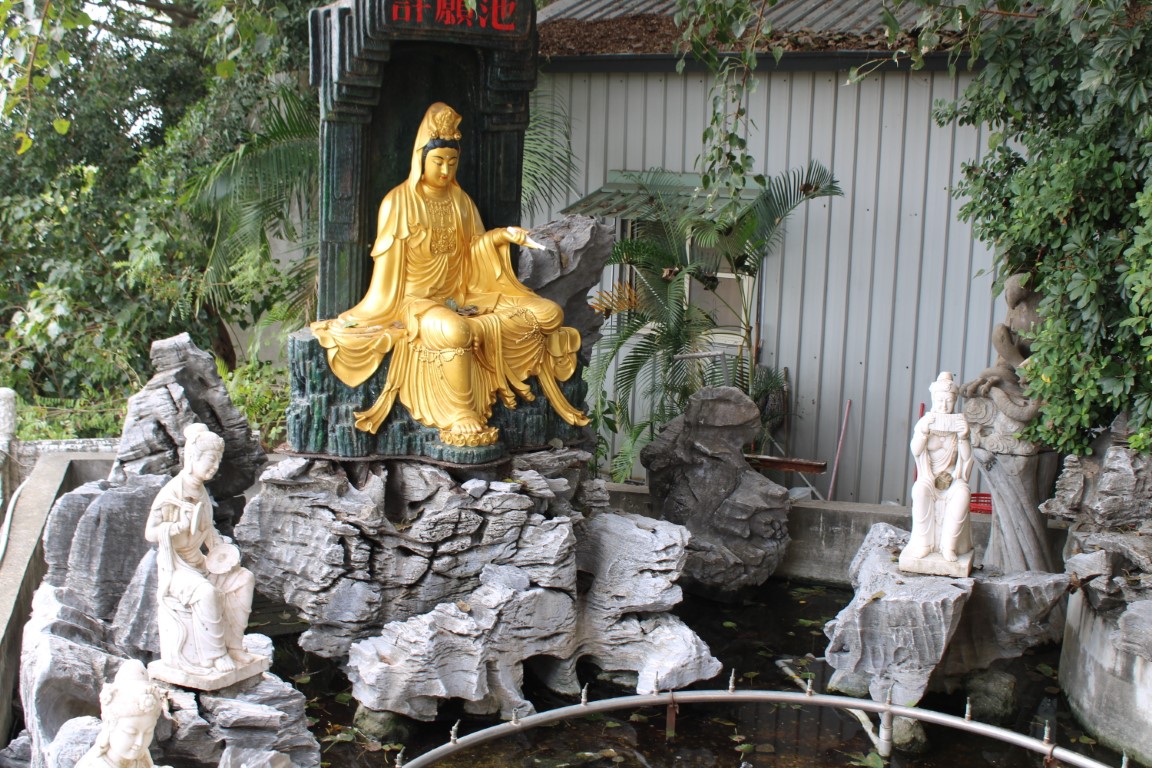
The stone Bodhidharma,
Meant as more than likeness.
It tries to copy Damo's
Stillness & uprightness.
Category Archives: mind
“Bold” [Poetry Style #11] by Sikong Tu [w/ Audio]
View flowers like a bandit;
Let nature flow through you,
Breathing in the Great Way
As you let your crazy brew.
Wander like the free winds --
Sea and mountain in gray-blue.
Feel true power overflow,
As all nature lives through you.
Before: sun, moon, and stars;
Behind: the one from two.
By dawn, sea turtles have gone,
Soak your feet where they withdrew.
NOTE: The late Tang Dynasty poet, Sikong Tu (a.k.a. Ssŭ-k‘ung T‘u,) wrote an ars poetica entitled Twenty-Four Styles of Poetry. It presents twenty-four poems that are each in a different tone, reflecting varied concepts from Taoist philosophy and aesthetics. Above is a crude translation of the eleventh of the twenty-four poems. This poem’s Chinese title is 豪放, which has been translated to “Free,” “Set Free,” and “Broad-minded” in various English language translations.
“One’s-Self I Sing” by Walt Whitman [w/ Audio]
One's-Self I sing, a simple separate person,
Yet utter the word Democratic, the word En-masse.
Of physiology from top to toe I sing,
Not physiognomy alone nor brain alone is
worthy for the Muse, I say the Form complete
is worthier far,
The Female equally with the Male I sing.
Of Life immense in passion, pulse, and power,
Cheerful, for freest action form'd under the laws
divine,
The Modern Man I sing.
PROMPT: Bothered
The second half of the question is quicker and simpler to answer. Things bother me because I — through conditioning and petty impulses — allow them to bother me. I neither blame external circumstances, nor accept that said externalities can be responsible for my state of mind. I could remain unbothered by the things that bother me, with enough work to break engrained patterns. I should also note that I could choose to be bothered by a great many happenings that don’t bother or offend me in the slightest.
As for what bothers me, the list — sadly — remains many. That said, I don’t think it’s wise to broadcast the things that get under one’s skin out into the universe. Just like I wouldn’t announce if I had a gimpy knee or a weak jaw to a general audience that might include those who wish me ill. It just seems strategically unwise.
“The Rainy Day” by Henry Wadsworth Longfellow [w/ Audio]
The day is cold, and dark, and dreary;
It rains, and the wind is never weary;
The vine still clings to the mouldering wall,
But at every gust the dead leaves fall,
And the day is dark and dreary.
My life is cold, and dark, and dreary;
It rains, and the wind is never weary;
My thoughts still cling to the mouldering past,
But the hopes of youth fall thick in the blast,
And the days are dark and dreary.
Be still, sad heart, and cease repining;
Behind the clouds is the sun still shining;
Thy fate is the common fate of all,
Into each life some rain must fall,
Some days must be dark and dreary.
Countless Pieces of Hate [Free Verse]
PROMPT: Improvement
What’s one small improvement you can make in your life?
Realize you have no control of what happens in the world, but complete control of your perception of it.
BOOKS: “Play” by Stuart Brown
Play: How It Shapes the Brain, Opens the Imagination, and Invigorates the Soul by Stuart M. Brown Jr.My rating: 4 of 5 stars
Amazon.in Page
Why does biology encourage play? Why does it stop encouraging play at some point? Should play end, or should one maintain a dedication to play throughout life? These are principal questions addressed by this book.
Brown explores the advantages of leading a playful life, and he doesn’t restrict himself to childhood play. In fact, the book doesn’t restrict itself entirely to human play, but also presents insights derived from the study of other playful species. One of the most profound lessons from the book comes from a story about a sled dog that has repeated playful interactions with a polar bear — a hungry polar bear, at that.
The book is presented more like an essay or a collection of essays than the usual popular science or pop psychology book. That is to say, it is not annotated and lacks a bibliography. The author sites the occasional book or study in the text, but it’s in the manner one would see in journalism or essays. This approach has its advantages, but the flipside of those advantages are the disadvantages. On the positive side, the author is able to communicate more freely, including the ability to discuss more speculative possibilities than one would expect from scientific reporting (with its usual “just the facts” approach.) Of course, the extensive speculation will be frustrating to readers who want to know what evidence has been produced for the proposed benefits. Furthermore, it often feels like the speculation in question is of the “when you’re a hammer every problem is a nail” nature — i.e. when one is a play researcher, one may be inclined to see play as a panacea for all the ills facing humanity (it surely is for some, but probably not all.) [To be fair, the book is almost fifteen years old, and I suspect it was / is probably harder than pulling teeth to get academic funding for play research outside of early childhood development, and so part of what the book was probably trying to do was build enthusiasm for supporting this kind of research, which necessitated talking about possibilities that were outside the known.]
The book does have a chapter on “the dark side of play.” It deals with compulsive behaviors like gambling and video game playing addiction (i.e. not people who like playing video games once in a while, but those who go 48 hours without sleep and who live in cave-like darkness to limit screen glare.) Much of the chapter argues that, while those problems are real and of concern, the activities aren’t play, not as per the definition presented early in the book.
This book does make a sound case for a number of benefits of play and for not abandoning play in one’s youth. If you’re interested in how play can help one to cope in a world of uncertainty, to keep one’s mind and body healthy, and to maintain or grow one’s capacity for imagination, this book is well worth reading.
View all my reviews
Worlds, Inner & Outer [Free Verse]
Starry Nights [Verse / Free Verse Mutt]

I’m stunned by all the starry nights
Beyond the sprawling city’s lights:
Swirls made of so many colors —
The dark, the light, middling others.
What eternal infinite
Exists out there between
All those stars?
All the dust and nothingness
Of that cold, unbounded expanse
Dances in the hot shell
Of my skull.