DAILY PHOTO: An Emperor’s Jail

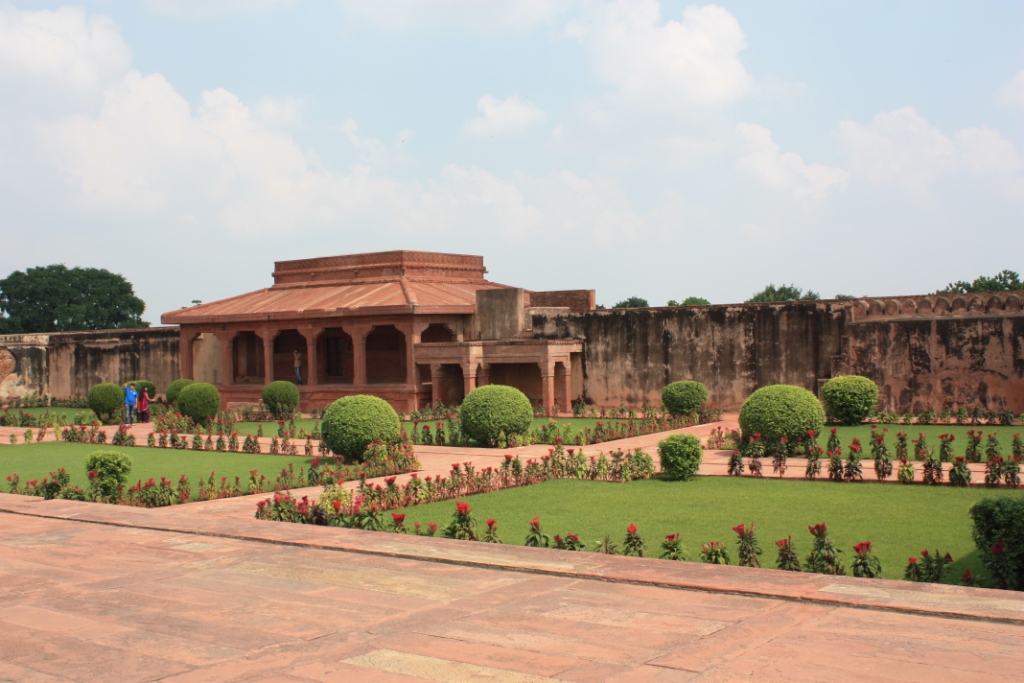
Taken on October 12, 2013 at Agra Fort.

Taken on October 12, 2013 at Agra Fort.

The top of this tower is where Shah Jahan was imprisoned by his son, Aurangzeb–the latter being the 6th Mughal Emperor. The 5th Emperor’s “cell” offered a great view of the Taj Mahal, the monument that Jahan built to his wife, Mumtaz Mahal.

This just goes to show that just because one kills off one’s brothers who are ahead of one in line for succession, and imprison one’s own dad,  doesn’t mean one has to be completely heartless.

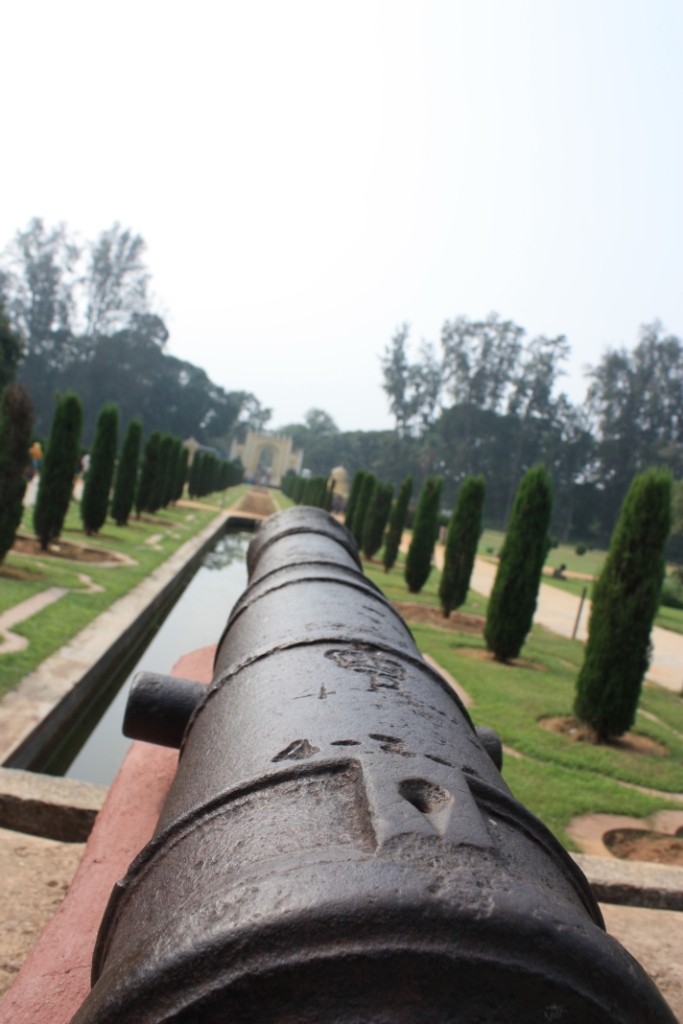
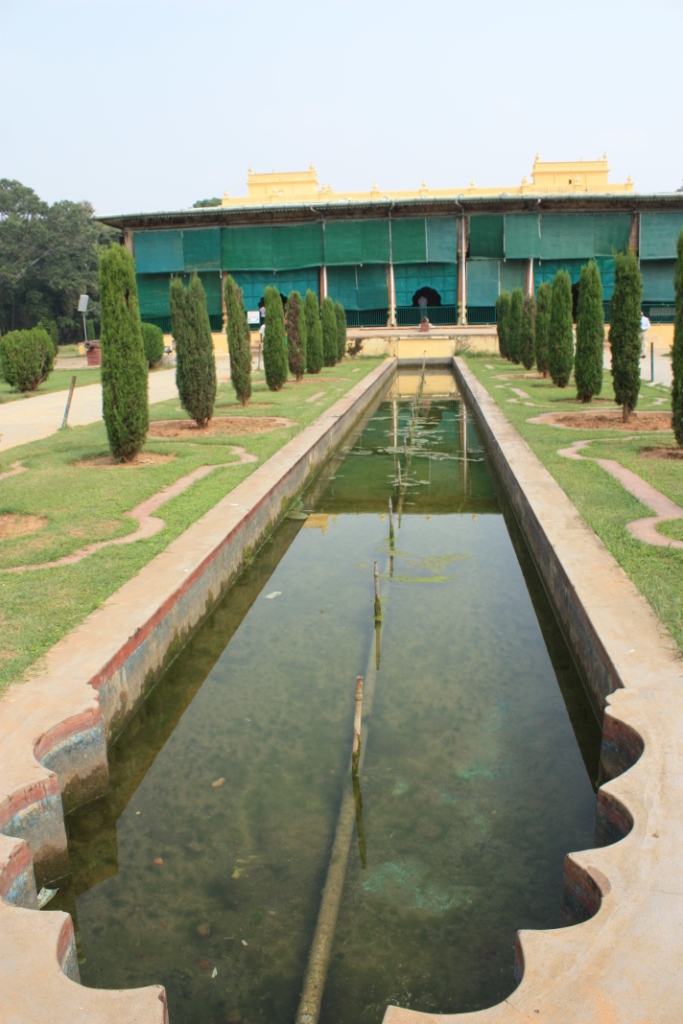
This is what Jahan would have seen-- except from about one story up and a couple hundred feet to the left.

This is what Jahan would have seen– except from about one story up and a couple hundred feet to the left.


DAILY PHOTO: Shiva Dancing in an Elephantine Demon

Taken November 23, 2013 at Halebidu.

Taken November 23, 2013 at Halebidu.

This frieze is located at Hoysaleshwara temple in Halebidu. Hoysaleshwara is dedicated to Shiva, and was finished in 1121AD–though many believe it was not actually finished. It’s one of the largest temples to Shiva in southern India and is actually a double temple–the inside being split between the king’s temple and the queen’s temple.

This is a depiction of Shiva dancing inside a vanquished elephant. It may seem mean to kill an elephant and dance inside it, but this particular elephant was a demon or possessed by a demon. Of course, the question remains as to why one would dance inside a slain enemy. I guess it’s a little like dancing on your enemy’s grave, but a lot stinkier and messier. It’s just weird no matter how you slice it. 

DAILY PHOTO: Chennakeshava Temple at Belur

Taken November 23, 2013 at Belur.

Taken November 23, 2013 at Belur.

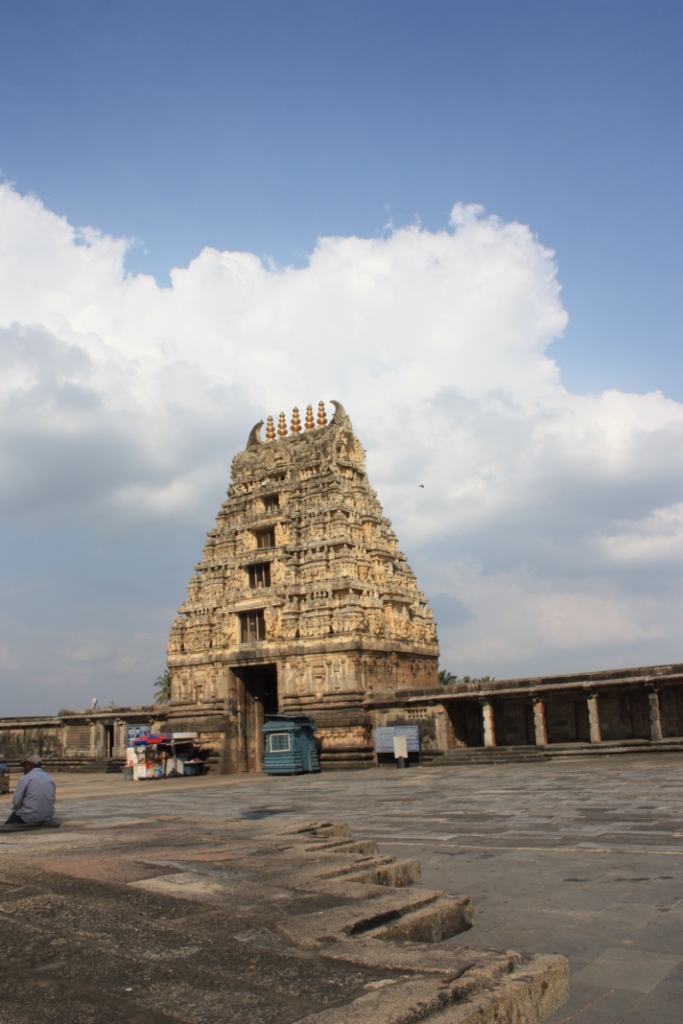
Chennakeshava temple at Belur is a Hoysala era temple to Vishnu–the deity of the Hindu trilogy responsible for processes of sustenance and evolution (as opposed to creation or destruction, which are the bailiwicks of Brahma and Shiva, respectively.)

This temple and its sister temple at Halebidu, Hoysaleshwara temple, are probably the most ornate structures I’ve seen anywhere in the world. They are covered with soapstone carvings arranged in several tiers. For example, the bottom layer is a series of elephants, each one unique. There is a layer that tells tales from the Mahabharata in pictures.

Soapstone is soft and easily worked when quarried, but it becomes hard enough to survive everything but looters as it’s exposed to the elements. You’ll note the “windows” carved in the rock to allow in light and breezes.

Close up

Close up


DAILY PHOTO: Gomateshwara of Shravanabelagola

Taken on November 23, 2013 on Shravanabelagola Hill

Taken on November 23, 2013 on Shravanabelagola Hill

[As I was on the road yesterday and missed my Daily Photo post, I’ll double up today—if I can. I’m iffy because Bangalore got 2” of rain in an hour last night (which we arrived home in; I saw a city bus literally—no hyperbole here whatsoever—half underwater in an underpass.) Anyway, my internet connection is spotty at the moment, and could go out permanently at any moment.]

The Gomateshwara (a.k.a. Bahubali) sculpture at Shravanabelagola is the world’s largest monolithic stone sculpture. Gomateshwara was a Jain Arihant, and was said to be the second of 100 sons of the first Tirthankara.

An Arihant–literally a “vanquisher of enemies” (a rather bellicose title for a sect that won’t eat onions because the plant must be killed to harvest them), is one who has defeated anger, ego, deception, and greed. (Oh, THOSE enemies. you say.) A Tirthankara is a special kind of Arihant that appears every so often to revitalize the Jain community.

Shravanabelagola is not a well-known site. Being in rural Karnataka, and not on the regular tourist loops, it’s easy to miss. However it can be grouped nicely with trips to the temples at Halebidu and Belur.

Tip 1: You’ll have to walk to the top of a rather large hill in bare feet, so be prepared. On the bright side, the steps are quite clean and devoid of the usual multi-species feces common to footpaths in India.

Tip 2: Jains, like Hindus and some Buddhist sects, utilize the swastik emblem heavily. Despite the ubiquity of what some call the “twisted cross” or “swastika,” you are not in a den of neo-Nazis. That emblem, and its mirror-image, was used for thousands of years in South Asia before Hitler co-opted the symbol—presumably misinterpreting its meaning (as he misinterpreted so many things.) Ironically, it means a wish for good fortune.

POEM: Awkward Bird Conversation

AgraFort17Three little birdies sat on a rail.

Two little birdies spoke of no avail.

“Sam, you’re just not one of us.”

“I’m not a bird, like you or Gus?”

“No. Some birds just don’t go together.”

“You mean the ones without any feathers.”

“No. Some birds are just kind of unique.”

“Yeah, I once saw one without any beak.

“Some birds are from very different type eggs.”

“We all have two legs, so what’s wrong–I begs.”

“It’s not that there’s anything wrong, per se–

It’s just that–well–we’re green, and you’re grey.”

“So you won’t sit on a rail, preen, or be seen

with any bird, unless its color is green?”

“Well, it just sounds silly when you put it that way.”

DAILY PHOTO: How Many People Fit in an Auto-Rickshaw?

Taken October 12, 2013 in Agra, India

Taken October 12, 2013 in Agra, India

It’s a question that has been debated since the dawn of the Tuk-tuk. Like the question of how many licks it takes to get to the center of a Tootsie-Roll Tootsie-Pop, attempts to definitively answer the question have resulted only in controversy. The question?

HOW MANY PEOPLE FIT IN AN AUTORICKSHAW?

In the highfalutin cities, people think that nobody is supposed to ride upfront with the driver, but elsewhere they’ve figured out that you can put at least one man on either side of the driver (as long as the weight of each man is fairly evenly matched–there’s only one tiny front wheel after all.) How many one can fit in the back is influenced by the average yoga skill level of the riders and whether one has any Twister (TM) grand-champions on board. 

There are myths of tuk-tuks containing entire villages tooling down the back-roads. Theoretical physicists tell us that you can pack them in until their density forms a self-sustaining black-hole, and then everybody out to the event horizon is drawn in… ya-da-ya-da-ya-da.

The answer is: “a lot.”


POEM: Scared Little Chipmunk

Taken at Fatehpur Sikri

Taken at Fatehpur Sikri

Poor little rodent, run up a door.

Chattering and chattering, frantic, he swore.

Babel Fish Rodentia translated his words:

“It’s not bad enough, the cats and the birds,

hectic humans and their frantic pace,

always running about like they’re in a race.

Stuck on this peg for nigh half a day.

‘A break in the traffic’, I fervently pray.

Pfff! Bipedal humans with their gigantic feet

designed to crush chipmunks right in the street.”

DAILY PHOTO: Herd of Elephants

Taken November 10, 2013 at Bannerghatta

Taken November 10, 2013 at Bannerghatta

Elephants are paradoxes. They seem like gentle giants–making an end-run around tiny mice. Then you realize that humans are the only animal idiotic enough to screw with one in its natural habitat. OK, if an entire pride of lions can separate one injured elephant from its herd, they might go for it. But, generally, the most fearsome predators in the world look at an elephant and say, “Oh, that would not end well for me.” And, of course, one has to consider that they never forget. If you do piss one off, you have to worry about it coming at you all Tony Soprano-style a decade later. 

I’ve ridden an elephant in Thailand near the Mae Wang River. It was pleasant. It’s a little terrifying when it goes up or down a steep grade. You have a moment where you think, if this thing topples over, I’m a goner. (You’d have a moment where you hit the ground and said, “I’m alive, I made it.” And then you’d be like, “I didn’t know there was a solar eclipse today” and then” SPLAT!”) At one point, our driver jetted, but–it didn’t matter–the  elephant knew where it was going and how to get there. As long as you don’t run out of bananas, the elephant will get you where you’re going. Of course, you will run out of bananas. Fun fact: a person can’t carry enough bananas to satiate an elephant. Then your elephant will get all morose and brooding. 

DAILY PHOTO: Gazing Tiger, Drinking Tiger

Taken November 10, 2013 at Bannerghatta.

Taken November 10, 2013 at Bannerghatta.

White Tiger drinking

White Tiger drinking

Bannerghatta has several tigers, two of which are white tigers, that can be seen on the “safari.” It’s not a safari in the usual sense, as the cats are in fenced off containment zones and segregated from their food. One rides in buses or jeeps in through a double-fenced gate, and then through the area.

At some point it occurs to you that they are in the larger area, with greater freedom of movement, and so in some sense one is on exhibit for the animals. The vehicle even has steel mesh over the windows to make the caging experience complete.  There are periodical camera portals to give one the illusion that it’s all for the humans’ entertainment. 

There are several enclosures to keep lions, tigers, and bears separated.

I saw tigers looking, drinking, walking, stalking, and sniffing–but not crouching. I didn’t see a dragon, and so I must assume that it was hidden.

DAILY PHOTO: Hanuman

Taken November 2, 2013 at Hampi.

Taken November 2, 2013 at Hampi.

Among the many devotees of this Hindu deity are wrestlers, who admire the monkey-god for his reputed strength. In Rama’s war against Ravana, he was said to have picked up a mountain and carried it a great distance, which is pretty strong.

He’s not whimsical and mischievous like Sun Wukong, the Taoist monkey-king (who also has god-like powers), but some believe that Sun Wukong’s myth was partially influenced by Hanuman’s myth. (Of course, the more irreverent and anti-authoritarian Taoists had a different take than the caste-conscious Hindus. (Whimsicality and mischievousness are considered more virtuous among the former than the latter.)

This Hanuman temple is a small, stone-block affair abutting a giant boulder on the trail from Hampi Bazaar to Achyutaraya temple. As you can see, it still has local devotees.