DAILY PHOTO: Tiny Temple and Wind-blown Trees

Taken November 3, 2013 at Hampi.

Taken November 3, 2013 at Hampi.

These trees, raising like hands out of fresh, graveyard soil in front of this tiny temple really captured my imagination. It would probably be a better picture in low light, when the creepiness of the scene could really root around in your brain–but I took what I could get.  There were a couple of places around Hampi that I thought would make the perfect setting for horror, and this was one. Another was the banyan tree that had many-colored satchets of rock tied to hang from the tree’s drooping roots.

This picture is taken on top of the hill that overlooks Virupaksha temple, not far from the Ganesh temple.

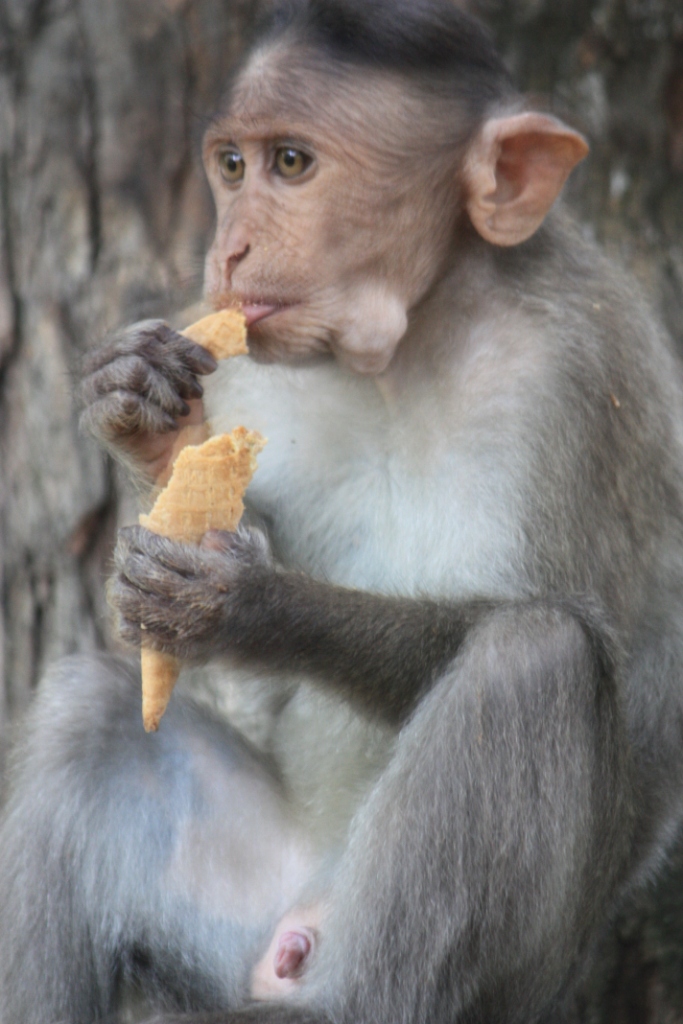
DAILY PHOTO: Gray Langur Watchmonkey

Taken Nov 3, 2013 at Hampi

Taken Nov 3, 2013 at Hampi

Gazing into the distance

he renders his assistance

to the mischievous monkeys–

making him a monkey flunky

A watchman of the langur pranks

yet not a part of their prankish ranks

He screeches warnings now and then

on sight of broom-wielding women

He neither seeks nor needs praise

just the occasional banana raise

He does it not for power or glory

just the occasional funny story

DAILY PHOTO: Lotus Mahal

Taken November 2, 2013 at Hampi

Taken November 2, 2013 at Hampi

The Lotus Mahal is one of the most popular attractions at Hampi. It’s atypical in that it’s built, in part, in the Indo-Islamic style (note: the arches.) (Hampi [Vijayanagar] was the capital of a Hindu kingdom that was defeated by a confederation of Islamic states. ) While this pavilion is often referred to as the “Lotus Temple,” it was believed to be either a rest-house for visiting royalty or the queen’s recreational building–but not a religious building of any sort. 

We got there with good timing. The beige-pink lime mortar seems to glow in the low, afternoon sunlight.  

The Lotus Mahal is located in the Zenana Enclosure with the Elephant Stables. 

DAILY PHOTO: Black Marble Pillars of Hazara Rama Temple

Taken November 2, 2013 at Hampi.

Taken November 2, 2013 at Hampi.

There’s a good chance that Hazara Rama temple isn’t even mentioned in your guidebook. It’s on the loop that includes the Queen’s Bath, the Mahanavami Dibba, the Lotus temple, and the Elephant Stables, but it would be easy to dismiss as lesser ruins if you’re traveling by yourself. This would be a mistake. This small temple has some of the most impressive friezes and carvings at Hampi. This was the King’s own personal temple.

The centerpiece of the temple are four black marble pillars. While black marble can be seen commonly enough at sites in other parts of India (e.g. Agra), it’s a rare building material here. In fact, these pillars were the only use of black marble that I remember seeing at Hampi.  The marble holds the carved images better than the sedimentary stone that is most common at Hampi.

Experts say the most prized sight at Hazara Rama are the friezes of Vishnu as Buddha, which are apparently quite rare.

Out front.

Out front.

DAILY PHOTO: Mahanavami Dibba

Taken November 3, 2013 at Hampi

Taken November 2, 2013 at Hampi

The Mahanavami Dibba was a monument built to honor Emperor Krishnadevaraya’s win over the state of Kalinga. (I believe he had it built himself. The arrogance of emperors knows no bounds.) At a little over 20 foot tall, it’s the highest structure in the Royal Enclosure, and offers a nice view of the palace ruins as well as  the boulder mountains of the surrounding countryside. The sides of the platform are covered in friezes in which elephants play heavily, but also dancing-girls and hunting scenes.  We had great skies for our visit.

The Royal Center is part of Hampi that one will need to have transportation to get around because it’s quite far from the Hampi Bazaar (where the guest houses are) and the key sites (e.g. Queens Bath, Hazara Rama Temple, the Lotus Mahal, and the Royal Elephant Stables) are spread out over a large area. However, willing auto-rickshaw (tuk-tuk) drivers abound.

DAILY PHOTO: Columns at Achyutaraya Temple

Taken November 2, 2013 at Hampi

Taken November 2, 2013 at Hampi

I thought the varying colors and designs of these columns made an interesting photo. This is taken at Achyutaraya Temple, which is one of the more extensive standing structures at Hampi, though not necessarily the most well-preserved/restored.

If one is on the Hampi Bazaar, walk away from Virupaksha Temple and toward the police station. Follow the steps that lie past the large bull sculpture, and when one gets to the top of the hill, just past the little Hanuman (the Hindu monkey-god) shrine, follow the fork to the right. One will soon see Achyutaraya temple down below. After visiting Achyutaraya, one can follow the flat land toward the Vittala Temple, which is sort of the crown jewel of Hampi.

Hae Kum Gang: Korean Food in Bangalore

Jeyuk-Chulpan with assorted sides.

Jeyuk-Chulpan with assorted sides.

I’ve been eating a lot at restaurants since we moved to Bangalore, both because it’s (usually) cheap and for the experience of it. I’ve eaten at enough places to have developed some favorites, but I try to keep broadening my experience by eating at as many new places as  I can.

Today, I had a lunch experience that was new on two fronts. For one thing, it was a restaurant that’s new to me, but–for another–it was my first experience with Korean food as prepared in India. I’ve eaten at several Chinese restaurants in India, and, while the places I’ve tried were all pretty good, they were all distinctively Indo-Chinese. In other words, the dishes didn’t taste like they did in other places at which I’ve had Chinese food, e.g. China. On the other hand, the Bangalorean Thai restaurant, Lan Thai, seems pretty authentic to me, except perhaps the diminished use of fish sauce (which is incredibly popular in Thailand and almost non-existent in India.) I was, therefore, uncertain what to expect from Hae Kum Gang–other than that it had a pretty high rating on Zomato and so it likely had decent food.

I can’t say what Korean food tastes like in Korea, as I’ve not yet gotten outside of Inchon airport, but Atlanta had a pretty huge Koreatown and I ate at a variety of Korean restaurants there. (A Korean man once told me that Korean food in Korea tasted very different because of the taste of the vegetables–given the spice palette of Korean food, I wasn’t sure whether to dismiss this as nostalgia–e.g. tasting the difference between American cabbage and Korean cabbage through the kim chi chili seasoning and fermentation seems a bit of a challenge.)

At any rate, what I found at Hae Kum Gang was on par with what I’ve had in Duluth, Georgia.  This was a pleasant surprise because their menu states Korean, Chinese, and Japanese cuisine. While these cuisines have some overlap–particularly with Korea in the middle–they are each distinct. My concern was based on bad experience with “multi-cuisine” restaurants in India that try to do everything and end up doing everything in a mediocre fashion.  (Hampi was loaded with such places.) What I ordered was pretty typically Korean, I imagine if you had a Chinese or Japanese dish off the menu you might not find it authentic, but rather like a Korean interpretation of the dish. (Although, Duluth has some fine sushi places with Japanese names and advertising themselves as Japanese food, but clearly owned, run, and staffed by Koreans.)  

I ordered the Jeyuk-Chulpan, which was described as: “Stir-fried pork with vegetables, served in spicy chili sauce on a sizzler plate.” The description was spot on. The platter sizzled for about 15 minutes after it got to the table. The dish had a pleasant level of heat (spice) and was tasty.  This isn’t a dish for those watching their cholesterol. The pork was quite fatty, which, of course, made it sumptuous and delicious but higher in fat content than many might desire. For lunch it suited me. It’s not something that I would eat for dinner, both because I don’t sleep well if I have red meat immediately before bedtime and because one needs some active time to burn off some of those calories  before going to bed. 

I was told a bowl of steamed rice came with this dish, but was pleasantly surprised to find seven other sides were brought out as well. Getting a load of side dishes along with your main is not uncommon with Korean food and I’ve had similar experiences elsewhere. The first small plate to arrive was Yukhoe,–a spicy Korean answer to steak tartare. I was a little reluctant about eating a raw beef dish in India, but I forged ahead and found it delectable. It was spicy, and warmed through–though not enough to cook the meat. While it was tasty and I’m none the worse for wear, I don’t know if I’d recommend you partake of this dish unless you know your constitution to be caste-iron and you like to live a little on the wild side. In the US, where there are all sorts of regulations and health inspections in restaurants, there is still invariably a warning to consume at your own risk. The same could be said of Japan, where 4 people died (35 hospitalized) in 2011 from eating a batch of the Japanese version of this dish that was tainted with E. Coli.  The standard for raw beef dishes is less than a day between slaughter and freezing and less than a day between thawing and use. I can’t say what this restaurant’s practice is. It tasted clean and fresh, but exercise care.

There was also a soup and a salad. The soup actually tasted more like something I’ve had on occasion in India than anything I’ve had in a Korean restaurant, except the vegetables were typically Korean. I believe the salad was a seaweed. There was also braised tofu, boiled baby potatoes in a teriyaki-esque sauce, and the Korean mainstay kim chi.  If you eat the Yukhoe, I’d recommend you eat your kim chi. Kim chi isn’t a personal favorite of mine, but its fermentation may offer you some assistance in digestion.

I’d recommend Hae Kum Gang.  My food was 480 Rs. (plus tax, tip, and a mineral water), which is pricey by Indian standards–but, as I always say, sushi and brain surgery are two things you don’t want a great deal on.

No, I don’t know if the name is supposed to register as “Hey, Come Gang!”

HaeKumGang2 HaeKumGang3 HaeKumGang4 HaeKumGang5 HaeKumGang6 HaeKumGang7

DAILY PHOTO: Reservoir Goat

Taken November 2, 2013 at Hampi.

Taken November 2, 2013 at Hampi.

This goat was strutting along in slow motion like he was in the opening scene of Reservoir Dogs.

Have no idea what I’m talking about? See below.

DAILY PHOTO: Climbing Lizard

Taken November 2, 2013 at Hampi.

Taken November 2, 2013 at Hampi.

These little lizards were one of the most common animal lifeforms at Hampi.  They blend into the rock quite well despite the broken white or yellow line of dots on their backs, which itself blends into the splotched pattern of the creature.

I believe they are called Psammaphilus Dorsalis, Peninsular Rock Agamas, or South Indian Rock Agamas. [However, I know nothing about lizards and am open to correction by a herpetologist.]

DAILY PHOTO: Precarious Rock

Taken November 3, 2012

Taken November 3, 2012

Part of what makes Hampi so surreal is all of the precariously balanced boulders. This shot is oriented straight up and down, i.e. the camera is not tilted, and so one wonder’s “How is that rock not falling?”