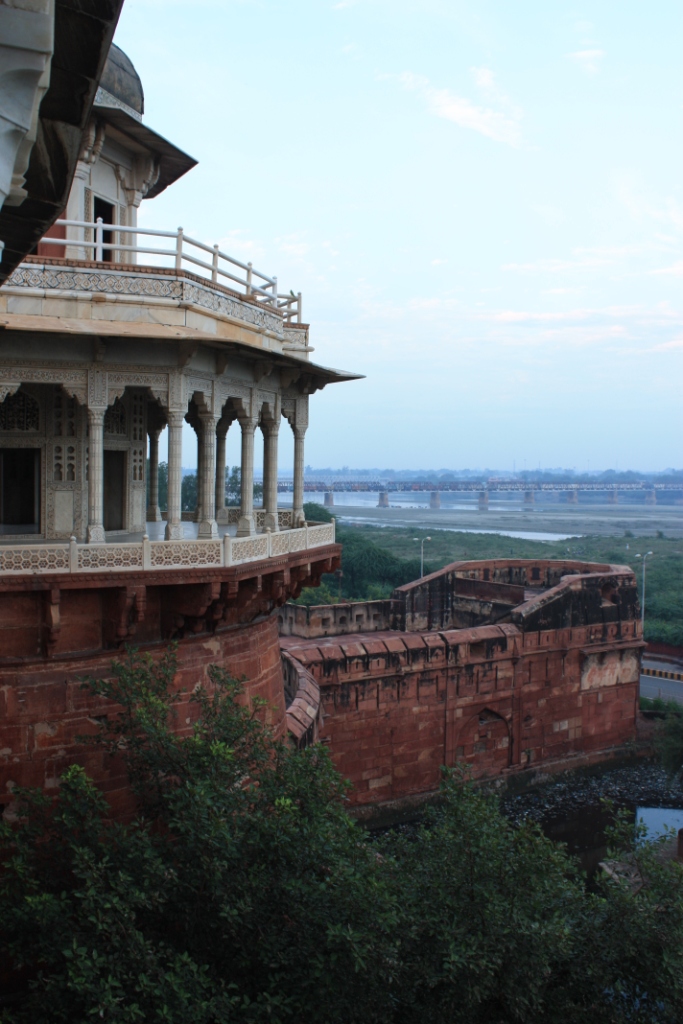
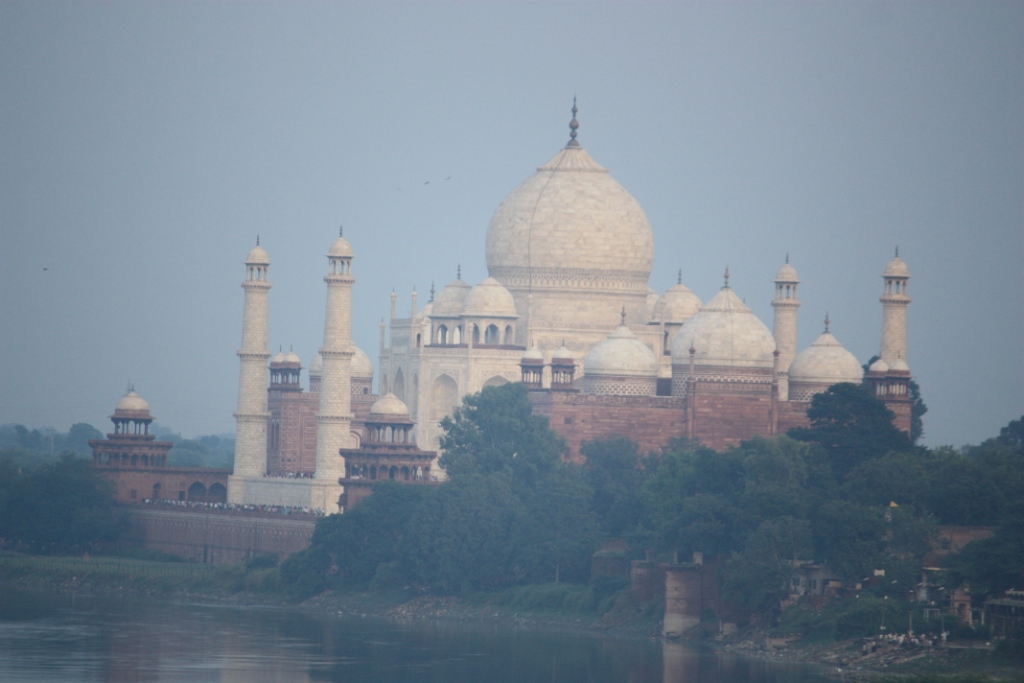
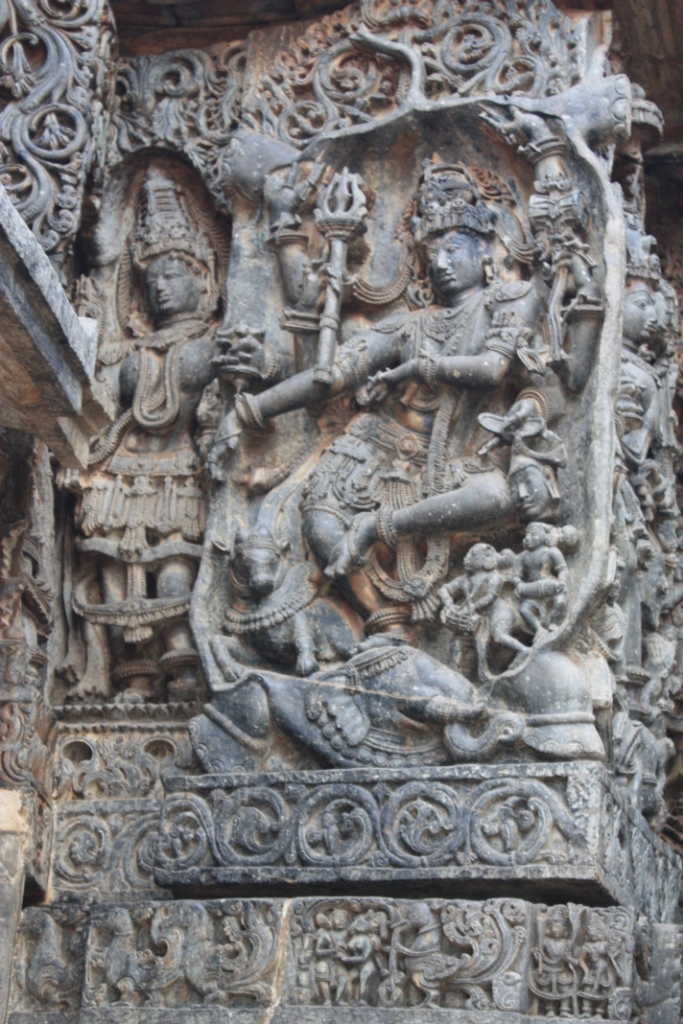
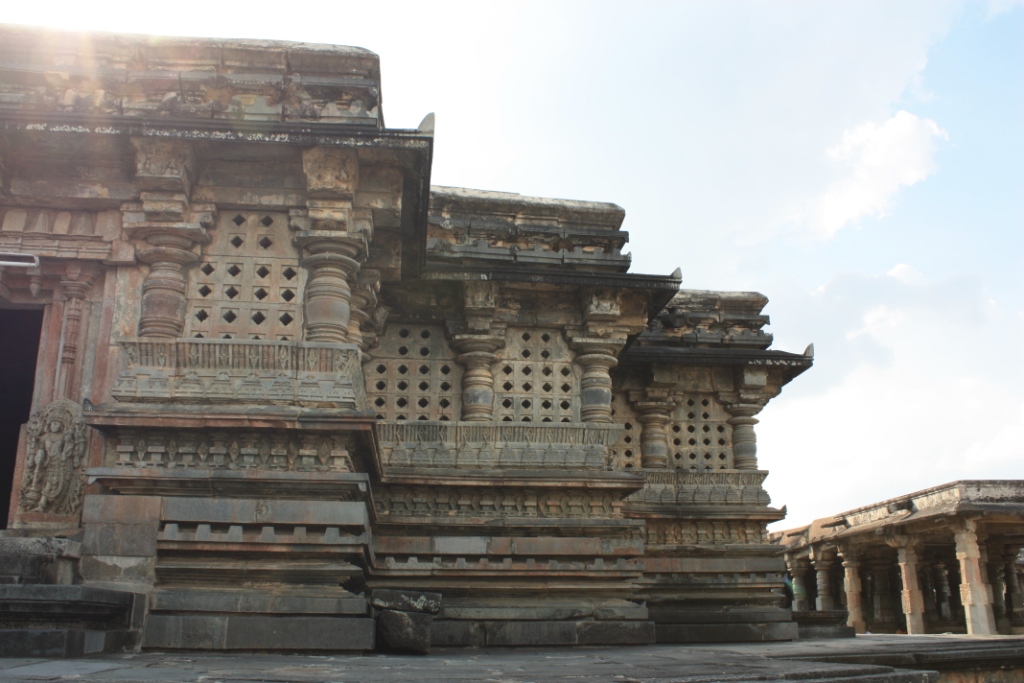
This stone chariot is one of the most iconic scenes of Hampi. The wheels on the chariot were once capable of moving, but no more. It remains an amazing sculpture. It’s in the Vittala temple complex, and is one of the first things that draws the eye when one enters through the gate that one can see in the background.
Category Archives: India
DAILY PHOTO: Towering 4-Handed Guardian
DAILY PHOTO: Yellow Blossoms
The Hampi area is painted from a different palette than most of Karnataka. Instead of uniform green, the brownish-red of the boulders dominates, and, while green lines the spaces between the rock, the vivid yellow of these flowers decorate the base of many hills. Of course, there remain islands of green, in the form of corn fields, banana plantations, and palm groves.
DAILY PHOTO: Sunset Over Hampi
In the tropics the summer days seem so short and the winter days seem so long–at least if you grew up at 42°N (northern Indiana) and now you’re living at 13°N (Bangalore, India.) There’s no discernible adjustment in the length of days here. Maybe, if you’re a local. But it always gets dark around 6 at night and becomes light around 6am the next morning.
Can India Compete With China?
There’s perennial hope in the West that India will succeed. Having won the Cold War, advocates of democracy and rule of law aren’t eager to replay it and have a Communist country win–not even one that yields to market forces in large part. Citizens of democratic nations want reaffirmation that democratic rule and rule by law, not men, is the superior paradigm. We acknowledge that such a system is rarely easy, but live with the words of Winston Churchill ringing in our ears:
Democracy is the worst form of government, except for all those other forms that have been tried from time to time.
When I found out that I was moving to India, I read all that I could find on India in magazines I subscribed to, such as Foreign Affairs, National Geographic, and Wilson Quarterly. Needless to say, there was a lot to read. Besides India’s nuclear programs, both energy and weapons, I hadn’t followed its role in the world. These articles took me on a roller coaster ride. If one went back many years, no one expected much of India. Then, a few years back, massive enthusiasm blossomed that India was going to rocket off and leave India in its dust. Then I got to the most recent articles, which did yet another turnabout–saying that India’s growth had been ephemeral and no one should expect much from the country in the near future.
India has a number of advantages. Almost everyone who is capable of publishing is fluent in the de facto international language of business and academic publication–namely English. India has as abundant a supply of cheap labor as anywhere. Indians have a culture that values education. They are building a first-class university system by, in part, having sent students to the very best of academic institutions globally. Their universities are attracting foreign students. This, in combination with such a big population, has given them the potential to build impressive student bodies.
So, why isn’t India competitive? The first thing that should be stated is that things are never as simple as they appear in aggregate. In some domains, India is competing quite nicely–and not just with China. Here in Bangalore, it’s apparent that large IT companies see big advantages in doing business in India.
I made a recent trip to Hampi and was amazed to see how successful India was in building up wind power generation in central Karnataka. India is 5th in installed wind capacity overall. Many democracies have difficulty getting traction with wind because the public views the turbines as an eyesore.
Still, India has its problems. Political and Economic Risk Consultancy (PERC) surveyed business leaders about Asian bureaucracies and found India to be the worst bureaucracy in Asia. On a 1 to 10 scale, where 10 is the worst possible, India rated a 9.21. This isn’t a surprise in the least. It seems to be common knowledge that business leaders who move to India do so in spite of India’s governance, not because of it. India’s bureaucracy hasn’t embraced the IT-revolution. It’s interesting being in Bangalore, where IT-companies are state-of-the-art, and being asked for the same copies of documents a half-dozen times because the information is only stored on non-networked PC hard-drives–and paper files are collected but don’t seem to be organized in any way.
An ethos of corruption is ubiquitous in India. Police officers have been known to sit in parks and solicit “admissions fees” from tourists. I’m pretty sure I saw a shakedown in progress this past week when our car went through a toll booth on a toll road we had already paid for and two guys standing outside in front of the toll-taker insisted that our driver pay for the toll that he had already paid not ten minutes before. Being from a country where corruption is punished severely, I’m ignorant of the process of bribes. (I suspect this is why I’ve had so little success in getting anything done that involves the Indian bureaucracy.) For a less anecdotal experience, one can turn to the “Corruption Perceptions Index,” which places India in the bottom half among all nations.
One may wonder how a democracy retains a culture of corruption. Usually, citizens of a democracy get fed up and start voting their disapproval. At the Bangalore Literature Festival, I heard an interesting policy panel featuring a politician, a retired general, and a policy pundit. It was said that there is a high degree of apathy among the Indian middle class. Indian voter turnout rates are generally below 60%. There’s a belief that those most capable of affecting change are relatively happy and, thus, unwilling to rock the boat. I don’t know how true this is, but it seems that India is having trouble defeating some of the problems that wither on the vine in the face of a politically active public.
It also seems that there is a segment of the population who are completely cowed. This is a legacy not only of colonial repression but also of caste repression. While castes have been done away with, there remains a large segment of the population who are accustomed to doing just as they’re told without questioning and without making moves to get ahead. Perhaps, because they believe they exist in a world in which there’s no getting ahead.
India’s abundance of cheap labor may be a curse as well as a blessing. While cheap labor has brought in foreign direct investment, it has also contributed to a business culture that doesn’t seem to value increased productivity. As an example, if one goes into a small shop in Chicago or Copenhagen or even Beijing, it’s likely that a single salesperson will show one merchandise, ring it up, and bag it. If it’s a big store, there may be a two person interaction–salesperson and cashier. In an Indian store, a salesperson will show one merchandise, a clerk will write up an invoice, one will take that invoice to a cashier, that cashier will take one’s money and hand one a carbon-copy of the “paid” stamped invoice and direct one to a pick up window, a bagger will bag your purchase, and a “checker” will check your receipt and hand you the bag. I love specialization as much as the next economist, but this is a Rube Goldbergesque approach to retail operations.
If India wants to be a first-rate power, it needs to take on corruption, bring its bureaucracy into the 21st century, and its population needs to realize they can have a more satisfying life than waiting around for someone to need them for a momentary job. The citizenry needs to value good governance, and businesses need to figure out how to increase productivity.
DAILY PHOTO: 1008 Linga on the Tungabhadra Bank
I read the Wikipedia article on Shiva linga, which said that it was a grave error to think of a lingam as a phallus. However, the article went on to say that the union of the lingam and the yoni represents the inseparability of male and female and the act of creation. Therefore, I’m sticking with the neophyte view that this symbolically represents the male organ of amour. [Note: the terms linga and yoni are used in the Kama Sutra to describe the male and female organs, respectively. The terms may have been euphemisms that distorted the true initial meaning, or this might be taken as evidence of the correctness of the neophyte view. I’m not qualified to comment.]
Shiva is one of the top-tier aspects of God in Hinduism. He’s one aspect of the Hindu trilogy. Brahma is the creator. Vishnu is the operator. And, Shiva is the destroyer. This may seem a little ominous, but it’s obvious that something must be destroyed to make way for new things to come into existence. In a more modern interpretation, matter cannot be created or destroyed but can only change forms. These two ideas may seem very different, but when one considers that there is a finite amount of matter, if you want to make something new, then something else has to give up its matter to build it.
So while Shiva’s hallmark quote is, “I am become death, destroyer of worlds,” [reiterated by Robert Oppenheimer in referring to his role in the Manhattan Project] he’s really not so bad a deity.
BOOK REVIEW: Seven Spiritual Laws of Superheroes by Deepak Chopra
The Seven Spiritual Laws of Superheroes: Harnessing Our Power to Change the World by Deepak Chopra
My rating: 3 of 5 stars
This is Deepak Chopra’s attempt to capitalize on society’s fascination with superheroes. By “capitalize” I’m not necessarily saying to “make money off of,” but perhaps to “use to his advantage in conveying his lessons.” [I’ll leave it to the reader to make judgments about the former.] There are books on the physics of superheroes, the philosophy of superheroes, and the mythology of superheroes, so why shouldn’t there be a book on the spiritual life of superheroes?
The book uses both the superheroes of mythology—i.e. Indian, Greek, Judeo-Christian, Muslim, and others—as well as the superheroes of comic books. While Chopra’s knowledge of the former is considerable, he enlists the co-authorship of his son Gotham (not named after Bruce Wayne’s hometown) to offer insight into the latter.
This book is also intended to capitalize (again, take that as you see fit) upon Chopra’s best-selling book, The Seven Spiritual Laws of Success, but without rehashing the same laws. The Seven Spiritual Laws of Superheroes format is as straightforward as its title. There are seven chapters, each corresponding to one of Chopra’s laws. Said laws address balance, transformation, power, love, creativity, intention, and transcendence.
As I read the book, there was something that rubbed me the wrong way about the writing. It wasn’t that I had major disagreement with Chopra’s ideas, but rather the way he was stating them. At first I thought this was the use of gratuitous assertion. He often began chapters with detailed statements about what superheroes are, do, believe, and understand without much—if any–substantiation of these claims. However, as I got into the first chapter I noticed that he would put one section in each chapter that discussed an example in-depth, offering at least anecdotal support for his claims.
This still left a bit of a bad taste in my mouth. It was because he used general statements like “superheroes know…” and “superheroes understand…,” and then provided a solitary example that fit his statement well, but leaving a vast cast of heroes that didn’t. It seemed a low form of inductive reasoning. In other words, he was attributing an enlightened way of thinking and acting to characters like Hulk and Wolverine.
Chopra and his supporters might make the claim that saying, “The Hulk understands X [insert any of the laws here]” doesn’t necessarily mean he understands them as an intellectual exercise, but rather that he shows this understanding through his behavior. Let me give a story that may make my meaning clearer.
An economist is giving a lecture on consumer behavior. Someone in the audience says, “Professor, how could consumers possibly behave in the way you suggest? Your theory requires complex Lagrangian optimization mathematics, which very few of them understand?”
The Professor replies, “Most of them don’t understand Newton’s work either, but they obey the Law of Gravity without fail.”
I thought about Chopra’s statements from this perspective, but concluded that his point was probably something entirely different. As an author of self-help books about the mind, when Chopra says “Superheroes understand X,” he’s not saying “Each and every superhero understands X,” but instead he’s saying, “If you want to be a superhero, you need to understand X.”
Accepting that that’s what Chopra meant, only one more qualm with the book remained. Laws can be clearly stated (OK, perhaps not tax law, but laws of physics—which seem to be more the kind of law he seeks to emulate), but Chopra’s discussion of his “laws” is vague and ill-defined. Each chapter begins with a large-font italics statement. I don’t know if this is supposed to be “the law” or not. It usually begins with a definition (some vaguely stated) and then statements that superheroes comport themselves in accordance with said definition. Maybe the unstated laws are supposed to be, “Superheroes live a life of balance,” and so on for the other chapters. As one trained as an economist, I’m well-aware of the wide-spread overuse of the term “law,” and maybe the ill-defined nature of Chopra’s laws is a recognition of this.
This book is written for Chopra’s usual audience of seekers of enlightenment. I don’t know that it’ll do well with hard-core science fiction or comic fans, and I don’t know that the Venn intersect of “spiritual self-help readers” and “comic book fans” is as big as Chopra would like. (But, I could be wrong.) Some of Chopra’s ideas about the potential spiritual ramifications of “quantum entanglement” are quite popular with sci-fi fans, but I’m not sure that that offers this book a clear audience. (It might. Chopra is a trained physician, and has some scientific bona fides—unlike many who share shelf space with him and who exist in a spiritual plane entirely unrelated to the world as we know it.)
All this being said, there are some thought-provoking ideas in this book, and the superhero and mythological examples help entertain and—in doing so—become the spoon of sugar that makes the medicine go down. Another testimonial is that I read most of this book in a single sitting, and I tend to jump from a chapter in one book to another book unless something really holds my interest.
DAILY PHOTO: Hampi Boulders
I just got back from a trip to Hampi, India. My wife and I agreed that it’s the most spectacular Indian historic site we’ve seen to date. The reason why it edges out the–awe-inspiring–Taj Mahal for us is that even if man had never touched this land it would be a spectacle to behold due to the unique geological processes that have taken place there. (The Taj Mahal is impressive, but once you leave its gates, the glory shrivels. In Hampi, leave the ruins and the awe has just begun.)
The rocks in that region are some of the planet’s oldest, and while much of the softer rock has been entirely washed away, the harder marble remains, but has been eroded over time. It creates an otherworldly appearance that is suitable for the set of a sci-fi film. Some formations seem to defy gravity, with boulders stacked on boulders in impossible ways.
I highly recommend a trip to Hampi. It’s about 7 hours by car from Bangalore (if your driver knows where he’s going–ours was a bit longer.)
A couple of points to keep in mind.
-There’s no alcohol allowed in Hampi village.
-There’s little non-vegetarian food in Hampi (Even if you’re vegetarian, you may be a little underwhelmed. It’s bland by Indian standards, and almost every guesthouse / restaurant tries to sell every ethnic food imaginable resulting in a “jack-of-all-trades-master-of-none” warmed-over mediocrity. The one exception that we found was the Mango Tree restaurant, which is generally packed. Eat at off hours if you can.)
-If you stay across the river, the ferry only runs until 6pm. We stayed in one of the many basic guesthouses in Hampi proper. Staying in a nicer hotel incurs a trade-off that one will have to travel quite a while to get to the site. (As my wife said, “30 kilometers is too far in India.”) If you miss the ferry, the trip by car is a long way around.
DAILY PHOTO: Fatehpur Sikri
Fatehpur Sikri is a historic site not far from Agra (home of the Taj Mahal.) It’s almost entirely red sandstone, and is impressive site and well-maintained– including ornate carvings inside many of the structures.
This will be my last post for a few days as I will be traveling to Hampi, another set of famous Indian ruins of once great states. I’ll be back after Diwali with photos and experience from that visit.
9 Nights at an Ashram
Indian cities don’t whisper. They are often lovely, always lively, but offer little relief from bombardment of the senses. Horns are relentless. Bus and truck air-horns can make a person jump from one’s skin. The smells may be pleasing or putrid, but they’re never faint. There is sign pollution, wherein it’s often impossible to find what one is looking for in the sea of signage–even when it lies right in front of one’s face. Colors pop and glow, not smooth pastels, but oranges and purples that you can practically taste.
It shouldn’t have surprised me when I got to the southern edge of the city to find one of the major land uses was Ashrams. Ashrams in all shapes and sizes, from the small but authentic Narayana Gurukula (mentioned a few DAILY PHOTO installments back) to the massive Art of Living International Center–headed by Bangalore’s most famous guru, Sri Sri Ravi Shankar. Out Kanakapura Road, where monkeys sling through trees and fields of corn remind me of my own Hoosier upbringing, lies a diverse collection of houses of spirituality and reflection. They offer a much-needed island of tranquility amid a sea of chaos.
I stayed for nine nights at one of the most singular of these ashrams, Fireflies. One way in which it’s unique is that it’s a “guruless” ashram. That may seem oxymoronic. The terms “guru” and “ashram” seem to go hand in hand. Guru means teacher. My dictionary defines ashram as, “the home of a small community of Hindus.” [I think this definition could be challenged both on the necessity of “smallness” and “Hindu-ness.” As indicated, there are some pretty massive ashrams and there are ones that are associated with non-aligned spiritual groups.] It’s true that the typical ashram has a spiritual leader or yogi as its head. At Fireflies the gurus come and go with the groups that visit. While I was there, besides our group of Thai Yoga Bodywork practitioners, there was a group of psychotherapists and an organization of past life regressionists. Rather than housing a single unified set of beliefs, at this ashram a diverse and sometimes conflicting set of beliefs are harmoniously housed.
As I have little experience with ashrams, I can’t speak authoritatively about other differences. However, it’s my understanding that one other difference between Fireflies and many–more typical–ashrams is that the latter often have limited or non-existent staff. This means that the visitors may do much, if not the bulk, of the work. Fireflies has a staff that does the cooking and takes care of many needs of the visitors. This isn’t to suggest that it’s like a hotel stay. There’s somewhat of an expectation that visitors will take care of the things that they can do for themselves, and the accommodations are basic.
I found the experience of my stay to be beneficial, if not always stress-free. The main source of my stress had little to do with the Ashram. I received my phone sim card right before I left. After a couple of days I got my phone working for a day or two only to have the phone company turn it off because no one was home when they randomly dropped by to verify my address. [Showing up unannounced in the middle of the day and then treating you as non-existent if no one is home is one of the annoying little hallmarks of Indian institutions (corporate and government) that I’ve experienced on more than one occasion.] I will admit that it is a mark of both society’s and my own wussification that we can’t go a few days without being in contact with home and news of the world. Twenty years ago no one would have expected to have such constant verification that all was well in the world. People could go days back then without worrying that the sky was falling. While it wasn’t pleasant to be cut off, it was an eye-opening experience. [I will note that the Ashram property is on a slope and at the low end I got no reception at all, but on the high end I’d get a bar or two–enough to do the job if the phone company wasn’t screwing me over.]
It was also useful to go without brain candy for a while–that is without television and related entertainment. Part of what I hoped to learn from my stay was whether I was prepared to take the 10-day Vipassana meditation course in the spring. The Vipassana course is considerably more spartan level of existence than that of Fireflies.
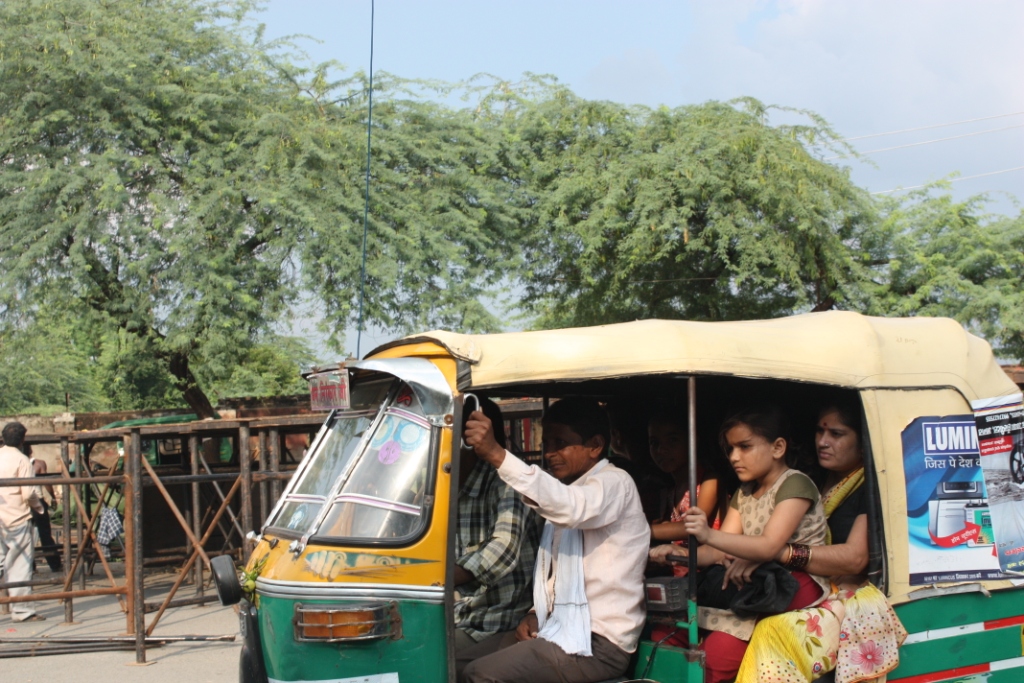
On some levels, I proved ready, and on others I have yet to do so. I did just fine eating two vegetarian meals and a snack for dinner each day. (I could have had three full meals per day, but I wanted to make sure I was ready to cut my intake adequately. Therefore, I stuck with a snack in the evening and ate reasonable portions for breakfast and lunch.) I found the meals at Fireflies to be quite good, and I had no complaints in that regard. It should be noted that the ashram is not an easy walk to any restaurants or substantial stores (there are a couple small shops up on the corner, but they’re geared toward locals and don’t necessarily have what a traveler needs) so it’s not easy to go out for something–though I did see one auto-rickshaw around the premises at times.
The true test of preparation for the Vipassana course is that there are no books or notebooks allowed. This will be my greatest challenge. I finished two novels and two nonfiction books on Kindle during my stay, plus probably another 100 pages of other books, and I filled 2/3rds of a journal–mostly with notes from the TYB workshop.
Also, at the Vipassana meditation course one is not allowed to speak to anyone but the instructor at a specific time when they take questions about the course. I wasn’t nearly so cut off from humanity at Fireflies. The workshop participants and teachers were around all day and I had occasional conversations in the evening with others at the ashram. Furthermore, I’m a fairly solitary creature.
It was interesting that during the weekends there were so many people around, but during the middle of the week there were few. For a while I thought I was the only non-staff member person at the ashram—though I later found that to be incorrect.
So my time at the ashram was Spartan, but that’s part of the beauty of it.
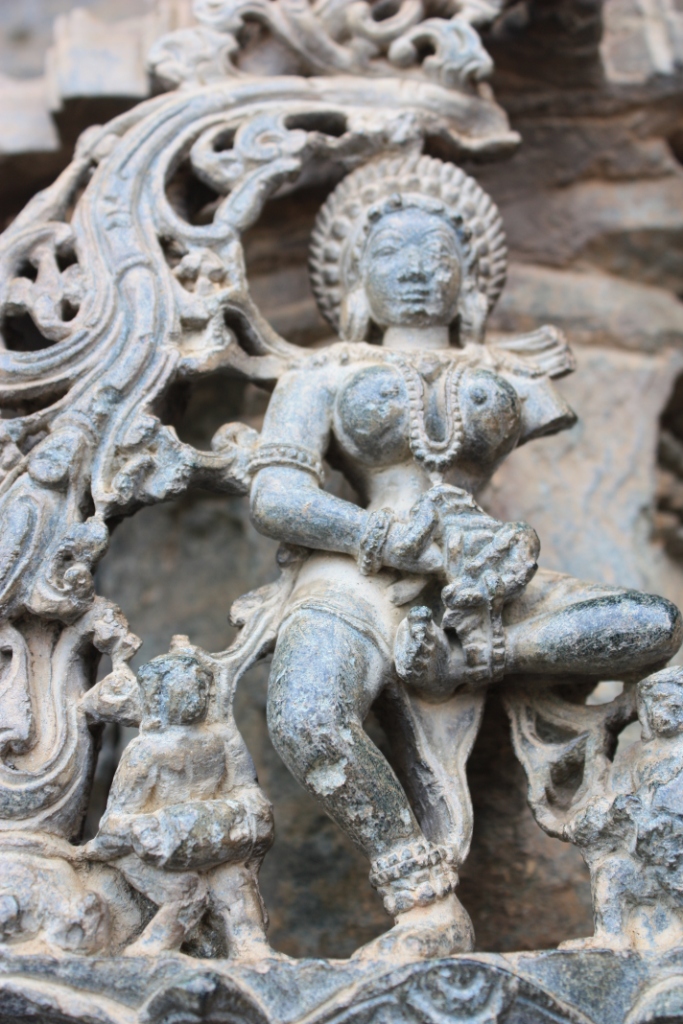
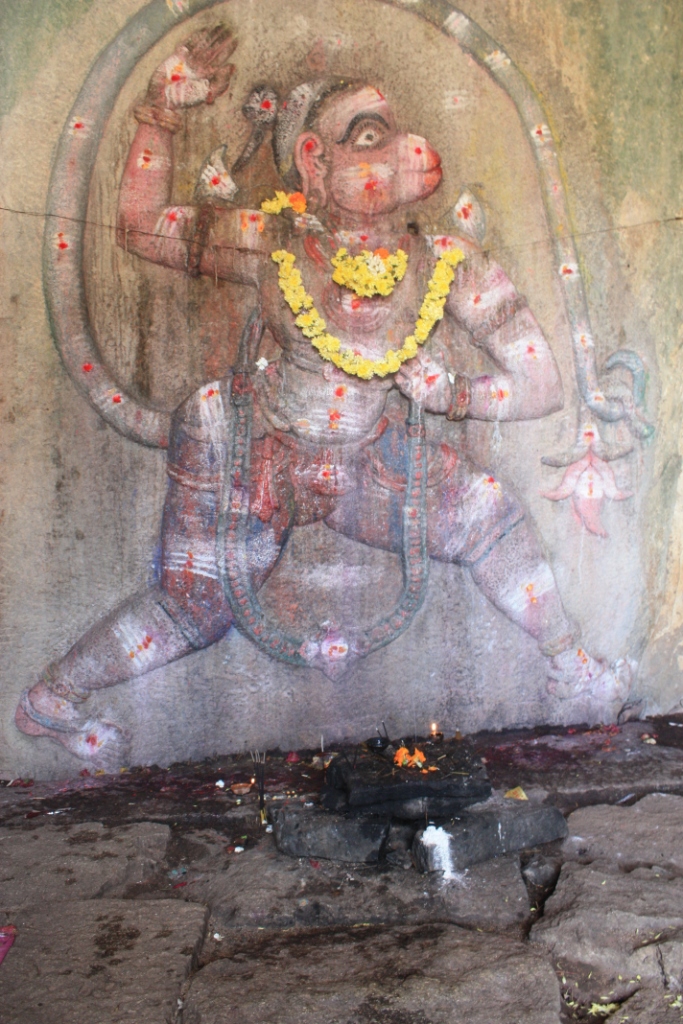
I should point out that there are some impressive stone carvings located throughout the property. The artists are international in scope. Each of these carvings or sculptures offers its own story. I’ll attach a few pics for your edification.