BOOK REVIEW: Ghachar Ghochar by Vivek Shanbhag (Trans. Srinath Perur)

Ghachar GhocharGhachar Ghochar by Vivek Shanbhag
My rating: 5 of 5 stars

Amazon.in Page

This novella, translated from Kannada, shows the Indian family as both a gordian knot that can be the source of great strength through unity and as an unruly tangle that can neither be loosed nor made neat. It’s character-driven literary fiction that focuses on a young man in a family that becomes nouveau-riche. He is aimless and dependent upon the income of his family’s business, and that is fine and natural with him until his newly-wedded wife discovers he’s more man-child than the business executive his calling cards proclaim him to be.

I found the book to be both insightful and brilliantly crafted. As mentioned, it’s more about the family dynamic than a story, but it’s humorous, contemplative, and shows the psychology of family drama nicely.

I’d highly recommend this novella for readers of literary fiction.


View all my reviews

BOOK REVIEW: Expanding Consciousness by Mario Beauregard

Expanding Reality: The Emergence of Postmaterialist ScienceExpanding Reality: The Emergence of Postmaterialist Science by Mario Beauregard
My rating: 3 of 5 stars

Amazon.in Page

Beauregard aims to persuade readers that the materialist view of consciousness is irredeemably irreconcilable with observed reality. In this objective, he fails. (He’s not alone. There are too many unknowns for the rational skeptic to take a firm stance on the nature of consciousness.) What Beauregard succeeds in doing is cataloguing research findings that could be interpreted as suggesting there is more to consciousness than materialists can account for.

Cleverly, Beauregard begins with the most compelling evidence and concludes with the most audacious, controversial, and unvalidated findings. That most compelling evidence is the role of mental attitude and beliefs upon health outcomes. It’s firmly established that mind state has a huge impact on health and health outcomes. From the placebo effect to a health outcome premium to those who pray (and believe there is a god that takes requests,) thought matters. Unfortunately for Beauregard, it’s a huge leap to say this means there is some sort of spirit force that acts on the material world. If one begins from the realization that the human body (and those of other animals) is really good at self-repair within certain limits and given certain conditions (and that among those conditions is the ability to dampen the stress response and trip the rest & digest mode,) then one needn’t call on anything supernormal / supernatural to explain the influence of thoughts on healing.

I don’t have the time or inclination to systematically go through the strengths and weaknesses of all the arguments, but the one I mentioned stands as an example of what is good and bad about the book. On the positive side, I think Beauregard accurately reports on some interesting findings, but then he uses them to bootstrap the position that materialism can’t work ineffectively. I found myself thinking “that does not follow” a great deal. Either there wasn’t enough known to draw a conclusion, or – as in the case of healing – there are competing hypotheses that work as well but without the need to appeal to anything so complicated or unproven as a web of consciousness.

Beyond healing, the book goes through findings that suggest the possibilities of extrasensory perception, telekinesis, and an afterlife for consciousness (e.g. near death experiences [NDE.]) In some cases, this evidence is strong but quite limited (usually limited both in the degree of effect and in understanding of what causes said effect,) but in a few cases the evidence is anecdotal and / or completely unvalidated. The same variation exists when Beauregard takes on competing hypotheses. In a few cases, I found myself thinking his refutations had compelling elements or bases, but in other cases the refutations seemed to be – at best – big stretches. [I expected an extensive refutation of the finding that OBEs (out-of-body-experiences, a common feature in NDEs) have been found to be triggerable at will using physical processes (electrical stimulation) to material (brain tissue,) but did not get it. To my mind, this finding is a challenging – though not damning – counter to postmaterialist arguments.]

If you’re interested in a cataloging of findings that suggest the possibility that there is more to consciousness than materialists propose, this is a fine book to check out. However, don’t expect a persuasive holy grail of persuasion, but rather a mixed bag that ultimately shows no more than the fact that there is a massive amount that we don’t know about how consciousness works.


View all my reviews

DAILY PHOTO: Colorful Houses of Kanyakumari

Taken in Kanyakumari in December of 2020

BOOK REVIEW: The Three-Cornered World by Natsume Sōseki

The Three-Cornered WorldThe Three-Cornered World by Natsume Sōseki
My rating: 5 of 5 stars

Amazon.in Page

This novel was originally entitled Kusamakura or “Grass Pillow,” and it’s the Alan Turney translation that bears the title The Three-Cornered World. Turney drew from a concept that Natsume presents in the book – i.e. that an artist lives in the triangle created by the collapse of a corner called common sense. It’s a poetic and philosophical novel that is very much character-centric. In other words, if you must have an intriguing story, this book is not so much for you. However, if you find ideas and clever use of language appealing, you’ll love it.

The premise is that an artist takes retreat in the mountain countryside, and becomes infatuated with a local woman with a storied past. As the book tells us of the artist’s experience, it discusses aesthetics, the philosophy of art, and the place of emotion in artistic experience. This book is often compared to Bashō’s travelogue (i.e. Narrow Road to the Deep North) as it involves a great deal of elegant imagery and the occasional interspersed poem.

While the book is light on story, I was wowed by the author’s thought process and his use of language. While I’ve never read the original in Japanese, Turney’s translation is beautiful writing in its own right and I suspect it captures the sparse beauty for which Natsume’s work is famed. It is definitely worth reading.

View all my reviews

BOOK REVIEW: Murder on the Orient Express by Agatha Christie

Murder on the Orient Express (Hercule Poirot, #10)Murder on the Orient Express by Agatha Christie
My rating: 5 of 5 stars

Amazon.in Page

This is one of Agatha Christie’s most popular and beloved murder mysteries, in large part because of the atmospherics and premise of the book. It’s not just that the murder takes place on a long-distance luxury train, an exotic and exciting setting to be sure, but that said train is stopped indefinitely by a build up of snow on the tracks in the mountains. What this does is to cut the detective, Hercule Poirot [who just happens to have ended up on the train,] off from the usual resources he would have at hand to solve a case – e.g. forensic science, law enforcement officers, etc. (Though forensic science wasn’t so advanced during the early twentieth century when the story takes place.) This requires Poirot to solve the case with only his wits, encyclopedic knowledge of crimes, and skepticism to piece together a solution to this locked-door mystery.

This was the first Agatha Christie novel I’ve read, and I felt it was a fine entry point into her work. While Poirot – like Sherlock Holmes – is a recurring character that features in a number of short stories and novels, this is a completely standalone story that requires no knowledge from the nine Poirot books that precede it. Poirot has other aspects in common with Sherlock Holmes, but is also quite distinct. Both detectives know pretty much everything there is to know about investigating crimes, but Poirot is much more personable and suave. This makes the Frenchman a more likable but less interesting detective than Holmes – i.e. Poirot is unflawed but correspondingly less believably brilliant.

I enjoyed this story. It does a spectacular job of building intrigue, and that is no doubt largely responsible for the book’s great success.


View all my reviews

Rock at the End of the World [Haiku]

rock swells from sea,
a perfect perch to think on
the world's end

Still Water [Haiku]

boats in still water,
subdued prows reflect
a world below

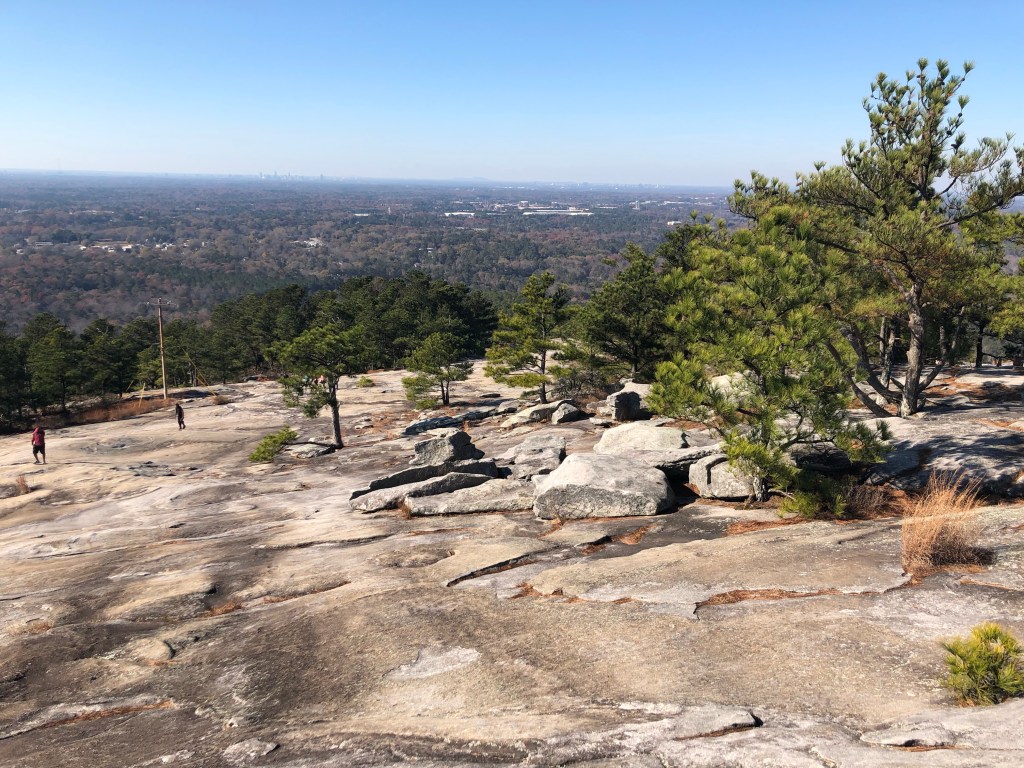
DAILY PHOTO: Stone Mountain Walk-up Trail

Taken in December of 2021 on Stone Mountain, GA

Only Up [Haiku]

shaggy parasol
sits by the sidewalk,
knowing only up

DAILY PHOTO: Boulder Beach

Taken on Havelock Island in 2018.