BOOK REVIEW: The Mind of the Guru by Rajiv Mehrotra

The Mind of the Guru: Conversations with Spiritual MastersThe Mind of the Guru: Conversations with Spiritual Masters by Rajiv Mehrotra

My rating: 3 of 5 stars

Amazon Page

The Mind of the Guru is a compilation of 20 interviews with various teachers and spiritual leaders. While most of the individuals are from Indian spiritual traditions or offshoots thereof, the author makes concerted efforts to represent a range of religious and spiritual traditions.

The list of interview subjects is impressive and includes: The Dalai Lama (Tibetan Buddhism), Thich Nhat Hanh (Zen), S.N. Goenka (Vipassana), BKS Iyengar (yoga), Deepak Chopra (medical doctor and spiritual pundit), Sri Sri Ravi Shankar (Art of Living founder), Desmond Tutu (Christianity), and The Aga Khan (Islam.)

The book is at its best when these gurus are discussing their thoughts on development of the mind and spirit. Obviously, there is a lot of this type of discussion as that is the expertise of most all of the assembled teachers.

A brief forward by The Dalai Lama sets the theme of the discussion. His Holiness states that in Buddhist tradition one becomes a teacher because one has students. Consider this in contrast to traditions that fallaciously believe the title of teacher is granted from above. A master teacher may grant a teaching licence, but that’s just a piece of paper unless someone shows up to one’s lessons. He then goes on to say that one should abandon teachers who act in an unwholesome manner. This, too, is an important point. Having invested oneself in loyalty, it can feel like betrayal to leave a teacher who no longer suits one.

His Holiness is the lead chapter interviewee. In the early part of the chapter, he presents many thoughts on Tibetan mind science. “Mind science” may seem like a strange term, but there’s an important part of Tibetan Buddhism that deals not with deities and conceptions of morality, but with understanding and improving how the mind operates.

If one comes from a tradition in which science and religion are in tension, this may seem unusual, but there is a definite scientific approach (observing the mind and playing out experiments with it.) One doesn’t see a rift between science and religion in Tibetan Buddhism. In fact, His Holiness says that if certain parts of the religious tradition were proved not to exist, they would have to be abandoned. (For those beginning to raise objections, shown to be unlikely and disproven are two different things.)

A second Tibetan Buddhist, Sogyal Rinpoche, addresses the topic of death, and lends the book one of my favorite quotes: “If you are worried about dying, don’t worry, you will all die successfully.”

The first part of this five part book also includes interviews with Thich Nhat Hanh and S.N. Goenka. The former talks about mindfulness and the “interbeing,” and the latter describes the Vipassana approach to meditation and its development. Interbeing is a term coined by Hanh to address a being who is connected to all things. For those unfamiliar with Vipassana, it’s a meditation practice that emphasizes 10-day intensive meditation retreats. There are many retreat centers where this is practiced around the world, including one in the city in which I currently live, Bangalore.

The second part deals with the unity of mind and body. BKS Igenyar, head of a self-named branch of Hatha yoga, opens the chapter with discussion of his background and approach to yoga. Deepak Chopra talks about the intersection of science and spirituality. David Frawley talks about Ayurvedic medicine as well as some more “out there” subjects, such as astrology.

I hadn’t heard of two of the three interviewees in part three, Swami Ranganathananda and Mata Amritanandamayi. However the third interview was Sri Sri Ravi Shankar, a guru well-known internationally for his soft-spoken teachings that combine yoga with a secular spiritualism rooted in Hinduism but not explicitly advocating it. Swami Ranganathananda is from Ramakrishna’s order, which was a secular spiritualism movement rooted in Vedantic traditions but embracing diversity of belief. Mata Amritanandamayi is one of only two women interviewed for the book, indicating women haven’t achieved equality in guru-hood just yet–for all the talk of enlightened thinking. (This is not a dig at the author, who probably went out of his way to include these two to have diversity in gender as well as diversity of tradition.)

The fourth part adds to the diversity by opening with an interview with Sufi Muslim, Pir Vilayat Inayat Khan. Sufi is the mystical branch of Islam. (Mysticism meaning a belief structure in which God is considered to be part of one and is accessed by mindfulness and introspection. This in contrast to the largest strands of the world’s major religions in which God is conceptually something distinct from the self and is an entity to be worshiped. Most major religions have mystical elements or a mystical branch, including Christianity and Islam.) This interview eases us away from the traditions that are either of India or have their roots in India. (By that I mean that Buddhism has its roots in India, though, for example, Zen is different from Buddhism as practiced in India today.)I say “eases us away” because the mystical nature of Sufi would not create much cognitive dissonance in yoga practitioners, Hindu spiritualists, or Zen monks, but, instead, shares much common ground.

The second chapter in part 4 is that by the other female guru, Radha Burnier, who is a practitioner of Theosophy, which means “divine wisdom.” This modern development is secular in that it doesn’t advocate a particular religion, but rather engagement to fix societal problems and eliminate biases and divisions. In the interview we get a hint of the divides that plagued this organization.

Part four is rounded out by interviews with Swami Parthasarathy and U.G. Krishnamurti (not to be confused with Jiddu Krishnamurti, who probably would have been included in this book if he hadn’t died in the 1980’s.)The former speaks about the end of knowledge and the latter about his role as an anti-guru, rejecting traditional approaches to thinking about spirituality.

The fifth part of the book is entitled “The Ethics of Engagement” and I’m afraid it’s where the wheels roll off. It has six excellent authorities, Desmond Tutu, Baba Amte, Ajarn Sulak Sivaraksa, Swami Agnivesh, The Aga Khan, and Karan Singh.I don’t criticize the selection of interviewees, but what happens here is that the chapters predominantly become about politics and policy. Some of this discussion is present throughout the earlier chapters, it’s a point that the author/interviewer finds either intriguing or salable. For example, he asks The Dalai Lama about the politics of Tibet and China, but only after much wisdom is shared.

Here is my–sure to be highly controversial–view on the subject. Wise people show the least wisdom when they’re speaking of politics and policy. I understand why readers may want to hear their thoughts, and I know that as leaders they shape movements in these domains. However, their thoughts on such subjects rarely pack the wallop of value they do when they are talking about subjects like improving one’s mind or living a moral life–subjects on which they have great authority.

What happens when the wise talk about policy is the same thing that happens when most people do, they fail to understand the complexity of the issues and they end up making a lot of “have our cake and eat it too” statements. The most common of these is that we need to: a.) raise all the poor to a certain standard of living (a noble cause), b.) eliminate attachment to materialism and consumerism (also a fine cause, no one should be addicted to “stuff.”)

As one trained as an economist, however, when I see these statements issued by the same person in the same interview, I laugh. We have no idea how to achieve these two things simultaneously; anybody who tells you they do is living in a dream world or is deceiving you. If everybody decided tomorrow that they didn’t need a bunch of new gadgets and widgets, this wouldn’t help pull the poor out of poverty. On the contrary, it would lessen their opportunities to raise their quality of life. Conversely, if you want to pull people out of poverty, they have to produce and sell things that other people want. Rising incomes result from rising productivity, and rising productivity comes with rising production–but someone has to buy that increased production. If you have a way to truly get around this dilemma and it’s one that economist haven’t thought of before and which hasn’t either been proved wrong or internally inconsistent, I will personally lobby for you to be nominated for next year’s Nobel Prize in Economics, and would place a bet on you to win.

I will say that some of the authors seem more savvy of the political and societal domain than others. For example, Mata Amritanandamayi says, “Even if we remove all nuclear weapons from our armories and transfer the to a museum [that last bit is, admittedly, a really bad idea], it wouldn’t bring an end to war. The real nuclear weapons, the negative thoughts in our mind, should be eliminated.” In other words, you can’t fix society’s problems through dictates, particularly when those dictates are in contradiction.

One of my lesser complaints with the book is that the author sometimes asks leading questions (i.e. he subsumes a conclusion in the way he forms the question.) However, almost invariably the speaker sets the record straight, but it makes one wonder about how the message is shaped by the interviewer.

There may be a little too much cultural self-congratulation going on throughout the book for some. There’s a primacy fallacy theme throughout the book that India had everything perfect until it was infected by Western ideas. This isn’t to imply there aren’t fantastic ideas and cultural developments that have come out of India. I wouldn’t have read the book if I didn’t believe there were, but there was also the caste system and some other fairly giant issues of institutionalized injustice like women essentially being sold off into marriage.

An example of this bias can be seen in the talk of Swami Ranganathananda. He says of Socrates, “Had he been in India, he would have been honored and worshipped.” Yeah, if he were of the right caste, maybe, but he also might have been bludgeoned to death in a fashion far more brutal than having to drink hemlock.

Overall, I would recommend the book. It is an impressive collection of teachers and all of them have something intriguing to offer in food for thought. One just needs to go back to The Dalai Lama’s Forward and not be so awe-inspired that you fail to look critically at the message of each.

View all my reviews

Mindfulness Meditation: Why be Mindful?

IMG_0430“Why be mindful?” That was the question asked to the group assembled at the Thubten Lekshey Ling Tibetan Buddhist meditation center on Sunday.

We had just completed a couple of rounds of mindfulness meditation. We’d been told that there are four themes of mindfulness meditation, but there can be variations on each. First, there is mindfulness of the body. This was the first type of meditation that we practiced. It isn’t about recognizing the body as an object so much as a field of perceptions.

Second, there is mindfulness of one’s feelings or sensations, in other words, mindfulness of the outside world as perceived by our sense organs. We did a meditation in which we were mindful of sound in particular. The key, we were told, was to hear everything–even the sound of silence. “Listening to the sound of silence” may sound like an oxymoron, but it makes sense as one experiences it. When one thinks in terms of hearing sounds, one begins to actively try to “catch” a sound. One may even try to anticipate sounds, particularly sounds in series–like a roofer using a nail-gun on a nearby roof. This active listening, rather than hearing, is not what one wants.

We also did a mindful eating/tasting exercise. We ate a tiny bit of snack mix. The whole processing taking many times what it normally does to shovel a bit of snack into one’s mouth and wolf it down. The food was raised to one’s face, experienced, placed in one’s mouth, experienced, chewed, experienced, and swallowed.

Third, there is meditation on the mind. That is, one watches one’s thoughts. We didn’t do one of these meditations. However, I’ve tried it in the past, and I find this particularly difficult . Watching thoughts go by as if they were rising bubbles or logs floating on a river suggests a division between the observing mind and the thought-producing mind. Recognition of the thought intrudes upon it, and this becomes a whole new line of thought.

Finally, there is meditation on emotion. We did not do one of these in this session either.

Our final meditation was another type of meditation on the body, but it was a moving meditation. We walked and experienced the motion of the body as it moved through the room. I particularly enjoyed this.

However, before the last meditation, we discussed this question of “why be mindful?” I had my own ideas, which I shared. Others had their own ideas, some closer and others farther from my own thinking, but all thought-provoking and valid.

My own thoughts were two-fold. First, mindfulness allows one to be more stable and grounded. Fear is about the future and anger and sadness are about the past. In the present one is neither afraid nor fearful. Second, by being mindful, we can come to see problems before they tumble out of control. We can catch our angry thoughts and dissect them before they do us harm. We can recognize the subtle problems with our bodies before they come full-blown ailments.

Of course, as a martial artist, I had always thought in other terms about mindfulness. There’s no time at the speed of combat to consciously recognize and consciously respond to attacks, one must be mindful to have any hope of surviving a surprise attack.

BOOK REVIEW: Know Your Mind by Sri Sri Ravi Shankar

Know Your MindKnow Your Mind by Sri Sri Ravi Shankar

My rating: 4 of 5 stars

Sri Sri Ravi Shankar is an Indian guru headquartered in Bangalore, India. In addition to his work as a spiritual leader, he heads up an organization called the “The Art of Living,” which has both a philanthropic mission and a role in spreading knowledge of yoga. Among his most important accomplishments is the development of a breathing technique for helping to attain greater emotional well-being. However, he may be most broadly known for occasional appearances on television programs such as those of CNN International.

The slim volume K(no)w Your Mind contains a series of short chapters, many of which are partly in Q&A form–coming from talks he has given internationally. The common theme of these discourses are how one can understand one’s mind and learn to live in a way that maximizes happiness.

Sri Sri’s approach is quite mainstream when compared to more controversial gurus such as the late Bhagwan Shree Rajneesh (i.e. Osho.) There is little that would raise hackles of most people. It proposes nothing magical–though Shankar supports belief in some, broadly defined and mystical, deity. His approach doesn’t rely on said deity. The book is essentially just about training the mind to look at the world in a different way.

One example that the author uses in various permutations is that people dwell on the negative. As he says, “When you are healthy, you never ask the question, ‘Why am I healthy?’When you are sick you say, ‘Oh, why am I sick?'” Similarly he mentions that, if someone tells us they like us we don’t question it, but if they tell us they hate us, then we do.

When asked how to avoid stress, he states flatly that one shouldn’t avoid it, but rather learn hope to cope with it more effectively.

On the positive side, the book conveys a lot of good information in a highly readable format. Shankar explains the mind with humor and occasionally with a parable or narrative to help make the lessons more memorable.

However, if one is looking for a systematic approach, one won’t so much find that here. It’s clear that this is a series of snippets from talks combined together. If that’s what you’re expecting, then it shouldn’t be a problem. However, if one is expecting a step-by-step guide, this book may not suit one. Occasionally it’s helpful if on has some yoga terminology in one’s head like samadhi or pranayama, but context should make the meaning clear.

I’d recommend it for someone looking for food-for-thought on bite-sized pieces on issues like memory, emotion, and mindfulness.

View all my reviews

Picture Your Unhappiness in its Underwear

I was writing some six-words on Smith Magazine the other day. I do this now and again as an exercise to get the creative juices flowing. There are a series of themes, and I try to write in as many of them as I can in less than 20 minutes, writing in a free form, stream of consciousness style.

When I got to the category HAPPINESS the first six-word to jump to mind was: “Picture your unhappiness in its underwear.” This one drew a nice response, which began me thinking about whether this advice might have actual merit–as opposed to being a non-nonsensical statement that might at best function as a Zen koan.

As I thought about it, three legs of the stool came to mind.

1.) Have a sense of humor. Anger and sadness have a hard time taking hold if one can manage a good laugh. I’ve found that being able to dance personal tragedy into comedy has been a great coping mechanism. One does have to be conscientious about not becoming a snarky person. One risks beginning to see the world through a crap-colored lens just as a means to comic fodder (or from a martyrdom complex.)

Perhaps even if one can’t formulate humor, one can still use laughter. There’s a system called laughter yoga that is based on the belief that you can create the same range of physiological responses from “forced” laughter as one does from spontaneous laughter. It’s a sort of chuckle pranayama (breathing exercises.)  While I don’t know much about the system, I can believe that it has merit based on what I’ve read about human emotions.

2.) Lay the source of your unhappiness bare. This sounds simple enough. One must know what is making one unhappy in order to turn that frown up-side-down.

That being said, human beings have an astounding ability to attribute all negative happenings in their lives to external factors. Like politicians, we like to take responsibility for what is going right (regardless of whether we are responsible or not), and we love to place the blame for failure firmly elsewhere (even it it’s mostly our fault.) This may be an evolutionarily-hardwired coping mechanism, but it can keep one in the doldrums.  If one continually says, “He makes me so mad” or even, “His actions make me so mad,” then you’re forfeiting control over your emotional state. Jerks and bitches might be an intermediary cause of unhappiness, but ultimately one’s own perceptions and responses lead to the negative emotional state.

This is where the hard work of mind training comes into play. Instead of being swamped by negative thoughts, one has to recognize them early, find the root cause, and recognize that our desire to for things to be a certain way is ultimately what makes us unhappy. We may want people to think we are smart or beautiful, and intimations to the contrary (whether intended or not) make us fume.

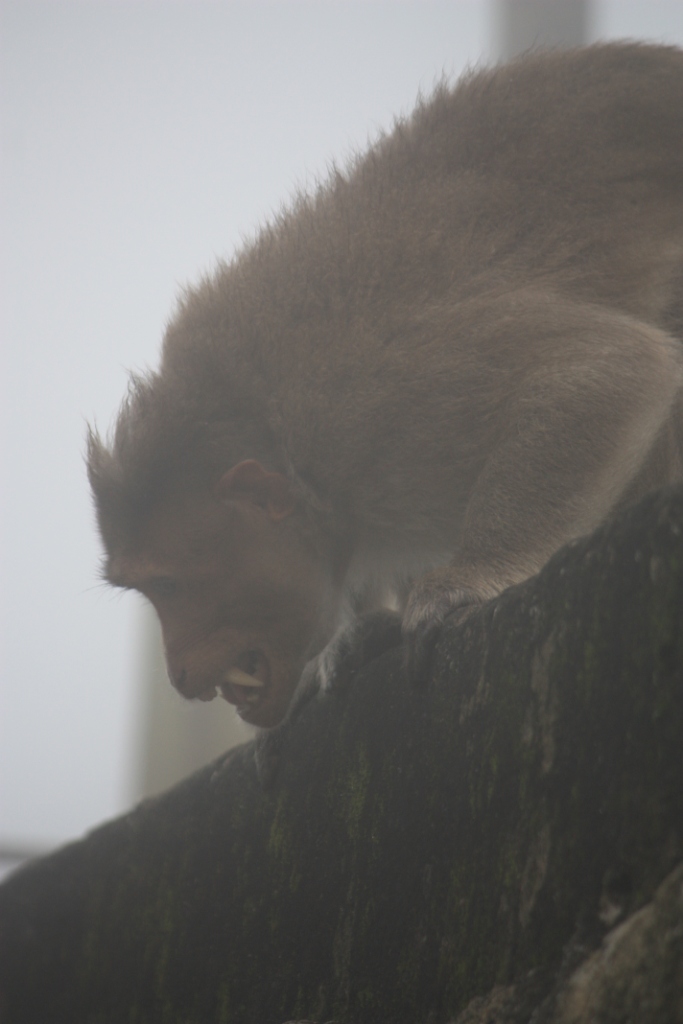
Don't be an angry monkey!

Don’t be an angry monkey!

One of the few things I remember explicitly learning in high school was about what our psychology teacher called a “gestalt of expectations.” Like most ideas one remembers though only taught once, I remember it because it had a memorable story attached to it. The story goes like this: “A man is driving through the desert in the American southwest. Now, out in the southwest, gas stations can be few and far between. So the man runs out of gas, and realizes that the station he passed 20 miles back is his safest bet because–contrary to what he had thought– the next one going forward might be another 50 miles.  So he starts walking. It’s hot. He’s hungry. He’s thirsty, and only has some lukewarm water that’s getting hotter by the minute. The backs of his hands and his face are getting sunburned. He starts thinking about how the little two-pump gas station is going to gouge him. He realizes he’s desperate, and so he figures the attendant is probably going to sell him gas at $6 a gallon, a bottle of cold water for $8, and don’t forget the jerrycan at $20.  These thoughts and the heat keep making him madder and madder. Finally, he gets to the station, and the attendant comes out and say, ‘Oh my, Mister, you must have had a horrible time.’ And so the man on the verge of heat-stroke punches out the attendant, a kid who only wanted to help him out.” Once one starts attributing one’s unhappiness to external sources, one can easily mis-attribute unhappiness because one thinks one knows what is in the minds of others, when really one doesn’t.

3.) Unhappiness, like standing around in one’s underwear, is–at most–a temporary state. As Taoists have been known to suggest, one’s darkest hour is a time to rejoice, for surely it will  get better from there. The only way one can remain in a perpetually unhappy state is to carry it with one long past its time. Just like the only way that can always be rained on is if one carries around a complicated mechanism with a showerhead and tank and keeps refilling that tank so that the shower never runs out. Otherwise, the dry season will come eventually.

Slow Down and Savor the Instant Karma

Our tenant moved into our house and we still have a couple of days until we fly to Bangalore. So I’m living in a hotel in a densely populated part of town. Today, I made a trip to the supermarket. Almost every spot in the parking lot was full. I was  leisurely trolling the lot when I spotted an available spot. The spot was near the periphery of the lot–i.e. distal to the store, but I’m never opposed to a little walk.

I noticed a truck at the other end of the aisle gun its engine. The driver had probably been looking for a spot for a few minutes and was in a hurry. Though he had about eight cars between himself and the spot, and I merely two, I stopped and let the scowling, elderly man race into the spot. Having nowhere urgent to be until my Friday morning flight, I saw no need to sweat it. Once he was parked, I moved forward cautiously.

Wouldn’t you know it, as I was getting to the end of the aisle, a lady backed out of the end spot nearest the store. I checked to make sure that it wasn’t reserved for the disabled, pregnant women, or the employee of the month, and– seeing no competitors for the spot– I drove in. As I was getting out of the car, the scowling man shot me an icy stare. I don’t think he was angry with me, but, rather, he was convinced that the universe was against him. I imagine that he was thinking that guys like me get all the luck. He’s right. Of course, if he’d have stopped to let me take the first spot, he would have gotten the closer one–then we’d both be guys who get all the luck.

Eulogy for Sonny

Sonny was a stray who hopped up into my lap one day as I was reading on the back porch. He petted himself against me, and moved in shortly thereafter. He was between kitten and cat then, and so we estimate his age was approaching 12 when he left us.

Being a gruff, introverted stoic, I realize that I am an acquired taste as a friend. I have few non-contextual friends: that is, friends outside of a common endeavor such as a workplace or a school. Not that there’s anything wrong with friendships born of a common workplace or pastime, but Sonny’s out-of-the-blue arrival created a special fondness. That was Sonny’s nature.

He was a little dirty at first. A tiny notch in his ear–one that would be made symmetric later in life, marked him as a fighter as well as a lover. All about the love in the home, but ready to scrap to defend his adopted lair at a moment’s notice.

The books said his breed wasn’t inclined to be lap cats, but—being a cat—Sonny didn’t read much. And, therefore, he would spend hours curled into a torus on my lap, until my legs fell completely asleep and I had to stumble through pins and needles to refresh his throne.

Sonny developed a growth in his head. It was removed and biopsied, and then once more. Though Sonny’s Chi was strong, each time his nemesis grew back with greater ferocity. He fought it quietly and calmly. Making no complaints; demanding no sympathy. He was unflappable.

Sonny was a bundle of virtue: patient, kind, forgiving, strong, and stalwart. If the religions that believe in transmigration of souls are right, Sonny has earned the right to be whatever the hell he pleases in his next life.  He was a Bodhi-cat-va, helping us to eliminate stress and teaching us how to accept upset.

Your gentle head-butts will be missed. Your popcorn bowl conformity will be missed. You, my friend, will be missed.

We never knew where Sonny’s scars and nicks came from, but I imagine it quite like that of Neil Gaiman’s The Price

Transmigration of Blog

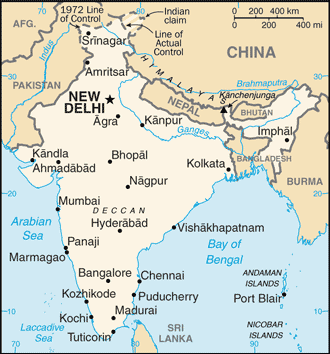
india_sm_2012We’re down to about a month until our move to India.

The house is largely in order with only a few odds and ends remaining.

Most of our worldly possessions are in storage, and I haven’t really missed any of it. (A lot of “moss” collects when your stone stops rolling for a few years.) The house now echoes. Movers will be coming to get the small amount of stuff we’ll ship to India in the next couple weeks. Then we’ll really be living minimalist.

We’ve got all our shots with the exception of the final doses for Hepatitis. We’ll get those in country. With respect to shots, when moving to India, one has to get… well,  all of them.

Visas are in the works though we’ve had some delay on that front. However, fortuitously, the local Indian Consulate is beginning to take applications, and so I won’t have to send my application off to another city and can eliminate the time and risk of postal transit.

My list of things to do consists of fewer large, all-consuming tasks and more quick and easy jobs.

All of this means that I’m getting back to writing.  This is a bit like getting a corroded junk-yard jalopy running again. It’s remarkable how much the creative juices curdle when one spends a few months focusing on home repairs, monitoring contractors, getting shots, and other mundane tasks of international relocation. I worked almost exclusively on drafting two novels for a period of a little over a year, and now–as I resume writing and revisions–I’m having to re-read just to figure out what they’re about. On the bright side, I sometime surprise myself with what I wrote. For me, there’s definitely economy of scale in long writing  projects. Writing eight hours a day yields a lot more than eight times writing for one hour a day. I lose voices, character idiosyncrasies, and plot detail so easily unless I’m immersed in them.

As for this blog, I think a rebirth is in order. Since I’m moving to India, I’ve invoked the concept of transmigration of soul. In Hinduism, some sects of Buddhism, as well as a few lesser known religions, there’s a belief in reincarnation in which the soul may be reborn into an altogether different type of container. For example, if you were good in your last life, you might come back as a lama or a lap cat. If you were bad in your last life, you might come back as a slug or a Congressman. So the question of the moment is what this blog will be reborn as when  it sputters up from out of the ashes.

I would like the site to remain (or, perhaps, become)  humorous, but I’d like the humor to be less curmudgeonly. This presents a challenge because I’m not sure that I know how to be funny without being a curmudgeon. In point of fact, I’m not sure I know how to not be a curmudgeon–funny or otherwise.

I want this site to be reflective of my new life. I’ll continue posting photos, though after the move they will be disproportionately from Bangalore, India, and a few adjacent countries to which I will be traveling. So it’ll remain part travel site. I’m sure I’ll have plenty of lessons learned about travel in India to share.

When I’m not writing or sleeping, I’ll be engaged in a quest of self-improvement. The development of mind and body have been raised to high art in India, and I hope to  find some of those individuals with that knowledge.

Expanding my abilities and understanding of martial arts is one of my goals for this period. It’ll be a challenge to keep from becoming rusty in the jissen kobudō (Japanese old school martial arts that emphasize pragmatic skills) that I have been studying my entire adult life. However, in addition to working on what I know, there are other activities that I think will help expand my understanding while keeping me suitable limber and conditioned. I would like to learn  a little about indigenous Indian martial arts such as kalaripayattu, silambam, and–if time permits–gatka. Furthermore, I would like find a place to train in Bangalore where I can do some training in what I’d call general jissen (practical fighting) skills.

However, my attempts to improve myself will not be limited to martial arts alone. India might be cursed with plagues of poverty, pollution, and–well–plague, but they have no shortage of gurus–whether I can find one that’s reputable and willing is another matter. The older I’ve gotten, the more I’ve realized that I don’t have a firm grasp of my mind. My mind runs and I don’t pay enough attention to what it is telling me; I don’t put enough effort into fixing what is broken. I read a quote recently about people who put great effort into studying the external world, but who remain ignorant of themselves.  This struck close to home, but it’s not just me–it’s widespread. People study psychology in school and learn about cognitive biases, but they don’t put the information to use in becoming more virtuous people. For example, a person might learn about the “self-serving bias” –whereby people claim responsibility for successes but place blame for failures on external factors–and say, “yeah, it’s funny that other people totally do that.”

Part of practicing martial arts is keeping one’s self healthy, against all odds. While I’ve never practiced yoga, I appreciate the belief that mind and body are inseparable. I would like to work on building a body that is less likely to be crippled by the practice of martial arts as I age. I intend to study Thai yoga massage, which incorporates stretching and pressure point massage. There’s an interesting connection between India and Thailand with respect to this form of bodywork. While it’s most closely associated with Thailand, some claim that its roots are in Northern India with a master called Guru Jivaka. While visiting Thailand, I developed an appreciation for the health benefits of this type of massage–particularly for one prone to have things out of whack. However, I didn’t have the time to study it during that visit. There is also the more distinctly indigenous holistic healing system of India, Ayurveda, and I would like to learn more about it as well.

In short, I intend to have a pretty full agenda while living in India, and I hope readers will find my posts about these experiences interesting and worthwhile.

BOOK REVIEW: A Search in Secret India by Paul Brunton

A Search in Secret IndiaA Search in Secret India by Paul Brunton

My rating: 4 of 5 stars

Amazon page

A Search in Secret India is a travelogue by Paul Brunton as he wondered through India in search of sages. In the process, he found a number of masters of body, mind, and both. However, he finds these individuals as rare nuggets in a sea of frauds.

Brunton states up front that he won’t waste time with any of the blatant frauds or suspected frauds, but he does devote space to a number of the more impressive ones. Impressive either by way of a large following or artfulness of technique. He also finds individuals he doesn’t know what to make of. These individuals appear to have impressive otherworldly skills, but skills that he can neither reconcile with known scientific understanding nor uncover as hoaxes despite his best skeptical inquiry. Given Occam’s Razor, he seems to be left suspecting that these are masters of illusion, but he maintains skepticism of his skepticism. A prime example of this is a Yogi who seems to be able to conjure any scent upon request.

Brunton also runs across individuals who are able to do amazing things that are inconsistent with his knowledge of the world, but which his exhaustive investigations leave little room to dispute. For example, there is one yogi who can completely cease his respiration for a seemingly impossible length of time, and who resumed breathing not with a gasp but with a slow, calm series of breaths.

As suggested above, this book is really an attempt to analyze India’s spirituality through the lens of Western logical and scientific approaches. The author is a Brit and the book was first published in the 1930’s. His worldview is consistent with that status. While Brunton would like to master his own mind, he is unwilling to let himself be duped.

There is another side to this juxtaposition of East and West. The yogis and gurus with which Brunton comes into contact often have trouble grasping the Western mindset (there is one notable exception.) What these wise-men have difficulty understanding is why a people, like the British, devote so much time to mastering the external world (and with a great measure of success it must be added), but put so little effort into mastering or understanding the self. Most of the gurus appreciate that a Brit is taking an interest in the spiritual and yogic ways of India, but with their own skepticism. They find Westerners materially rich, but bankrupt of the mind. They find the Brits strong, but lacking the supple power that yoga introduces.

After completing his travels, it seems the book is set to draw to an end. However, Brunton realizes that while there were a number of skilled individuals that he came across in his travels,there is one that stands out as someone he should not miss an opportunity to learn more from. Therefore, instead of getting on a steamer back to England, he returns to South India to a man called the Maharishee in order to find out if the guru will take him as a student. The last couple chapters describe his time under the Maharishee’s tutelage as well as under one of the guru’s most advanced students. The Maharishee is a sage the likes of which Brunton has not seen in all his travels. The guru has the humility to say that he cannot teach Brunton anything, but instead can only show him some things that he learned on his own journey.

If there is a lesson for those who would like to follow in Brunton’s footsteps, it seems to be that there is an inverse relationship between how easy a guru is to find(/how eager a guru is to talk to one) and the level of skill of that teacher. In almost all cases, Brunton had to take great initiative and steer off the beaten path to find the true masters. On the other hand, most of the individuals who were easily found, and eager to talk, were just con men.

I recommend this book for those interested in development of the mind and body.

View all my reviews

Teachable and Unteachable Lessons

[Note: This is posted in my Jissen Budōka blog as well.]

Source: Wikipedia; Status:  Public Domain

Source: Wikipedia; Status: Public Domain

Miyamoto Musashi, who was undefeated in over 60 duels, claimed that he never had a teacher. Some historians refute this claim. Whether one accepts it or not, the statement astonishes.

Musashi wasn’t talking only about martial arts, but about the many areas in which he was accomplished. Not being a painter or a sculptor, I can’t say how important a teacher is in such domains. But it’s easy enough for me to imagine a successful writer who never took a formal class in writing; someone who read profusely and practiced his (or her) craft relentlessly could do it. (Certainly, one can easily imagine successful writers whose formal education was in some area other than writing because there are so many of them–probably at least as many as those whose education was in writing. Examples include: Vonnegut [Chemistry], Crichton [Medicine], Zane Grey [Dentistry], Ursala LeGuin [Anthropology], and J.K. Rowling [French]. That’s not even to start on the many literary legends who dropped out all together– e.g. Dickens, Faulkner, Twain, H.G. Wells, and Jack London.) This isn’t to say that writing teachers don’t make writing better, but just that there is a path to this skill that doesn’t involve being fed lessons.

However, I struggle to imagine a martial artist achieving so much without a teacher. Boiled down to its most workaday definition, a martial art is a collections of lessons about what works in a combative situation. This is what separates the importance of a teacher in martial arts from that of a discipline like writing. In writing, one has the leisure to make one’s mistakes, learn from them, and self-apply course corrections. Musashi was in life or death duels; he couldn’t learn lessons at such a leisurely pace and in such an iterative fashion.

A martial arts teacher has a number of roles, such as preventing inertia (slacking) from taking hold in the training hall. However, the most fundamental purpose is to pass along the collection of lessons so that a student doesn’t have to learn them all by way of personal experience. Most of us aren’t Miyamoto Musashi; we can’t survive the process of learning all our own lessons.

Needless to say, I am a firm believer in the value of a good teacher. I’ve had several over the years, and I received valuable lessons from all of them–all with different, but no less valid, points of emphasis and flavor.

Having said all that proceeds, there’s much that cannot be taught. Such lessons may be described or discussed, but they cannot be learned except through the initiative of the student. I said that most of us can’t survive the process of learning all one’s own lessons, but I’ve increasingly come to believe that one can’t survive learning none of them either. In the beginning, one must be fed the lessons from a teacher in order grow. However, as the decades pass, one increasingly needs the space to learn one’s own lessons. If one lacks said space, one will stagnate and eventually the wheels will roll off one’s training altogether.

So what are the unteachable lessons? Knowledge can be conveyed, but not everything that a martial artist must learn is knowledge. Confidence cannot be taught. A teacher may explain–or even show–how he or she became confident, but that won’t translate one iota into the student being more confident.  This is like a Buddhist monk telling one that “desire is the root of suffering.” One may understand that statement. One may believe the statement. However, one’s suffering won’t decrease because one has the knowledge.  One’s suffering will only decrease if one conscientiously does the hard work of reducing one’s desires.

Another area of unteachable lessons are the lessons that the teacher has never learned. Loyalty is a great virtue, and so there may be a tendency to restrict one’s learning to the lessons of one teacher. However, even if one has an outstanding teacher and are practicing a great lineage, blind spots happen. The only way to learn whether there is anything of value obscured in those blind spots is to throw off one’s blinders and have a look for oneself.

What blinders? An excellent and tricky  question.  It’s like when someone says, “it’s not what you said, but the way you said it.” We all understand that there is some intangible character in language that is commonly understood but not easily seen or defined. In any culture (and a dōjō contains a culture, believe me) there’s always a collection of norms, rules of thumb, ideas, beliefs, mores, credos, etc. that come to be taken so much for granted that they become an invisible filter through which one sees the world. This isn’t an inherently bad thing, and it’s probably necessary to produce sufficient order in a chaotic world in which to learn and grow. Having said that, some of the ideas and beliefs in our cultural filter may be arbitrary, or at least not universal, but yet we don’t necessarily see the potential for error because we are seeing the world through the cultural filter. We take for granted that grass is green, but what if we see it through a yellow filter? Then it’s blue. Right?