Transmigration of Blog

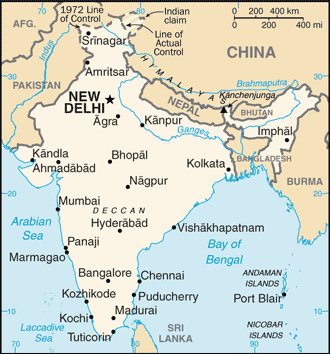
india_sm_2012We’re down to about a month until our move to India.

The house is largely in order with only a few odds and ends remaining.

Most of our worldly possessions are in storage, and I haven’t really missed any of it. (A lot of “moss” collects when your stone stops rolling for a few years.) The house now echoes. Movers will be coming to get the small amount of stuff we’ll ship to India in the next couple weeks. Then we’ll really be living minimalist.

We’ve got all our shots with the exception of the final doses for Hepatitis. We’ll get those in country. With respect to shots, when moving to India, one has to get… well,  all of them.

Visas are in the works though we’ve had some delay on that front. However, fortuitously, the local Indian Consulate is beginning to take applications, and so I won’t have to send my application off to another city and can eliminate the time and risk of postal transit.

My list of things to do consists of fewer large, all-consuming tasks and more quick and easy jobs.

All of this means that I’m getting back to writing.  This is a bit like getting a corroded junk-yard jalopy running again. It’s remarkable how much the creative juices curdle when one spends a few months focusing on home repairs, monitoring contractors, getting shots, and other mundane tasks of international relocation. I worked almost exclusively on drafting two novels for a period of a little over a year, and now–as I resume writing and revisions–I’m having to re-read just to figure out what they’re about. On the bright side, I sometime surprise myself with what I wrote. For me, there’s definitely economy of scale in long writing  projects. Writing eight hours a day yields a lot more than eight times writing for one hour a day. I lose voices, character idiosyncrasies, and plot detail so easily unless I’m immersed in them.

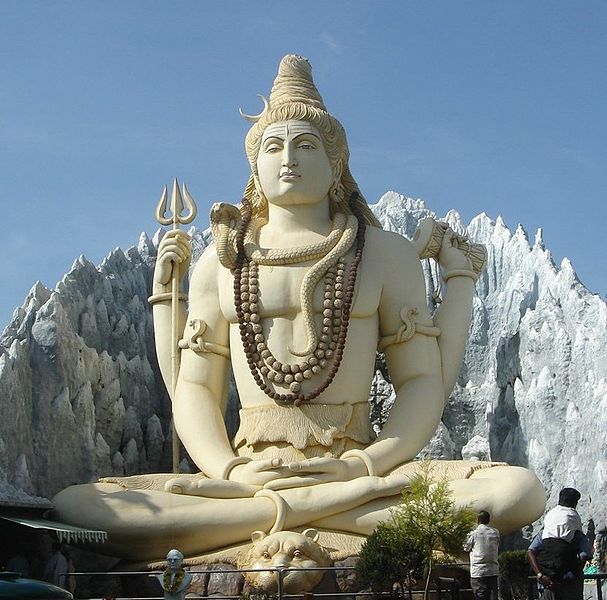
As for this blog, I think a rebirth is in order. Since I’m moving to India, I’ve invoked the concept of transmigration of soul. In Hinduism, some sects of Buddhism, as well as a few lesser known religions, there’s a belief in reincarnation in which the soul may be reborn into an altogether different type of container. For example, if you were good in your last life, you might come back as a lama or a lap cat. If you were bad in your last life, you might come back as a slug or a Congressman. So the question of the moment is what this blog will be reborn as when  it sputters up from out of the ashes.

I would like the site to remain (or, perhaps, become)  humorous, but I’d like the humor to be less curmudgeonly. This presents a challenge because I’m not sure that I know how to be funny without being a curmudgeon. In point of fact, I’m not sure I know how to not be a curmudgeon–funny or otherwise.

I want this site to be reflective of my new life. I’ll continue posting photos, though after the move they will be disproportionately from Bangalore, India, and a few adjacent countries to which I will be traveling. So it’ll remain part travel site. I’m sure I’ll have plenty of lessons learned about travel in India to share.

When I’m not writing or sleeping, I’ll be engaged in a quest of self-improvement. The development of mind and body have been raised to high art in India, and I hope to  find some of those individuals with that knowledge.

Expanding my abilities and understanding of martial arts is one of my goals for this period. It’ll be a challenge to keep from becoming rusty in the jissen kobudō (Japanese old school martial arts that emphasize pragmatic skills) that I have been studying my entire adult life. However, in addition to working on what I know, there are other activities that I think will help expand my understanding while keeping me suitable limber and conditioned. I would like to learn  a little about indigenous Indian martial arts such as kalaripayattu, silambam, and–if time permits–gatka. Furthermore, I would like find a place to train in Bangalore where I can do some training in what I’d call general jissen (practical fighting) skills.

However, my attempts to improve myself will not be limited to martial arts alone. India might be cursed with plagues of poverty, pollution, and–well–plague, but they have no shortage of gurus–whether I can find one that’s reputable and willing is another matter. The older I’ve gotten, the more I’ve realized that I don’t have a firm grasp of my mind. My mind runs and I don’t pay enough attention to what it is telling me; I don’t put enough effort into fixing what is broken. I read a quote recently about people who put great effort into studying the external world, but who remain ignorant of themselves.  This struck close to home, but it’s not just me–it’s widespread. People study psychology in school and learn about cognitive biases, but they don’t put the information to use in becoming more virtuous people. For example, a person might learn about the “self-serving bias” –whereby people claim responsibility for successes but place blame for failures on external factors–and say, “yeah, it’s funny that other people totally do that.”

Part of practicing martial arts is keeping one’s self healthy, against all odds. While I’ve never practiced yoga, I appreciate the belief that mind and body are inseparable. I would like to work on building a body that is less likely to be crippled by the practice of martial arts as I age. I intend to study Thai yoga massage, which incorporates stretching and pressure point massage. There’s an interesting connection between India and Thailand with respect to this form of bodywork. While it’s most closely associated with Thailand, some claim that its roots are in Northern India with a master called Guru Jivaka. While visiting Thailand, I developed an appreciation for the health benefits of this type of massage–particularly for one prone to have things out of whack. However, I didn’t have the time to study it during that visit. There is also the more distinctly indigenous holistic healing system of India, Ayurveda, and I would like to learn more about it as well.

In short, I intend to have a pretty full agenda while living in India, and I hope readers will find my posts about these experiences interesting and worthwhile.

BOOK REVIEW: A Search in Secret India by Paul Brunton

A Search in Secret IndiaA Search in Secret India by Paul Brunton

My rating: 4 of 5 stars

Amazon page

A Search in Secret India is a travelogue by Paul Brunton as he wondered through India in search of sages. In the process, he found a number of masters of body, mind, and both. However, he finds these individuals as rare nuggets in a sea of frauds.

Brunton states up front that he won’t waste time with any of the blatant frauds or suspected frauds, but he does devote space to a number of the more impressive ones. Impressive either by way of a large following or artfulness of technique. He also finds individuals he doesn’t know what to make of. These individuals appear to have impressive otherworldly skills, but skills that he can neither reconcile with known scientific understanding nor uncover as hoaxes despite his best skeptical inquiry. Given Occam’s Razor, he seems to be left suspecting that these are masters of illusion, but he maintains skepticism of his skepticism. A prime example of this is a Yogi who seems to be able to conjure any scent upon request.

Brunton also runs across individuals who are able to do amazing things that are inconsistent with his knowledge of the world, but which his exhaustive investigations leave little room to dispute. For example, there is one yogi who can completely cease his respiration for a seemingly impossible length of time, and who resumed breathing not with a gasp but with a slow, calm series of breaths.

As suggested above, this book is really an attempt to analyze India’s spirituality through the lens of Western logical and scientific approaches. The author is a Brit and the book was first published in the 1930’s. His worldview is consistent with that status. While Brunton would like to master his own mind, he is unwilling to let himself be duped.

There is another side to this juxtaposition of East and West. The yogis and gurus with which Brunton comes into contact often have trouble grasping the Western mindset (there is one notable exception.) What these wise-men have difficulty understanding is why a people, like the British, devote so much time to mastering the external world (and with a great measure of success it must be added), but put so little effort into mastering or understanding the self. Most of the gurus appreciate that a Brit is taking an interest in the spiritual and yogic ways of India, but with their own skepticism. They find Westerners materially rich, but bankrupt of the mind. They find the Brits strong, but lacking the supple power that yoga introduces.

After completing his travels, it seems the book is set to draw to an end. However, Brunton realizes that while there were a number of skilled individuals that he came across in his travels,there is one that stands out as someone he should not miss an opportunity to learn more from. Therefore, instead of getting on a steamer back to England, he returns to South India to a man called the Maharishee in order to find out if the guru will take him as a student. The last couple chapters describe his time under the Maharishee’s tutelage as well as under one of the guru’s most advanced students. The Maharishee is a sage the likes of which Brunton has not seen in all his travels. The guru has the humility to say that he cannot teach Brunton anything, but instead can only show him some things that he learned on his own journey.

If there is a lesson for those who would like to follow in Brunton’s footsteps, it seems to be that there is an inverse relationship between how easy a guru is to find(/how eager a guru is to talk to one) and the level of skill of that teacher. In almost all cases, Brunton had to take great initiative and steer off the beaten path to find the true masters. On the other hand, most of the individuals who were easily found, and eager to talk, were just con men.

I recommend this book for those interested in development of the mind and body.

View all my reviews

Teachable and Unteachable Lessons

[Note: This is posted in my Jissen Budōka blog as well.]

Source: Wikipedia; Status:  Public Domain

Source: Wikipedia; Status: Public Domain

Miyamoto Musashi, who was undefeated in over 60 duels, claimed that he never had a teacher. Some historians refute this claim. Whether one accepts it or not, the statement astonishes.

Musashi wasn’t talking only about martial arts, but about the many areas in which he was accomplished. Not being a painter or a sculptor, I can’t say how important a teacher is in such domains. But it’s easy enough for me to imagine a successful writer who never took a formal class in writing; someone who read profusely and practiced his (or her) craft relentlessly could do it. (Certainly, one can easily imagine successful writers whose formal education was in some area other than writing because there are so many of them–probably at least as many as those whose education was in writing. Examples include: Vonnegut [Chemistry], Crichton [Medicine], Zane Grey [Dentistry], Ursala LeGuin [Anthropology], and J.K. Rowling [French]. That’s not even to start on the many literary legends who dropped out all together– e.g. Dickens, Faulkner, Twain, H.G. Wells, and Jack London.) This isn’t to say that writing teachers don’t make writing better, but just that there is a path to this skill that doesn’t involve being fed lessons.

However, I struggle to imagine a martial artist achieving so much without a teacher. Boiled down to its most workaday definition, a martial art is a collections of lessons about what works in a combative situation. This is what separates the importance of a teacher in martial arts from that of a discipline like writing. In writing, one has the leisure to make one’s mistakes, learn from them, and self-apply course corrections. Musashi was in life or death duels; he couldn’t learn lessons at such a leisurely pace and in such an iterative fashion.

A martial arts teacher has a number of roles, such as preventing inertia (slacking) from taking hold in the training hall. However, the most fundamental purpose is to pass along the collection of lessons so that a student doesn’t have to learn them all by way of personal experience. Most of us aren’t Miyamoto Musashi; we can’t survive the process of learning all our own lessons.

Needless to say, I am a firm believer in the value of a good teacher. I’ve had several over the years, and I received valuable lessons from all of them–all with different, but no less valid, points of emphasis and flavor.

Having said all that proceeds, there’s much that cannot be taught. Such lessons may be described or discussed, but they cannot be learned except through the initiative of the student. I said that most of us can’t survive the process of learning all one’s own lessons, but I’ve increasingly come to believe that one can’t survive learning none of them either. In the beginning, one must be fed the lessons from a teacher in order grow. However, as the decades pass, one increasingly needs the space to learn one’s own lessons. If one lacks said space, one will stagnate and eventually the wheels will roll off one’s training altogether.

So what are the unteachable lessons? Knowledge can be conveyed, but not everything that a martial artist must learn is knowledge. Confidence cannot be taught. A teacher may explain–or even show–how he or she became confident, but that won’t translate one iota into the student being more confident.  This is like a Buddhist monk telling one that “desire is the root of suffering.” One may understand that statement. One may believe the statement. However, one’s suffering won’t decrease because one has the knowledge.  One’s suffering will only decrease if one conscientiously does the hard work of reducing one’s desires.

Another area of unteachable lessons are the lessons that the teacher has never learned. Loyalty is a great virtue, and so there may be a tendency to restrict one’s learning to the lessons of one teacher. However, even if one has an outstanding teacher and are practicing a great lineage, blind spots happen. The only way to learn whether there is anything of value obscured in those blind spots is to throw off one’s blinders and have a look for oneself.

What blinders? An excellent and tricky  question.  It’s like when someone says, “it’s not what you said, but the way you said it.” We all understand that there is some intangible character in language that is commonly understood but not easily seen or defined. In any culture (and a dōjō contains a culture, believe me) there’s always a collection of norms, rules of thumb, ideas, beliefs, mores, credos, etc. that come to be taken so much for granted that they become an invisible filter through which one sees the world. This isn’t an inherently bad thing, and it’s probably necessary to produce sufficient order in a chaotic world in which to learn and grow. Having said that, some of the ideas and beliefs in our cultural filter may be arbitrary, or at least not universal, but yet we don’t necessarily see the potential for error because we are seeing the world through the cultural filter. We take for granted that grass is green, but what if we see it through a yellow filter? Then it’s blue. Right?

Paul Brunton’s Search for Sages in India

Source: Kalyan Kumar by way of Wikipedia

Source: Kalyan Kumar by way of Wikipedia

As I prepare to move to India, I’ve begun to read up on this subcontinent about which I know too little. For example, I’d never heard of Paul Brunton before a week ago, but now I am immersed in his book A Search in Secret India. Brunton was a Brit who, like a number of his contemporaries living in the first half of the 20th century, struck out to experience the mysteries locked in the heart of India. Like many, he wanted to gain access to the country’s treasure, but the treasure he sought had nothing to do with material wealth or ancient artifacts. He sought living sages, and the lessons they could teach him. The book I’m reading tells the story of this search.

Something about India drives internal reflection and the spirituality that often accompanies it. It’s the home of Hinduism, Buddhism, Sikhism, and Jainism, as well as many non-denominational wisemen (and wisewomen) who at once can be seen as followers of no religion and believers in many religions.  Value for the unity of mind and body can be seen in the popular national practice of Yoga, which is the antithesis of mindless exercise in which one jumps on a treadmill with an i-Pod and zones out for an hour as one’s body churns through its paces. Yoga, like Tai Chi, requires one’s full attention, and that one’s movement, one’s breath, and one’s awareness are all working toward the same purpose.

So far, Brunton’s work has appealed to me not only because he is in search of wisdom, but because he goes about this pursuit as a skeptic. In the introduction he tells how he edited out the many meetings with charlatans and frauds. Charlatans always abound in the presence of sages because it’s quite lucrative to convince people that they can achieve self-improvement effortlessly through some patented approach. (I’m here to tell you that self-improvement is a struggle that requires your physical and mental energy all the way–what I cannot yet tell you is whether it is worth it or not.) If one cannot see the cloud-enshrouded destination, it’s easy to sell maps–whether one knows the route oneself or not–and many are all too ecstatic to buy a map that shows a secret route that takes them to the pinnacle by way exclusively downhill paths.  The fact that Brunton enters his quest with a degree of skepticism suggests he didn’t fall for such traps; traps that should be obvious but that appeal to those for whom the force of wanting to believe is stronger than the force of truth. [As I am only a few chapters in, I reserve the right to change this prognosis. At some point, I’ll put up a review with my final thoughts.]

I look forward to discovering whether wisdom is alive and well on the subcontinent. Hopefully, the hucksters haven’t won the war for the mind’s of seekers.

BOOK REVIEW: Zen Mind, Beginner’s Mind by Shunryu Suzuki

Zen Mind, Beginner's MindZen Mind, Beginner’s Mind by Shunryu Suzuki

My rating: 5 of 5 stars

Amazon page

This thin volume packs a great deal of knowledge about the Zen approach to the mind. It’s divided into three parts: right practice, right attitude, and right understanding. The first section is technical (e.g. posture, breathing, etc.); the second section is inspirational; and the third section is philosophical. This is consistent with the Zen priority of putting practice first and being cautious about philosophizing.

The core concept is captured by the book’s topic sentence, “In the beginner’s mind there are many possibilities, but in the expert’s there are few.” This sentence contains a valuable truth, but I can’t help but think that the related title probably hurt the book’s sales. Sadly, many people would rather read a book entitled “How to be a Zen Master in 90 Days.” Everybody wants to be an expert, and few are open to the lesson that they must look at the world through the eyes of a novice. I’ve noticed this in the martial arts. Most individuals seem to be much happier as mediocre black belts with only a few years of practice than they would be as a highly competent white belt. This, of course, is the lure of external validation, which is a weak salve for one’s private demons.

At any rate, the value of cultivating shoshin (i.e. beginner’s mind)is to avoid have one’s experience jaded or tarnished by one’s past. It’s about avoiding attachment to what one believes one knows, such that one is incapable of learning something new. It’s like that old, but popular, tale that is told in both the Zen Buddhist and Taoist traditions about a cocky, young student who comes to learn from a master and proceeds to tell the master all he has already learned. The master pours tea for the youth, and when the cup is full he continues to pour until the scalding liquid spills over into the kid’s lap. When the student angrily asks why the teacher did that, he is told, “Your cup is already full. In order to take in more you must first empty your cup.”

I enjoyed this book. It’s very readable. The chapters are concise and not the least bit arcane. The bits on practice are not bogged down in minutiae. As I indicated, this book covers a lot of ground. I would dare say that if you are only going to read one book on Zen in your lifetime, this is a suitable candidate.

View all my reviews

MASTER WORKS: Apology by Plato

ApologyApology by Plato

My rating: 5 of 5 stars

Amazon page

Apology is Plato’s account of the trial of Socrates. This brief work presents Socrates’ defense of himself as well as his reaction to the death sentence verdict against him. Of course, it is all through the lens of Plato, as Socrates left us no written works.

Socrates was charged with impiety and corruption of the youth. He acknowledged both that he was eloquent and that he was a gadfly of Athens (the latter being a role for which Socrates believes he should be valued.) However, he denied both of the formal charges.

Socrates refuted the charge of corrupting the youth first by denying that he had taken money in exchange for teaching. Taking money was a component of this charge. Socrates’ claim is supported later when Socrates tells the court that he can only afford a very small fine, even in the face of the alternative–a death sentence.

Socrates says that he sees nothing wrong with taking money for teaching–if one has wisdom to share. Socrates says that he has no such wisdom, and suggests the philosopher/teachers that are taking money aren’t in error for taking money, but rather because they really don’t have wisdom themselves.

This is summed up nicely by this pair of sentences, “Well, although I do not suppose either of us knows anything really beautiful and good, I am better off than he is–for he knows nothing and thinks he knows. I neither know nor think I know.”

While Socrates raised the ire of the Athenian leaders with what they no doubt believed to be his arrogance, in fact it wasn’t that he thought himself wiser than they, but that he thought they were deluded in thinking themselves wise.

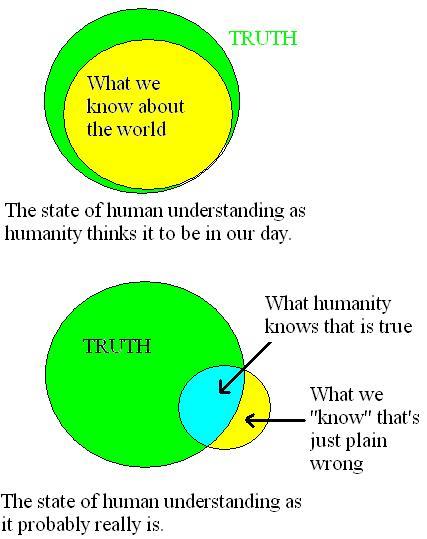
Socrates’ lesson remains valid today. It is the scourge of all ages to think that have finally attained true understanding of the world. Our posterity may know more, but we know all of the essentials and are rapidly converging on a complete picture of our world. We think our generation to be humanity’s sage elders, when, in fact, we are the impetuous teen whose growth spurt has made him cocky. I would propose to you that in all likelihood, even today, the sets of “that which is true” and “that which humanity ‘knows'” form a classic interlinking Venn Diagram. That is, some of the body of knowledge that we take to be proven true is, in fact, false. This occurs because we cannot accept that there are things we are not yet prepared to know, so we use sloppy methodology to “prove” or “disprove.” This one reason we have all these conflicting reports. E.g. coffee is good for you one week, and carcinogenic the next.

VennDiagram_WhatWeKnow

Socrates uses the method that today bears his name, i.e. the Socratic method, to challenge the arguments of Meletus, the prosecutor. The Socratic method uses questions as a device to lead the opposition to a conclusion based on premises they themselves state in the form of their answers. Socrates proposes that if it is he alone who is intentionally corrupting the youth, they would not come around–for no one prefers to be subjected to evil rather than good.

Socrates denies the suggestion that he does not believe in the gods, and in fact indicates that the very suggestion by virtue of the charges against him is a contradiction. What Socrates is guilty of is encouraging those who come around him to develop their own thoughts on god, and not to subordinate their thought to anyone–an idea the leaders found disconcerting.

Socrates goes on to say why he is unmoved by the death sentence. He wonders why it is thought he should beg and wail, when he doesn’t know for sure that an evil is being done against him.

The moral of the story is that those in power fear and will attempt to destroy advocates of free thinking.

This book should be read in conjunction with a couple other Platonic Dialogues, Crito and Phaedo.

View all my reviews

The Budō Fishbowl

I posted this on my martial arts blog, Jissen Budōka, but decided to re-post here.

fishbowlI’ve read and heard many quotes about the degree to which martial arts CAN’T be taught. At the extreme, there’s Miyamoto Musashi, who claimed to never have had a teacher of swordsmanship.

I recently found myself asking, “What if only 10% of budō is teachable?”

If that were the case, someone who was close to having all of the pieces that could be taught would think themselves a master–even if they were largely ignorant of the other 90%.

Such an individual would be like a fish in a fishbowl, thinking that there was nothing but emptiness above the waterline.

He would be like primitive man, thinking the stars were but pinpricks painted on a dome.

Or, in all likelihood, like the modern man who thinks that if we can just reconcile a couple sciencey bits–maybe experimentally validate string theory– that our picture of the universe would be complete.

BOOK REVIEW: Bones of the Master by George Crane

Bones of the Master: A Journey to Secret MongoliaBones of the Master: A Journey to Secret Mongolia by George Crane

My rating: 4 of 5 stars

I’m a sucker for a tale of the sage next door. In an unwise world, it’s nice to believe that the wise exist, and that they walk among us. That they are not relegated to secluded retreats, but live in suburban subdivisions. In Bones of the Master a quirky Asian man drops in on his neighbor. The neighbor turns out to be the author of this book, poet George Crane. The visitor is Tsung Tsai, a Cha’an monk who trekked from Inner Mongolia to Hong Kong in 1959 in order to ensure the teachings of his monastery would survive.

The two men strike up a friendship, collaborating on poetry translation and eventually making a journey together back to Tsung Tsai’s home. The first part of the book tells of their meeting and describes Tsung Tsai’s 1959 journey to freedom. The second part deals with the two men’s mid-1990’s return trip. The monk’s ambitious plan is to find the bones of his master, cremate them, and relocate them in accord with the dictates of his religious tradition. He also wants to rebuild the temple that was razed by the Red Guard during the cultural revolution. As this is nonfiction, it’s not all happy endings. Not everything works out as they’d like it to. A brief third part tells of their return to the states with an interesting stopover in Hong Kong.

Much of the appeal of the book stems from how the monk’s worldview rubs off on the author. The monk assumes matter-of-factly that they will be able to sell the book for a sufficient advance to pay for the trip and a monument to his teacher. As one can imagine– particularly anyone who knows a bit about publishing– Crane is suitably skeptical, but ultimately buys into the plan. The monk often tells Crane that he worries too much. However, most of us would worry about these daunting challenges. For example, how to get a one ton statue from New York to Inner Mongolia, or–more importantly–whether the aged and ailing monk will be able to complete the trip alive.

There are tidbits of insight as well as poetry scattered throughout the book.

View all my reviews

BOOK REVIEW: The Journeys of Socrates by Dan Millman

The Journeys of SocratesThe Journeys of Socrates by Dan Millman

My rating: 4 of 5 stars

The Journeys of Socrates shines the spotlight on Dan Millman’s mysterious teacher from The Way of the Peaceful Warrior. We discover that Socrates was born Sergei in Russia to a Cossack father and a Jewish mother.

His youth is scarred by tragedy. His mother died in labor with him and his father died of alcohol poisoning while Sergei was away at military school. His only remaining relative that we know of, his grandfather, dies. He flees military school to avoid having to harass Jews as a soldier, and in the process he has to battle his arch-rival. He marries into a family, but that brings its own tragedy. His family by marriage are Jews living under false identities at a time when it is very dangerous to be a Russian Jew.

It is after this tragedy that Socrates’ search for warrior skills and revenge drive the narrative. In injecting so much tragedy into his life, Millman makes the main character’s transformation all the more impressive. At every turn, Socrates is faced with events that should fill him with bitterness and hatred, but he must keep going and learn to control his emotions to become the warrior that he wants to be.

He proceeds to train under a warrior trained in the way of Japanese swordsmanship, a man named Razin. Razin only reluctantly accepts him as a student. He then lives at a hermitage, learning to reign in his mind and to respond freely and appropriately to attacks. His teacher at the hermitage, Father Serafim, teaches him to fight, while encouraging him to give up his vendetta. Finally, he travels abroad to train with a convened collection of sages from various traditions (Taoism, Buddhism, Judaism, Christianity,etc.)

Socrates narrative arc is well developed. He is pitted against a powerful enemy named Zakolyev, aka Gregor Stakkos, a military school rival who became an antisemitic Cossack gang leader. Socrates is reluctantly drawn into a final decisive battle with this nemesis, but there is a twist at the end to further complicate that event.

I’ll admit I’ve had mixed feelings about Millman’s work. I was a big fan of the original books Way of the Peaceful Warrior and to a lesser extent Sacred Journey of the Peaceful Warrior. Those books provided great insight into mind-body development in a readable narrative form. However, I later picked up one of his subsequent books and found it to be some sort of numerology/astrology drivel. That was disconcerting not only because it offended my sensibilities as a Cartesian skeptic, but even more so because it seemed to fly in the face of the Peaceful Warrior message– which was one of self-empowerment, not passive acceptance of some randomly bestowed fate.

So I picked The Journeys of Socrates reluctantly. However, I found this book to be the most readable of all. It is written like a novel or the memoir of someone who led the rare novel-shaped life.

View all my reviews