BOOK REVIEW: The Good Psychopath’s Guide to Success by Andy McNab and Kevin Dutton

The Good Psychopath's Guide to Success: How to Use Your Inner Psychopath to Get the Most Out of LifeThe Good Psychopath’s Guide to Success: How to Use Your Inner Psychopath to Get the Most Out of Life by Andy McNab
My rating: 4 of 5 stars

Amazon page

The central premise of this book is that psychopaths have a range of traits that help them succeed. These traits include thick skin, focus, fearlessness, charisma, and coolness under high pressure. The “good” in “good psychopath” is used to describe individuals who have psychopathic characteristics while retaining the ability to play by societal rules—at least to the extent necessary to stay in good stead with the law—as well as to recognize the ramifications of their personalities. If you thought you were going to learn how to get away with a tristate prostitute killing spree, you’re looking into the wrong book. The book does discuss what differentiates good from bad psychopaths, but it’s clearly addressing the former.

Unlike Dr. Dutton’s previous book, “The Wisdom of Psychopaths,” this book is a self-help book rather than pop science. It’s designed to help anyone channel their inner psychopath. If you’re already a psychopath, it may help you think about how you can apply your natural tendencies to getting what you want in life. If you’re not a psychopath, it’ll advise you on how to go about facilitating the growth of characteristics that serve psychopaths. McNab serves as the psychopath in-residence, offering stories and his own experience, while Dutton is the scholar trying to lend a more objective understanding of the subject.

The book’s organization is straight forward, there is a prologue plus three chapters that outline the subject and lay out the key concepts, and then chapters 4 through 10 each address one of the seven essential characteristics of the good psychopath. These include proclivities like non-procrastination, being confident, being oneself, taking criticism with ease, being persuasive, living in the moment, and reducing the influence of emotion in decision-making / behavior. These seven chapters are the heart of the book, and they explain how to think about and advance these personality characteristics.

One strength of the book is the use of stories and jokes to convey ideas in a reader-friendly manner. However, some of these stories are clichéd. On the other hand, a number of them come from the career of McNab, and he—as a former SAS member–had a more fascinating career than most. Also, many of tales and anecdotes come from the interaction of this scholar / warrior duo. The chapters also have quizzes that will help the reader evaluate their level of psychopathy, and the e-version of the book is linked to on-line versions of the quizzes.

I can imagine a range of responses to this book from love to hate. There’s one way to love this book (despite its faults), but two ways to hate it. The most obvious way to dislike it, but probably not the most common way, is substantive. One may object to a range of virtues such as coolness under pressure and living in the moment being labeled psychopathic. However, if this was a problem for the reader, one probably wouldn’t purchase (or, being psychopathic, steal) the book. Reading the blurb would tell one what to expect in that regard.

The more likely reason for hating this book is stylistic. The authors wrote it as though they were speaking to the reader, and we know there are good reasons for one’s written style of communication being different from the spoken word. The first such reason is that spoken language can confuse when one is lacking non-verbal information streams. In this case, there are two authors who haven’t merged into one voice, but instead retain their distinct voices. This means that one may have moments of not knowing who’s speaking. Such confused moments usually don’t last long because the authors work hard to create widely different personas. Dutton is the PhD with an erudite / nerdy bent, but who works to come off as the cool professor whose class one might enjoy taking. McNab is the psychopath, and he’s a soldier to the core. Still, even the occasional half sentence in confusion is distracting.

The second reason for writing differently than speaking is that one doesn’t know to whom one is speaking. Not everybody digs f-bombs and bawdy jokes. Those who do will probably find the style neither distracting nor offensive. Many readers won’t have a problem with the language, but will nonetheless find the authors’ attempts to come off as cool to be distracting or irritating. Working to appear cool wears well on 13 year olds, but seems a little pathetic in grown men talking to an audience of other adults.

I found this book interesting and I’d recommend it for people interested in personal development. However, I can’t say that I didn’t find the style of the book grating on occasion.


View all my reviews

How to Kill a “Cereal Killer” and Restore Halloween

cereal killerI know what you’re going to say. Why would I want to murder a cereal killer, a taco belle, a holy cow, a pig in a blanket, a deviled egg, or any of the other bearers of bad Halloween punnery? First, you want to kill someone.  You don’t have to admit it to me and I’d advise against admitting it to the District Attorney, but at least admit it to yourself. Second, if you kill the person you really want to kill (e.g. your boss, the tax man, your personal trainer, or your hairdresser—sorry, low blow) you’ll be the lead suspect. Therefore, you need to find a way to vent your homicidal rage into productive outlets, and I’d argue that the killing of punsters is community service. You shouldn’t even think of it as murder. It’s more like culling the Halloween herd. Forest fires kill, but the next year the forest is more lush and beautiful than ever before.


Now let’s get down to the real reason to conduct your own Halloween killing spree. Because it’s the perfect time for the perfect crime. Think about it.

  • Anonymity: Except for the lazy people who wear a T-shirt with “Halloween Costume” printed in unimaginative block letters, everybody is in makeup or has their head stuffed in some stinking mask that five people have thrown up in within the last three years. This makes it almost impossible to identify suspects. The lazy bastards would be eliminated immediately anyway because it takes commitment to be a homicidal maniac.
  • Relative Inconspicuousness: You won’t be the only one who’s apparently blood spattered. Besides Marti Gras and full moons, what other nights can one say that. There will be large numbers of people wielding weapons and looking creepy. What better time to blend in?
  • Distraction: If I might be granted a brief diatribe. Halloween used to be the holiday of terror, but no more. Valentine’s Day may be the holiday of romance (or florists), but Halloween is the holiday of sex. However, you can use this trend to your advantage. There’s a great deal of distraction to be garnered from the proliferation of sexy nurses, sexy waitresses, and sexy actuarials. When the girl whose costume is painted on rather than worn walks through the room to get a single potato chip, that’s a good time to jab the hypodermic into the neck of the nearest drunk pun and get the hell out of dodge.


So how will you choose your target? First, as indicated, it’s best to pick someone who’s inebriated because no one will realize they’re dead–and not just passed out–until they begin to stink. Don’t worry, finding a drunk won’t be hard. At a given Halloween party there will be four designated drivers for the 150 people in attendance—so 148 people will be completely hammered. [No, my math is not that bad. Two of those designated drivers are cheating bastards. If you kill a pun who’s a cheating designated driver you’ve hit the trifecta—OK, maybe my math is that bad. At any rate, you get bonus points. ]


Next comes the question of determining whether the costume is a pun or not. This can be harder than it seems. Sure there are the easy ones I mentioned above (and others like Kevin “Bacon” [Kevin nametag on a meat vest], “Bat” Man [w/ Louisville Slugger], Down for the Count [Dracula with a blowup doll orally affixed to his crotch region], Spice Girl, Dust Bunny, Formal Apology [tuxedo-clad man with “sorry” written on his tie], etc.) that will be immediately obvious.


However, what if one sees a guy in a Grim Reaper costume with a bag of pot. Perhaps this is just someone who likes to imbibe. However, if the pot is dayglow green, then you may have a “the grass is greener on the other side” who desperately needs killing. The key is that one must pay attention to the details. Sometimes the costume will be poorly done. Imagine a fine “Tom the Cat” costume with three misshaped spheres feebly stapled to the crotch region. This is a “horny as a three-balled tom cat” who must die.


On the other hand, you should avoid reading too much into costumes. Say you see a girl who looks like a stripper. You shouldn’t engage in some Rube Goldberg-esque thought process in which you conclude that she is saying, “All that glitters is not gold–because sometimes it’s a stripper.” Said woman may merely be costumed as a stripper, or might be a stripper who just got off stage and didn’t have time to go out looking for a costume.


When in doubt, if the costume doesn’t seem to make a lick of sense, it’s probably someone’s sense of clever gone awry and you shouldn’t feel bad about friendly fire against a non-pun.


Finally, some general rules of thumb (BTW: feel free to kill anyone dressed in a giant mitten with a page of the tax code taped to the thumb):

  • Only kill one pun per party. Being a killer of puns is like being a Marine Sniper—except that it’s completely illegal and involves no honor whatsoever—my point is that if you loiter in place you’ll get pinned down by the Vietcong. It doesn’t matter whether the party in question has the best pigs in a blanket (i.e. the hors doeuvres, not the cutesy couple costume), the best DJ, or the sluttiest witches, maids, librarians, or geologists in town. Don’t get greedy. Get in and get out—well, you can grab a handful of those delectable pigs in a blanket on the way out, but then get out of the house!
  • Never wear the same costume to more than one party. The police call that a clue. You have to be like Kathrine Heigl in that 27 Dresses  movie—which I never saw. Do the quick change like Clark Kent between parties. That brings me to an alternative killing scheme whereby you can kill anyone who’s dressed as a character from a romantic comedy.
  • Don’t consume a lot of legumes, high fiber foods, beer, or Taco Bell before your outing. Just because no one will see your face inside that barf-splotched mask doesn’t mean they won’t be able to smell you. Plus the zippers in costumes are unreliable, and you don’t want a case of Taco Trots to hamper your evening’s fun.
  • Don’t wear a costume that’s too menacing. You want to be able to point to someone who is nearby, completely innocent, and who looks like a killer and say, “she did it.” Also, don’t wear the “Identity Thief” costume in which one has name tags all over one’s outfit with different names. First, it plants the seed of criminality in the mind of those around you. Second, it’s a bad pun and may result in your being stabbed. Which brings me to the ultimate rule:
  • Don’t wear a pun costume yourself, it may result in your being stabbed. I’m not saying that I once stabbed a prostitute with a Seeing Eye dog who turned out to be just another good-hearted Halloween killer because “love is blind,” but…


I hope this guide to perpetrating a Halloween massacre has been helpful. I think we’d all like to bring the fear back to Halloween like all the Saints who partied down on All Saints’ Day Eve intended. So, whether you’re a first time killer or you’ve been around the block (another potential costume cliché to kill), a few simple steps will keep you out of the hands of the slutty cops—or regular cops.

BOOK REVIEW: The Alchemist by Paulo Coelho

The AlchemistThe Alchemist by Paulo Coelho

My rating: 3 of 5 stars

Amazon page

This is a short and simple book. Its premise can be summed up as “follow your dreams and all will work out.” It’s about a shepherd boy from Andalusia in southern Spain who yearns to travel. He sells his flock and sets out to do just that. Over the course of the book, he crosses North Africa from Gibraltar to the pyramids of Egypt and back. Along the way he faces many setbacks and barriers, but his willingness to adopt a positive attitude and roll up his sleeves and get to work allows him to overcome these obstacles. As he travels, mysterious guides and mentors–most notably the title-roled Alchemist–show up along the way to induce him to keep going rather than giving up.

As with The Coroner’s Lunch, which I reviewed a couple of reviews back, there’s a supernatural component to this book that seems superfluous. First, the supernatural element doesn’t add much to the story. Second, to my mind, if you are trying to sell the notion that you can make your dreams come true (in this self-helpy sort of way), having your character live in a world of magic detracts from that message. The take away for the reader may be, “Sure, the shepherd boy could do it, he lives in a world in which people can turn lead into gold. In my world, bound by laws of thermodynamics and whatnot, things are not so simple.”

You will note that my middling rating is anomalous. Having skimmed through reviews of this book, I found they were overwhelmingly divided between 5 star and 1 star reviews. It’s rare for one to see the same book being cast both in the best and worst book role by various readers. However, that seems to be the case for this book. Some people adore this book and consider it life-changing. Others think it’s oversimplified tripe for granola-munching potheads and/or six-year olds. I suspect that Coelho is quite pleased. I know—as a writer—if you can’t get someone to love your book, you want them to despise it. Mediocrity doesn’t put one in good stead for building readership. Hate is a passionate response; it means the book struck some kind of chord. Clunkers are remembered just like perfect melodies; it’s the so-so performances that vanish into the background—or the bargain bin.

Unlike the lovers and haters, I found this book to be just alright. It presents some good ideas, but not novel ideas, and it does so in a clear but not brilliant way. It wouldn’t hurt to read it as it’s very short and highly readable.

View all my reviews

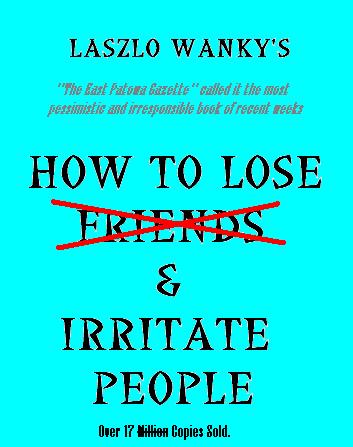
BOOK REVIEW: How to Lose Friends & Irritate People by Laszlo Wanky

Cover_How_to_Lose_Friends


How to Lose Friends and Irritate People by Laszlo Wanky

My Rating: 5 out of 5 Stars

Amazon Page


Wanky pays an homage to Dale Carnegie’s seminal self-help book by calling it, “a book for its time–that time being one in which people were lonely, pathetic, and didn’t understand social networking.” The author’s central premise is that we live in very different times, and today people are inundated by Facebook friends they neither like nor find interesting. Furthermore, Wanky goes on to argue, gone are the days when likable people are  liked. We live in an era in which douche-bags and drug-addled celebrities are gods among men. The book offers many headline examples, such as how Miley Cyrus’s career crashed as the sweet and admirable Hannah Montana, but then she caught her second wind by adopting the persona of a meth-addicted prostitute.


Roughly half of the book is dedicated to how to find success in defriending unwanted virtual amigos. Wanky suggests that the usual tactic of subtly “un-adding” people almost always fails because people are too “wussified” to make it stick. The only effective strategy, according to the author, is to trick others into removing you from their list of pseudo-friends. Be forewarned, however, being uninteresting and annoying is not enough–one must be spectacularly despicable. This is hard for most people–whom Wanky calls “the sychophantic masses”–because they slobber over being liked. Wanky devotes three chapters to helping people get over their love of being liked. The most cogent of these chapters is, “Kim Jong Un or Gandhi: Who Ya Wanna Party With?


The aforementioned chapters also help set up Part II of the book, which explains how one can put a skyrocket on one’s career by borrowing the techniques of the likes of Howard Stern, Rush Limbaugh, and Piers Morgan. Wanky shows how, like these individuals, one can be thoroughly unlikable while having people hang on your every word.  Again, three chapters form the core of this part of the book. They are: “Loud = True”, “Bombastic Fact Picking for Beginners”, and “Your Hairstyle Makes You Sound Stupid.”


I’m not going to pretend that Mr. Wanky’s language is fluid or graceful.  The author’s prose is colloquial… at best. A typical sentence–seen in chapter 8–is, “If ya wanna get with the boom-chiggy-booms, you gotta shout those fart-monkeys down, cause if they hear ’em they’ll all be like, ‘who’s the fart-monkey now, bitch, who’s the fart-monkey now?'”


The book’s strengths include its incredible brevity. Weighing in at only 26 pages, four chapters consist entirely of 27-syllable haiku. It also features fine graphics such as a picture of a “fart-monkey” that any grandmother would be proud to stick on their refrigerator. (The color choices were bit odd, but Wanky was clearly limited to the 16-color box of Crayolas.)


I’d recommend this book for anyone who doesn’t like friends and who really despises people’s indifference toward them. I have no doubt that by following Mr. Wanky’s recommendations, one can become a thoroughly loathsome individual in a matter of days.


Lastly, Happy April Fool’s Day.


BOOK REVIEW: The Miracle of Mindfulness by Thich Nhat Hanh

The Miracle of Mindfulness: An Introduction to the Practice of MeditationThe Miracle of Mindfulness: An Introduction to the Practice of Meditation by Thích Nhất Hạnh

My rating: 4 of 5 stars

Amazon page

This book by the renowned Vietnamese Buddhist monk, activist, and poet, Thich Nhat Hanh, offers pointers on how to live a life of mindfulness. Like most of Hanh’s works, this one is brief, concise, and the front and back matter account for about as much verbiage as the chapters themselves.

The seven chapters that make up the book proper examine mindfulness from various angles, with various approaches, and have a loose organization. The most readable of these chapters–owing to its narrative format–is the last, which retells a Tolstoy story about an Emperor who receives three questions and–unable to find suitable answers by offering a reward to his subjects–dons a disguise and visits a hermit sage. Needless to say, the sage (and life events) enlighten the Emperor, and the answers revolve around the theme of mindfulness. Among the most thought-provoking of the chapters is one that proposes that one take one day of the week to focus on mindfulness. Hanh offers advice on how to best select and structure such a day.

While the appended matter of some of Thich Hhat Hanh’s books can read like filler (intended to reach a page quota), that isn’t so much the case with this book. The most valuable of the appendices gives 32 exercises for building mindfulness. Many of these exercises are variations on a theme, and some are much more extensive than others, but it’s a crucial section and might even be called the heart of the book. Likewise, there are five sutra translations that will be appreciated by readers who are actually Buddhist. (Non-Buddhists may find the sutras to be a less colorful and more repetitive restatement of what Hahn has told them in the chapters. If one pays attention to the chapters and does the exercises, reading the sutra’s isn’t necessary for those who are not students of the religion.)

There is an odd postscript by one of Hanh’s students that is like those I’ve seen in other Hanh books. It’s an odd little testimonial. I put it in the filler category as anyone buying the book knows who Thich Nhat Hanh is and about the accolades he has received and, therefore, they don’t need a prologue telling them how awesome he is. It actually detracts from his persona as a wise man, because it makes one wonder who inspired the little ego trip. I suspect this is more a publisher desired addenda than an author inspired one, but, at any rate, it’s not useful. It can be interesting to hear about the war days, but there’s an outlet for that. Furthermore, I would think the place to tell us how awesome the author is would be at the beginning of the book–not the end. If one gets to the back matter, he must have done something to impress one.

I’d recommend this book for meditators, would-be meditators, and anyone who thinks that life is slipping through his or her fingers because of constant stress and a runaway mind.

View all my reviews

BOOK REVIEW: The Introvert Advantage by Marti Olsen Laney

The Introvert Advantage: How to Thrive in an Extrovert WorldThe Introvert Advantage: How to Thrive in an Extrovert World by Marti Olsen Laney

My rating: 4 of 5 stars

Amazon page

A number of books have come out about introversion in recent years. Most of these books seek to dispel common myths about being introverted, such as:

a.) Introverts can and should change teams to the extroverted
“light side” as soon as possible.

b.) There’s something psychologically wrong (re: neurotic or even psychotic) with being introverted.

c.) “Introverted” is synonymous with:

1.) Shy (i.e. having social anxiety disorder)
2.) Schizoid
3.) Anti-social
4.) Self-centered (in the pejorative sense–a more neutral meaning could be said to be true by definition.)

This isn’t to say that one can’t be both introverted and any of the above, but one can also be extroverted and any of the above (including, believe it or not, shy—i.e. it’s possible to be an extrovert with social anxiety disorder.)

Where Dr. Olsen Laney’s book tries to carve a niche is in teaching introverts how they can conduct their lives in an extrovert-centric world so as to maximize their effectiveness and minimize their exhaustion. One will note that her advice doesn’t advocate attempting to become extroverted. In fact, one of the most interesting and informative sections of the book is chapter 3, which explains the differences in brain chemistry that result in introversion or extroversion. While some of the conditions mistaken for introversion–such as shyness–can be overcome or trained away, introversion is hardwired into the brain.

The book’s ten chapters are organized into three parts. The first part explains just what defines an introvert, what traits commonly mistaken for introversion aren’t introversion, and the physiological roots of introversion. The second part consists of four chapters that delve into problems faced by introverts in four critical domains: relationships, parenting, socializing, and work. The final three chapters present the prescription for modifying one’s behavior to keep one’s energy up in the face of the demands of modern life. It’s really all about energy—how we use it and replenish it differently. The external world—most notably interaction with other people but also anything of a chaotic environment—drains the energy of introverts faster than that of extroverts.

As one reads through the book, there are many tips for mitigating the negative effects of common introvert characteristics seen as problematic in an extrovert’s world. It should be noted that some of these are genuine problems (i.e. how one metabolizes food) and others are a matter of perspective (i.e. lack of conviction v. open-mindedness.) These “problems” include: difficulty making quick decisions, difficulty with word retrieval, lack of investment in one’s own ideas (“wishy-washy” in extrovert lexicon, but arguably open-minded), tendency toward over-stimulation, lack of inclination to engage in [prolonged] eye contact, proclivity to metabolize food quickly with resultant blood sugar drops, proclivity towards sedentariness, and a tendency to fail to delegate work and reward job completion—if one happens to be the boss.

I found this book to be enlightening. There were many ideas I found myself agreeing with (e.g. using hobbies and activities as a means of controlled interaction.) There were only a few pieces of advice that I thought poor (i.e. picking a weekend day to lay in bed or on the couch all day—reading or otherwise.) While it may seem logical that movement would drain energy in contradiction of the goal of restoring energy, I find being sedentary beyond a certain number of hours to be a huge energy drainer and that periodic movement is necessary and restorative to keep my energy level robust. (And I’m about as introverted as one gets by the criteria established in the book, most of which apply to me.) Of course, there are variations among introverts–just as among extroverts—not only with respect to the degree of introversion but also with respect to specific characteristics experienced. (e.g. Some introverts may not find that all of the criteria in the preceding paragraph apply to them.)

I’d recommend this book not only for introverts, but for those who interact with introverts in key ways (e.g. familial relations, significant others, bosses, employees, etc.) Non-introverts may find some sections are more helpful and necessary than others, and may not find they need to read from cover to cover.

View all my reviews

BOOK REVIEW: How to Meditate by Lawrence LeShan

How to Meditate: A Guide to Self-DiscoveryHow to Meditate: A Guide to Self-Discovery by Lawrence LeShan

My rating: 3 of 5 stars

Amazon page

LeShan’s book offers a secular and scientific guide to meditation. By secular, I don’t mean to suggest that it’s devoid of mention of religion. On the contrary, How to Meditate delves into a wide variety of meditation styles that have roots in religion, and it quotes from spiritual teachers across a range of religions–including the mystic branches of Christianity and Islam. I mention the latter because the book seems tailored to bringing individuals into meditation that do not normally think meditation as being their bag, which could include atheists, secular humanists, or those whose religious practices don’t involve a mystical component. I just mean that the book is secular in that it doesn’t advocate a specific religion or suggest that one needs to hold any particular spiritual beliefs to benefit from meditation.

Also, by scientific I don’t mean to suggest that the book gets bogged down in the minutiae of EKG’s or the like. How to Meditate is readable to the general reader, except perhaps for chapter 11, which deals with using meditation in psychotherapy. [However, by the author’s own admission, one can skip that chapter with no great loss if you aren’t a therapist.] What I do mean to say is that LeShan takes an approach to meditation that is grounded in real-world, observable results. He tells the reader of the mental and physical benefits of meditation as they are discussed in the scientific literature.

In other words, if you think that meditation is only for hippie-types who believe in auras and astral planes, this book may convince you otherwise. On the other hand, if you’re one who believes in auras, astral planes, or the idea that only one true guru / path exists, you’ll probably be miffed by this book. There are a couple of chapters devoted to ideas that people believe that both have little evidence of grounding in reality and which detract from meditation. This includes ESP, auras, strange maps of reality, and guru-worship.

The core of the book is chapter 8, which explains how to do meditations of eleven different kinds. The book addresses single-point awareness, breath counting, thought watching, bodily awareness (specifically, Theravada Buddhist style meditation), word association (1,000-petaled lotus), mantra meditation, meditation on “I”, movement meditation (particularly Sufi-style), sensory awareness, safe harbor meditation, and unstructured meditation. The first ten are all types of structured meditation, and an earlier chapter is devoted to distinguishing structured from unstructured approaches to meditation. There is also an earlier chapter that discusses a broad taxonomy of meditation and sub-classes of meditation.

The book is logically arranged for the most part. It begins with a chapter on why one should meditate. This first chapter sets up two chapters that deal with the psychological and physiological effects of meditation. There is one oddity of organization. The core “how-to” chapter is bookended by a chapter on ESP and one on various pitfalls of spiritualism. It would seem these two chapters should go together as they both deal with things that detract from meditative practice, and not with the central chapter wedged between them.

The last couple chapters and the Afterword aren’t as beneficial for the general reader as the first 3/4ths of the book or so. One of those chapters is the aforementioned chapter for psychotherapists and the other deals with the social significance of meditation. The last chapter before those that I found superfluous, however, is one addressing the question of whether one needs a teacher to learn meditation. This pro and con discussion seems like a good way to end this book.

There is a long afterword by Edgar N. Jackson that adds a perspective on what we should take from LeShan’s book. I suspect that if page count were not a concern the book would have ended on the chapter that talks about decisions about a teacher. The last two chapters and the Afterword seem to have been added for the twin-fold purpose of hitting a target page count and to add a couple of niche audiences—namely students of psychology and fans of Edgar N. Jackson (i.e. Christians with an interest in mystical approaches to their religion.)

Overall, I’d recommend this book for those who are new to meditation, those who are seeking to expand their practice to new types of meditation, and those who are interested in the mind in general. As I mentioned, if you think of meditation as a route to see the glow of chakras or to commune with the dead, this probably isn’t the book for you—you’re likely to find its disregard for such otherworldly endeavors to be unappealing.

View all my reviews

BOOK REVIEW: Seven Spiritual Laws of Superheroes by Deepak Chopra

The Seven Spiritual Laws of Superheroes: Harnessing Our Power to Change the WorldThe Seven Spiritual Laws of Superheroes: Harnessing Our Power to Change the World by Deepak Chopra

My rating: 3 of 5 stars

Amazon page

This is Deepak Chopra’s attempt to capitalize on society’s fascination with superheroes. By “capitalize” I’m not necessarily saying to “make money off of,” but perhaps to “use to his advantage in conveying his lessons.” [I’ll leave it to the reader to make judgments about the former.] There are books on the physics of superheroes, the philosophy of superheroes, and the mythology of superheroes, so why shouldn’t there be a book on the spiritual life of superheroes?

The book uses both the superheroes of mythology—i.e. Indian, Greek, Judeo-Christian, Muslim, and others—as well as the superheroes of comic books. While Chopra’s knowledge of the former is considerable, he enlists the co-authorship of his son Gotham (not named after Bruce Wayne’s hometown) to offer insight into the latter.

This book is also intended to capitalize (again, take that as you see fit) upon Chopra’s best-selling book, The Seven Spiritual Laws of Success, but without rehashing the same laws. The Seven Spiritual Laws of Superheroes format is as straightforward as its title. There are seven chapters, each corresponding to one of Chopra’s laws. Said laws address balance, transformation, power, love, creativity, intention, and transcendence.

As I read the book, there was something that rubbed me the wrong way about the writing. It wasn’t that I had major disagreement with Chopra’s ideas, but rather the way he was stating them. At first I thought this was the use of gratuitous assertion. He often began chapters with detailed statements about what superheroes are, do, believe, and understand without much—if any–substantiation of these claims. However, as I got into the first chapter I noticed that he would put one section in each chapter that discussed an example in-depth, offering at least anecdotal support for his claims.

This still left a bit of a bad taste in my mouth. It was because he used general statements like “superheroes know…” and “superheroes understand…,” and then provided a solitary example that fit his statement well, but leaving a vast cast of heroes that didn’t. It seemed a low form of inductive reasoning. In other words, he was attributing an enlightened way of thinking and acting to characters like Hulk and Wolverine.

Chopra and his supporters might make the claim that saying, “The Hulk understands X [insert any of the laws here]” doesn’t necessarily mean he understands them as an intellectual exercise, but rather that he shows this understanding through his behavior. Let me give a story that may make my meaning clearer.

An economist is giving a lecture on consumer behavior. Someone in the audience says, “Professor, how could consumers possibly behave in the way you suggest? Your theory requires complex Lagrangian optimization mathematics, which very few of them understand?”

The Professor replies, “Most of them don’t understand Newton’s work either, but they obey the Law of Gravity without fail.”

I thought about Chopra’s statements from this perspective, but concluded that his point was probably something entirely different. As an author of self-help books about the mind, when Chopra says “Superheroes understand X,” he’s not saying “Each and every superhero understands X,” but instead he’s saying, “If you want to be a superhero, you need to understand X.”

Accepting that that’s what Chopra meant, only one more qualm with the book remained. Laws can be clearly stated (OK, perhaps not tax law, but laws of physics—which seem to be more the kind of law he seeks to emulate), but Chopra’s discussion of his “laws” is vague and ill-defined. Each chapter begins with a large-font italics statement. I don’t know if this is supposed to be “the law” or not. It usually begins with a definition (some vaguely stated) and then statements that superheroes comport themselves in accordance with said definition. Maybe the unstated laws are supposed to be, “Superheroes live a life of balance,” and so on for the other chapters. As one trained as an economist, I’m well-aware of the wide-spread overuse of the term “law,” and maybe the ill-defined nature of Chopra’s laws is a recognition of this.

This book is written for Chopra’s usual audience of seekers of enlightenment. I don’t know that it’ll do well with hard-core science fiction or comic fans, and I don’t know that the Venn intersect of “spiritual self-help readers” and “comic book fans” is as big as Chopra would like. (But, I could be wrong.) Some of Chopra’s ideas about the potential spiritual ramifications of “quantum entanglement” are quite popular with sci-fi fans, but I’m not sure that that offers this book a clear audience. (It might. Chopra is a trained physician, and has some scientific bona fides—unlike many who share shelf space with him and who exist in a spiritual plane entirely unrelated to the world as we know it.)

All this being said, there are some thought-provoking ideas in this book, and the superhero and mythological examples help entertain and—in doing so—become the spoon of sugar that makes the medicine go down. Another testimonial is that I read most of this book in a single sitting, and I tend to jump from a chapter in one book to another book unless something really holds my interest.

View all my reviews

BOOK REVIEW: Vagabonding by Rolf Potts

Vagabonding: An Uncommon Guide to the Art of Long-Term World TravelVagabonding: An Uncommon Guide to the Art of Long-Term World Travel by Rolf Potts

My rating: 5 of 5 stars

Vagabonding is a book about how to make the leap from a cubicle-dwelling company-man (or woman) to a wandering free-spirit.

This book serves two functions. The first is to answer questions about how one goes about seeing the world if one is not independently wealthy or a recent lotto winner. In this role it provides information such as how one can fund one’s travel time, and, perhaps more importantly, how one can get a job after one has an 18 month void in one’s resume.

The second function is to psyche one up to take the leap. In this role it is more persuasive than informative. In both roles it succeeds, but it is in this second role that it is most useful. The Introduction title is “How to Win and Influence Yourself” and Chapter 1 is entitled “Declare your Independence.”

Each chapter has a list of tips and/or references, quotes from those who have done it, and a profile of a famous person associated with the lifestyle, including: Thoreau, Whitman, Muir, and Annie Dillard. The quotes show you that mere mortals have made this leap. The profiles show that you that you will be in excellent company if you do it.

One of the most important themes in this book is simplified living. If one isn’t independently wealthy, one will have to make “sacrifices” to adopt this lifestyle. However, if one learns to live lean, one will be able to make do with much less. One must also live lean during one’s travels. Potts’s advice is to travel light, and leave the electronics at home. (The latter may seem impossible these days, but as a person who recently lost a laptop in a travel accident, I respect the logic.)

I highly recommend this book for anyone who is ready to take the leap, but only if you’re serious.

View all my reviews