The debt is paid,
The verdict said,
The Furies laid,
The plague is stayed,
All fortunes made;
Turn the key and bolt the door,
Sweet is death forevermore.
Nor haughty hope, nor swart chagrin,
Nor murdering hate, can enter in.
All is now secure and fast;
Not the gods can shake the Past;
Flies-to the adamantine door
Bolted down forevermore.
None can re-enter there, --
No thief so politic,
No Satan with a royal trick
Steal in by window, chink, or hole,
To bind or unbind, add what lacked,
Insert a leaf, or forge a name,
New-face or finish what is packed,
Alter or mend eternal Fact.
Tag Archives: Ralph Waldo Emerson
“Days” by Ralph Waldo Emerson [w/ Audio]
Daughters of Time, the hypocritic Days,
Muffled and dumb like barefoot dervishes,
And marching single in an endless file,
Bring diadems and fagots in their hands.
To each they offer gifts after his will,
Bread, kingdoms, stars, or sky that holds
them all.
I, in my pleached garden, watched the
pomp,
Forgot my morning wishes, hastily
Took a few herbs and apples, and the Day
Turned and departed silent. I, too late,
Under her solemn fillet saw the scorn.
“Parks and Ponds” by Ralph Waldo Emerson [w/ Audio]
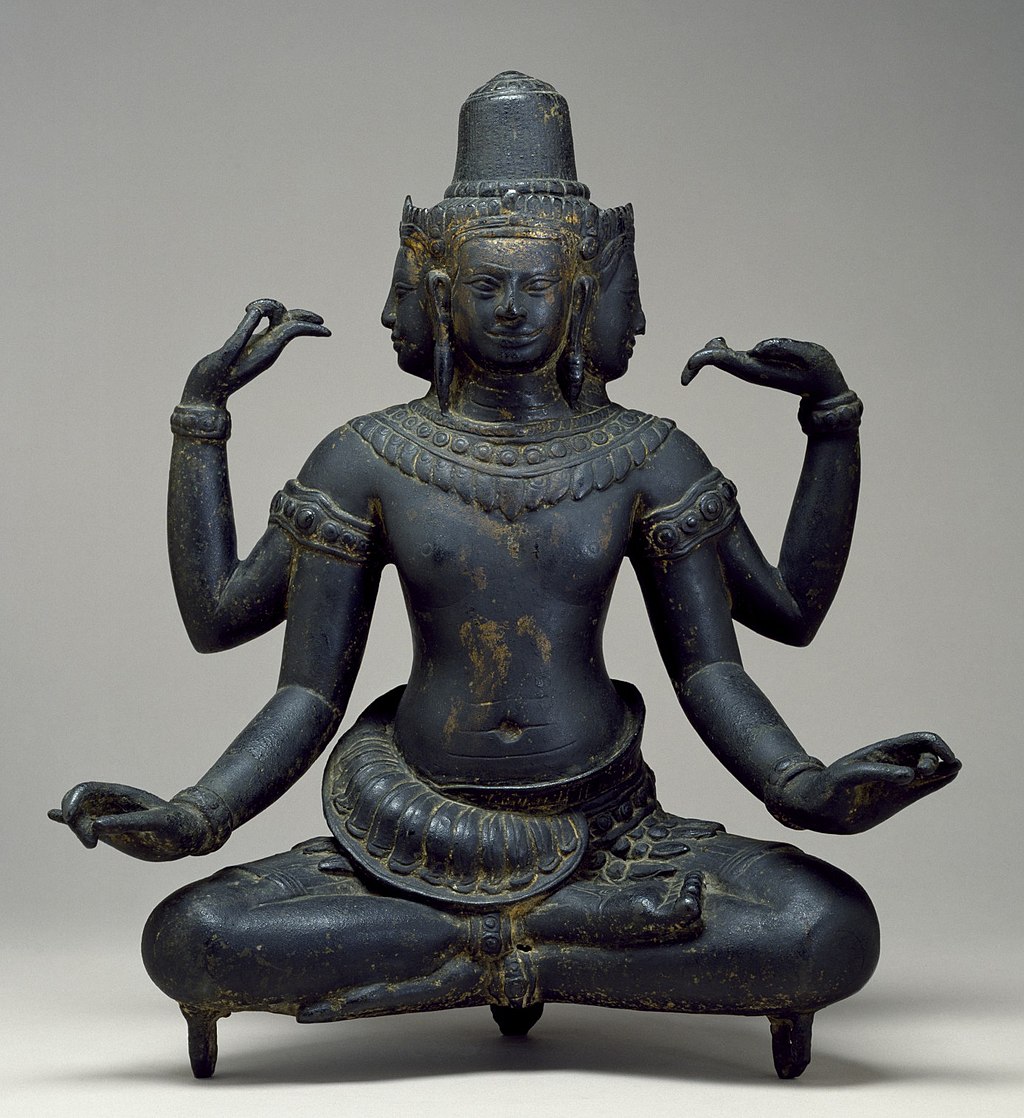
Brahma by Ralph Waldo Emerson
If the red slayer think he slays, Or if the slain think he is slain, They know not well the subtle ways I keep, and pass, and turn again. Far or forgot to me is near; Shadow and sunlight are the same; The vanished gods to me appear; And one to me are shame and fame. They reckon ill who leave me out; When me they fly, I am the wings; I am the doubter and the doubt, I am the hymn the Brahmin sings. The strong gods pine for my abode, And pine in vain the sacred Seven; But thou, meek lover of the good! Find me, and turn thy back on heaven.
Emerson’s Wave [Free Verse]
Society is a wave. The wave moves onward, but the water of which it is composed does not.
Ralph waldo emerson, Self-reliance
Is there any angst that we will tumble off a cliff that we should have railed off long ago? -- Nuclear War -- I fear that wave has rolled onward, and we have lost that angst. Do we not fear: blast wave disintegration? fire that turns wet things -- such as ourselves -- into instant ash? clumps of hair in the hands of the neutron-cooked? If we've forgotten to fear such things, we are surely doomed.
BOOK REVIEW: A Transcendental Journey by Stephen Evans
A Transcendental Journey by Stephen EvansMy rating: 4 of 5 stars
Amazon.in Page
Release date [for 25th Anniversary ed.]: September 10, 2022
Get Speechify to make any book an audiobook
A Transcendental Journey intersperses a quirky travelogue of a rambling road-trip through America with a book report on selected essays of Ralph Waldo Emerson. On a positive note, the book offers genuinely funny lines within a generally amusing wandering discussion of events, and there’s something authentic about the voice – you may find yourself hearing the words in the voice of someone you know (or a character) who is idiosyncratic and nerdy in a way that is not uncommon in America. I did. In addition to the funny lines, there are statements that feel profound and are definitely thought-provoking.
Some of the offbeat elements go a bit too far, reaching the point of distraction. For some reason, the author decided to note not only each time he drank a Coca-Cola, but the size of the beverage. At first, it’s just a bit of weirdness that seems to contribute to the aforementioned authentic voice, but eventually one is made sad by the idea that this guy is giving himself diabetes and involving you, as reader, in the process. I can’t say that the philosophy bit is particularly well integrated into the travelogue, and the author often seems like an Enlightenment guy more than a Transcendentalist. (Transcendentalism being an offshoot of Romanticism, a philosophy meant to counteract the perceived cold, hard rationality of Enlightenment thinking and take a more mystical / spiritual [though not necessarily religious] view of the world.) That said, I can’t fault an inability to keep these schools of thought in boxes, as my own philosophy and worldview are fairly ala carte. My point is just that someone who picked up the book expecting to have a clearer view of what distinguishes Transcendentalism from other philosophies might come away confused.
If you enjoy travelogues, particularly of the United States, you’ll find this book a fun read. If you’re familiar with the works of Emerson, I wouldn’t expect any deep philosophical insight, but there are some fine quotes and discussions to remind you of Emerson’s great ideas and beautiful language. (And there are certainly many varied insights to ponder.)
View all my reviews
Iron String [Free Verse]
Emerson said, "Trust thyself: every heart vibrates to that iron string." REM said, "What's the frequency, Kenneth?" Will Kenneth's waves propagate down the line? If so, would they add to, or cancel out, the waves of others? That depends on the frequency, Kenneth! I guess that's why Michael Stipe took such an impassioned interest in the question. Is it even a good thing if one's waves add to those of another? Might it not become disharmonious, like a runaway washing machine, shaking violently, parts flying through the air in smooth ballistic arcs only to bounce and clatter in dull discordance. Does one's iron string even need to come into contact with Kenneth's? Might not the wave energy passing through the air stir up a resonance in one's bones? Questions, such as these, haunt me -- not to mention: Who, exactly, is Kenneth?
BOOK REVIEW: The Transcendentalist by Ralph Waldo Emerson
The Transcendentalist by Ralph Waldo EmersonMy rating: 5 of 5 stars
Amazon.in Page
Free Online: Emersoncentral.com
In this short essay (about ten pages,) Emerson lays out an argument for Idealism over Materialism, and then contends that it’s reasonable to excuse oneself from the economic and civic aspects of society in favor of a simple life of introspection. [e.g. As Thoreau did in his years at Walden Pond.]
Emerson opens by suggesting that Transcendentalism is just Idealism by a different name. Idealism being a philosophical stance which puts consciousness at the fore while proposing that there is something beyond [that transcends] our experience of sensory information. The arguments put forth in favor of Idealism include the fact that sensory illusions exist and the Kantian critique of Locke’s view that there’s no more to the intellect than that which is or was sensory experience; Kant argues that there’s intuition. Kant’s influence is considerable, and Emerson explains that even the term “Transcendentalism” is derived from Kant’s use of the term “transcendental.”
The latter part of the essay echoes Emerson’s masterwork, the essay “Self-Reliance.” It proposes that it’s perfectly laudable to take advantage of the greatest gift one has, one’s consciousness, to introspect and indulge one’s need to better understand.
I may have mixed views on Emerson’s ideas, but one can’t say he doesn’t use language and reason and passion to make compelling claims. I found this brief essay to be both thought-provoking and inspirational, and I’d highly recommend it.
View all my reviews
BOOK REVIEW: Essays by Ralph Waldo Emerson
Essays by Ralph Waldo Emerson by Emerson Ralph Waldo
My rating: 5 of 5 stars
There are many collections of Emerson’s essays in publication – some more complete or more recently compiled – but the one under review here was originally published by the Charles E. Merrill Co. in 1907. It contains eleven essays, including selections from both Emerson’s First and Second Series. There are around 700 end-notes that provide points of clarification. The front matter includes a brief biographical statement on Emerson, a discussion of critical opinion of his work, and a list of his writings.
Rather than discuss the essays as a whole, I’ll describe each in turn.
1.) The American Scholar: a major theme in this essay is avoiding pretentiousness and not neglecting to see the virtue in the simple and unrefined.
2.) Compensation: Emerson had an interesting philosophy on this subject, believing that everything that belongs to one or which one ought to have will come to one. There is a Taoist feel to this essay, e.g. “For everything you have missed, you have gained something else: and for everything you gain, you lose something.”
3.) Self-Reliance: This is my favorite essay, hands down. It’s full of pithy, powerful, and quotable statements. e.g. “Trust thyself: every heart vibrates to that iron string.” “A foolish consistency is the hobgoblin of little minds.” “If I know your sect, I anticipate your argument.” Even where it’s not so concise and quotable, it delivers important ideas.
4.) Friendship: There is a quote that I think is quite illustrative of Emerson’s thoughts on the subject: “I do then with my friends as I do with my books. I would have them where I can find them, but I seldom use them.”
5.) Heroism: Consistent with the ideas in “Self-Reliance,” Emerson proposes that the route to heroism is in trusting oneself and having inner confidence, rather than in trying to satisfy the dictates of society.
6.) Manners: Emerson was a fan of a polite and genteel nature. This may seem at odds with his general inclination to avoid pretension or elitism, but if one treats all people with polite respect, then these ideals do not conflict.
7.) Gifts: Related to the earlier essay on compensation, this piece decries getting caught up in giving opulent gifts and thinking it a grand virtue, while it doesn’t criticize gift giving all together.
8.) Nature: This is the subject that one likely most associates with Emerson and his friend and protégé, Thoreau. As one expects, Emerson suggests one spend more time in nature. Something interesting I found in this piece was his rebuke of pseudo-science. Not that it should be unexpected, but one must consider that the line between science and the occult wasn’t as fully formed as it is today and Emerson was a mystic. But consider this: “Astronomy to the selfish becomes astrology; psychology, mesmerism (with intent to show where our spoons are gone); and anatomy and physiology become phrenology and palmistry.”
9.) Shakespeare; or, The Poet: While honoring Shakespeare, Emerson points out that our recognition of brilliance isn’t recognition of originality. e.g. “The greatest genius is the most indebted man.”
10.) Prudence: Emerson insists that sagacity in managing oneself and one’s affairs is crucial.
11.) Circles: This essay covers a lot of ground in dealing with topics that are cyclical – though they may seem progressive. In parts it reminds me of the portion of self-reliance that says “society is a wave,” and which goes on to explain how it’s not a matter of society steadily advancing because it recedes on one side as quickly as it gains on the other. This can be seen in a quote such as: “New arts destroy the old.” I think a quote that drives to the heart of not falling into the illusion of believing fashions of the moment are an invariable truth can be seen here: “No facts are to me sacred; none are profane; I simply experiment, an endless seeker with not past at my back.”
I highly recommend this collection of essays. Some have maintained greater relevance than others, but all offer some interesting food for thought.
BOOK REVIEW: The Bhagavad-Gita Translated by Barbara Stoler Miller
The Bhagavad Gita by Anonymous
My rating: 4 of 5 stars
The Bhagavad-Gita is a philosophical poem, the title of which is translated as “Song of the Lord.” It’s often read as a stand-alone work, but it’s included in the sixth book of longest known epic poem, entitled the Mahabharata.
In The Bhagavad-Gita, Krishna teaches the warrior-prince Arjuna about sacred duty (dharma.) The setting is the battlefield at Kurukshetra as a war is about to get underway. Arjuna asks his charioteer, Krishna, to halt the vehicle between the opposing armies. Arjuna is struck with a crisis of conscience. He doesn’t want to fight and kill the men on the opposing side–some of whom are related to him by blood and others of whom are well-respected elders. Arjuna can see no virtue in the war.
Krishna, after briefly mocking what he describes as Arjuna’s newly developed cowardice, goes on to offer his explanation of why it is that Arjuna should fight. The first argument is that nobody really dies because consciousness is reborn. This makes sense if you believe in reincarnation… otherwise, not so much. A concise restatement of this argument is presented in the 11th teaching: “I am time grown old, creating world destruction, set in motion to annihilate worlds; even without you, all these warriors arrayed in hostile ranks will cease to exist. Therefore, arise and win glory! Conquer your foes and fulfill your kingship! They are already killed by me. Be just my instrument, the archer at my side!”
Another of Krishna’s argument is that if Arjuna fails to fulfill his duty he will be thought less of by others. This is an odd argument to make as Krishna makes a more compelling case for ridding oneself of ego, whereas this seems to be saying that one should put what others think of one above doing what one believes is right. That sounds a lot like succumbing to ego rather than eliminating. In the 12th teaching, in fact, Krishna tells us that the best of men are “Neutral to blame or praise…” This suggests that perhaps one shouldn’t be moved by what others will think of one.
At the core of Krishna’s argument is that one cannot escape the Karmic cycle by engaging any acts but those that are selfless. Like the reincarnation argument. One may find this logic compelling or not depending upon whether one believes in Karmic theory. Karma is the idea of cause and effect. If you do good, you’ll receive good effects and if you do bad you’ll experience bad effects. Ultimately, however, the goal is to break free of the Karmic cycle and, in theory, the only way to do that is to engage in acts that are selfless—hence doing your sacred duty. If your driver isn’t God, it’s not entirely clear how you know what your sacred duty is, at least not by way of this work. (Presumably, God talks to kings and princes, and kings and princes tell the unwashed masses what they are supposed to do. If you happened to have already done away with such a system—as most of the planet has—you may have trouble with this logic.) However, if one takes the lesson to be that one should not be consumed with personal gain when one acts, one has an argument of more general appeal.
Another argument is that devotion to God is all important, not a man’s actions in any absolutist sense. From the 9th teaching, “If he is devoted to me, even a violent criminal must be deemed a man of virtue, for his resolve is right.”
It should be noted that Krishna delivers a number of lessons beyond the need to comply with one’s dharma, and, in my opinion, many of these ancillary lessons are more compelling than Krishna’s explanation of why Arjuna must fight.
One such lesson is to concern oneself with the journey and not the destination. Krishna states it as such, “Be intent on action; not the fruits of action…” Furthermore, there are a great many teachings that will be familiar to Buddhists, such as the need for non-attachment and moderation.
The poem contains lessons of Samkhya (e.g. discussion of the three gunas) and Yoga. It describes concepts from the three original forms of yoga (predating yoga as a fitness activity by centuries): those being of action yoga (karma yoga), knowledge yoga (jnana yoga), and devotional yoga (bhakti yoga.) While The Bhagavad-Gita predates the formulation of eight limbs of yoga as described by Patanjali, it does address certain among them in varying detail. Early on, it speaks about pratyahara—withdrawal from the senses—in considerable detail. There are also references to pranayama (breath/energy control exercises) and most of the yama and niyama are listed among the virtues in the latter part of the teachings. Of course, samadhi (liberation / yoga’s 8th limb) is a central concept in this work.
While The Bhagavad-Gita remains widely cited and relied upon for guidance to this day, it’s not without its controversial elements. In the fourth teaching, Krishna explains how he created the caste system. Of course, Krishna might not have intended it to be the stain it became.
The Miller translation that I read has a few nice ancillary features. There is an introduction that offers background and context for those who have little knowledge of Indian history or mythology. There’s also a glossary that goes into detail about terms that are frequently used in the work. It’s not that there are Sanskrit words mixed into to the text. The glossary explains what the English words should be taken to mean in the context of the Hindu worldview.
What is most intriguing, however, is the afterword which is entitled, “Why Did Henry David Thoreau Take the Bhagavad-Gita to Walden Pond?” Of all the thinkers that have cited The Bhagavad-Gita, the use of Thoreau and Emerson as examples raises intriguing questions. The Thoreau of Civil Disobedience and the Emerson of Self-Reliance would seem to be as far from the message of The Bhagavad-Gita as possible. Krishna is telling Arjuna to ignore his conscience, and just do what God tells him to do—be a selfless instrument of destruction. Thoreau and Emerson both preached that one’s conscience should always be one’s ultimate guide. Thoreau went to jail because he refused to pay taxes that would support the war with Mexico. I suspect Krishna would say to Thoreau, “Hey, I’m throwing this war, and you’d damn well better do your part.” However, there are ideas in The Bhagavad-Gita that work with the American Transcendentalist philosophers. The idea of removing self-interest and egotism as a way to eliminate delusion before one makes one’s own decision is a consistent suggestion.
I have mixed feelings about The Bhagavad-Gita. Like many (most?) sources of religious doctrine, I think the central message of The Bhagavad-Gita is just another means by which to keep the masses under the control of an elite—and, specifically, fighting the wars of the royalty. However, I–like Thoreau and Emerson—also see a great deal of insight into how to be a better person in this poem.
I think The Bhagavad-Gita is worth a read, regardless of how you may ultimately feel about its message. It offers a concise summary of key ideas in Indian philosophy and psychology. It will give one a better understanding of the Indian worldview, and may teach you something about how to live in the process.