Five Seasonal Poems of Miura Chora [w/ Audio]

NEW YEAR

New Year's Day:
the ancient voice of a
nightingale.

SPRING

idyllic nights
and quiet days:
spring rains.

SUMMER

cold water, and
a couple of rice cakes:
it's summertime.

AUTUMN

morning glories
are tousled by
Autumn winds.

WINTER

lingering wind
and snow fall
upon me.

“Concentrated” [Poetry Style #4] by Sikong Tu [w/ Audio]

Evergreen woods and a rough-hewn shack.
The sun sets through clear sky.
I shed my hat as I walk alone,
Listening for songbirds.
No wild geese are flying
From whence my beloved lives.
But in my mind, we are close --
Close enough to touch.
Dark clouds stand over the sea,
But in moonlight river isles gleam.
My eyes and my words stop at
That great river that sprawls ahead.

NOTE: The late Tang Dynasty poet, Sikong Tu (a.k.a. Ssŭ-k‘ung T‘u,) wrote an ars poetica entitled Twenty-Four Styles of Poetry. It presents twenty-four poems that are each in a different tone, reflecting varied concepts from Taoist philosophy and aesthetics. Above is a translation of the fourth of the twenty-four poems.

“Silver” by Walter de la Mare [w/ Audio]

Slowly, silently, the moon
Walks the night in her silver shoon;
This way, and that, she peers, and sees
Silver fruit upon silver trees;
One by one the casements catch
Her beams beneath the silvery thatch;
Couched in his kennel, like a log,
With paws of silver sleeps the dog;
From their shadowy cote the white breasts peep
Of doves in a silver-feathered sleep;
A harvest mouse goes scampering by,
With silver claws, and silver eye;
And moveless fish in the water gleam,
By silver reeds in a silver stream.

“All the World’s a Stage” [Soliloquy from AS YOU LIKE IT] by William Shakespeare [w/ Audio]

All the world's a stage,
And all the men and women merely players:
They have their exits and their entrances;
And one man in his time plays many parts,
His acts being seven ages. At first the infant,
Mewling and puking in the nurse's arms;
Then the whining school-boy, with his satchel
And shining morning face, creeping like a snail
Unwilling to school. And then the lover,
Sighing like furnace, with a woeful ballad
Made to his mistress' eyebrow. Then a soldier,
Full of strange oaths, and bearded like the pard,
Jealous in honour, sudden and quick in quarrel,
Seeking the bubble reputation
Even in the cannon's mouth. And then the justice,
In fair round belly with good capon lin'd,
With eyes severe and beard of formal cut,
Full of wise saws and modern instances;
And so he plays his part. The sixth age shifts
Into the lean and slipper'd pantaloon,
With spectacles on nose and pouch on side.
His youthful hose, well sav'd, a world too wide
For his shrunk shank; and his big manly voice,
Turning again toward childish treble, pipes
And whistles in his sound. Last scene of all,
That ends this strange eventful history,
Is second childishness and mere oblivion;
Sans teeth, sans eyes, sans taste, sans everything.

NOTE: Sometimes called the “Seven Ages of Man,” this soliloquy is spoken by Jacques in Act II: Sc. 7 of As You Like It.

“Drinking” by Abraham Cowley [w/ Audio]

The thirsty Earth soaks up the Rain,
And drinks, and gapes for drink again.
The Plants suck in the Earth, and are
With constant drinking fresh and faire.
The Sea itself, which one would think
Should have but little need of Drink,
Drinks ten thousand Rivers up,
So fill'd that they o'erflow the Cup.
The busy Sun (and one would guess
By 's drunken fiery face no less)
Drinks up the Sea, and when he's done,
The Moon and Stars drink up the Sun.
They drink and dance by their own light,
They drink and revel all the night.
Nothing in Nature 's Sober found,
But an eternal Health goes round.
Fill up the Bowl then, fill it high,
Fill all the Glasses there, for why
Should every creature drink but I,
Why, Man of Morals, tell me why?

“Fire and Ice” by Robert Frost [w/ Audio]

Some say the world will end in fire,
Some say in ice.
From what I've tasted of desire
I hold with those who favor fire.
But if it had to perish twice,
I think I know enough of hate
To say that for destruction ice
Is also great
And would suffice.

“Memory” by William Butler Yeats [w/ Audio]

One had a lovely face,
And two or three had charm,
But charm and face were in vain
Because the mountain grass
Cannot but keep the form
Where the mountain hare has lain.

“Butterflies in Love with Flowers” by Zhu Shuzhen [w/ Audio]

Thousands of willow twigs beyond my bower sway;
They try to retain spring, but she won't stay
For long and goes away.
In vernal breeze the willow down still wafts with grace;
It tries to follow spring to find her dwelling place.
Hills and rills greened all over, I hear cuckoos sing;
Feeling no grief, why should they give me a sharp sting?
With wine cup in hand, I ask spring who won't reply.
When evening grizzles,
A cold rain drizzles.

Translation: Xu Yuanchong [translator]. 2021. Deep, Deep the Courtyard. [庭院深深.] Cite Publishing: Kuala Lumpur, pp. 146-147.

ESSAY: “Tradition and the Individual Talent” by T.S. Eliot

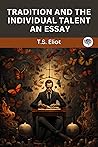
Tradition and the Individual Talent: An EssayTradition and the Individual Talent: An Essay by T.S. Eliot
My rating: 5 of 5 stars

Read for free at the Poetry Foundation

Amazon.in Page

While this is a controversial essay and I don’t accept it wholesale, myself, I would wholeheartedly recommend it as required reading for poets (and other artists.) What is Eliot’s controversial thesis? It’s that poetry should be less about the poet. That broad and imprecise statement can be clarified by considering two ways in which Eliot would make poetry less about the poet. First, Eliot proposes that poets should be in tune to the historic evolution of their art and — importantly — should not be so eager to break the chain with the past masters. He’s not saying a poet needs to be a literary historian, but rather that one be well-read in the poetry of the past. Second, Eliot advocates that a poet avoid packing one’s poetry with one’s personality, and – instead – let one’s personality dissolve away through the act of creation.

A quote from the essay may help to clarify — Eliot says, “Poetry is not a turning loose of emotion, but an escape from emotion; it is not an expression of personality, but an escape from personality.”

One can imagine the accusations of pretension and dogmatism that Eliot received in 1919 from the mass of poets who were moving full speed ahead into poetry that was suffused with autobiography, was avant-garde, and which was free of meter, rhyme and other compositional elements that had once been seen as the defining characteristics of poetry.

I don’t see this essay as being the map to our new home, but rather as the catalyst of a conversation that could move us to a more preferable intermediary location. I have, too often, picked up a collection by a young poet that was entirely autobiographical and (also, too often) of the “everybody hates me, nobody loves me, I think I’ll go eat worms” variety of wallowing in personal feelings. And I always think, when I want to read something depressing, I’ll read something from someone who has lived tragedy — e.g. a Rwandan refugee, not something from a twenty-four-year-old MFA student at some Ivy League school.

So, yeah, maybe we could use more connection to the past and a bit less autobiographical poetry from people who haven’t lived a novel-shaped life.

View all my reviews

“The Call” by Charlotte Mew [w/ Audio]

From our low seat beside the fire
Where we have dozed and dreamed and watched the glow
Or raked the ashes, stopping so
We scarcely saw the sun or rain
Above, or looked much higher
Than this same quiet red or burned-out fire.
To-night we heard a call,
A rattle on the window-pane,
A voice on the sharp air,
And felt a breath stirring our hair,
A flame within us: Something swift and tall
Swept in and out and that was all.
Was it a bright or dark angel? Who can know?
It left no mark upon the snow,
But suddenly it snapped the chain
Unbarred, flung wide the door
Which will not shut again;
And so we cannot sit here anymore.
We must arise and go:
The world is cold without
And dark and hedged about
With mystery and enmity and doubt,
But we must go
Though yet we do not know
Who called, or what marks we shall leave upon the snow.