Allow me to make a
    Socratic suggestion:
 That you pursue the lowly
    Art of the question.

Showing you love knowing
   More than you love learning
 Shows only that you're not
   Discerning, and lack requisite
 Yearning to find the Truth.

Allow me to make a
Socratic suggestion:
That you pursue the lowly
Art of the question.
Showing you love knowing
More than you love learning
Shows only that you're not
Discerning, and lack requisite
Yearning to find the Truth.
 Fluent Forever: How to Learn Any Language Fast and Never Forget It by Gabriel Wyner
Beginning my studies, the first step pleas'd me so much,
 The mere fact, consciousness -- these forms -- the power of motion,
 The least insect or animal -- the senses -- eyesight -- love;
 The first step, I say, aw'd me and pleas'd me so much,
 I have hardly gone, and hardly wish'd to go, any further,
 But stop and loiter all the time, to sing it in ecstatic songs.
 Play: How It Shapes the Brain, Opens the Imagination, and Invigorates the Soul by Stuart M. Brown Jr.
Sometime not too distant,
   There will come a day
 When you will return to
   A frequent state of play.

When that day comes around,
   You'll have lost all concern
 For the adults' belief that
   Frivolity must be spurned.

You'll take to tossing balls
 And climbing up the walls,
 Just like you used to do
  When you were one or two --
    Before that human zoo
     Got its hooks in you.
By the measure of having taught still useful lessons about HOW to think (those who taught me WHAT to think are largely forgotten along with their lessons,) that would be a tie between my 11th grade Psychology teacher and an undergrad Religious Studies professor. The former, among other ideas, first exposed me to what I would come to believe is the most important lesson of human existence under his label of the “gestalt of expectations.” [I’ve never heard anyone else refer to it as such, but the lesson was sound and I would latter find it in philosophies from Buddhism to Stoicism.] The latter teacher, among other ideas, exposed me to two common opposing modes of fallacious thinking, what he called “the outhouse fallacy” and “the first-est is best-est fallacy” (he was a folksy, if erudite, professor.)
In terms of personal growth and development, generally speaking, there are numerous teachers of martial arts, yoga, and other mind-body practices that are incomparable and thus unrankable. Not to mention, a sound argument can made for the repugnantly unhumble statement that I am my most influential (and most important) teacher. (I state this claim not as though I am unique, but as one that could apply to anyone.)
Heavy Indian Club movement patterns and the core tenets of Perennial Philosophy.
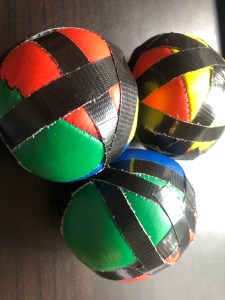
I’ve been learning to juggle. It’s an excellent skill because you have to fail a million times before you can be successful, and you can’t partially fail or fail in a controlled fashion. It’s kind of all or nothing. So, it teaches persistence and to be less prone to becoming demoralized. It also teaches one a lot about how one’s mind works at the speed of instinct.
I feel out of place in social settings pretty much everywhere and always. This, perhaps surprisingly, has made me an excellent and avid traveler because I feel the same level of out of place among a group of people who speak a different native language, practice an unfamiliar religion, and who have different skin and hair characteristics as I would with a group of people who share a common ancestry, went to the same school, and grew up with the same cultural trappings. This creates an internal pressure to go to unfamiliar places, because familiar places offer the same anxiety with none of the learning opportunities, whereas the unfamiliar always offers new lessons.
There are so many. Life is short and there’s so much to learn. There are swim strokes (and related skills) I’d like to pick up, including drownproofing. I never learned to drive a proper motorcycle. Archery would be nifty.


 Tiger Riding for Beginners