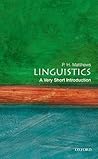
BOOKS: “Linguistics: A Very Short Introduction” by P.H. Matthews

Linguistics: A Very Short IntroductionLinguistics: A Very Short Introduction by P.H. Matthews
My rating: 4 of 5 stars

Publisher Site – OUP

This book offers an overview of the territory studied by the discipline of linguistics, from general topics such as what a language is and what distinguishes human language through more technical and scientific subjects such as the nature of vocal sound and the role of the brain in language.

It introduced me to some interesting ideas that I hadn’t previously given much thought, such as: the importance of redundancy in language, the idea that a word can’t necessarily be thought of as simply a label put on a pre-existing notion or thing, the question of whether language developed once or multiple times (independently,) how languages are learned, and how speaking influences thinking and vice versa.

Until the penultimate chapter (Ch. 8 – “Sounds”) I felt the book was doing a fine job of sticking to the basics, being interesting but not obscure. The “Sounds” chapter seemed to get more into the weeds than the rest (but, I’ll concede, it may have been part my relative interest in the topic, your results may vary.)

The book, like others in the series, has a few monochrome graphics as well as a “Further Reading” section.

If one is looking for a broad introduction to linguistics, I’d recommend this as a fine place to start.

View all my reviews

“Yes, I have a thousand tongues” by Stephen Crane [w/ Audio]

Yes, I have a thousand tongues,
And nine and ninety-nine lie.
Though I strive to use the one,
It will make no melody at my will,
But is dead in my mouth.

BOOKS: “Chinese Grammar Wiki BOOK: Elementary” ed. by John Pasden

Chinese Grammar Wiki BOOK: ElementaryChinese Grammar Wiki BOOK: Elementary by John Pasden
My rating: 5 of 5 stars

Publisher Site

Confronted with a vast sea of Chinese grammar texts, this is the series I chose, and I’ve been happy with my decision. This, the beginner level grammar guide, is reasonably priced, logically organized, easy to use, and has all one needs without time-wasting excesses.

The core of the book consists of 135 grammar points (40 “A1” level and 95 “A2” level.) For each point there is a clear but simple explanation of the rule, a formulaic statement of said rule [an easy to find timesaver when reviewing,] a number of examples (with Chinese characters, pinyin, and an English translation) and any cautions to consider (i.e. common mistakes, ways Chinese grammar differs from English, and common exceptions to the rule.) The examples used simple and common words and phrases to drill basic and useful vocabulary.

This book is organized to put bite-sized chunks of learning at hand so that one can do more or less, depending upon one’s schedule.

I’d recommend this book for anyone looking for a basic Chinese Grammar text.

View all my reviews

BOOKS: “Language” by Xiaolu Guo

LanguageLanguage by Xiaolu Guo
My rating: 5 of 5 stars

Publisher Site

This book is excerpted from a full-length novel entitled, A Concise Chinese-English Dictionary for Lovers, and it conveys what it’s like to be a stranger in a strange land — particularly when one has only a rudimentary grasp of the local language. Specifically, the story revolves around a young Chinese woman who moves to London to pursue her studies. In London, the young woman becomes involved with an older man, and much of the story looks at how culture — and particularly language — impacts the nature of the relationship. (And, also, how being in a relationship with a native of her new home impacts her language learning.)

Perhaps the most important factor influencing whether a reader will like or loath this book is how one feels about reading broken English. Like the dialectic poetry of Paul Laurence Dunbar, this book isn’t written in grammatically correct standard English. The broken – “learner’s” – English is quite effective at conveying the struggle of language learning and how culture and language are intertwined. But if reading grammatically incorrect writing gives you a headache, then this book is not for you.

As for why this book consists of excerpts, it’s part of a series called “Vintage Minis” that consists of short (or excerpted) works from prominent authors from around the globe, generally with a straightforward unifying theme. [Vintage Classics is an imprint of Penguin Random House.] The fact that the book was an excerpt didn’t create a problem for me. The origin material is a literary fiction novel and doesn’t seem to be significantly plot-driven. It’s much more character-driven, and thus getting a limited picture doesn’t open up a lot of unanswered questions about what will come next. In other words, it felt like it could have been a full piece of short, character-driven literary fiction.

I enjoyed reading this slim volume. I think it offers interesting insight into being a language learner abroad. If you’re interested in the challenges of language and culture in an unfamiliar place, this thin book is well worth reading.

View all my reviews

BOOKS: “Translation: A Very Short Introduction” by Matthew Reynolds

Translation: A Very Short Introduction (Very Short Introductions)Translation: A Very Short Introduction by Matthew Reynolds
My rating: 5 of 5 stars

Publisher’s Site

Language translation is one of those tasks that people take for granted is a straightforward endeavor — especially in the current era in which computers are starting to do a decent job of it. It turns out that translation isn’t at all straightforward, and a number of tradeoffs must be addressed through the act of translating — e.g. should one try to convey the original author’s meaning as closely as possible or should one make the writing as approachable and comprehensible to the readership as possible? This might seem like a false dichotomy, but because languages never map perfectly to each other and reflect differing worldviews, there is always some degree of trade-off necessary.

Reynolds addresses not only cases from literature, but also shows the role that translation (and mistranslation) can play in the legal, political, and business domains as well. I found this book to be interesting and useful in providing food-for-thought on the subject. It is particularly illuminating in its discussion of how translation is changing in an era of AI, and how profound an effect this will have on our future. (e.g. People worry about the death of languages with small followings, but if automated translation becomes cheap and ubiquitous, will the pressure to focus one’s efforts on one of the world’s major languages remain?)

If you are interested in issues of language translation, this is a fine book with which to begin one’s exploration.

View all my reviews

BOOKS: “Mother Tongue” by Bill Bryson

The Mother Tongue: English and How It Got That WayThe Mother Tongue: English and How It Got That Way by Bill Bryson
My rating: 5 of 5 stars

Publisher’s site

This is a humorous and readable overview of the English language. It examines the language’s history and evolution, as well as exploring some niche areas of interest such as swearing, wordplay, and naming conventions. Bryson takes on such questions as how a language that’s a train wreck of non-phonetic spelling and logical inconsistencies that made a career for comedian, Steven Wright (e.g. Why do we park in the driveway and drive on the parkway?) becomes the world’s most broadly spoken language. (At this time, it’s even the most spoken in absolute terms, but the book is fairly old now.)

Part of what one learns is that English isn’t so bad. Yes, our spelling is random and nonsensical (despite many failed attempts to improve it,) but in some ways English is grammatically simpler than many languages. English also has a history of embracing loan words and so there’s something familiar for all comers. Bryson does provide a number of fascinating points about other languages, largely by way of comparing and contrasting them with English.

Bryson was born in America, worked much of his life in Britain, and moved back to America. This bi-nationalism gives him unique insight into some of the book’s central questions — e.g. whether the language of these two hubs of English language will diverge or converge. There has been a concern that the English language would become so fractured that it would no longer be mutually intelligible to those on opposite sides of the Atlantic. However, increasingly, there is greater concern that people who watch both British and American versions of “The Office” may homogenize the language into one in which regional differences vanish.

I found this book to be both interesting and entertaining and would highly recommend it for anyone who wants more insight into the English language presented in an approachable manner.

View all my reviews

BOOKS: “The Story of Chinese Characters” by Fang Zeng

Languages - The Story Of Chinese Characters: 汉字的故事 (Bilingual Chinese with Pinyin and English - Simplified Chinese Version) - Preschool, Kindergarten (Educational ... Books For Smart Kids: 聪明宝宝益智成长绘本 Book 2)Languages – The Story Of Chinese Characters: 汉字的故事 (Bilingual Chinese with Pinyin and English – Simplified Chinese Version) – Preschool, Kindergarten by Elite Panda book
My rating: 5 of 5 stars

Publisher’s YouTube Channel

This story book is apparently perfect for preschoolers and definitely is for someone newly learning Chinese. It is the tale of a man who goes hunting and his mild trials and successes. It’s not a gripping tale, but that’s perfect for those new to the language as it allows simple language and concepts. The language is grammatically and semantically straightforward. This bilingual book presents Chinese characters, pinyin with tone markers, and the English translation all on the same page.

The story teaches a few rudimentary Chinese characters (person, mountain, boat, bird, etc.,) particularly ones that are either pictographic or lend themselves to pictographic memory tricks. (For those unfamiliar with Chinese, it is a common misconception that all the characters are pictographic. In fact, about eighty percent of characters appear as they do because of their spoken sound quality [i.e. they appear similar to another character with the same sound, but often with an entirely unrelated meaning.]) The illustrations not only tell the story but invokes the shape of the character that is under study.

I found this book useful for learning to read in Chinese. A little more separation of the pinyin and characters might be nice so one could cover it up to focus on reading characters, but I was clearly not the intended demographic. I don’t see any reason why the book couldn’t work either way, i.e. for English learning Chinese speakers as well as English speaking Chinese learners.

View all my reviews

BOOKS: “Languages: A Very Short Introduction” by Stephen Anderson

Languages: A Very Short IntroductionLanguages: A Very Short Introduction by Stephen R. Anderson
My rating: 4 of 5 stars

Publisher’s Website

This is a quick guide to the (not so briefly answered) question of how many human languages there are. SPOILER ALERT: There is either one or some number of thousands, depending upon one’s philosophical leanings and a range of factors touched upon by this book. Given that there is clearly not a consensus answer, much of the book deals with what obstructions hinder a clear count, as well as some related questions that influence the number of languages over time.

With respect to the trouble spots of counting languages, the core question is what exactly is a language? Can two people who can understand each other (e.g. as I’ve been told Russians and Ukrainians can) be said to be speaking two different languages? If yes, the number of languages will be higher than if not. But then, how well do you have to understand each other? There are short and simple sentences in German that I understand, but that doesn’t mean I could understand a German, or a German would understand me (well, they probably would because most speak English as an Other Language.)

The related questions dealt with in the book include: why is number of languages shrinking, and is it inevitable? Can a globalized world be consistent with thousands of tribal-scale languages, and — if so — how?

The book also discusses the diversity of sign languages, and how signed languages differ from (and are similar to) spoken languages. The final chapter considers a number of questions, including how language separates humanity from wildlife, or — alternatively stated — what is it that makes human language different from the communication systems of other species of which we’re aware.

This is a readable book that deals in some interesting questions.

View all my reviews

“Untitled” [Pronunciation Poem] by Anonymous* [w/ Audio]

I take it you already know
Of tough and bough and cough and dough.
Others may stumble, but not you,
On hiccough, thorough, lough and through.
Well done! And now you wish, perhaps,
To learn of less familiar traps.

Beware of heard, a dreadful word
That looks like beard and sounds like bird.
And dead -- it's said like bed, not bead.
For goodness sake, don't call it deed!
Watch out for meat and great and threat.
They rhyme with suite and straight and debt.

A moth is not a moth in mother,
Nor both in bother, broth in brother,
And here is not a match for there,
Nor dear and fear for pear and bear.
And then there's dose and rose and lose
Just look them up -- and goose and choose.

And cork and work and card and ward.
And font and front and word and sword.
And do and go, then thwart and cart.
Come, come I've hardly made a start.

A dreadful language? Man alive,
I'd mastered it when I was five!

* This poem has come to be attributed to a T.S. Watt with a date of 1954. However, the broad divergence of titles and lack of other publication information suggest the alternate possibility that attribution was invented after the fact and has just been mindlessly copied across the internet. I don’t wish to cheat T.S. Watt, if he or she was an actual person who wrote this clever poem, but I also don’t wish to contribute to the spread of false information that happens regularly across the internet. Hence, this note.

BOOK: “Twenty-Nine Goodbyes” by Timothy Billings

Twenty-Nine Goodbyes: An Introduction to Chinese PoetryTwenty-Nine Goodbyes: An Introduction to Chinese Poetry by Timothy Billings
My rating: 5 of 5 stars

Publisher website

The premise of this book is simple, Billings presents twenty-nine different translations of a famous farewell poem by the Tang Dynasty poetic genius, Li Bai, and compares, contrasts, and critiques them in detail. The included translations weren’t all crafted in the English language, but English translations (of the translations) are presented as needed. There are translations from French, Spanish, Japanese, and even modern Mandarin Chinese — among others.

Despite how that may sound, it is a tremendously readable book. Billings writes with engaging prose, employs humor (especially when critiquing his own contribution in the final chapter,) and uses complicated jargon only when necessary and with comprehensible explanations.

Still, it does take a certain level of passion to read because one is repeatedly examining the same poem, and one has to have an interest in the minutiae of said poem and – more importantly — an interest in the broader lessons conveyed about translation. If whether a color is translated as green or blue (or what symbolic object tumbles on the ground, or what sound a horse makes) doesn’t seem change the emotional experience of the poem for you, then you’ll probably have a hard time getting into this book. That said, the ability to take a longitudinal view –seeing same points in a given poem through the lens of different poets and translators cross time and cultures, does offer insight that one would be unlikely to get from reading any of the twenty-nine translations in isolation as part of a single translator’s collection of translations.

The most useful thing the book did for me was to increase my understanding of the nature of translation and its tradeoffs, as well as to elucidate how easy it is to miss the mark when one is translating from a perspective so different in time and worldview.

I’d highly recommend this book for anyone interested in Tang Dynasty poetry, translation, and the interface of culture and language.

View all my reviews