


I plan to travel to the future one minute at a time.
At least until they invent a time machine that can transport something bigger than a subatomic particle, and only milliseconds into the future at that.

I plan to travel to the future one minute at a time.
At least until they invent a time machine that can transport something bigger than a subatomic particle, and only milliseconds into the future at that.
List 10 things you know to be absolutely certain.
1.) Nothing is permanent.
2.) The world is not what it seems.
3.) One’s subjective experience is not determined by the state of the world.
4.) Nobody grasps enough truth to be intolerant.
5.) Uncertainty is the root of all fear.
6.) Fear is the root of all hatred.
7.) Hatred is a subjective experience (See #3.) Also, uncertainty is the root of all hatred (by the transitive property,) hence the benefit of travel.
8.) Any who: a.) has suffered a string of hardships; b.) allows themselves to believe that some “other” is wholly responsible for said hardships; and c.) who lacks a sufficient sense of self-empowerment to avoid surrendering entirely to a group identity can (and likely will) become a Nazi (or the equivalent of their day.)
9.) No one can predict the future. [Regardless of how much we all love to try. (See #5.)]
10.) Entropy increases (ultimately, in a closed system.)
NOTE: I remain ready to abandon any certainty in the face of better information.
I think humanity has a golden age coming. Unfortunately, a.) as John Maynard Keynes pointed out, “In the long run, we are all dead.” Accordingly, I don’t expect I’ll live to see that great age. And, b.) said great age is likely to come on the backend of a tragic period whose reach and devastation will make the Second World War seem like a puny and short-lived regional skirmish by comparison. [I also think there’s a good chance I’ll miss the worst of this, but there’s no accounting for the rapidity at which it might move (and the process has begun.)]
The root of this combination of relative near-term pessimism and long-run optimism is the observation that we are experiencing a technological revolution that there is no reason to believe won’t end in machines that are both smarter and more capable than we, and we have no plan for what to do in that scenario. We have no conception of what an economy looks like in which machines do everything faster, more cheaply, and more efficiently than human labor. I wouldn’t be so pessimistic if our institutions and legal frameworks were trending better and better, but — in fact — after years of spreading rule of law and democracy, we are starting to see global shrinkage and a rise of a strange populist authoritarianism that I can only imagine being catastrophic under the stress test that is to come.
Why the long-term optimism? Nothing lasts forever, and tough times breed tough and capable people. [Whereas comfort addiction is a major factor in our near-term predicament.] I think the Golden Age will be humans learning not to be defined by production / consumption but by developing the human body and mind to its utmost capacity.
A lot of people are worried about population collapse. I am not so worried about that. I think that: a.) humanity could use some thinning; b.) we do fine with long time scale threats. As pressures rise, the adjustments start and — perhaps with some growing pains — we’ll get where we need to be. The AI / Machine Learning revolution concerns me because I suspect it will happen too quickly to steer the ship (like being in an aircraft carrier as a tsunami comes, there’s no agility to navigate out of the way and no speed to outrun it, you just have to take the damage and try to recover.)
You were probably looking for an answer like flying cars, but I gave up on those long ago.
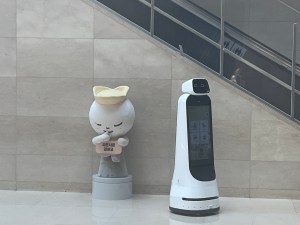
Humans have been hunters,
   gatherers,
   farmers,
   machines,
   thinkers,
   and creators,

And have no idea what we'll next be.

I think that people will next be
      -- simply --
   Human Beings,
      Full-time Human Beings --
      More Human,
      More Being...

And many will fail spectacularly.
What are you most worried about for the future?
A global rise in governance by populist authoritarians in which people give up abstract conceptual benefits like checks and balances and rule of law in exchange for the more tangible bread and circuses.
I’m not so concerned about the demographic crises because I think those long-scale issues work themselves out, just as when Malthus predicted the human population was growing too fast and global famine was inevitable.
I’m also not so worried about [G]AI because if we make machines that can crush us, we deserve to be crushed to make way for the new. That said, I think we are at the beginning of a crisis of modernity that will reach its apex when machines can do all productive tasks better than can humans. But, I’m pretty sure I’ll outrun that, and by choosing to focus on the art of being human, it’s not so impactful, personally.
Technology has changed everything, for good and for ill. It’s the source of our vast growth in productivity, but also at the heart of our modern crises (e.g. I’m almost certain that no caveman ever experienced “imposter syndrome.” But like other crises of modernity, I suspect that technological dependence and an ever-continuing trend toward ultra-specialization are its cause.)
I count myself fortunate to be of an age to (probably) miss the (rapidly approaching) day when machines and artificial intelligence do all “productive tasks” better, faster, and with far less energy consumption than a human being. I don’t think most of humanity will be prepared for that day, and it will – in all likelihood – go down catastrophically. [I think we’re seeing the cracks in the dam already.]
I spend more and more time with the only technology-proof sector of which I’m aware: building a more capable human being.
I believe if every person spent some time learning skills like primitive living (sustainable wilderness survival skills) or unarmed martial arts (that train against armed opponents) society would be much better off. I pick these two as examples of skill sets that give practitioners a deep confidence in themselves [not in themselves + technologies that they can’t build, can’t fix, and which they don’t really understand.] I suspect that the core self-empowerment that would result would ease away much of the general shittiness of character we are increasingly prone to see in the world, shittiness that — like all shittiness — is ultimately rooted in fear.
Is your life today what you pictured a year ago?
I make no predictions. Forecasting is a sucker’s game.
What are you doing this evening?
Probably just reading and otherwise restfully winding down from the day.
But who can know what the future holds?

the river trickles.
 but its broad shoulders tell
 of expectations.
Do you spend more time thinking about the future or the past? Why?
I spend the most time trying to figure out how to live mostly in the present. The past is dead and the future is unknowable, so I might as well settle into this moment.


