BOOK REVIEW: The Unreasonable Effectiveness of Mathematics in the Natural Sciences by Eugene Wigner

The Unreasonable Effectiveness of Mathematics in the Natural SciencesThe Unreasonable Effectiveness of Mathematics in the Natural Sciences by Eugene Paul Wigner
My rating: 4 of 5 stars

Available online here

This brief essay asks why math proves so effective for describing / codifying physical laws, and whether our physical theories — built on (phenomenally successful) mathematics — offer the truth, the whole truth, and nothing but the truth.

There’s a popular story in which a drunk man is found on his hands and knees under a lamppost at night when a police officer comes along. The cops says, “What-cha doin’?” To which the drunk replies, “I dropped my keys, and I’m looking for them?” So, the cop says, “Well, they’re clearly not where you’re looking, why not look elsewhere?” And the drunk says, “Cuz this is where the light is.” I think this story can help us understand what Wigner is getting on about, if only we replace the drunk’s “light” with the scientist’s “elegant mathematics.” Wigner reflects upon why it should be that so many laws of nature seem to be independent from all but a few variables (which is the only way scientists could have discovered them –historically, mathematically, and realistically speaking.) On the other hand, could it be that Physics has led itself into epistemological cul-de-sacs by chasing elegant mathematics?

There’s no doubt that (for whatever the reason turns out to be) mathematics has been tremendously successful in facilitating the construction of theories that make predictions that can be tested with high levels of accuracy. However, that doesn’t mean that some of those theories won’t prove to be mirages.

A few of the examples used in this paper are somewhat esoteric and won’t be readily understood by the average (non-expert) reader. That said, Wigner puts his basic arguments and questions in reasonably clear (if academic) language. The essay is definitely worth reading for its thought-provoking insights.


View all my reviews

BOOK REVIEW: The Transcendentalist by Ralph Waldo Emerson

The TranscendentalistThe Transcendentalist by Ralph Waldo Emerson
My rating: 5 of 5 stars

Amazon.in Page

Free Online: Emersoncentral.com

In this short essay (about ten pages,) Emerson lays out an argument for Idealism over Materialism, and then contends that it’s reasonable to excuse oneself from the economic and civic aspects of society in favor of a simple life of introspection. [e.g. As Thoreau did in his years at Walden Pond.]

Emerson opens by suggesting that Transcendentalism is just Idealism by a different name. Idealism being a philosophical stance which puts consciousness at the fore while proposing that there is something beyond [that transcends] our experience of sensory information. The arguments put forth in favor of Idealism include the fact that sensory illusions exist and the Kantian critique of Locke’s view that there’s no more to the intellect than that which is or was sensory experience; Kant argues that there’s intuition. Kant’s influence is considerable, and Emerson explains that even the term “Transcendentalism” is derived from Kant’s use of the term “transcendental.”

The latter part of the essay echoes Emerson’s masterwork, the essay “Self-Reliance.” It proposes that it’s perfectly laudable to take advantage of the greatest gift one has, one’s consciousness, to introspect and indulge one’s need to better understand.

I may have mixed views on Emerson’s ideas, but one can’t say he doesn’t use language and reason and passion to make compelling claims. I found this brief essay to be both thought-provoking and inspirational, and I’d highly recommend it.


View all my reviews

On Intrusive Thoughts & Shoving Someone in Front of a Train

The other day I read that a man had pushed a person onto the tracks in front of an oncoming train. 

The week before that, I'd read in a book by Robin Ince that a person who -- having had a baby thrust into his hands -- has intrusive thoughts of throwing said baby out of the nearest window is [believe it, or not] the best person to ask to hold one's baby.

The argument goes like this, the person having these intrusive thoughts is being intensely reminded by his or her unconscious mind that under no circumstances -- no matter what unexpected or unusual events should transpire -- is he to throw the baby out the window (or otherwise do anything injurious.)

I've heard that, at some point, virtually everyone has some type of awkward intrusive thought such as the thought of pushing a stranger in front of a train. 

Most never do it, nor truly want to do it.

Then this one time... someone did.   

BOOK REVIEW: Civil Disobedience by Henry David Thoreau

Civil DisobedienceCivil Disobedience by Henry David Thoreau
My rating: 5 of 5 stars

Amazon.in page


This 30+ page political philosophy essay argues that it is one’s responsibility to avoid letting the government make one complicit in its unjust activities. The major points of contention for Thoreau were two-fold: state facilitation of the institution of slavery and the Mexican-American War (which Thoreau – like many – saw as a shameless land grab.) Thoreau put his money where his mouth was, and was briefly jailed for failure to pay taxes. [This brief stay might have been much longer had not someone paid the tax bill without Thoreau’s knowledge. While Thoreau doesn’t name said individual (if he ever knew who it was,) he treats that person as someone who did a bad deed in his name rather than someone to be thanked.] The discussion focuses heavily on tax-paying (or, rather, non-payment) as opposed to other acts of civil disobedience / passive resistance / non-violence such as breaking unjust laws.

This essay has been cited as an influence by Mahatma Gandhi, Martin Luther King, Jr., Leo Tolstoy, and many who are less well-known as proponents of non-violent resistance against oppressive or unjust governance. While the meeting of unjust governance with passive resistance has shown itself to be a powerful strategy in the intervening years, Thoreau was at the vanguard of thinking on this issue. Later activists would expand the domain of civil disobedience greatly, and it would become more explicitly associated with non-violent opposition. [Thoreau doesn’t talk up the virtue of avoiding violence like Gandhi does, but he also doesn’t mention violence as an alternative to his approach — and it seems he would find violent acts as morally reprehensible as supporting the government in its acts of aggressive violence.] I would be interested to know the following of this essay by different elements of the political spectrum today, and how that following was influenced by those who took up its banner. [It has a libertarian “the government is fundamentally untrustworthy” vibe going, but I suspect it is probably popular with elements the left who generally view the government as a savior against corporations, given the essay’s past proponents. Though I could be wrong.]

Thoreau doesn’t focus on his own case, which he only gets to well into the essay and which he addresses in quick manner. Rather, he spends most of the essay discussing the justification for breaking the law (i.e. not paying taxes) and what is moral and proper and what is not. [e.g. He says that he pays the highway tax because his desire to be a good neighbor matches his desire to be a poor subject. [paraphrased.]] Obviously, it’s a nuanced issue. If no one paid their taxes who had a gripe with the government, it might just result in everyone finding a gripe with the government – in perpetuity. Thoreau, himself, has quite a negative view of government’s ability to be just. While his focus is on abolition of slavery and the war with Mexico, it’s not as though he proposes that these are exceptional and uncharacteristic cases.

Though it is short, this essay can be obtained as a standalone work (as it’s reviewed here,) but it’s also included in many Thoreau collections and political philosophy anthologies. Like it or lump it, it’s definitely worth reading because it addresses some pretty fundamental questions about what an individual’s responsibilities are to the government as well as what are one’s responsibilities to resist the government’s activities.

View all my reviews

ESSAY: This I Believe [Including My Views on Unicorns]

Occasionally, I’m asked whether I BELIEVE some idea or BELIEVE in X [i.e. fill in the person, place, thing, or concept.]

If I were to answer these questions honestly, that answer would almost invariably be, “No.”

But, because that can seem overly contrarian — not to mention insane — I often try to guess the sense in which the questioner is using the words “BELIEVE” and “BELIEF,” and then answer accordingly.

Like many words, BELIEVE is one whose meaning meanders, and shadows fall across it in different ways, creating different hues [and impressions thereof,] depending upon one’s vantage point.

Often, people seem to use the phrase, “I BELIEVE X ” synonymously with “I understand X to be true.” “I BELIEVE it” can mean: I behave as though X is true, [but am not necessarily commenting on the degree to which X is supported by evidence or reason.] I, on the other hand, try to use BELIEVE in the sense of: “I accept the truth of X and behave accordingly, but I don’t really have any solid basis on which to rest this conclusion.” I like to draw as few such conclusions as possible, though sometimes it’s hard not to. For example, like most people, I live my life as if we are living in base reality — as opposed to being in some “Matrix”-like computer simulated world, but — if pressed — I’d have to admit that I can’t really support this belief convincingly.

If I were to be asked whether I BELIEVE there is a force that inexorably pulls me toward the Earth’s center, using my own interpretation of the word “BELIEVE,” I would reply in the negative. Before you ask how I can be so anti-gravity [pun not intended, but acknowledged,] let me say that I firmly understand there to be such a force as gravity. This is not to say that I fully understand the mechanism by which gravity works — which I certainly do not — but rather to say that I recognize the truth of such a force’s existence. I can experience gravity in my pathetic vertical leap, and even note it in the very impressive vertical leap of skilled athletes. I see it in the red leaf, twirling as it falls to the ground. I feel it upon takeoff as an airplane’s seat raises against my butt. Furthermore, I recognize that there are many scientists who’ve come to understand a great deal more about gravity than I, but also that none of what they’ve learned through their vast number of controlled observations contradicts my basic idea that I’m being pulled toward the planet (and it toward me.)

At the Jaipur Jantar Mantar, I was once asked whether I BELIEVED in astronomy and astrology? The questioner clearly thought this was a closed-ended, yes or no, question — as if the two fields dealt in identical content. Of course, from my perspective, it was a question similar to: “Do you BELIEVE in Zebras and Magical Unicorns?” — which is to say, not at all a straightforward and closed-ended yes or no question. [Incidentally, the reason I used the modifier “magical” is because I do “believe” in unicorns. I just call them “Indian Rhinoceroses” [Latin name: Rhinoceros Unicornis.]]

A Unicorn — i.e. the Indian Rhinoceros, or Rhinoceros Unicornis

The long and short of the matter is this: I strive to BELIEVE as little as I can, and to hold even those BELIEFs only so tightly that they might fall away in the face of learning. Otherwise, what’s learning for [or is it even possible?]

POEM: Notes on Being an Introvert: or, Weird

Most people turn a spigot to control the flow of the informational self. Opening the valve at will, and adjusting the flow as the pipe diameter allows. I have a hammer and a dam. Slamming the hammer into the dam yeilds nothing the first knock, and only a few droplets seep through over next several frantic smashings. Then spews a deluge of stone and water. Fortunately (or unfortunately,) by the time the flood crests, everybody has found safe ground elsewhere — usually.

“One-track mind” is a pejorative label, a criticism of an obsession. But the best one can aspire to is a two-track mind. Track One is what you are aware of, and Track Two is being aware of what you’re aware of it — metacognition. [Some Buddhas may be able to mirror it out to a third level, but not me.] Sure, one can juggle things in and out of Track One like a spastic circus worker, but it’s still a one-track mind. And dialing in Track Two is like tuning into one of those cross-country super-stations back in the radio days. The ones that only came in clearly in the stillness of the dead of night, and, otherwise, tipped into static with the slightest provocation on this spinning, orbital world.

My point is that I require a track for actions that usually take place down below the waterline, in the engine room — i.e. eye contact, smiling, etc. So when my one-track mind is occupied with information flows, I’m staring off who knows where — looking like the person who peers over your shoulder at a clock or at the prettier person he wishes he was talking to — but without recovery, because I’m oblivious to what my eyes are taking in. Worse, sometimes I remember to juggle “make eye-contact and smile” into Track One, and then I realize after the fact that I stared down an interlocutor with a maniacal grin until he excused himself, worrying I might have been sizing him up to make a coat of his skin.

Lest you think me wallowing in the mire, there’s a sweet upside. Under the right conditions, I gobble up and manage information like one of those giant harvesters that chews through a 200 acre cornfield in a day — separating grain and chaff — and stowing it away neatly. And, putting my body in motion, I can dive a mile inside, losing my Self and becoming blissfully enamored with this electric life.

Then there’s that aspect of me that I used to feel a curse, but have come to embrace: my inability to give two fucks about things that drive “the normals” to frenetic lunacy, such as:

  • collecting and squirreling away bits of matter
  • sports teams (A digression: I’ve always found spectator sports to be like being invited to watch a party through the window from the outside. I see why the athletes are fervent about it, but can’t figure out why anyone else would care.)
  • the need to be loved by every single person I come into contact with — that must be exhausting
  • the need to feel that I understand the world (I love the chase, but I’m like a mutt chasing a Mack truck. Catching it would prove fatal. It might not crush my body, but it would crush my soul.)

I’ve been thought many things:

  • People-hating: Untrue. I see each person as a bright and splendid sun. Warming. Soothing. Invigorating. Burning. Scorching. Cancer causing. And, ultimately, fatal. “The poison is in the dose,” as they say. Catch me without sunscreen and I’ll flee. With it, we may know some time together. My wife seems to be the only one free of this harsh and curious radioactivity.
  • Arrogant: OK, it’s not wrong that I be thought arrogant, but it’s usually in ways and degrees that do not hold. I once heard Neil Gaiman say something to the effect that a writer must balance humility with the lunatic overconfidence of a seven-year-old schoolboy. To clean out the attic before it explodes out the windows and into the street requires an inexplicable degree of comfort with everybody seeing the skeletons, sex toys, and unused fitness equipment you’re putting to the curb.
  • Depressive: Perhaps, in the days I felt the need to be someone else, but more likely just drained from the time-release vampires.

BOOK REVIEW: The Complete Poetical Works of Edgar Allan Poe

Complete Poetical WorksComplete Poetical Works by Edgar Allan Poe
My rating: 5 of 5 stars

Amazon page

Gutenberg page


The title is self-explanatory with respect the book’s content. However, if one is just expecting all of Poe’s poems bound together, one may be pleasantly surprised by some relevant bonus material in the form of scenes from plays and a few essays on poetry.

The works included are divided into seven sections. The first is entitled “Poems of Later Life” and includes many of the author’s most famous works such as: “The Raven” and “Annabel Lee.” The book then follows an inverse chronological order with the section entitled “Poems of Manhood” coming next. Next there are scenes from a drama entitled “Politian” that emulates classic Greco-Roman plays. Then there are the poems written in Poe’s youth. There are two more sections of poetry with only a few pieces each. The first is the “doubtful poems’’ – i.e. poems that may or may not have been penned by Poe. The last chapter of poetry consists of Poe’s prose poems. Finally, there is a section consisting of three essays about poetry. This is a nice inclusion as it offers the reader insight into Poe’s thoughts on poetry. For example, Poe believed in a poetry Goldilocks zone. That is poems that were too long would not be able to maintain the emotional experience, but one’s that were too short would not be able to convey meaning.

I enjoyed this book. Not all the poems are of the caliber of “The Raven” by any means, but the book is insightful nonetheless, and there’s a mix of Poe’s trademark darkness with pieces that might strike the reader as decidedly uncharacteristic. As I said, it’s fun to have Poe’s essays on poetry next to his poems so that one can consider his verse in that light. The inverse chronological order provides an interesting way to view the evolution of a poet – Benjamin Button style. (Plus it offers one some strong momentum by starting the reader off with some of Poe’s most exceptional work.)

There’s a brief biography in the front of the book, and there are a surprising number of detailed notations for a collection of poetry. That’s all the ancillary matter. There are editions with illustrations, but the edition that I read didn’t have them (i.e. the version on offer from Gutenberg Project .) Amazon seems to have editions both with and without illustrations. (I don’t think they would offer much value-added.)

I’d recommend this for poetry readers and poets interested in Poe’s approach to the art.

View all my reviews

Blinders (Literal and Figurative) in the Martial Arts

IMG_2553Many years ago I was training at a dōjō that had a practitioner who was a teacher for the blind. He requested that we put together a self-defense workshop for his students.  (If you’re wondering what kind of evil jackass would attack a blind person, rest assured that—sadly–such a level of jackassitude exists in the world.) The request presented an intriguing challenge. How does one adapt techniques that are premised on being able to see what the opponent is doing? Or maybe one shouldn’t adapt existing techniques but rather start from square one?


In preparation for working up a lesson plan, the person that asked for the workshop briefed the black belts. We learned that very few of the blind students lived in complete darkness. Instead, they displayed a wide range of different visual impairments. He even brought a large bag of goggles that simulated various impairments so that we could train in them to better understand what would or wouldn’t work with different types of impairment.


There were goggles that had funnels over the eyes such that one could see two little circles clearly while the rest of the world was black. There were others that had a complete field of view, but had translucent tape over the lenses so that everything was reduced to fuzzy blobs—as if one were looking through Vaseline. There were lenses that had a crackle effect such that one could only see veins of area clearly. There were goggles with no peripheral vision, and ones with only peripheral vision. He also had some goggles that blacked out the world entirely. Completely blind individuals may not be as common as one would think, but they certainly exist. Putting on any of the goggles was disorienting at first. A couple of the black belts even got vertigo or nausea when they moved around too quickly.


Now imagine what it would be like if one had always had the goggles on, that it was the only worldview one had ever known. Furthermore, imagine that everyone you interacted with on a daily basis all wore the same variety of goggles. You wouldn’t see it as an affliction or a limitation. To you, your view of the world would be full and complete. You would engage in behaviors that might seem odd to an outsider with unobstructed vision (e.g. sweeping your hands around in big arcs, turning your head at unusual angles, or calling out into the “darkness”), but these behaviors wouldn’t seem odd to you because you’d know it as natural behavior for someone who experienced the world as you did.  Because everyone you dealt with would see the world in the same way, it wouldn’t occur to you to think about whether there was another way to behave.


The preceding paragraph serves as an analogy for culture. One’s own culture is often invisible, especially if you don’t get outside of it much. All the people around you confirm your belief that you’re seeing the world as it is and behaving in the only natural and normal way imaginable. Sure, you may notice other people’s cultures—their skewed worldviews and the anomalous behaviors that result– but that’s because they do “strange things.” Still, some individuals will maintain that their culture doesn’t display any of the “odd” ways of behaving that more “exotic” cultures do.


But it does. Every culture is a mix of the good, the bad, and the ugly of how a people goes about living in the world given their cultural blind spots and skews. It includes collective coping mechanism for dealing with fears of uncertainty, and those are often the ugly side of culture. They encourage ingroup / outgroup separation, as well as primitive and superstitious approaches to dealing with those events, people, and behaviors that are out of the ordinary.


It’s easy to display double standards when one is blind to culture. I will give an example from my own life. It’s only been since I’ve been living in India (and traveling in Asia) that I’ve become aware of how many people are upset by Westerner’s secularization of Eastern religious / spiritual symbols and imagery. That’s a mouthful; so let me explain what I mean by “secularization of Eastern symbols and imagery.” I’m talking about “OM” T-shirts / pendants, bronze Buddhas, Tibetan thanka paintings, mandalas  (on T-shirts or posters), miniature shrines, or tattoos that are purchased because they are trendy, aesthetically pleasing, or vaguely conceptually pleasing without any real understanding of the tradition from which they came or intention of honoring it.


Granted it’s easy to miss the above issue if you’re a tourist because: a.) Many of said Eastern traditions practice a live-and-let-live lifestyle that make their practitioners unlikely to be confrontational about such things (in contrast to  practitioners of Abrahamic traditions (i.e. Judaism, Christianity, or Islam.)) b.) There are merchants in every country who are willing to sell anything to anybody for a buck, and so there are vast markets for tourists that offer up these symbols and images in droves.


It still intrigues me that it once caught me off guard that there were Hindus, Buddhists, Jains, etc. who were dismayed by the secularization of their traditions. I’m agnostic, but I was raised in a Christian household. Therefore, I can imagine the animosity aroused by the following conversation.


A: [Wearing a simple crucifix [or Star of David or crescent & star] pendant on a chain.]

B: Hey, A, I didn’t know you were Christian [or Jewish or Muslim]?

A: Because I’m not.

B: But you’re wearing a crucifix [or other Abrahamic symbol] pendant?

A: Oh, yeah, that. That doesn’t mean anything. It just looks cool. It’s kind of like the Nike swoosh.

B: [Jaw slackens.]


Now replace the crucifix with an “OM” shirt, and an inquiry about whether “A” is Hindu. Does it feel the same? If it doesn’t, why shouldn’t it?


Every martial art represents a subculture embedded in the culture of the place from which it came.  [Sometimes this becomes a mélange, as when a Japanese martial art is practiced in America. In such cases the dōjō usually reflects elements of Japanese culture (e.g. ritualized and formal practice), elements of American culture (e.g. 40+ belt ranks so that students can get a new rank at least once a year so they don’t quit), and elements of the martial art’s culture (e.g. harder or softer approaches to engaging the opponent.)]


The way that culture plays into a country’s martial arts may not become clear until one has practiced the martial arts of different countries—particularly in their nation of origin. While my own experience is limited, I have practiced Japanese kobudō in America (and extremely briefly in Japan), Muaythai in Thailand, and Kalaripayattu in India. I’ll leave Muaythai out of the discussion for the time being because I can most easily make my point by contrasting Japanese and Indian martial arts.  The Japanese and Indian martial arts I’ve practiced each reflects the nature of its respective culture, and they couldn’t be more different.

 

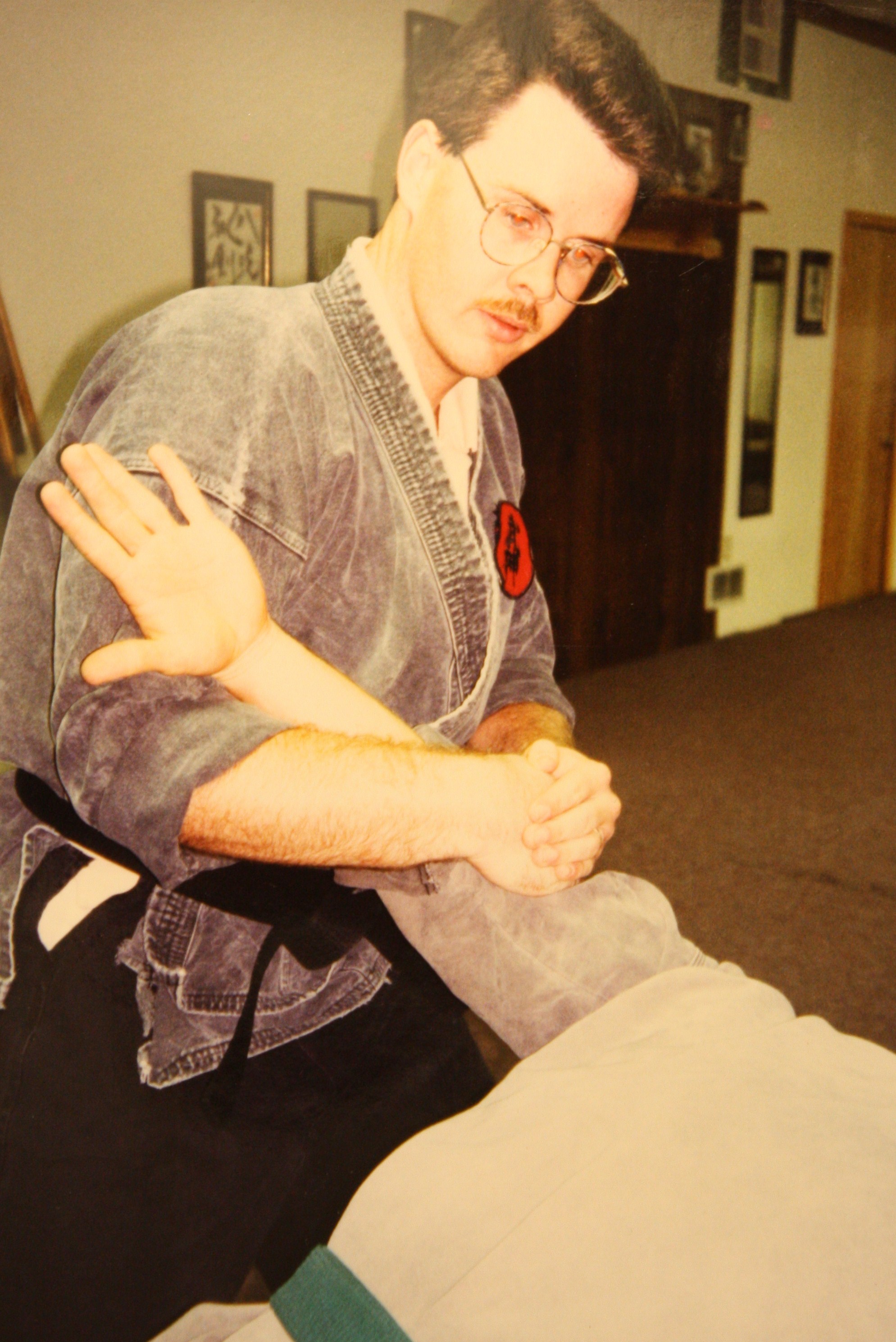
IMG_4525What are the differences between the Japanese and Indian martial arts I’ve studied? I’ve been known to answer that by saying that the Japanese martial art rarely uses kicks above waist level, while in Kalaripayattu if you’re only kicking at the height of your opponent’s head you’ll be urged to get your kick up a couple of feet higher.  What does that mean? The Japanese are expert at stripping out the needless and they work by paring away excess rather than building difficulty. The impulse of the Japanese is to avoid being showy. KISS (Keep It Simple, Stupid) appeals to the Japanese mind. (Except for the “Stupid” part, which would be considered needlessly confrontational and gratuitously mean-spirited.) There’s a reason why Japanese martial arts don’t feature prominently in global martial arts cinema. They don’t wow with their physicality; efficiency is at the fore.
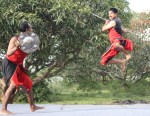
 

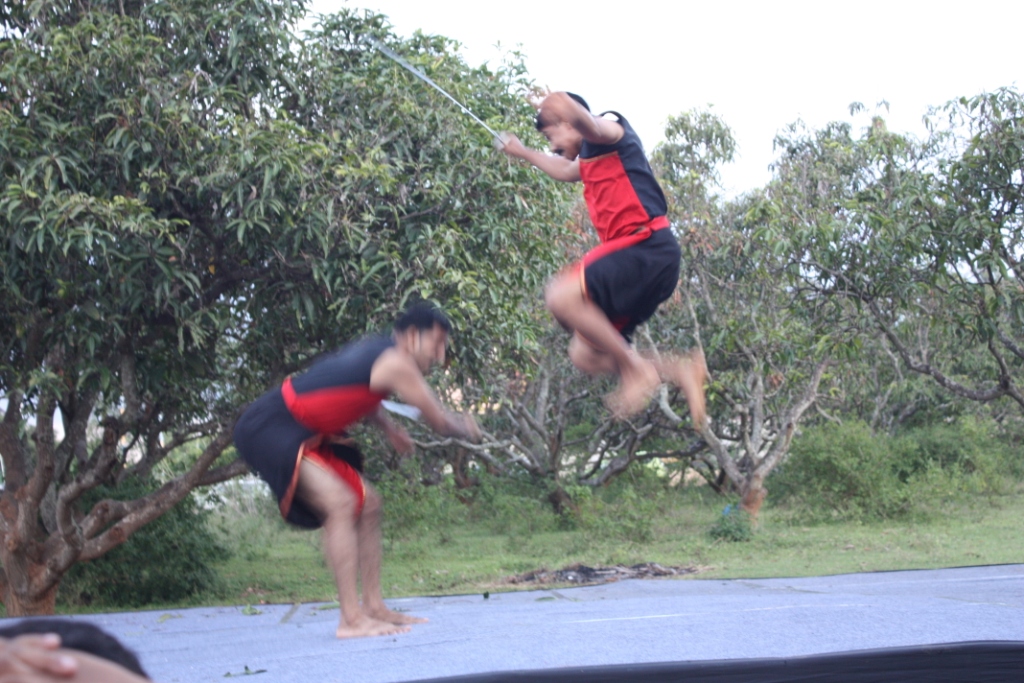
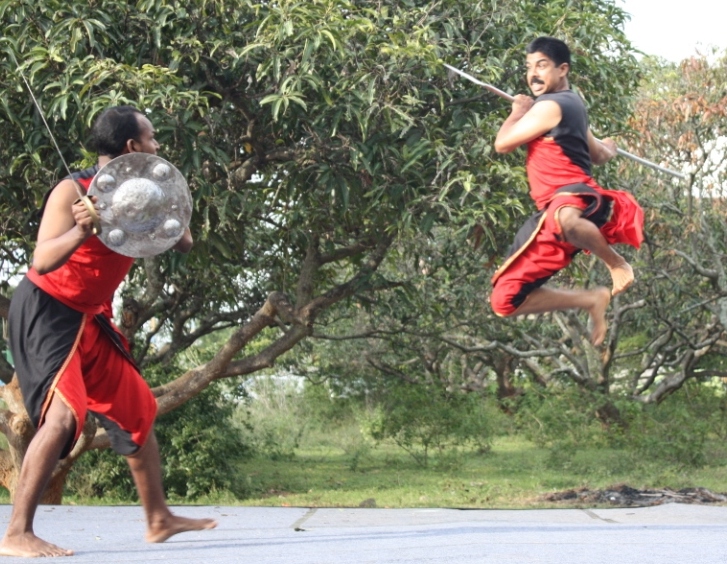
IMG_2246On the other hand, Indians are a vastly more flamboyant bunch, and Kalaripayattu is extremely impressive to watch and in terms of the physicality required to perform the techniques.  The Indian art isn’t about simplifying or cutting away the unnecessary. One has to get in progressively better shape as one advances to be able to perform techniques that require one leap higher, move faster, and be stronger. The Indian art isn’t about paring away excess, it’s about making such an impressive physical display that the opponent wonders whether one is just a man, or whether one might not be part bird or lion.


It might sound like I’m saying that the Japanese martial art is more realistic than the Indian one. Not really. Each of them is unrealistic in its own way. It’s often pointed out that the Japanese trained left-handedness out of their swordsmen, but that’s only one way in which Japanese martial arts counter individuation.  Given what we see in terms of how “southpaws” are often more successful in boxing, MMA, and street fighting, eliminating left-handedness seems like an unsound tactic at the individual level. There are undoubtedly many practitioners of traditional Japanese martial arts who can dominate most opponents who fight in an orthodox manner, but who would be thrown into complete disarray by an attacker who used chaotic heathen tactics. Consider that the only thing that kept the Japanese from being routed (and ruled) by the Mongolians was two fortuitous monsoons. The samurai were tremendously skilled as individual combatants, but the Mongolians could—literally—ride circles around them in warfare between armies. Perhaps, a more relevant question is whether Miyamoto Musashi would have defeated Sasaki Kojirō if the former had followed all the formal protocols of Japanese dueling instead of showing up late, carving his bokken from a boat oar, and generally presenting a f*@# you attitude. Who knows? But as the story is generally told, Musashi’s disrespectful and unorthodox behavior threw Sasaki off his game, and it was by no means a given that Musashi would win. Some believed Sasaki to be the more technically proficient swordsman.


All martial arts are models of combative activity apropos to the needs of a particular time, place, culture, and use.  And—as I used to frequently hear in academia—all models are wrong, though many are useful. (Sometimes, it’s written: “All models are lies, but many are useful.”)


[FYI: to the readers who say, “The martial art I practice is completely realistic.” My reply: “You must go through a lot of body-bags. Good for you? I guess?”]

BOOK CHAT: Walking by H.D. Thoreau

WalkingWalking by Henry David Thoreau

My rating: 5 of 5 stars

Amazon page

Thoreau paints a portrait of walking in such grandiose terms that one will cease to think of putting one foot in front of the other as one of life’s mundane tasks. He’s not talking about just any walking, however. He’s not talking about the mall walkers who briskly exercise in temples of consumerism. He’s not talking about those who walk through the park with top 40 hits blaring from their iPod ear buds.

Thoreau is talking about those individuals he calls saunterers. To saunter, as to stroll, is to walk in a leisurely and aimless fashion. Thoreau’s walking is that which:
-takes place in nature.
-leaves worldly worries behind.
-is not a trivial time commitment.
-is more an exercise of the mind and spirit than of the body.

To the mall walker, Thoreau would point out the error of a missed opportunity to get away from mankind’s chaos and enjoy nature. As he puts it, “The most alive is the wildest.” and “…all good things are wild and free.” He’s also clear in that walking for exercise misses the point by injecting hurriedness into a time that should be about slowing down.

On those with iPods, cellphones, or other contrivances that distract one from the environs, Thoreau is equally clear, “What business have I in the woods if I am thinking of something outside the woods?”

Thoreau’s essay broadens as it progresses. From a commentary on the virtues of sauntering, the essay turns to the glories of nature, the character of America, and the state of thought in his contemporary society. These may seem like unrelated concepts, but there is a string of logic that connects them.

The connection to nature and the virtue of wildness should be clear. It’s nature that is the optimal backdrop of sauntering. It’s in nature that one can be set free from the troubles of the world of man and obtain a glimpse of god. It’s in nature where creativity breeds with chaos turned down and native brilliance turned up.

Thoreau’s discussion of America is tied to the theme of walking in a couple of ways. The first is as a land made for walkers. For example, he points out that a man could pitch a tent almost anywhere in North America without great risk of becoming a meal. The same couldn’t be said of India or Africa or Siberia, where man isn’t the sole predatory creature. The second is America as a place with room to venture out into uncharted territory. Thoreau points out that we may look to the East for the lessons of our predecessors, but a person should look West for opportunities to grow in one’s own right. Of course, Thoreau’s America was different from today’s America.

The end of the essay broadens out even further. Thoreau comments upon mankind and the state of ideas and thought. He echoes Socrates when he talks about that age-old question of whether it’s better to be ignorant (to know one knows little) or deluded (to think one knows a lot, but be drowning in false knowledge.) A reader may suggest that this is a false dichotomy. Why can’t one know most everything and not have a one’s body of knowledge rife with false knowledge? I can’t say, but all of the evidence suggests that if such a state exists, it’s the domain of God or gods (if such entities exist.)

Thoreau also bemoans what he sees as the decline of thinking man. What does this have to do with walking? I think Thoreau answers in the following quote:
“So it would seem few and fewer thoughts visit each growing man from year to year, for the grove in our minds is laid waste—sold to feed unnecessary fires of ambition, or sent to mill—and there is scarcely a twig left for them to perch on.”

I think that everyone should read this thin book–really an essay and not a full-scale book. The problems Thoreau notes have only gotten worse in our modern age. Far too few take the time to walk, and to acquire the benefits of sauntering.

View all my reviews

CLASSIC WORKS: Bushidō by Inazo Nitobe

Bushido: The Soul of JapanBushido: The Soul of Japan by Inazo Nitobe

My rating: 4 of 5 stars

Amazon page 

On the whole, people are ambivalent about feudal times. On the one hand, it was a horrible time to be alive for 99.5% of the population. Chances are that if you’d lived during that time you’d be toiling ceaselessly on the land with no hope of improving your lot in life. Everything was determined by heredity, with merit having little to do with anything. This added insult to injury because that person you’d have had to suck up to was as likely to be putz as not.

On the other hand, there is widespread nostalgia for those times because one can’t help but feel that they were the golden days of virtue. As Ralph Waldo Emerson said, we think that society is ever advancing, but, in reality, we advance like a wave–losing as much on the backside as we gain on the front.

Inazo Nitobe’s book gives us an accounting of the chivalric virtue practiced by the samurai, the warrior class of feudal Japan. Bushidō means the way of the warrior. Nitobe lived after Japan’s feudal era, in the late 19th and early 20th centuries. Nitobe was an educator, and the book has a feel of erudition. Interestingly, the author was a Quaker and received education in the West, and, therefore, is able to contrast the Japanese worldview with that of Westerners.

The book is built around discussion of the seven virtues of bushido: justice, courage, benevolence, politeness, sincerity, honor, and loyalty. Each of these virtues has a chapter devoted to it (Ch. 3 through 9.) But first the book introduces bushido as an ethical system, and then it explains the effect that Buddhism, Shintoism, and Confucianism played in the development of this system.

Later chapters outline the education and training of a samurai, the importance of stoicism, the institution of suicide (seppuku), the symbolism of the sword in Japanese society, the role of women, the role of bushido as an ethical system in the present-day (his present), and its proposed role in the future. It is interesting that the book begins by discussing those things that influenced the development of bushidō, and it ends with discussion of how bushidō influences the larger world.

Our views of virtue have changed, but at some level remain consistent. The seven virtues are all still considered virtuous, but we don’t regard them in the same way today. In some cases we are undoubtedly better off with today’s views, but that’s not always the case.

Consider the seventh precept, loyalty. We still value loyalty, but in today’s world the rule of loyalty has an ever-present Shakespearean addenda: “to thine own self be true.” In other words, we no longer believe in loyalty that is blind as was valued in the days of old.

Sincerity, by which Nitobe generally means honesty, is also seen in a different light today. As depicted in the Jim Carey movie, Liar Liar, there’s a widespread view that it’s better to fib and make someone feel better than it is to tell the truth and hurt that person’s feelings.

One of the most intriguing chapters is the one that deals with seppuku. This is a concept that has never been well-understood in the West, and it’s a major point of cultural disconnect. While the Japanese have tended to see suicide as a means to restore honor that was lost in failure, in the West we tend to see it as a more pathetic and cowardly affair. I’ve recently been reading Ian Fleming’s You Only Live Twice, and this is one of many points of diverging attitudes between “Tiger” Tanaka and James Bond.

Bushidō is definitely worth a read. It’s thought-provoking, and is one of those books to be read slowly and conscientiously.

View all my reviews