When greeting an old lady of Belize
 a tourist praised, "You speak English with ease."
   "I know it, you fool;
   They teach it in school!"
 English is the State Language of Belize.
BELIZE LIMERICK
1

When greeting an old lady of Belize
a tourist praised, "You speak English with ease."
"I know it, you fool;
They teach it in school!"
English is the State Language of Belize.
 The Mother Tongue: English and How It Got That Way by Bill Bryson
 Languages: A Very Short Introduction by Stephen R. Anderson
 Chinese Grammar Wiki BOOK: Just the Basics by John Pasden
Bent double, like old beggars under sacks,
 Knock-kneed, coughing like hags, we cursed through sludge,
 Till on the haunting flares we turned our backs,
 And towards our distant rest began to trudge.
Men marched asleep. Many had lost their boots,
 But limped on, blood-shod. All went lame; all blind;
 Drunk with fatigue; deaf even to the hoots
 Of gas-shells dropping softly behind.

Gas! GAS! Quick, boys! -- An ecstasy of fumbling
 Fitting the clumsy helmets just in time,
 But someone still was yelling out and stumbling
 And flound'ring like a man in fire or lime. --
Dim through the misty panes and thick green light,
 As under a green sea, I saw him drowning.

In all my dreams before my helpless sight,
 He plunges at me, guttering, choking, drowning.

If in some smothering dreams, you too could pace
 Behind the wagon that we flung him in,
 And watch the white eyes writhing in his face,
 His hanging face, like a devil's sick of sin;
 If you could hear, at every jolt, the blood
 Come gargling from the froth-corrupted lungs,
 Obscene as cancer, bitter as the cud
 Of vile, incurable sores on innocent tongues, --
 My friend, you would not tell with such high zest
 To children ardent for some desperate glory,
 The old Lie: Dulce et decorum est
   Pro patria mori.
NOTE: Dulce et decorum est pro patria mori is a line written by Horace in Latin that translates to: “It is sweet and fitting to die for one’s country.”
What was your favorite subject in school?
Depends on the year. In twelfth grade, I remember enjoying Physics the most. In Eleventh, Psychology was the best class I attended. There was a year when I got the most out of an English class that focused on Creative Writing. I guess my most longstanding preference was for classes like Geography and Social Studies, wherein we learned about the world outside our world.

An English painter named Richard Dadd
 went completely stark raving madd.
  He stayed in asylums -
  Broadmoor to Bedlam.
 For stabbing to death his dear old dadd.
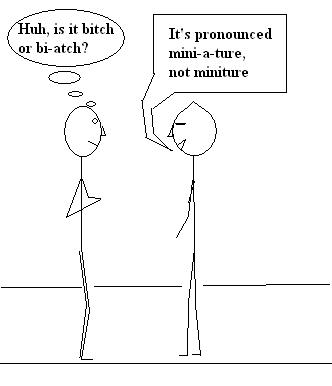
Pronunciation is tricky.
If you’ve ever had someone tell you that any water can be put in a pot (for pronouncing drinking water pot-table rather that po-table), then you may be with me here. If you frequently exercise your perogative, rather than your prerogative, you may agree. Have you had sherbert, or only sherbet? Do both your eggs and oxen have yokes?
If you’re not with me, you –my friend– might be the person on the right in my little stick cartoon.
I’m as anal about language as the next writer, but let’s try to dial down the pretentiousness. The big question I have for pronunciation police is this: What in your experience with the English language has led you to believe it is a phonetic language?
For those who think English is phonetic because they learned it via “Phonics,” let me expose you to a poem that says it more eloquently than I ever could. (I would attribute the poem, but it is to my knowledge owed to that most prolific “Anonymous” chap.)
Hints on Pronunciation for Foreigners
I take it you already know
of tough and bough and cough and dough.
Others may stumble, but not you,
On hiccough, thorough, laugh and through.
Well done! And now you wish, perhaps,
To learn of less familiar traps.
Beware of heard, a dreadful word
That looks like beard and sounds like bird.
And dead-it’s said like bed, not bead.
For goodness sake, don’t call it deed!
Watch out for meat and great and threat.
They rhyme with suite and straight and debt.
A moth is not a moth in mother,
Nor both in bother, broth in brother,
And here is not a match for there,
Nor dear and fear for pear and bear.
And then there’s dose and rose and lose
Just look them up–and goose and choose.
And cork and work and card and ward.
And font and front and word and sword.
And do and go, then thwart and cart.
Come, come I’ve hardly made a start.
A dreadful language? Man alive,
I’d mastered it when I was five!
If you still don’t believe that the language can handle multiple pronunciations, check out what the experts say.







 Tiger Riding for Beginners