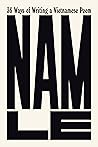
BOOKS: “36 Ways of Writing a Vietnamese Poem” by Nam Le

36 Ways of Writing a Vietnamese Poem36 Ways of Writing a Vietnamese Poem by Nam Le
My rating: 4 of 5 stars

Amazon.in Page

Release Date: March 5, 2024

This is a clever collection of poems, lighthearted in places but raw and incensed in others. (A pacing that I appreciate in poetry collections.) The collection draws heavily on the author’s experience being of Vietnamese ethnicity while growing up in the West. It touches upon the tragedies lived by his elders, but, more so, how his life (and perception of him) has been shaped by war and the diaspora it caused. The collection playfully engages with language and cultural concepts in a way that is interesting and – at times – scintillating.

My main gripe with this collection would be its occasional swerves into the domain of huge, rare, and super-specialized terminology. I enjoy being sent to the dictionary as much as the next person, but in a poetry collection – where evoking emotion is the name of the game – I find it takes me out of the experience.

I enjoyed reading this collection and would recommend it for poetry readers.

View all my reviews

BOOKS: In Praise of Shadows by Jun’ichirō Tanizaki

In Praise of ShadowsIn Praise of Shadows by Jun’ichirō Tanizaki
My rating: 5 of 5 stars

Amazon.in Page

Tanizaki’s essay on Japanese aesthetics doesn’t just show the reader the simple, rustic, and weathered traits of Japanese beauty, it fully submerges them in an otherworldly place ruled by different principles of seeing. So enamored with this pre-modern Japanese aesthetic was Tanizaki that we are convinced he would give up all present-day conveniences to see the world this way (but, alas, he recognizes the impossibility of maintaining a household or business in today’s world that way.)

While the book is principally a tour of this Japanese shadow world, moving from architecture to toilets to lacquerware to Noh plays to skin tones to hotels (with other stops along the way,) it is also a critique of modernity, and particularly a modernity shaped by the West by virtue of Western countries building a lead in a number of key technologies. The most crucial of these technologies, and the one Tanizaki most decries, is electric lighting, which does away with the artistic beauty that derives from the interplay of varied toned shadows (and occasionally a little bit of light.) [I should say, he’s not bashing the Western technology or ways, but rather how poorly they work with maintaining Japanese aesthetic ways.]

I’d highly recommend this book for all readers. If you’re interested in aesthetics, art, architecture, culture, or “things Japanese,” then all the more so, but I can’t remember the last time description pulled me into a book as hard as this one. The essay can be a bit rambling and shifts from euphoria to rant and back, rapidly, but that is part of its magic.

View all my reviews

Rivers of the Dead [Free Verse]

So many cultures
make their dead
cross a river.

The Greeks' Styx.
The Hindus' Vaitarna.
The Norse Gjȍll.
The Gnostic's Hiṭpon.
The Japanese Sanzu-no-Kawa.
The Mesopotamians' Hubur.
Taoists cross Naihe Bridge --
over what (I'm not sure,
but) is probably a river.

No rest for the dead?
It seems kind of rude.

BOOK REVIEW: Identity: A Very Short Introduction by Florian Coulmas

Identity: A Very Short IntroductionIdentity: A Very Short Introduction by Florian Coulmas
My rating: 5 of 5 stars

Amazon.in Page

This book explores the slippery metaphysical concept of identity — not only as it’s presented in philosophy, but also in psychology, law, politics, anthropology, and literature. It begins with individual identity and expands outward to encompass gender, political, socio-economic, and linguistic identities. The aforementioned slipperiness of identity stems from the fact that we all have an intuitive grasp of identity that could be leading us astray. It tends to make us believe that aspects of identity are inherent features of the universe, when – in fact – they may be arbitrary designations – in which case, a given criterion or classification of identity may be chopped up in different ways than a given culture happened to glom onto.

I learned a great deal from this Introduction, and feel it was well organized and presented. How we see various dimensions of group identity (as well as how we weight them) has a lot to do with our social tensions and strife, and the issues around identity are worth dissecting — despite the fact that it might seem like a dry academic topic at first blush.

If you’re interested in learning more about identity, selfhood, and how various group identities feature in an individual’s overall identity, this book is worth investigating.


View all my reviews

BOOK REVIEW: Social and Cultural Anthropology [VSI] by John Monaghan & Peter Just

Social and Cultural Anthropology: A Very Short IntroductionSocial and Cultural Anthropology: A Very Short Introduction by John Monaghan
My rating: 5 of 5 stars

Amazon.in Page

Get Speechify to make any book an audiobook

This was one of the most interesting “Very Short Introduction” books — of the many titles in the series that I’ve read. The authors use stories and examples to convey the basics of the subject in way that’s not mind-numbingly dry (i.e. the scholarly norm) – in fact, there’s a fair amount of humor laced throughout the book.

Most of the examples come from the two tribes that these two authors study – i.e. one in Mexico and the other in Indonesia. However, those two groups provide a rich arena of interesting anecdotes, and the authors do use social groups outside their research focus when necessary.

In addition to learning about the nature of ethnographic fieldwork and what anthropologists do, there’s an exploration of culture, the various ways in which people are socially organized (i.e. kinship, castes, societies, etc.,) and how different societies view religious belief, economic activity, and selfhood.

If you’re starting from zero and are seeking an introduction to anthropology, I’d highly recommend this one.

View all my reviews

BOOK REVIEW: Introducing Cultural Studies: A Graphic Guide by Ziauddin Sardar

Introducing Cultural Studies: A Graphic GuideIntroducing Cultural Studies: A Graphic Guide by Ziauddin Sardar
My rating: 4 of 5 stars

Amazon.in Page

Get Speechify to make any book an audiobook

Culture is a deep and fascinating topic, but a dirty little secret of academia is that there are two words used to signal subjects and courses for the not-so-bright kids: one is “Studies” and the other is “for.” (As in “Math FOR Economists,” a course that I once took that was – I’m sure of it – greatly dumbed down from what Math majors learned. “Economics FOR Business Majors” is a more widely known example; it’s Economics for people who are afraid of equations and who can’t figure out which way is up on a supply and demand curve.) So, I wasn’t sure what to expect from a guide to “Cultural Studies,” as opposed to a book about, say, Cultural Anthropology, which I believe is the big-boy pants version of the discipline under discussion.

The author is forthright that cultural studies is a bit amorphous and that it struggles to find its place amid the established disciplines that touch upon culture from varying perspectives (i.e. psychology, philosophy, anthropology, etc.) The book begins before there was a “Cultural Studies,” per se, discussing competing definitions of culture and related precursor disciplines, e.g. semiotics. It then describes the evolution of the subject and its varied points of focus and ideas across its major epicenters: Europe, North America, Australia, and South Asia. It investigates colonization and its influence on indigenous cultures, and it looks at how a range of concepts intersect with culture, including: science, technology, race, gender, sexuality, and media. It concludes by reflecting on globalization and the discontents who wish to end or replace this homogenizing force.

I did learn quite a few new things from this book, and if you’re looking to understand culture as a landscape of academic study, it’s worth having a look at it.


View all my reviews

BOOK REVIEW: Why I’m Not a Hindu by Kancha Ilaiah Shepherd

Why I Am Not a Hindu: A Sudra Critique of Hindutva Philosophy, Culture and Political EconomyWhy I Am Not a Hindu: A Sudra Critique of Hindutva Philosophy, Culture and Political Economy by Kancha Ilaiah Shepherd
My rating: 4 of 5 stars

Amazon.in Page

As a foreigner living in India for almost a decade, I’m always looking for books that offer insight into cultural and political realities that remain obscure even after many years in country. I stumbled upon this book and the diametrically titled book, “Why I Am a Hindu” by Shashi Tharoor. I figured the two books might cover the pro / con accounting of Hinduism through two personal accounts of how a couple of thoughtful individual’s perceptions of the religion differ.


Having read this book, chronologically the first, I discovered that the two books might not mirror each other as well as I’d thought. For one thing, this book is really more about: a.) why dalitbahujans shouldn’t be considered Hindu, and b.) why following the dalit cultural framework would be better for India than following Hinduism. That’s not to say that the book doesn’t count off many theological points that rub the author the wrong way, socio-politically speaking. It also displays no shortage of anger (which one could certainly be argued is righteous, but nonetheless detracts from the feeling of scholarly objectivity that one might hope for in such a book.) But, at the end of the day, this is a book about caste, and how the system is used by the few to oppress the many. [It also turns out that both books cast themselves in opposition to the Hindu nationalist movement.]


In short, the author argues that the “high castes” of Hinduism (i.e. Brahmins and Kshatriyas) are parasitic, misogynistic, violent, oppressive, corpulent, and demanding of “spiritual fascism.” On the other hand, the Dalitbahujans are painted as productive, egalitarian, democratic, creative, less materialistic, and capable of creating a sustainable path toward a healthy India of the future. I don’t know whether I came away with a much better insight into the truth of the situation, but as a social scientist I learned that what is true is often not so important as what is believed to be true – the latter can have huge impacts regardless of its objective truth. I say this because the author does make a lot of gratuitous assertions – unsupported statements — and these are particularly difficult to process when they address the motives of high caste people. He also sometimes whitewashes the “sins” of other religions to make the argument that Hindus are the worst / most unreasonable of all religions.


While it’s certainly true that the caste system has been oppressive and that the oppressed are within reason to be angry and to insist upon change, it’s hard for me to get a good read on what is true regarding the details because the author takes a preaching-to-the-choir route and doesn’t really provide the evidence an outsider would need to judge. That said, the book still offers a great deal of value because it tells one what the author (and presumably many others) feel to be the truth of the situation.


I found this book insightful and thought-provoking. There may be better books out there in terms of supporting arguments, but it’s a solid counter to the throngs of books by the Hindu intellectual elite. [FYI – The book will drive typo-haters insane, it’s loaded with missing letter typos, etc.]

View all my reviews

Around the World in 6 Myths

6.) Thor & Loki in the Land of Giants (Norse): There’s no shame in putting a mere dent in the impossible.


5.) Rama & Sita (Hindu / from the Ramayana): Careful with your assumptions. You may end up looking like a jerk even if you’ve proven yourself generally virtuous.


4.) Anansi the Trickster (Ghanan / Akan): Don’t do favors for tricksters.


3.) Arachne the Weaver (Greek): Don’t be arrogant, even if you’re the best.


2.) Izanagi & Izanami (Japanese [creation myth]): Hell hath no fury…


1.) White Buffalo Calf Woman (Native American / Lakotan): Don’t let your lust get away from you and be careful in your assumptions.

BOOK REVIEW: The Geography of Bliss by Eric Weiner

The Geography of Bliss: One Grump's Search for the Happiest Places in the WorldThe Geography of Bliss: One Grump’s Search for the Happiest Places in the World by Eric Weiner
My rating: 5 of 5 stars

Amazon page


This book combines travel writing with pop science discussion of what makes people happy (or unhappy.) Weiner travels to ten countries in pursuit of happiness, and reflects upon the cultural components of bliss.

Some of the countries, like Switzerland and Iceland, rank among the world’s happiest in international surveys. Some of the countries, such as Qatar and America, have every reason to be happy, but aren’t necessarily as blissful as the rest of the world would expect. Some of them, like India and Thailand, have good reason to be unhappy, and yet they manage to be global exemplars of happiness [at least within certain domains.]

Then there are a few nations that have unique relationships to happiness. Bhutan has a national policy on happiness [plus it’s a Buddhist country, and Buddhism probably offers the most skillful explanation of what it takes to be happy of any world religion.] Moldova provides a counterweight as it’s one of the least happy countries in the world. Weiner visits the Netherlands in part because one of the biggest academic centers studying happiness is located in Rotterdam, but it also offers an opportunity to study whether the country’s unbridled hedonism (drugs and prostitution are legal) correlates to happiness. That leaves Great Britain, a country known for wearing the same happy face as its sad, terrified, and enraged faces.

I’ve been to half of the countries on Weiner’s itinerary, and—of the others—I’ve been to countries that share some—though not all—of the cultural constituents of happiness. (e.g. I haven’t been to Qatar, but I’ve been to the UAE. I haven’t been to Moldova, but I’ve seen somewhat less grim Eastern European states. I haven’t been to Switzerland or Iceland but I’ve been to cold countries in Western Europe. I haven’t been to Bhutan, but I’ve been in areas where Tibetan Buddhism was the dominant cultural feature.) This allowed me to compare my experiences with the author’s, as well as to learn about some of the cultural proclivities that I didn’t understand during my travels. And I did find a lot of common ground with the author, as well as learned a lot.

I found this book to be interesting, readable, and funny. Weiner has a wacky sense of humor that contributes to the light-hearted tone of the book—perfect for the subject. That said, some people may be offended because the author doesn’t pull punches in the effort to build a punchline, and this sometimes comes off as mocking cultures. However, in all cases—even that of Moldova—Weiner does try to show the silver lining within each culture.

The paperback edition I read had no graphics or ancillary matter. There are no citations or referred works (except in text), and the chapters are presented as journalistic essays. The chapters largely stand alone, and so one could read just particular countries of interest. He does refer back to events that happened in earlier chapter or research that related to another country’s cultural proclivities, but not often. The first chapter, on the Netherlands, would be a good one to read first because he describes many of the scientific findings on happiness in that one.

I would recommend this book for anyone interested in what makes some places happier (or sadder) than others.

View all my reviews

DAILY PHOTO: Fire Handler

Taken in May of 2015 in Kandy

Taken in May of 2015 in Kandy

IMG_0474