


Nah. I’d say I’m normal-stitious, possibly even substitious.
PROMPT: Superstitious
Reply

Nah. I’d say I’m normal-stitious, possibly even substitious.

I turned to speak to God
 About the world’s despair;
 But to make bad matters worse
 I found God wasn’t there.

God turned to speak to me
 (Don’t anybody laugh)
 God found I wasn’t there—
 At least not over half.
No. I’ve trained myself to recognize factors, such as selection bias, that contribute to superstitions. And I try to hold all beliefs only so tightly as they can be shaken away by better understanding, particularly beliefs that aren’t strongly supported by experience and reason.

I never saw a moor;
 I never saw the sea,
 Yet know I how the heather looks
  And what a billow be.

I never spoke with God,
 Nor visited in heaven.
 Yet certain am I of the spot
 As if the checks were given.
 Knowledge: A Very Short Introduction by Jennifer Nagel
 Miracles: A Very Short Introduction by Yujin Nagasawa
Occasionally, I’m asked whether I BELIEVE some idea or BELIEVE in X [i.e. fill in the person, place, thing, or concept.]
If I were to answer these questions honestly, that answer would almost invariably be, “No.”
But, because that can seem overly contrarian — not to mention insane — I often try to guess the sense in which the questioner is using the words “BELIEVE” and “BELIEF,” and then answer accordingly.
Like many words, BELIEVE is one whose meaning meanders, and shadows fall across it in different ways, creating different hues [and impressions thereof,] depending upon one’s vantage point.
Often, people seem to use the phrase, “I BELIEVE X ” synonymously with “I understand X to be true.” “I BELIEVE it” can mean: I behave as though X is true, [but am not necessarily commenting on the degree to which X is supported by evidence or reason.] I, on the other hand, try to use BELIEVE in the sense of: “I accept the truth of X and behave accordingly, but I don’t really have any solid basis on which to rest this conclusion.” I like to draw as few such conclusions as possible, though sometimes it’s hard not to. For example, like most people, I live my life as if we are living in base reality — as opposed to being in some “Matrix”-like computer simulated world, but — if pressed — I’d have to admit that I can’t really support this belief convincingly.
If I were to be asked whether I BELIEVE there is a force that inexorably pulls me toward the Earth’s center, using my own interpretation of the word “BELIEVE,” I would reply in the negative. Before you ask how I can be so anti-gravity [pun not intended, but acknowledged,] let me say that I firmly understand there to be such a force as gravity. This is not to say that I fully understand the mechanism by which gravity works — which I certainly do not — but rather to say that I recognize the truth of such a force’s existence. I can experience gravity in my pathetic vertical leap, and even note it in the very impressive vertical leap of skilled athletes. I see it in the red leaf, twirling as it falls to the ground. I feel it upon takeoff as an airplane’s seat raises against my butt. Furthermore, I recognize that there are many scientists who’ve come to understand a great deal more about gravity than I, but also that none of what they’ve learned through their vast number of controlled observations contradicts my basic idea that I’m being pulled toward the planet (and it toward me.)
At the Jaipur Jantar Mantar, I was once asked whether I BELIEVED in astronomy and astrology? The questioner clearly thought this was a closed-ended, yes or no, question — as if the two fields dealt in identical content. Of course, from my perspective, it was a question similar to: “Do you BELIEVE in Zebras and Magical Unicorns?” — which is to say, not at all a straightforward and closed-ended yes or no question. [Incidentally, the reason I used the modifier “magical” is because I do “believe” in unicorns. I just call them “Indian Rhinoceroses” [Latin name: Rhinoceros Unicornis.]]
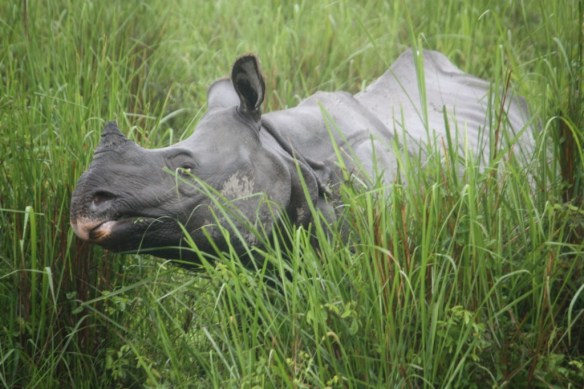
A Unicorn — i.e. the Indian Rhinoceros, or Rhinoceros Unicornis
The long and short of the matter is this: I strive to BELIEVE as little as I can, and to hold even those BELIEFs only so tightly that they might fall away in the face of learning. Otherwise, what’s learning for [or is it even possible?]
tree on one corner
on the other a shrine
they hedged their bets
stood astride the line
they sealed their letters to the holy ghost
and slipped them in the midnight post
afraid of what their friends would say
if they mailed them in the light of day
each one believed in the abstract
a realm free of the force of fact
but when that ghost began to ride
they laced their cakes with cyanide
better to be crazy amid false gods
than run the table and play the odds

I passed a man on the street,
in the brutal noonday heat.
Blending in, but for his Tee.
It read, “Nothing is as it seems.”
I said, “Ain’t that the truth, brother.”
He walked on, like all the others.
A message sent on the sly?
From some watcher in the sky?
How’d he know it’d draw my eye?
And not be taken for a lie?
Maybe my will is not so free,
and what I “know” isn’t reality.
[Later that day…]
Rev. screamed, “We’re living in a simulation!”
“Friends, this ain’t no pre-apocalyptic nation.”
“Aliens watch us on their reality-TV station.”
“All I can offer is a bargain spaceship vacation.”
I distrust those who shout from a box,
and distrust more the joining of flocks.
But the kook’s words rattled in my mind.
Maybe lunatics get things right sometime.
What if the world is just a simulated grind,
and passersby just figments of my mind?
If this world is fake, should I abstain?
Or try much harder to entertain?


 Tiger Riding for Beginners