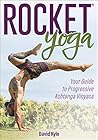
 Rocket® Yoga: Your Guide to Progressive Ashtanga Vinyasa
 by
David Kyle
My rating:
5 of 5 stars
Publisher Site – Human Kinetics
This book provides an overview of Rocket Yoga, which is newcomer to yoga’s ranks that adapts from the Ashtanga Vinyasa school of Pattabhi Jois. The objective of Rocket is to make the practice more adaptable, both in terms of being suitable for a broad range of students and for individual students to adapt the practice in ways that would fit their objectives, strengths, and limitations. There are also adjustments made in the sequence to streamline the flow.
For those unfamiliar with Ashtanga Vinyasa, it is a fixed form flow style. Fixed form means that at a given level one is repeating the same sequence the same way every session until one bumps up to the next level. This offers great advantages for building fitness, muscle memory, and connection to the practice, but many find it tedious and the threat of burnout is ever-present. Rocket attempts to keep the benefits of fixed form practice but to mitigate the burnout factor by having three sequences that can be interspersed in one’s practice, as well as by allowing more room for individual variation. Ashtanga Vinyasa is also often perceived as daunting because as a flow form it involves a lot of vigorous transitional movement and also because even some of the preliminary series asana (postures) are challenging for your average practitioner. While Ashtanga Vinyasa generally allows for modification, Rocket leans into this a bit more. (That said, the Rocket system also has ways to step up the challenge as well.)
As with many system-centric yoga books, much of the book is description of the asana (postures) that make up the system as well as elaboration on how they are sequenced. However, the book does open with philosophical and historical background and ends with discussion of how the practice might be adapted (e.g. there is a section for pregnancy.)
The book has a lot of color photographs that are clear and well captured (if of limited perspective.)
If you are an Ashtanga Vinyasa practitioner (or perspective practitioner) and are curious about how the basic concept might be adjusted to mitigate potential burnout or make the system more flexible, I’d recommend giving this book a look.
View all my reviews
Share on Facebook, Twitter, Email, etc.










 Tiger Riding for Beginners