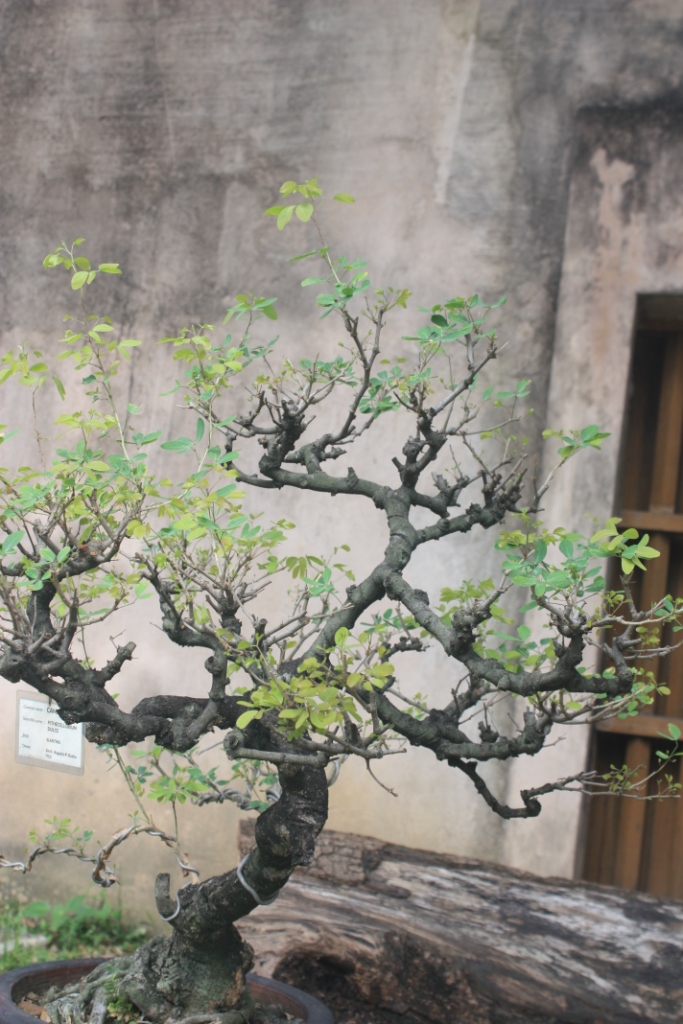
Bonsai [Haiku]

a potted bonsai --
twisted, knobbed, and deformed --
stony mountain mind

BOOK REVIEW: Bankei Zen by Peter Haskel [trans.] & Yoshito Hakeda [ed.]

Bankei Zen: Translations from the Record of BankeiBankei Zen: Translations from the Record of Bankei by Yoshito Hakeda
My rating: 5 of 5 stars

Amazon.in Page

This collection of sermons, notes, poems, and letters from the Zen monk Bankei present his iconoclastic views on Buddhism. Bankei’s central teaching revolves around a state of mind that calls Unborn Buddha Mind. The Unborn Buddha Mind isn’t defined neatly (perhaps it can’t be,) though Bankei does refer to the capacity to perceive without consciously directing one’s attention – that is, to achieve spontaneous perception of a sensory input without the error that one might experience in thought, when one’s mind is analyzing and judging.

Bankei presented a distinctive countercultural view, both religiously and culturally. In terms of the teachings and philosophy of Zen, this is most clearly seen in his rejection of many of Zen’s primary methods – e.g. koan (Zen “riddles”) and mondo (a conversational Q&A technique.) Even those techniques Bankei doesn’t reject (e.g. Zazen, seated meditation,) he does deemphasize in contrast to a more workaday focus. Culturally, one can see the difference of Bankei’s approach in his rejection of consensus views of the time, such as that women can’t achieve enlightenment.

The book uses stories, straightforward statements, and poetry to convey a unique approach to practice. The book can be a bit dry and repetitive. (Different media – e.g. sermons and letters – discussing the same teachings will lead to repetition.) That said, if you’re interested in Zen and mindfulness, there is much to be learned via this book. There are even a few teachings directed towards martial artists, and how they can apply the lessons of Zen.


View all my reviews

BOOK REVIEW: Zen Art for Meditation by Stewart W. Holmes and Chimyo Horioka

Zen Art for MeditationZen Art for Meditation by Stewart W. Holmes
My rating: 5 of 5 stars

Amazon.in Page

This is a clear and insightful exploration of what puts the Zen in Zen art. Zen Buddhism has long been associated with mind states conducive to peak performance in everything from tea making to swordsmanship. This book examines how Zen philosophy and mindset shows up in paintings and haiku poetry.

Fifteen tenets of Zen are presented, and for each of them two paintings (i.e. sumi-e) and several poems (i.e. haiku or tanka) are shown that have subject matter exemplifying the precept in question. The text points the way to understanding how the art is informed by Zen ideas.

I’ve read other books on the nexus between Zen and art, but this one became my favorite. It is concise, well-organized, and illuminating. There are a number of classes of people for whom I’d highly recommend this book. If you are studying Zen meditation (or peak mental performance more generally,) this book is for you. If you are a poet interested in Japanese forms, this book is for you. If you are an artist or a student of Chinese and Japanese painting styles, this book is for you. And, if you are interested in philosophy, be it Buddhist philosophy or aesthetics, this book is for you.


View all my reviews

BOOK REVIEW: Zen in the Art of Writing by Ray Bradbury

Zen in the Art of WritingZen in the Art of Writing by Ray Bradbury
My rating: 5 of 5 stars

Amazon.in Page

I rarely re-read books, but I’m glad that I revisited this one. I think I read it more smartly on the second go — more in a way that benefited from Bradbury’s style and message. The book’s nine essays, capped by a small collection of poems, convey lessons on writing, and – specifically – creativity in writing. Bradbury was among my favorite authors because he combined brilliant language with clever stories – i.e. he was creative on both levels. That’s a rarity. There are many excellent storytellers whose language lacks poetry or finesse. And, there are writers who are eloquent and evocative with language, but who either care little for, or have limited gift for, story.

While Bradbury claimed no expertise in Zen and doesn’t hide that he cribbed his title from a popular work by Eugen Herrigel entitled, “Zen in the Art of Archery,” it remains an appropriate title for the book and its eponymous final essay. Throughout the book, one can feel the Zen in Bradbury’s writing. He lets his words and analogies flow without becoming obsessively analytical about them – or at least appearing not to have been. Bradbury uses a lot of short, punchy sentences and a great many poetic applications of figurative language. He practices what he preaches as he both gives lessons and simultaneous demonstrations on how to write. His advice ranges from using single word writing prompts to shake one out of writer’s block, to the very Zen idea of avoiding thought – i.e. letting the words come from the subconscious. Lest one think that there is a conflict in a book on creativity that draws from another book’s title, there’s a recognition that creative writing is never wholly novel.

This book is well worth reading, not just for writers but for other artists and creative types as well. I highly recommend it.


View all my reviews

Tea Master [Free Verse]

drink the wisdom --
you'll find it more in the heat
than in the liquid

subtle - 
like the flavor of tea

in drinking it 
you'll discover:

there is no tea,
but the tea --
a tea-less tea

the life in you
the life in me
melted into a mound
of unity

BOOK REVIEW: Zen Buddhism and Its Relation to Art by Arthur Waley

Zen Buddhism and Its Relation to ArtZen Buddhism and Its Relation to Art by Arthur Waley
My rating: 4 of 5 stars

Amazon.in Page

Project Gutenberg (FREE)

This essay reviews the history and key personalities of Zen Buddhism, and then has a quite brief discussion of Zen influenced art. The thin book at its most interesting when it discusses Zen Buddhist teachings by way of the life events and sayings of its historical figures (e.g. Bodhidharma.) It does have some nice straightforward explanations of concepts.

What’s not to like? First, it’s just an essay, so if you’re expecting a full book, you might be displeased. Second, the opening discussion about the sectarian divides of Buddhism is very biased in favor of Mahayana Buddhism and against Theravada. (Of course, if one is reading about a Mahayana sect, e.g. Zen, one probably expects as much.) Finally, the title might lead one to think the book will help one understand the Zen mind’s influence on creativity, but it’s not a great source for that.

If you know what to expect, this little piece has something fine to offer. Waley was a prolific translator and a renowned expert on things Asian (particularly poetry,) and he has an insightful way of communicating difficult concepts.


View all my reviews

BOOK REVIEW: Zen Buddhism by Christmas Humphreys

Zen BuddhismZen Buddhism by Christmas Humphreys
My rating: 5 of 5 stars

Amazon.in Page

This overview of Zen Buddhism isn’t so much an instructional guide as a reflection upon Zen as a life philosophy and an artistic influence. While it does have a chapter on technique, it’s mostly a mile-high overview of koan (paradoxes and riddles) and mondo (a Q & A-based practice,) and doesn’t enter into the fundamentals of meditation. If you’re looking for an introduction to Zen practice, this probably isn’t your book. Even the book’s conclusion, which is meant to address pragmatic matters, does so in an abstract and philosophical way. But this isn’t meant to denigrate the book. There are plenty of books that fill that role, and this book has a couple of specialties that set it apart and make it well worth reading.

There are three areas into which this book delves that are sparsely covered in other books. First, there’s a chapter devoted to Zen in English Literature, and throughout the book there’s much discussion of how Zen influences art, more broadly. The Zen in English Literature chapter draws heavily on a work by R.H. Blyth that is hard to find these days. Second, there’s an attempt to relate how ideas of Zen Buddhism can be conveyed to a Western mind. Third, while it’s acknowledged as being futile, the author discusses Satori in great depth.

I found a great deal of food-for-thought in this book. The author draws from many and varied sources to convey his message. Though that can also be a bit problematic. For example, Humphreys sometimes launches into ideas that come from yogic or other Eastern philosophies without a great deal of elaboration. There’s a certain pretentiousness that’s not unexpected from a mid-twentieth century British writer, but the book is by no means a dense read.

If you’re looking for a philosophical look at Zen, or one which discusses Zen as an artistic influence, check out this book.

View all my reviews

BOOK REVIEW: Cold Mountain: One Hundred Poems by the T’ang Poet Han-Shan

Cold Mountain: One Hundred Poems by the t'Ang Poet Han-ShanCold Mountain: One Hundred Poems by the t’Ang Poet Han-Shan by Hanshan
My rating: 5 of 5 stars

Amazon.in page


This brief collection gathers one hundred poems from the T’ang Dynasty poet Han-Shan. Most of the poems included consist of a single eight-line stanza of unrhymed verse of varied meter. [With a few exceptions that had more or fewer lines (often four or twelve.)] I do like that they didn’t pad out edition that I read with a lot of inane babble [as publishers are want to do when a volume is on the thin side.] Part of the reason that they may not have done so is that there is virtually nothing known about the author. It’s not even known whether there was a Han-Shan (i.e. as opposed to a group of people whose poems were anthologized under one name.)

The poems reflect Taoism’s disdain for pretension, authority, or scholarship for scholarship’s sake. Many of the poems reflect Zen sensibilities (which became entwined with Taoist sensibilities.) That is to say, like Zen koan, they seek to interrupt the tendency to overintellectualize matters. That said, in places the poems take a bit of a mocking attitude toward Buddhism. Nature plays prominently among the poems. And some of the poems are humorous or irreverent.

There are footnotes that are helpful in explaining verse that references teachings and events that would have been known to Han-Shan’s readership back in his day, but which most individuals who aren’t experts on Chinese folklore, literature, or religious teachings wouldn’t be likely to get, otherwise.

I enjoyed these poems tremendously. While I can’t say how they related to the original text, the translations were — on their own – works that conveyed wit and wisdom. I’d highly recommend this collection for poetry readers.

View all my reviews

POEM: The Zen of the High Mountain Pass

Each step through the scree field must be judged on: angle, stability, slipperiness — but the flat, dry, and robust rock is the one that will roll on you — heaving you headlong, rolling over brick and boulder.

Crossing the glacier, each step is taken both like it won’t fail and like it inevitably will.

The former because one can’t fear one’s hips will slip out from under one, but the latter because one needs to be ready to stab an axe into the snowpack without the other end puncturing one’s ribs. 

When you reach the altitude at which stepping is a series of singular activities — not a seamless sequence — you will love breathing like you haven’t since that time you were dangling upside-down outside the womb being smacked on the bottom by a masked man.

POEM: Rambling on a Koan

“What is your original face?”

Original? Does that mean I have one now?

Perhaps when I mirror gaze.

Otherwise, if I have a face, it resides in the minds of those who look upon it.

He who takes a scaffold built of patches of matter, varying distances from his eye

and reflecting various spectra of light, and fleshes it out in subjectivity owns the face.

That mean thing,

thing of glee,

that by which cantankerousness is displayed

thing of sorrow,

thing of madness,

that ugly-pretty, disheveled topography of flesh

is a faceless face,

or — perhaps — a thoughtless thought.