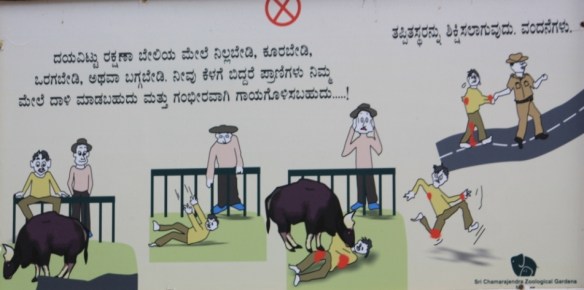
Taken at the Mysore Zoo in October of 2013
Sri Chamarajendra Zoological Gardens (i.e. the Mysore Zoo) wins the award for the most clever (and most gruesome) signage at a zoo.



Taken at the Mysore Zoo in October of 2013
Sri Chamarajendra Zoological Gardens (i.e. the Mysore Zoo) wins the award for the most clever (and most gruesome) signage at a zoo.

Said Socrates, “Oh, those poor bastards, for they think they know.
“I may be an ignorant slut, but I know I know not.”
[I paraphrase.]
My point, if I have one, is that “know” is an overused word.
Stinking up the discourse, like a bloated, floating pig turd.
[Remember Jim Carey, in the movie “Liar, Liar”]
“I object, Your Honor”… “Because, it’s devastating to my case.”
It’s a refrain seldom stated, but oft implied.
It works quite well, if you only talk to one side.
Fault us not for we’re wired to be certain.
If the cave wall shadow might be a tiger,
you don’t wait to see whether it’s a mouse.
That said, we’ve evolved these huge honking brains.
Our prefrontal cortexes might withstand the strain–
of asking:
How do I know this?
What if I’m wrong?
Might my mind deceive?
Facts: cherry-picked or strong?

Source: Wikipedia (Public Domain)
It was a fire-breathing preacher,
a hard-core and ceaseless teacher,
of lessons they said they wanted none.
Yet, it belched them out by the ton.
Spitting fire and dreadful lies
from the freedom of the skies.
And all about, its fires burned.
And people wailed like lovers spurned.
And then one day there came sage.
He found some sad, some in a rage.
“What troubles you folk,” he inquires.
“From far above, it slings these fires!
Can you save us, you wise old man,
from life in this blasted frying pan?”
“Every fire requires a fuel,
And every lie, a willing fool.
Do you feed the beast, or in its fires bask?”
“Neither, of course, and how dare you ask!”
“I can douse the flames, but they’ll flare right back,
if you fuel them with your petty, piddling yak.”
“Just do it, old man, before we all burn!”
“OK, I’ll give you this one chance to learn.”
So, pulling a hose, off the sage marched.
“Mighty dragon, you must be terribly parched?”
“You know, breathing fire IS a thirsty job.”
At a nod, minions spun the spigot knob.
The water caught the grateful dragon in the throat.
Steam rose, ash spewed, and that’s all she wrote.
With no fire to breath, the dragon flew off,
sputtering out its last ashen cough.
The town was saved, or so it appeared.
But it was as the sage had feared.
Soon, some dabbled in volatile mixtures–
at weakest moments, becoming fixtures.
And the fools? Oh, they missed the glow
of the dragon’s garish and tawdry show.
And soon enough, conditions were right
for the dragon’s fire to again alight.

It’s 4:45 in the morning and I’ve been sitting on my cushion at the Dhamma Setu Vipassana Meditation Center in Chennai, India for a quarter-hour. It’s day one, and I’m observing my breath as it comes in and out through my nostrils—at least for seconds to minutes at a time before I have to coral my mind back from some random tangent. This breath exercise (ānāpāna-sati), I will soon learn, is a preparatory exercise used to reign in the mind enough so that actual Vipassana meditation can be introduced on the middle of the fourth day. In eleven days, I’ll be in the closing session of the course.
There are several approaches to Vipassana meditation taught throughout the balance of the course, but the gist is the same for all of them. One rotates one’s awareness throughout the body systematically observing sensations. As one does this, one works toward equanimity, a calm and quiet state of mind in which one neither covets pleasurable sensations nor shuns unpleasant sensations. The idea is to train the deepest level of the mind to not habitually lunge one toward pleasure or away from displeasure. (FYI: displeasure = pain. At least for a novice, such as myself, there is a fair amount of pain involved in sitting still for such long periods. It’s generally referred to a solidified gross sensation to differentiate it from the uniform and subtle sensations that one may feel in the parts of the body that aren’t in agony. I joke about it here, but there’s good reason to train oneself to not think in terms of pain, and the negative connotation the word evokes.)
At that course’s beginning, I knew a little about Vipassana from research, including reading the book “Equanimous Mind,” one man’s account of his experience in the course. For example, I knew that most people who quit, leave either on day two or day six. At the time, I didn’t know why, but would learn soon enough. It’s nothing about those two days, but rather the days that precede them. Day 1 seems to last forever, and it’s easy enough to discern why it might give students trouble. When one gets through day 1, an optimist says “yeah, I can do this because I’m through the first day” but a pessimist says, “I just barely made it, I can’t do this.” Day 5 is when the strong commitment (adhiţţhāna) is added, which means that one has three one hour sessions during which one is to commit to not changing one’s posture for the whole session. No opening eyes, but—more challengingly—no unfolding /refolding one’s legs. This commitment to not changing posture steps up the difficulty of the course to another level.
It should be noted that one can opt to sit in a chair. However, that introduces an entirely new challenge—drowsiness. During the long sessions, when I’d get up to walk the lymphatic fluid out of my legs, there were usually two people in a straight-spined meditative position and six to eight who looked to be sound asleep. (Drowsiness was one reason that I didn’t sit in a chair. I’m prone to get sleepy enough during meditation, especially in a complete absence of caffeine. The other reason was that I’ve not found chairs to be more comfortable for long-sits of meditation. Once your bony parts start pressing into the chair, one begins to wish one was cross-legged on a cushion. One can make the chair more comfortable by placing padding wherever it’s uncomfortable, but eventually one has a virtual La-Z-boy and the drowsiness factor becomes all the more problematic.)
With respect to these strong commitment (adhiţţhāna) sessions, I didn’t make it the full hour without moving on the fifth day–or any day until day 10, in fact. However, I don’t count this as a failure, because I did give it my all. I say that based on the endorphin-induced euphoria, simple hallucinations, and a proprioceptive form of Alice-in-Wonderland Syndrome that I experienced from toughing it out past mere discomfort. I’ll get to what that all means, but for now suffice it to say these happenings were symptomatic of sitting still through the period in which the pain came, grew, and then started to numb out.
In fact, these trippy experiences may, sadly, have been one reason why it never occurred to me to want to leave around day six. While I tried not to get caught up in them, these experiences were fascinating. I could see why day 2 presents a challenge to so many, but day 6 was a hoot, relatively speaking. The second most challenging day for me was day 8, because I’d reached a plateau but I didn’t yet feel myself in the homestretch. But by day 8, who’s going to leave? You’ve gutted it out that long, and are almost done. For those concerned about whether they can make it to the end, I can honestly say that I never seriously considered quitting. It’s not that hard to get through the 10 days, as long as one isn’t too addicted to comfort and communication. That said, I wouldn’t offer a wholesale recommendation of the course as many do, but rather recommend it on a case-by-case basis. If you’ve done no meditation whatsoever, this is the meditative equivalent of going from couch-sitting to training for an ultra-marathon overnight. If you think you can’t get through nine days of silence–without no phones or books, maybe you can’t, and you should probably reevaluate your life.
I mentioned some of the unusual experiences that I witnessed during the course, and I’ll get into that a bit more. I should preface this by saying that one shouldn’t get caught up in these trippy happenings for reasons I’ll elaborate upon below, but they may happen so it’s worth being ready for them. Here’s a list of the unusual events I experienced:
-Extreme relaxation / lethargy: a little off topic, but between sessions on day 1, I noticed that I couldn’t be bothered to shoo away a fly that kept buzzing around my head with random touch downs. I don’t know how long I walked with the fly buzzing over me before it struck me that this was unusual. This was before Vipassana proper had been introduced, so it didn’t yet seem apropos.
-Olfactory hallucination / vivid scents: on day 2 I witnessed a distinct smell from my elementary school days (i.e. a mix of cleaning solution and milk cartons?) that theoretically could have originated at the Dhamma Setu, but which was quite probably an olfactory hallucination. It was short-lived and I never smelt it again. I did later experience an intense smell of flowers inside the meditation hall. This may well have been an actual scent as there were many blooming flowers there. These vivid scents were also short-lived.
-Endorphin-Induced Euphoria: on days 4 and 5, I experienced this as an almost intoxicated feeling. [Endorphins are the body’s indigenous pain-killers.] As drunks find unfunny things funny, so did I—including the pain in my legs and back. I wondered if anyone would be distracted by my occasional giggle-fits, but I think they were much more subdued than I suspected from my vantage point. Just like I’ve thought I was talking in my sleep in the past, only to be told that it sounded more like faint and indistinct whimpering. On day 6, I experienced a more sophisticated (not drunk-like) form of euphoria that expressed itself as a feeling of “oneness.” I’ve read about feelings of oneness being attributed to a form of transient hypo-frontality—i.e. a shutting down of the parts of the prefrontal cortex (PFC) that track the self / other distinction. There may have been more happening than endorphins (and other neurotransmitters) involved in that happening.
-Lifting sensation: This was the single most awe-inspiring experience that I was party to. For those unfamiliar with seated meditation, one of one’s chief enemies in long meditation sessions is a proclivity to slump. Slumping translates into agonizing back pain and labored breathing. So whenever one catches oneself slumping, one has to straighten one’s back. [If you wonder why a meditator would pretzel up his or her legs in full lotus (padmasana), the alignment of one’s legs helps one maintain a straight spine.] At any rate, on day 6 I experienced the feeling that I was being lifted up straight and it became effortless to maintain a straight back for the rest of that session—as if an outside force were doing the work. This lifting sensation wasn’t like being lifted by a person, but rather like the action of a “tractor beam” from the world of sci-fi. While I have some inkling of the causes of much of what I experienced based on the science of the human body, explanation of this “lift” is harder to come by. I did read an account in Oliver Sacks’ “Hallucinations” by a woman who suffered from migraine-induced hallucinations and Alice-in-Wonderland Syndrome that was a spot-on description of what I experienced as well.
-“Visual” [closed-eye] simple hallucinations: I didn’t experience anything even close to the what people usually think of as a hallucination—that is, there was nothing that could be confused with reality. I wouldn’t have even known to call these images hallucinations if I hadn’t been reading the aforementioned Oliver Sacks’ book. Mine were quite close to what are described as hypnogogic (falling asleep) hallucinations in the Sacks’ book. This makes sense. While I wasn’t drowsy at the time, my brain was probably in a pretty similar state of relaxation. Mostly, these were moving shapes that formed and dissipated in a field of black-fringed purple. On day 7, there were more complete visuals—mostly of partial faces, usually with mouths wide open. I took this as my subconscious mind’s comment on the noble silence. (On the noble silence: from about 6pm on day 0 [orientation afternoon] until the morning of day 10, one isn’t allowed to talk or in any way interact with / acknowledge anyone except to direct questions to the teacher or staff. Whether one has questions or not, one will speak at least a few words to the teacher every day or two when he / she reviews one’s progress. For some, this may be the single biggest challenge of the course, but I’m a hardcore introvert and could do ten days of silence standing on my head.)
-Tactile Alice-in-Wonderland Syndrome: Alice in Wonderland Syndrome usually refers to a visual form of hallucination in which things appear a great deal taller, smaller, closer, or farther than they actually are. What I experienced was a great deal less whacky and traumatic than that. With eyes closed, I felt a distortion of the size and shape of my arms. Sometimes my arms felt like they were six-foot long from deltoid to fingertips, and sometimes the same points seemed to lie a foot and a half apart. Needless to say, those are both distortions of the actual length of my arms.
-Inexplicable Beatles’ Music: On day 8 my mind bombarded me with music from the Beatles for a little while. In particular I heard “Sgt Pepper’s Lonely Hearts Club Band”, “Lucy in the Sky with Diamonds”, and “All You Need is Love,” or parts thereof, in high fidelity. Now, while this is fine music, it’s not music that I’ve listened to recently nor have I listened to that album a great deal. When I was growing up, there was a copy of “Sgt Pepper’s…” at home, but I’ve only periodically heard these songs on the radio since. The experience was monotonous because only the parts that I knew the words to (i.e. the choruses) replayed on a loop, but the music and voices were crystal clear as if I were listening to the album. Given the lack of personal relevance, I can only imagine that my subconscious thought this is the kind of music a person meditating would like to hear.
As I said, by about day 8 I’d hit a plateau. The aforementioned odd experiences were petering out, particularly when I did as I was supposed to do and gently returned my mind to the task at hand. Yet, the practice wasn’t getting any easier or smoother. I still had the same dead spots—areas that I could observe for extended periods without even the subtlest of sensations—and I still had growing pain zones in my back and legs—i.e. starting from isolated pains, the pain would become increasingly diffuse and of ill-defined boundaries—but often no less painful.
Now I’ll explain my comment about not allowing oneself to become captivated by the trippy experiences. If one seeks after these experiences, not only is one missing out on the value of the practice, one is actually moving in the wrong direction by coveting an experience while impulsive craving is what one is training oneself away from through Vipassana meditation. Beyond this, seeking out such experiences is likely to be frustrating because they are products of the subconscious mind and physiological processes that are beyond conscious control. They happen when they happen, on your body’s schedule. (Note: Some people think of these as spiritual phenomena. I don’t, but—for those who do—they still won’t happen on your schedule. Ostensibly, they’ll happen on some deity’s—presumably rather tight–schedule. And—divine as they may be—they are still a distraction from the objective of the practice—and that’s not my opinion, but according to the teachers of the tradition, starting with Gautama Buddha and through to S.N. Goenka.)
So when one experiences such phenomena, one should do the same as one always does in meditation, quietly and non-judgementally return one’s mind to the object of awareness—in this case, systematically witnessing the sensations on one’s body. I won’t say that this isn’t a challenge. It is, because your mind is presenting you with something fascinating and new, and you’re asking it to return to a task that has become rather mundane over hours and days of practice. It should be noted, I would broadly categorize the phenomena that I experienced into two slots, one of which is things the brain does to cope with a lack of external stimulation. (The other being, things the body does to cope with unrelenting pain.) So it takes some discipline, but one should remind oneself—as one is frequently reminded during the discourses—that you are there to give the Vipassana approach a fair trial, and as fascinating as these sideshows are they are a distraction from the practice.
That said, these things will happen and their unusual nature may make them points of concern or confusion, and so I’ll discuss them a bit more. I have a theory about the cause of the euphoric experiences, but it requires a little clarification and background. What makes Vipassana challenging for a new practitioner—at least for me— is that in systematically rotating one’s awareness to observe sensations, one has to ignore areas that are screaming with pain while carefully running one’s attention through areas that seem completely devoid of sensation. This requires quieting the mind and especially not feeding the anxiety about one’s pain and discomfort—hence, developing equanimity (steadiness of mind.) Sitting still for an hour at a time, lymphatic fluid piles up in your lower extremities (no pump in the lymphatic system but the one of movement), over time blood circulation may be inhibited, and this lack of circulation has ramifications for the cells not being adequately nourished. So your body notices this fluid build-up (a relatively minor concern, easily rectifiable, and which will take a while to be a serious problem for most people) and sends you some pain sensations to spur you to get up and move about. When you don’t get up and walk, it turns up the discomfort disproportionate to what’s happening with your body. You still ignore it. Eventually, your body starts to think maybe a boulder fell on your legs and you’re in shock (the conscious and unconscious minds don’t talk as much as you might think, and—even if they do—let’s face it, at least the conscious mind is a big, fat liar.) It’s at this point that your body starts to emit some feel-good chemicals. (I refer to “endorphin-induced euphoria,” but it’s more extensive than natural painkillers. In reading up on the subject, I noted references to serotonin and even melatonin (yes, the skin color chemical) in addition to beta-endorphins. I wouldn’t be surprised if there was some dopamine—a reward / feel good chemical—in the mix as well. Hence, the euphoria.
I don’t think it’s necessary to get into the hallucinations and other effects that the mind creates in order to cope with the lack of sensory input. This is a well-studied area, and there’s been a lot written on how the mind hates the dark and the quiet over extended periods. I would recommend the aforementioned book by Oliver Sacks on hallucinations as a case in point.
Saving the most crucial question for last, was it worth it? In his discourses, S.N. Goenka offers three criteria by which one might evaluate whether Vipassana is worth practicing. While all three are sound criteria, I’ll focus on just one of these, which is really the bottom-line, and that’s whether it makes an improvement in one’s life. That is, does one start to be less prone to impulsively react to craving and aversion and become more equanimous of mind?
On this, I’ll have to say that the jury is still out. Many come out of the 10-day course calling it life-changing. I’d say that it was beneficial because I learned a meditative technique that has a sound internal logic (even if one doesn’t believe every aspect of the mechanism by which it is said to work by Buddhists—which I don’t), an established track record of benefit for many, and the feel that it’s benefiting one. However, I’m still evaluating the approach. I’ve been doing Vipassana meditation twice a day with morning and evening affirmations. Let’s face it, 10-days isn’t a long time to overhaul one’s deeply ingrained modes of operation—even sitting in meditation for 10 hours a day. I’m optimistic, and the practice sure doesn’t hurt—except for those solidified gross sensations, they hurt.

Fair use, https://en.wikipedia.org/w/index.php?curid=8970653
Einstein defined what’s nuts,
clear as day, no ifs or buts.
Doing the same, time and again
and expecting change is insane.
So when you hit a fail,
don’t hammer the bent nail.
Pull it out, start anew,
and don’t let bent nails accrue.
 The Tibetan Yogas Of Dream And Sleep by Tenzin Wangyal
My rating: 5 of 5 stars
I stumbled upon this book in a used bookstore, and didn’t know what to expect–but was intrigued. It’s a book on the Tibetan Bön approach to dream yoga and sleep yoga, written by a Bön lama (monk.) Dream yoga is a term used in Buddhism and other Eastern traditions to refer to what is called lucid dreaming in Western scientific circles. My review will focus on the more than 3/4ths of the book that deals in dream yoga (lucid dreaming.) The 40-ish pages that deal with sleep yoga are outside my wheelhouse. The author suggests that that part is for initiates who are familiar with certain background concepts. I’m not an initiate, and—in fact—I have no idea whether there is any merit to sleep yoga practice. Lucid dreaming is a well-studied and documented phenomena, but, as far as I know, what the author calls sleep yoga remains unstudied. All I can say is that the part on dream yoga is readily comprehensible, despite much of it being couched in spiritual terms, but a lot of the section on sleep yoga is arcane and ethereal.
As it happens, I was pleasantly surprised with the portion of the book about dream yoga. Having read a number of books dealing with the subject recently, I wasn’t sure whether I would learn anything that was both new and useful. But I was exposed to ideas that were new, useful, and mind-blowing. There were a few ideas for helping one to achieve lucid dreaming—mostly through practices carried out during the day—that I’d not seen in other works, at least not put in such clear terms. Also, while there is a lot of reference to the Bön and Buddhist spiritual traditions, this didn’t result in the explanations being needlessly complicated or arcane. There is a lot of information that one doesn’t need if one is a secular practitioner, but many readers will find it interesting, even if it’s not necessary to advance their practice.
The book is organized into six parts: 1.) The Nature of Dream, 2.) Kinds and Uses of Dreams, 3.) The Practice of Dream Yoga, 4.) Sleep, 5.) The Practice of Sleep Yoga, and 6.) Elaborations. The last part has information pertinent to both dream yoga and sleep yoga.
There are some graphics in the book including photos, line drawings, and tables. Most of these aren’t essential, but some make it easier to imagine what the author is describing (e.g. when he discusses sleeping positions.) The book has a glossary and bibliography. The former is useful, and the latter doesn’t hurt (but it’s only one page and offers only a handful of citations.) The glossary is mostly of foreign terms, but includes English terms specific to the religious traditions discussed. It offers both Tibetan and Sanskrit variants of the word if they exist, which is a nice feature. There is also an appendix which summarizes the crucial practices elaborated upon in the book.
I’d recommend this book for those interested in developing a lucid dreaming practice. I will say that it may not be the best first book to read on the subject, unless you are a practitioner of Bön or intend to be. (For that, I would recommend Charlie Morley’s “Lucid Dreaming: A Beginner’s Guide…” which I recently reviewed.) However, this book makes an excellent follow-up once one has read a book that is couched in simpler terms (i.e. not specific to a certain spiritual tradition) and which reports on the science. I found that the book gave me a number of new ideas, and—in fact—offered some insightful ideas.
I met a man
along the road
who thought he knew
which way to go.
Certain was he;
he knew the path.
He had a map.
He’d done the math.
“Your map won’t help
you now, I fear.
Past the map’s edge
the world turns queer.”
“I’ll find my way,
be sure of that,”
the man dismissed
with words he spat.
When I returned,
an hour ago,
I passed a car-
cass in the snow.
No doubt, twas he,
the certain man–
hit a blizzard
in burning sands.

Public domain image of Epictetus, sourced from Wikipedia
There’s a story about Epictetus infuriating a member of the Roman gentry by asking, “Are you free?”
(Background for those not into Greek and Roman philosophy. Epictetus was a Roman slave who gained his freedom to become one of the preeminent teachers of stoicism. Stoicism is a philosophy that tells us that it’s worthless to get tied up in emotional knots over what will, won’t, or has happened in life. For Stoics, there are two kinds of events. Those one can do something about and those that one can’t. If an event is of the former variety, one should put all of one’s energy into doing what one can to achieve a preferable (and virtuous) outcome. If an event is of the latter variety, it’s still a waste of energy to get caught up in emotional turbulence. Take what comes and accept the fact that you had no ability to make events happen otherwise.)
To the man insulted by Epictetus, his freedom was self-evident. He owned land. He could cast a vote. He gave orders to slaves and laborers, and not the other way around. What more could one offer as proof of one’s freedom? Of course, he missed Epictetus’s point. The question wasn’t whether the man was free from external oppressors, but whether he was free from his own fears? Was he locked into behavior because he didn’t have the courage to do otherwise?
I recently picked up a book on dream yoga by a Tibetan Lama, Tenzin Wangyal Rinpoche. Lucid dreaming has been one of my goals as of late. I wasn’t expecting to learn anything new about practices to facilitate lucid dreaming because I’ve been reading quite a bit about the science, recently. I just thought that it would be interesting to see how the Tibetan approach to lucid dreaming maps to that of modern-day psychology. Tibetan Buddhists are–after all–the acknowledged masters of dream yoga, and have a long history of it. Furthermore, I’ve been doing research about the science behind “old school” approaches to mind-body development, lately. At any rate, it turns out that there were several new preparatory practices that I picked up and have begun to experiment with, and one of them is relevant to this discussion.
This will sound a little new-agey at first, but when you think it out it makes sense. The exercise is to acknowledge the dream-like quality of one’s emotionally charged thoughts during waking life. Consider an example: You’re driving to an important meeting. You hit a couple long red lights. You begin to think about how, if you keep hitting only red lights, you’re going to be late and it’s going to look bad to your boss or client. As you think about this you begin to get anxious. But there is no more reality in the source of your fear than there is when you see a monster in your dreams. There’s a potentiality, not a reality. Both the inevitability of being late and the monster are projections of your mind, and yet tangible physiological responses are triggered (i.e. heart rate up, digestion interfered with, etc.) It should be noted the anxiety isn’t without purpose. It’s designed to kick you into planning mode, to plan for the worst-case scenario. Cumulatively, one can get caught up in a web of stress that has a negative impact on one’s health and quality of life. For most people, when they arrive on time, they forget all about their anxiety and their bodily systems will return to the status quo, until the next time (which might be almost immediately.) Some few will obsess about the “close call” and how they should have planned better, going full-tilt into a stress spiral.
Mind states have consequences, whether or not they’re based in reality. I’ve always been befuddled by something I read about Ernest Hemingway. He’d won a Nobel Prize for Literature and was universally regarded as one of the masters of American literature, but he committed suicide because he feared he’d never be able to produce works on the level that he’d written as a younger man. There seems to be more to it than that. Many others managed to comfortably rest on their laurels when writing became hard[er]–including writers with much less distinguished careers. The monster may be imaginary, but if you feed it, it still gets bigger.
As you go about your day, try to notice your day-dreams, mental wanderings, and the emotional states they suggest. You might be surprised to find how many of them have little basis in reality. They are waking dreams.

I passed a man on the street,
in the brutal noonday heat.
Blending in, but for his Tee.
It read, “Nothing is as it seems.”
I said, “Ain’t that the truth, brother.”
He walked on, like all the others.
A message sent on the sly?
From some watcher in the sky?
How’d he know it’d draw my eye?
And not be taken for a lie?
Maybe my will is not so free,
and what I “know” isn’t reality.
[Later that day…]
Rev. screamed, “We’re living in a simulation!”
“Friends, this ain’t no pre-apocalyptic nation.”
“Aliens watch us on their reality-TV station.”
“All I can offer is a bargain spaceship vacation.”
I distrust those who shout from a box,
and distrust more the joining of flocks.
But the kook’s words rattled in my mind.
Maybe lunatics get things right sometime.
What if the world is just a simulated grind,
and passersby just figments of my mind?
If this world is fake, should I abstain?
Or try much harder to entertain?

“The Sleep of Reason Produces Monsters” by Francisco Goya
I awoke exuberant that I’d achieved lucidity in my dream and that I’d apparently slain a nasty character (picture Hans Gruber on a bad day)–a task that had seemed impossible before my eureka of “I’m lucid!” Only my exuberance was short-lived when I realized that Hans was also me. Do you have the courage to talk it out with your dream world nemesis instead of reacting from fear?
I was thinking that I should do a post on yoga for International Yoga Day (June 21st), but what to write about? My answer came in the wee hours of the morning when I had a minor breakthrough in lucid dreaming–also known as, dream yoga. I know this seems like a stretch because, despite “yoga” being right there in the name, this practice is much more firmly associated with Tibetan Buddhism than Hatha Yoga. But my last couple yoga posts (which were a while back on my experience with RYT300 teacher’s training and teaching a Yoga Kid’s Camp) were fairly conventional, so I’m due one that’s out there. Furthermore, I promise to try to make clear the relevance of dream yoga to my hatha yoga practice. (If you read the aforementioned posts, you’ll see that the theme of freeing oneself by managing one’s fears and anxieties is a recurring theme across all these posts. And that is the crux of the relevance of lucid dreaming to unifying mind, body, and breath [i.e. yoga.])
What is lucid dreaming? It’s becoming aware that one is in a dream as one is dreaming. One can then exert influence over the course of the dream. Maybe half of you have had this experience at some point in your lives, and so what I’m saying will not seem far-fetched. For those who don’t actively practice lucid dreaming, it’s much more common among the young, so maybe you had such dreams as an adolescent but don’t have them anymore.
For the other half, the whole idea may seem like poppy-cock. I could easily have been such a doubter. Without following a practice, I almost never remember dreams–let alone dreaming lucidly. At best, I get disappearing fragments of dreams that are ephemeral and hazy. I’m one of those people who might claim that he virtually never dreams, except that I read the science, which suggests that each of us dreams every night that we sleep long enough to cycle through REM (rapid eye movement) mode (and commonly 4 or 5 times a night.) We just don’t recollect these dreams. [However, I have had lucid dreams on rare occasions, and so my skepticism on the subject was curbed.]
Why do I practice dream yoga? While it wasn’t part of my formal hatha yoga training, dream yoga isn’t as far removed as one might think. I have been trained in yoga nidra (yoga sleep), which is an exercise that takes place in a hypnagogic state (on the edge between waking and falling asleep.) Commonly, yoga nidra is used as a deep relaxation exercise, but it can also help one to access the subconscious (as is reflected in repeating a sankalpa [a resolution] in the yoga nidra state.) Lucid dreaming is another approach to assessing the subconscious in order to see what’s going on in there and to try to make changes as necessary. Curiosity about the subconscious mind and its–largely unseen–influence on my daily life is what drew me to dream yoga. It’s just another aspect of knowing oneself and trying to expand one’s capacities of mind and body.
How does one practice dream yoga? Hardcore practitioners set alarms to wake themselves up when they think they’ll be in REM sleep. This, as I understand it, helps them reconnect with the dream when they drift back and greatly speeds the process. As I sleep with a wife who would clobber me with a brick if I set alarms for random times in the middle of the night, I’m not among those hardcore. My practice consists of three main aspects. First, I make resolutions to remember my dreams and to dream lucidly as I’m drifting off to sleep. Second, when I’m not making said resolutions, I try to just observe the subconsciously generated imagery that pops up as a witness–rather than letting my conscious mind go into its preferred mode of planning for an uncertain future. [One can tell the difference because the subconscious images don’t make a lick of sense, and–for me–are devoid of any verbal/language element–i.e. it’s all imagery.] Finally, I keep a journal in which I record any dreams or fragments that I can recall–sometimes with drawings to supplement the text (though my artisticness is lacking, to say the least.) The first and last of these are among the most common recommendations one will hear from experts.
I should point out that there are a number of books on the subject by individuals much more qualified than I. Said books give detailed guidance into how one can begin one’s own practice. One that I recently finished reading and would recommend is Charlie Morley’s “Lucid Dreaming: A Beginner’s Guide to Becoming Conscious in Your Dreams.” At some point, I’ll post a review of that book. Also, there is “Dreaming: A Very Short Introduction” by J. Allan Hobson, which I have reviewed.
As I wrote up the entry in my dream journal, I made a resolution to stop attacking the “bad guys” in my dreams and to try to understand them. Note: I don’t recommend this approach for dealing with real world axe-wielding maniacs, but I highly recommend giving it a try in one’s dreams.
Sweet dreams.


 Tiger Riding for Beginners