As you enjoy your weekend, if at any point dread of the work-week to come arises, take a moment to reflect on the fact that at least you don’t have this guy’s job carrying stones on your head up several flight of uneven stone steps all day – everyday.
“The Sleep of Reason Produces Monsters” by Francisco Goya
I awoke exuberant that I’d achieved lucidity in my dream and that I’d apparently slain a nasty character (picture Hans Gruber on a bad day)–a task that had seemed impossible before my eureka of “I’m lucid!” Only my exuberance was short-lived when I realized that Hans was also me. Do you have the courage to talk it out with your dream world nemesis instead of reacting from fear?
I was thinking that I should do a post on yoga for International Yoga Day (June 21st), but what to write about? My answer came in the wee hours of the morning when I had a minor breakthrough in lucid dreaming–also known as, dream yoga. I know this seems like a stretch because, despite “yoga” being right there in the name, this practice is much more firmly associated with Tibetan Buddhism than Hatha Yoga. But my last couple yoga posts (which were a while back on my experience with RYT300 teacher’s training and teaching a Yoga Kid’s Camp) were fairly conventional, so I’m due one that’s out there. Furthermore, I promise to try to make clear the relevance of dream yoga to my hatha yoga practice. (If you read the aforementioned posts, you’ll see that the theme of freeing oneself by managing one’s fears and anxieties is a recurring theme across all these posts. And that is the crux of the relevance of lucid dreaming to unifying mind, body, and breath [i.e. yoga.])
What is lucid dreaming? It’s becoming aware that one is in a dream as one is dreaming. One can then exert influence over the course of the dream. Maybe half of you have had this experience at some point in your lives, and so what I’m saying will not seem far-fetched. For those who don’t actively practice lucid dreaming, it’s much more common among the young, so maybe you had such dreams as an adolescent but don’t have them anymore.
For the other half, the whole idea may seem like poppy-cock. I could easily have been such a doubter. Without following a practice, I almost never remember dreams–let alone dreaming lucidly. At best, I get disappearing fragments of dreams that are ephemeral and hazy. I’m one of those people who might claim that he virtually never dreams, except that I read the science, which suggests that each of us dreams every night that we sleep long enough to cycle through REM (rapid eye movement) mode (and commonly 4 or 5 times a night.) We just don’t recollect these dreams. [However, I have had lucid dreams on rare occasions, and so my skepticism on the subject was curbed.]
Why do I practice dream yoga? While it wasn’t part of my formal hatha yoga training, dream yoga isn’t as far removed as one might think. I have been trained in yoga nidra (yoga sleep), which is an exercise that takes place in a hypnagogic state (on the edge between waking and falling asleep.) Commonly, yoga nidra is used as a deep relaxation exercise, but it can also help one to access the subconscious (as is reflected in repeating a sankalpa [a resolution] in the yoga nidra state.) Lucid dreaming is another approach to assessing the subconscious in order to see what’s going on in there and to try to make changes as necessary. Curiosity about the subconscious mind and its–largely unseen–influence on my daily life is what drew me to dream yoga. It’s just another aspect of knowing oneself and trying to expand one’s capacities of mind and body.
How does one practice dream yoga? Hardcore practitioners set alarms to wake themselves up when they think they’ll be in REM sleep. This, as I understand it, helps them reconnect with the dream when they drift back and greatly speeds the process. As I sleep with a wife who would clobber me with a brick if I set alarms for random times in the middle of the night, I’m not among those hardcore. My practice consists of three main aspects. First, I make resolutions to remember my dreams and to dream lucidly as I’m drifting off to sleep. Second, when I’m not making said resolutions, I try to just observe the subconsciously generated imagery that pops up as a witness–rather than letting my conscious mind go into its preferred mode of planning for an uncertain future. [One can tell the difference because the subconscious images don’t make a lick of sense, and–for me–are devoid of any verbal/language element–i.e. it’s all imagery.] Finally, I keep a journal in which I record any dreams or fragments that I can recall–sometimes with drawings to supplement the text (though my artisticness is lacking, to say the least.) The first and last of these are among the most common recommendations one will hear from experts.
I should point out that there are a number of books on the subject by individuals much more qualified than I. Said books give detailed guidance into how one can begin one’s own practice. One that I recently finished reading and would recommend is Charlie Morley’s “Lucid Dreaming: A Beginner’s Guide to Becoming Conscious in Your Dreams.” At some point, I’ll post a review of that book. Also, there is “Dreaming: A Very Short Introduction” by J. Allan Hobson, which I have reviewed.
As I wrote up the entry in my dream journal, I made a resolution to stop attacking the “bad guys” in my dreams and to try to understand them. Note: I don’t recommend this approach for dealing with real world axe-wielding maniacs, but I highly recommend giving it a try in one’s dreams.
I was five when Saigon fell. So I can’t say that I remember the war as breaking news. However, by the time I was coming into adulthood, Vietnam remained front and center in the American psyche. Many of the most prominent movies on the war came out when I was in high school or shortly thereafter (e.g. Platoon (1986), Full Metal Jacket (1987), Bat 21 (1988), Casualties of War (1989), and Born on the Fourth of July (1989).) Even films that weren’t explicitly or solely about the war often featured characters transformed by its crucible (e.g. Lt. Dan from Forrest Gump.)
It wasn’t just cinema. While many of the most prominent books on the war came out in the 70’s and early 80’s, bestsellers were still coming out during my early adult life (e.g. The Things They Carried (1990) and We Were Soldiers Once… and Young (1992).) Even once the war wasn’t news anymore, discussion of the aftershocks continued to grace news and talk shows. I do remember my father watching an episode of 60 Minutes which showed footage of helicopters being pushed off of aircraft carriers into the sea as American forces steamed back home. I have no idea what that story was about (perhaps the ecological and environmental effects of the war,) I just thought it was too bad that they were destroying perfectly good whirly-gigs.
Terms like “the fall of Saigon” were etched into my consciousness before I had any capacity to understand them. It fell from what? To what? I didn’t know. It’s a city, right? How can a city fall? Balls fall. People fall. Dinner plates, unfortunately, fall. Of course, I’d eventually be taught what it meant, and would mistakenly think I knew what it meant for many years. I thought it meant the defeat of those forces that would keep Vietnam from becoming a totalitarian dystopia akin to the Soviet Union or, even more apropos, Kim dynasty North Korea. Sure enough, one side–the side that America had supported–had been defeated, but otherwise this “fall” was false.
As one walks around Saigon today, passing a few Starbucks, a Carl’s Jr, and innumerable Circle-Ks, it’s difficult to imagine how a victory by the other side would have resulted in a more entrepreneurial or vibrant Vietnam. The college kids at the dinner, largely ignoring the friends around them in favor of texting someone else on their iPhones, seem strikingly like their counterparts in Bangalore and Atlanta. They seem mirthful and exuberant. A tour guide lets fly little criticisms about the bureaucracy, and nobody sweeps in and throws a black hood over his head. People just don’t seem scared, brainwashed, or crazy, and–believe me–everybody who survives in North Korea fits one of those criteria. (While I’ve been impressed by cool, gregarious, and well-spoken North Korean diplomats; they’re always accompanied by a sinewy, mirthless “assistant” who I’m pretty sure has a syringe of strychnine in his pocket to silence the diplomat if he goes off script.)
I’m aware that it’s difficult to see the dysfunctions of a nation as a traveler or tourist. I also realize that–to twist Tolstoy– “All happy nations are alike; each unhappy nation is unhappy in its own way.” However, what Tolstoy’s quote doesn’t convey is that all families are unhappy in some measure–and the same is true of nations. However, it’s easy enough to see extremes of dysfunction. That’s why the Kims mostly keep foreigners out of the DPRK and carefully select and manage the experience of those they do let in. It’s difficult to imagine a degree to which things could be better in Vietnam that would have made the cost of that war worth it.
I also know that hindsight is 20/20, but where fear runs rampant foresight is 20/100 with a nasty astigmatism. In my International Affairs graduate program, I specialized in asymmetric warfare, writing a thesis entitled, “Playing a Poor Hand Well.” While my thesis didn’t focus on Vietnam, one can’t study asymmetric warfare without learning a thing or two about the Vietnam war. One learns that the mathematical, attrition rate-based formulas that analysts love are worthless in deciding a victor when one side is fighting in their backyard and the other is fighting in a place of marginal importance to a population who mostly couldn’t point said country out on a map. Will matters. What made America take on such a burden on the other side of the world? Many feared a domino effect. If Vietnam was lost to the forces of communism, soon we’d be surrounded by tyrannical totalitarian states blaring “one of us, one of us…” through loudspeakers until we relented–or something like that. In retrospect, it seems like an astounding lack of faith in the appeal of democracy and rule of law, but that’s what happens when one stews in one’s fears.
What worries me is that I still see a desire to make mountainous threats out of mere ant hills.
1.) 10%: As this story goes, we humans only use about 10 percent of our brain’s capacity. This long-debunked myth is so well ensconced that there was a film built around the premise as recently as 2014. That movie, “Lucy”, features a titular character who accidentally ingests an overdose of a drug that allows one to exploit increased levels of one’s mental capacity. Admittedly, by the movie’s end the 10% myth is one of the lesser violations of reality because as Lucy gets closer to 100% of mental capacity all the laws of physics dissolve in her presence.
I’ll give a reference at the bottom of this paragraph from which one can learn about all the evidence of the folly of this belief. I’ll just lay out part of the evolutionary argument. The fundamental rule of the biological world is that mother nature doesn’t over-engineer. Once there is no longer any benefit to be gained in terms of enhanced likelihood of survival, we don’t evolve new and costly capacities. We don’t see people who can run 500 miles per hour or jump 50 feet vertically from a standstill. Those capacities weren’t necessary to survive the beasts that preyed upon us. Our brains are very costly, they consume 20 to 25% of our energy intake. [For the science, see: Beyerstein, Barry L.1999. “Whence Cometh the Myth that We Only Use 10% of our Brains?”. in Mind Myths: Exploring Popular Assumptions About the Mind and Brain. ed. by Sergio Della Sala. Hoboken, NJ: Wiley. pp. 3–24.]
Why does this myth get so much play? There are two likely reasons. One is wishful thinking. We’d all like to think there is much more available to us. And lucid moments of meditation or flow, we may even feel that we have tapped into a vast dormant capability. (In both the aforementioned cases, it’s interesting that the enhanced performance we may experience is a function of parts of the brain shutting down and not increased capacity ramping up.) The other reason is that people see savants of various sorts, but they don’t account for the full picture. There are people who can carry out activities with their brains that seem supernatural. However, it should also be noted that savants who can memorize phone books or tell you the day of the week for a random date hundreds of years ago [or in the future] often suffer corresponding downsides with respect to their brain activity. Of course, there are people who are just geniuses. Geniuses are endowed with more intelligence than most of us. They have a bigger pie; they aren’t just eating a bigger slice.
2.) Left and Right Brained: The myth is that some people use one of the hemispheres of their brain much more than the other, and that this explains why some people are creative and artsy and others are logical and mathematical. We must be careful about the nature of the myth and separating it from reality. The science is NOT saying that there aren’t some people inclined to be “artsy” and some inclined to Spock-like rationality. Clearly, these personality types exist. The science is also not suggesting that there aren’t some functions that are carried out exclusively in one hemisphere–e.g. language is a left brain function. The myth says that predominant use of one hemisphere is the cause of these extremes of personality type. This myth has had–and continues to have–a great following, but it’s not supported by the studies that use the latest brain imaging technology to see exactly where the brain is being active.
For the science, see: Nielsen JA, Zielinski BA, Ferguson MA, Lainhart JE, Anderson JS. 2013. “An Evaluation of the Left-Brain vs. Right-Brain Hypothesis with Resting State Functional Connectivity Magnetic Resonance Imaging.” PLoS ONE. 8(8): e71275.
Why is this a persistent myth? First of all, we all know people who fit neatly into one of the boxes, either “artsy” or “logical.” The left-brained / right-brained explanation is as good a way as any to explain these differences in the absence of evidence. It may have also been a way for people to attribute their weaknesses to an uncontrollable cause (always a popular endeavor among humans.) Secondly, once this idea caught on, a lot of people built the idea into their teachings, businesses, and academic ideas. Yogis used the notion to support ideas about imbalances in the “nadi” (channels.) Psychologists used it in their personality testing and profiles. In short, many people had a vested notion continuing false belief. Thirdly (maybe), there could be something to the issue of how we notice differences versus similarities. (e.g. A person says, “Hey, look Jimi Hendrix is playing a left-handed guitar. Lefties are creative.” The next thing one knows people are disproportionately noticing the left-handed individuals in the arts [and failing to notice the many (more) righties.])
3.) The Conscious Mind Makes All Our Decisions: We all have a conscious mind that we think is our ultimate decision-maker. The evidence, on the other hand, suggest that this is wrong. It turns out that it’s entirely possible for an entity to think it has decision-making authority, when–in fact–it’s finding out about the done deal decisions after the fact. Like the left / right brain myth, this is an idea that was firmly affixed right up until brain imaging technology became sufficiently sophisticated to see what parts of our brain were firing and when. In the wake of such imaging studies, we could see that the subconscious mind does its work first, and this has led to the widespread (though perhaps not consensus view) that decisions are made subconsciously before they filter up to our conscious minds.
There are many sources of information on this idea, but one popular book that is built around the idea is David Eagleman’s “Incognito“, a book that devotes itself to the part of our neural load iceberg that goes on below the waterline (i.e. subconsciously.) Scientists often compare consciousness to the CEO of a large and complex corporation. The CEO doesn’t personally make every decision. Instead, the CEO sets an agenda and the strategy, and–if all goes as planned–the decisions that are made are consistent with those overarching ideas.
It’s easy to see why this myth is persistent. First, if part of a process is buried from view, as subconscious thought has been (and–to a large extent–continues to be) then it’s easy to see how humanity would develop a story that excludes it and fills in from the visible parts. Second, there is immense vested interest in protecting all sorts of views of consciousness that are embedded in religions and quasi-scientific undertakings.
Thirdly, people have a deep-seated need to feel in control, and reducing the role of consciousness to long-term strategist and rationalizer of decisions would seem to make free will illusory. A number of scientists and scholars (e.g. Sam Harris) do argue that free will is an illusion. However, it should be noted that there are others who suggest otherwise (e.g. Daniel Dennett and Michael Gazziniga.) These “compatibilist” scholars aren’t necessarily arguing that the conscious mind is the immediate decision maker in contradiction of the scientific evidence. What they are arguing is that through learning, thinking, and agenda-setting, people can influence the course of future decisions–perhaps imperfectly, as when one eats a sleeve of Oreos after contemplating what one has learned about how that’s not good for you. (This goes back to mother nature not over-engineering. The conscious mind must have some role in facilitating survival or it–being incredibly costly–wouldn’t have evolved. If it can’t influence our path, it can’t enhance or likelihood of survival.)
I’ll attach this video by Alfred Mele that contradicts the notion that free will has been proven an illusion. This isn’t to suggest that I’m convinced Mele is right, but he does lay out the issues nicely and more clearly than most.
4.) The Sleeping Brain Shuts Down: I won’t spend a lot of time on this one because: a.) in a sense it’s a continuation of the consciousness myth (i.e. we lose track of this time as far as our conscious mind goes, and so we think nothing is happening because our conscious experience = what we believe our world to be.) and, b.) it’s not as ingrained a myth as some of the others. Perhaps this is because it began to be debunked with electroencephalogram (EEG) studies which began decades ago–in the 1950’s–well before the functional Magnetic Resonance Imaging (fMRI) that has been providing many of our most recent insights into the brain. (The EEG measures brainwaves and the fMRI blood flow.)
The NIH (National Institutes of Health) offers a quick and clear overview of this science that can be viewed here.
Our bodies go from a very relaxed to completely paralyzed state over the course of a night’s sleep. The paralyzed state occurs with Rapid Eye Movement (REM) sleep and may be an adaptation that kept our ancestors from fleeing out of trees or cliff-side caves during their dreams. If the body is essentially immobile, it’s not a far stretch to imagine the brain is as well. However, the brain is like a refrigerator–always humming in the background (part of the reason it uses between 1/5th to 1/4th of our energy.)
5.) Adults Can’t Generate New Brain Cells: This was the prevailing thought until quite recently. It was believed that one’s endowment of cells–at least as far as the Central Nervous System (CNS) is concerned–didn’t change / replenish once one reached adulthood. It turns out that, at least for the hippocampus, there is now evidence to support the idea of CNS neurogenesis (the production of new nerve cells.)
There’s a Ted Talk by Sandrine Thuret that explains the current state of understanding on this topic, including what activities and behaviors facilitate neurogenesis. (Long-story short: Exercise and certain healthy foods are good, and stress and sleep deprivation are bad.)
What is the basis of this myth? First, one must recognize that the studies don’t show that any and all CNS nerve cells are regenerated. That means there is an element of truth to this myth, or–alternatively stated–a more precise way of stating the idea would produce a statement of the best current understanding of medical science. Of course, telling teenagers that every beer they drink kills 20,000 brain cells irrevocably has probably proved a popular–if ineffective–reason for the continuation of this myth. (Note: at least heavy drinking is definitely damaging to the brain, though by damaging / interfering with dendrites and not by “killing brain cells.” It’s also not believed to be irreversible.)
6.) Emotion and Reason Are Forever at Odds: Most people have had the experience of boiling over with emotion. That is, they’ve experienced instances during which they believed a particular emotion didn’t serve them and they didn’t want to be caught up in it, and yet they couldn’t help themselves. It’s clear that there’s an ability to inhibit or suppress emotions; recent findings have suggest that the neural pathways involved with voluntary suppression are different from those used when one is persuaded to suppress the emotion.
Of course, there’s also evidence that continually suppressing emotion can have a downside. While it remains an unclear correlation, it’s commonly believed that suppression of emotion is related to untimely deaths from certain diseases–e.g. cancer, and there has been some evidence to support this.
Still other evidence supports the notion that there are healthy ways of regulating one’s emotional life rather than the ineffective and counterproductive process of just suppressing emotions. The key may lie in changing one’s way of perceiving events rather than telling oneself to not show emotions. Rather than one’s conscious mind wrestling with the emotion, activities like breath control have shown effective in regulating exposure to stressful situations.
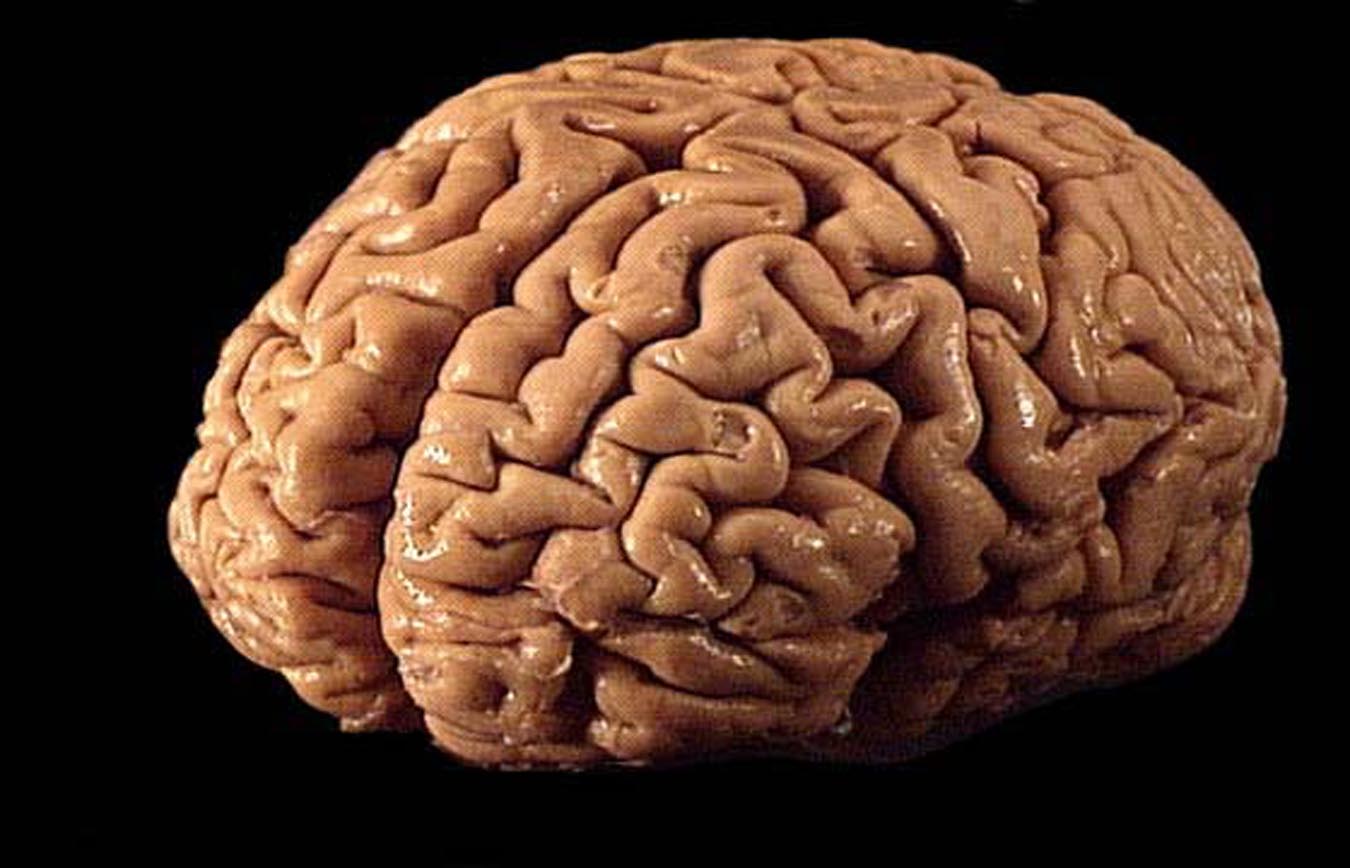
The brain is an organ we all possess, and we intuitively think we’ve got a grasp of it. Yet brain science is one of the scientific disciplines in which we have the most to learn.
In writing this post, I realized that Monty Python provides the I-Ching of life wisdom. If they don’t say it, it may not need being said. So I’ve let them expound upon my points wherever possible.
1.) Always Usually look on the bright side: Our brains are programmed to constantly be on the look for potential problems and ruminate over solutions. This isn’t without its advantages. However, as your brain takes flight with this problem anticipation mode, it can begin to taint how one sees the world.
My high school psychology teacher told us a story of what he called the “gestalt of expectations.” The story goes like this: One is driving across southwestern America and there’s a gas station coming up, but one still has half a tank. Being from the East, one doesn’t realize how rare service stations can be in the desert, so one passes it by. Of course one runs out of gas (it wouldn’t be much of a story otherwise.) As one is walking back toward the service station, one begins to obsess over how the service station attendant is going to screw one over. After all, the unknown individual knows one is in a desperate situation. The more one walks under a burning sun, the more one inflates the gas station attendant’s ill-intentions, and one suitably escalates one’s mentally rehearsed response. Finally, disheveled and weary, one reaches the service station. A concerned-looking attendant bursts out of the station to meet one, saying, “Geez, you look beat, what can I do for you?” And that’s when one punches him right in the nose.
The good news is that one can gradually train one’s brain to take a more positive perspective. A neuroscientist, Rick Hanson, has written a few books on how one can go about this cognitive rewiring. Buddha’s Brainis probably the most well-known of these books. The book lays out the science behind the brain and negative thinking in particular, and then goes on to present suggestions as to how one can change this cycle and yield the benefits of a more positive outlook. While the title of this book makes it seems like a religious tract, it’s really secular and scientific. If you’re still concerned, you might check out the more secularly titled Hardwiring Happiness.
2.) Make rest part of the process–and an essential one at that: Duh? Yeah, it sounds self-evident, but too many people think of rest as the slacking off that one does between doing “useful stuff.” What isn’t valued is given short shrift. Don’t think of rest as a necessary evil. Equating rest with goofing off results in two problems. First, the obvious one, people don’t get as much rest as they should. Second, while one thinks he or she is resting, one may be under chronic stress (the bad kind) as one’s minds churns over what they should be doing and the adverse impacts of not doing it. Just as one should have rests built into one’s workout for maximal effect, one should have rest times built into the day, week, and year.
3.)Find your bliss, and just do “it”: You probably think that by “it” I’m referring to sex. Actually, sex isn’t a bad “it,” as its go, but it’s not the only it. Exercise, work the heavy bag, do a vinyasa (yoga flow sequence), go to work solving the problem at hand, or practice your Silly Walk. This also sounds like a “duh!” kind of statement, but far too many people wallow when they feel overwhelmed. What do they wallow in? Negative feelings. They worry that they can’t possibly hit the deadline or find the perfect solution. They worry that they’ll let someone down. They get angry at other people, the world, or a god or gods for putting them in their present predicament. They bristle at the unfairness of the universe. All of this snowballs into a stress monster–to mix my metaphors up nicely. If one can’t meditate or keep one’s mind on one’s breath, one may find relaxation in exhaustion. It’s all about inertia. It’s hard to get moving when one thinks one’s world has gone to shit, but that movement will make one feel much better–even if it doesn’t seem it can solve the problem at hand. One might need to change one’s life’s course altogether and become a lumberjack.
4.) Don’t create false monsters: Remember what Michel de Montaigne said, “My life has been full of terrible misfortunes most of which never happened.” As this is really just expanding on a point in item #1, instead of elaborating, I will offer you this Monty Python skit to consider.
5.) Exhale: Each exhalation trips the “rest & digest” circuit (i.e. the Parasympathetic Nervous System [PNS]) just a little. Granted, this subtle relaxation effect is easily overwhelmed by the countervailing forces of stressors and even the antagonistic effect of inhalation with its–also minute–fight or flight mode (of the Sympathetic Nervous System [SNS.]) Still, if you don’t know what to do, controlling your breath while elongating each exhalation is a good start. This will help in two regards. First, it helps the PNS gain a little ground. Second, it’ll break your conscious mind’s obsession with the problem (or potential problem) at hand. One’s mind will wander and one will lose track of the breath, but the more one practices quietly returning one’s attention to the breath the better off one will be. Becoming frustrated with these diversions only strengthens the stress monster–so don’t do it.
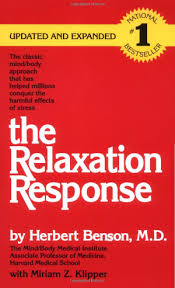
The bible of the rest and digest mode is Herbert Benson’s Relaxation Response. This book was first written over a quarter of a century ago, but it remains readily available. It’s telling that Walter B. Cannon’s work on “fight or flight” mode predates Benson’s work by such a long time. In other words, the medical and scientific community were researching the body under stress for decades before it ever occurred to anyone to think in terms of rest mode as a state that could be studied and advanced–as opposed to just being the normal state of affairs. This should give one an insight into how the human mind goes about considering problems.
6.)Recognize that stress is like cholesterol–there’s a good kind as well as the bad: Acute stress can serve one well during instances of danger. We have this response for good reason. The problem is chronic stress. When one’s body is in a stressed state, it’s not taking care of general maintenance tasks like healing itself. That’s fine in a short term, but problems compound over time. Chronic stress brings a high likelihood of illness because the body isn’t dealing with its run of the mill chores as it should be.
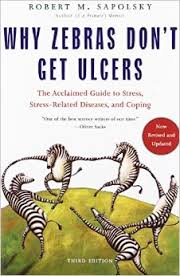
There are a number of books that expand upon this issue and which offer advice for keeping one’s stress of a healthy type. Robert Sapolsky’s Why Zebras Don’t Get Ulcersis among the best. It’s a long book and goes into great detail, but Sapolsky’s sense of humor helps to continue reading when the scientific minutiae might seem overwhelming. Another book on this topic that I found to be quite informative was Lissa Rankin’s Mind Over Medicine. Rankin is a medical doctor, and so she offers a little different perspective from that of Sapolsky. (The latter is a biologist / neurologist.)
7.) Realize that you are a speck in a vast universe and, so, how big or long-lasting can your problem be?: Yeah, it’s a double-edged sword because it’s–in a way–a demoralizing thought as well as a comforting one. Therefore, one should first watch this bit of Monty Python wisdom:
But then one can keep things in perspective through the realization that one is not yet dead.
So, the whole “dick move Mondays” concept may require clarification. First of all, some readers may be saying, “Every day is dick move Monday at our dojo.” However, readers who train at more orthodox schools may be wondering how such an apparently ludicrous idea would even come up. The idea’s origins are the result of seeking a martial art’s correlate to the “bad pass Fridays” that have been instituted in many basketball practices in recent years. On “bad pass Fridays” coaches give players passes that are catchable–but just barely. I’ll get into the scientific argument for this kind of training below, but for now suffice it to say that the idea is to have regularly scheduled instances in which the individual is taxed to his or her limits and forced to try to cope with worst case scenarios. While there needs to be some limitations for safety’s sake, I’ll argue that there’s some advantage to applying this concept from the sports science and motor learning literature to martial arts training. [Note: if your objective in practicing martial arts has nothing to do with being able to succeed in the context of a sporting match, an actual combat situation, or both (i.e. a situation in which an opponent is trying to clobber you and vice versa) then this isn’t really relevant to you. But feel free to read it any way.]
Here’s some low-down on the science. Historically, it’s been popular to teach / coach sports (and non-sport martial arts) using a “partial and blocked” approach. This method is extremely popular because: a.) it’s simple to organize and conduct practice sessions, b.) short-term growth is rapidly visible, and c.) it looks neat and tidy. “Partial” means that a particular skill (or even sub-skill) is extracted from the overall skill set of the activity at hand and practiced in isolation. This could be a throw, a strike, or a means of receiving or defending. “Blocked” practice means that one skill or sub-skill is practiced over and over again under the exact same conditions until it’s deemed time to move onto the next. “Whole and random” practice represents the opposites of “partial and blocked.” “Random” means that one drills a skill under an ever-changing situational context (e.g. one may still be drilling hip throws repetitively, but not against a static partner who’s standing in the same place–there’s movement and pushing and pulling, and possibly a few dick moves.) “Whole” practice simulates the actual event that one is practicing for–whether it’s a Muay Thai match or a parking deck brawl.
For a good explanation of the problems associated with blocked practice, watch the video by Trevor Ragan of “Train Ugly” that’s linked below. (fyi: “Train Ugly” is an apropos name for an approach that involves more “whole and random” practice because there will be more short-term failure and one won’t look masterful at what one is doing by the end of a practice session. However, long-term skill retention and the ability to integrate those skills and sub-skills into a more realistic environment is higher.)
As Ragan points out, the random approach requires one read the situation and environment and respond in a way that won’t leave one worse off. (I don’t like the word “planning” applied to martial arts because there’s never time to do any planning in the sense of using one’s conscious mind. However, I’d say reading is a very apropos concept, and there is a need to adjust to one’s context.)
So what would “whole and random” training look like in a martial art? First of all, one should realize that one doesn’t need to make every training session “whole and random” from the very beginning. In the beginning a lot of “partial and / or blocked” practice is necessary. The problem is that if one doesn’t ever move beyond that, one’s performance will be hindered. Second, all practice doesn’t have to be both whole and random; one can spend a lot of time with random drilling of a particular skill. One can drill a particular skill while moving around freely, applying counters, making timing more random, and making the approach less regimented. “Whole and random” practice in the martial arts involve sparring or randori. Jigoro Kano did a brilliant thing in making the techniques and practice environment safe enough that randori (free form) training became possible. For many years, I would have said that Kano Sensei made a system that was less “realistic” by paring out the dangerous elements of jujutsu. However, today I don’t see it that way. I’ve come to realize that the ability to train randori keiko actually added back in a great deal of realism. Who’s to say what the net effect on realism is. I certainly see the advantage over the old way in which one trained in a regimented fashion devoid free form components for years and then one day one went out on musha shugyō (warrior’s errantry) and may be the day you learned of a deficiency in your technique was the day you died.
So “dick move Mondays” is really a way to add randomness into training. One can’t ignore the reading portion of the attack because one never knows what whacky ass attack one’s opponent is going to come up with.
If you do implement “dick move Mondays” in your school or gym, you may want to review this instructional video by Master Ken because the “bitch slap” is sure to enter into your training.
[Disclaimer: Master Ken video included as farce. Readers are advised not perform any techniques suggested by Master Ken or his Amer-i-do-te practitioners.]
Many years ago I was training at a dōjō that had a practitioner who was a teacher for the blind. He requested that we put together a self-defense workshop for his students. (If you’re wondering what kind of evil jackass would attack a blind person, rest assured that—sadly–such a level of jackassitude exists in the world.) The request presented an intriguing challenge. How does one adapt techniques that are premised on being able to see what the opponent is doing? Or maybe one shouldn’t adapt existing techniques but rather start from square one?
In preparation for working up a lesson plan, the person that asked for the workshop briefed the black belts. We learned that very few of the blind students lived in complete darkness. Instead, they displayed a wide range of different visual impairments. He even brought a large bag of goggles that simulated various impairments so that we could train in them to better understand what would or wouldn’t work with different types of impairment.
There were goggles that had funnels over the eyes such that one could see two little circles clearly while the rest of the world was black. There were others that had a complete field of view, but had translucent tape over the lenses so that everything was reduced to fuzzy blobs—as if one were looking through Vaseline. There were lenses that had a crackle effect such that one could only see veins of area clearly. There were goggles with no peripheral vision, and ones with only peripheral vision. He also had some goggles that blacked out the world entirely. Completely blind individuals may not be as common as one would think, but they certainly exist. Putting on any of the goggles was disorienting at first. A couple of the black belts even got vertigo or nausea when they moved around too quickly.
Now imagine what it would be like if one had always had the goggles on, that it was the only worldview one had ever known. Furthermore, imagine that everyone you interacted with on a daily basis all wore the same variety of goggles. You wouldn’t see it as an affliction or a limitation. To you, your view of the world would be full and complete. You would engage in behaviors that might seem odd to an outsider with unobstructed vision (e.g. sweeping your hands around in big arcs, turning your head at unusual angles, or calling out into the “darkness”), but these behaviors wouldn’t seem odd to you because you’d know it as natural behavior for someone who experienced the world as you did. Because everyone you dealt with would see the world in the same way, it wouldn’t occur to you to think about whether there was another way to behave.
The preceding paragraph serves as an analogy for culture. One’s own culture is often invisible, especially if you don’t get outside of it much. All the people around you confirm your belief that you’re seeing the world as it is and behaving in the only natural and normal way imaginable. Sure, you may notice other people’s cultures—their skewed worldviews and the anomalous behaviors that result– but that’s because they do “strange things.” Still, some individuals will maintain that their culture doesn’t display any of the “odd” ways of behaving that more “exotic” cultures do.
But it does. Every culture is a mix of the good, the bad, and the ugly of how a people goes about living in the world given their cultural blind spots and skews. It includes collective coping mechanism for dealing with fears of uncertainty, and those are often the ugly side of culture. They encourage ingroup / outgroup separation, as well as primitive and superstitious approaches to dealing with those events, people, and behaviors that are out of the ordinary.
It’s easy to display double standards when one is blind to culture. I will give an example from my own life. It’s only been since I’ve been living in India (and traveling in Asia) that I’ve become aware of how many people are upset by Westerner’s secularization of Eastern religious / spiritual symbols and imagery. That’s a mouthful; so let me explain what I mean by “secularization of Eastern symbols and imagery.” I’m talking about “OM” T-shirts / pendants, bronze Buddhas, Tibetan thanka paintings, mandalas (on T-shirts or posters), miniature shrines, or tattoos that are purchased because they are trendy, aesthetically pleasing, or vaguely conceptually pleasing without any real understanding of the tradition from which they came or intention of honoring it.
Granted it’s easy to miss the above issue if you’re a tourist because: a.) Many of said Eastern traditions practice a live-and-let-live lifestyle that make their practitioners unlikely to be confrontational about such things (in contrast to practitioners of Abrahamic traditions (i.e. Judaism, Christianity, or Islam.)) b.) There are merchants in every country who are willing to sell anything to anybody for a buck, and so there are vast markets for tourists that offer up these symbols and images in droves.
It still intrigues me that it once caught me off guard that there were Hindus, Buddhists, Jains, etc. who were dismayed by the secularization of their traditions. I’m agnostic, but I was raised in a Christian household. Therefore, I can imagine the animosity aroused by the following conversation.
A: [Wearing a simple crucifix [or Star of David or crescent & star] pendant on a chain.]
B: Hey, A, I didn’t know you were Christian [or Jewish or Muslim]?
A: Because I’m not.
B: But you’re wearing a crucifix [or other Abrahamic symbol] pendant?
A: Oh, yeah, that. That doesn’t mean anything. It just looks cool. It’s kind of like the Nike swoosh.
B: [Jaw slackens.]
Now replace the crucifix with an “OM” shirt, and an inquiry about whether “A” is Hindu. Does it feel the same? If it doesn’t, why shouldn’t it?
Every martial art represents a subculture embedded in the culture of the place from which it came. [Sometimes this becomes a mélange, as when a Japanese martial art is practiced in America. In such cases the dōjō usually reflects elements of Japanese culture (e.g. ritualized and formal practice), elements of American culture (e.g. 40+ belt ranks so that students can get a new rank at least once a year so they don’t quit), and elements of the martial art’s culture (e.g. harder or softer approaches to engaging the opponent.)]
The way that culture plays into a country’s martial arts may not become clear until one has practiced the martial arts of different countries—particularly in their nation of origin. While my own experience is limited, I have practiced Japanese kobudō in America (and extremely briefly in Japan), Muaythai in Thailand, and Kalaripayattu in India. I’ll leave Muaythai out of the discussion for the time being because I can most easily make my point by contrasting Japanese and Indian martial arts. The Japanese and Indian martial arts I’ve practiced each reflects the nature of its respective culture, and they couldn’t be more different.
What are the differences between the Japanese and Indian martial arts I’ve studied? I’ve been known to answer that by saying that the Japanese martial art rarely uses kicks above waist level, while in Kalaripayattu if you’re only kicking at the height of your opponent’s head you’ll be urged to get your kick up a couple of feet higher. What does that mean? The Japanese are expert at stripping out the needless and they work by paring away excess rather than building difficulty. The impulse of the Japanese is to avoid being showy. KISS (Keep It Simple, Stupid) appeals to the Japanese mind. (Except for the “Stupid” part, which would be considered needlessly confrontational and gratuitously mean-spirited.) There’s a reason why Japanese martial arts don’t feature prominently in global martial arts cinema. They don’t wow with their physicality; efficiency is at the fore.
On the other hand, Indians are a vastly more flamboyant bunch, and Kalaripayattu is extremely impressive to watch and in terms of the physicality required to perform the techniques. The Indian artisn’t about simplifying or cutting away the unnecessary. One has to get in progressively better shape as one advances to be able to perform techniques that require one leap higher, move faster, and be stronger. The Indian art isn’t about paring away excess, it’s about making such an impressive physical display that the opponent wonders whether one is just a man, or whether one might not be part bird or lion.
It might sound like I’m saying that the Japanese martial art is more realistic than the Indian one. Not really. Each of them is unrealistic in its own way. It’s often pointed out that the Japanese trained left-handedness out of their swordsmen, but that’s only one way in which Japanese martial arts counter individuation. Given what we see in terms of how “southpaws” are often more successful in boxing, MMA, and street fighting, eliminating left-handedness seems like an unsound tactic at the individual level. There are undoubtedly many practitioners of traditional Japanese martial arts who can dominate most opponents who fight in an orthodox manner, but who would be thrown into complete disarray by an attacker who used chaotic heathen tactics. Consider that the only thing that kept the Japanese from being routed (and ruled) by the Mongolians was two fortuitous monsoons. The samurai were tremendously skilled as individual combatants, but the Mongolians could—literally—ride circles around them in warfare between armies. Perhaps, a more relevant question is whether Miyamoto Musashi would have defeated Sasaki Kojirōif the former had followed all the formal protocols of Japanese dueling instead of showing up late, carving his bokken from a boat oar, and generally presenting a f*@# you attitude. Who knows? But as the story is generally told, Musashi’s disrespectful and unorthodox behavior threw Sasaki off his game, and it was by no means a given that Musashi would win. Some believed Sasaki to be the more technically proficient swordsman.
All martial arts are models of combative activity apropos to the needs of a particular time, place, culture, and use. And—as I used to frequently hear in academia—all models are wrong, though many are useful. (Sometimes, it’s written: “All models are lies, but many are useful.”)
[FYI: to the readers who say, “The martial art I practice is completely realistic.” My reply: “You must go through a lot of body-bags. Good for you? I guess?”]
I went to a talk at the Rangoli Metro Arts Center last night entitled, Foresters’ Elephants. The talk was hosted by a group called “Friends of Elephants,” and the panel of speakers were all Conservation Officers in South India who were responsible for public lands home to Elephants.
The discussion offered some intriguing insight into state and local politics in India. But the best explanation of the night came from the Chief Conservator of Forests for Kodagu in a story that could be titled “A Third Roti.”
The Conservator explained that, as a junior forest officer, he’d been assigned to a remote station. His housing took the form of an old decrepit colonial era building. This house had a vermin infestation, and the hungry rodents would get bold as he and his wife slept and would nibble at their fingers and toes. Of course, this made for sleepless nights. To solve this disconcerting problem, the Conservator took to getting a third roti with his meals. [For my India-inexperienced readers, a roti is a circular flat bread that’s a common element of meals in many parts of India.] Putting the third roti out for the rodents negated the rat’s need to engage in the mutually terrifying act of nibbling on the forest officer or his wife.
I don’t know if the story is true, and–if it is–whether it’s truly the Conservator’s story. It doesn’t matter. What’s important is that it’s a great use of story to make a point. The point in this case is that a solution often needs to take into account the fundamental needs of the “adversary.” In other words, regulation and punishment can’t always provide the solution–especially when basic needs are not being met. One could try to scare the rodents away or one could set traps (potentially at risk to oneself), but if the rats are driven by hunger they might find the risk worth taking. The problem that he was addressing was the need for wood for fires, fence posts, and other needs. This caused people to enter public forests, putting themselves at risk of running into wild elephants.
The idea of trying to find a third roti for problems really resonated as an approach to creative solutions.
I had high hopes for Sam Harris’s book Free Will, but they didn’t pan out. It’s a very short book (less than 100 pages) on the subject of free will–or the lack thereof. While I’m normally a huge fan of brevity and conciseness, Harris could have put some more pages to good use. My two principal complaints regard the lack of information: a. substantiating the notion that free will is always and everywhere an illusion as Harris asserts; b. suggesting what logic is at the root of decision if our conscious thoughts are irrelevant. (If they were random synaptic firings our behavior wouldn’t be nearly so consistent. Self-preservation of genes? The hand of god? You won’t know from this book.)
Harris might claim that that’s not the purpose of this book, that one should familiarize oneself with the vast literature on the topic before getting to this book. In that case, my complaints remain two-fold. First, he shouldn’t take on such a bold and presumptuous title as Free Will (no subtitle) if he’s not going to educate us from the ground up on the titular topic. Second, if the reader has done all the scholarly reading on the subject, why should we care about Harris’s opinions?
I will say that if you liked Matrix Revolutions, the third Matrix movie, you will love this book. SPOILER: In that movie, we find out that Neo is the central element of an elaborate plan to fool people into thinking they have some control over their own lives. In Harris’s book, Neo is replaced by the conscious mind.
There’s a scientific literature supporting the notion that free will is an illusion–though Harris only touches on it. This conclusion has been reached by observing that subconscious parts of the brain involved with decision-making light up well in advance of the conscious parts of the brain. [On a note unrelated to the book: we also know that individuals with damage to the emotional centers in the brain become unable to make decisions because all options hold the same weight.] The most illuminating example offered is an experiment in which participants were asked to press a button to select a letter or number of their choosing from among a string of changing letters / numbers. Some subjects felt the scientists had mastered precognition (a class III impossibility according to physicists–i.e. impossible according to the laws of physics as we know them.) What was really happening was an exploitation of the lag between when the individual’s subconscious decided and when their consciousness became aware of their decision.
Harris briefly mentions a couple of these neuroscience experiments, but then expects that the reader will treat the free will illusion as law. That is, we are to accept that always and everywhere people’s subconscious minds decide some measure before their conscious minds. Maybe there has been a broad enough scientific investigation of the topic to safely conclude that free will is always and everywhere an illusion–but Harris does make this point.
Harris tells us about couple of studies in which, a.) there’s no cost differential between the different options; (i.e. is it possible that the mind treats decisions about picking a spouse or a house differently than picking a letter or number for which there is no objectively better or worse option?) b.) those studied are a random sample of individuals who have no particular expertise with their minds—probably mostly college undergrads. (If I drew a random sample of people and asked each to lift 300 lbs over his or her head. If no one could do it, would I be safe in concluding that lifting 300 lbs was something forever beyond the capacity of every member of the human race? In other words, what if exercising conscious control over decision-making requires training and expertise with the mind.)
There are a couple of red-flags for me about Harris’s approach to the subject. First, Harris scoffs at the suggestion that it might be that the conscious can overrule the subconscious, and seems to deem this as unworthy of study because it would just be the subconscious making a second decision instead of the conscious truly vetoing. Anytime a scholar is dismissive of another scholar’s attempts to further probe into a question signals that a pet theory has become a sacred cow.
Second, Harris suggests that anyone who truly studied his own mind in action couldn’t help but realize the fallacy of free will. People who can’t imagine that others see the world differently than them are also a point of concern when it comes to getting sound information. Could it possibly surprise Mr. Harris to learn that there are people who’ve spent far more time alone with their minds than he, who’ve concluded quite the opposite?
Alright, I may have overstated Harris’s position when I suggested the conscious mind is relegated to a Matrix Revolutions-style (and Rube Goldberg-esque) machine for tricking us into thinking we have choice and control over the direction of our lives. I suspect Harris would agree that evolution doesn’t over-engineer, and a conscious mind that is just part of a trick would be the vastest act of over-engineering in the history of the universe. (Unless the universe is a hologram, as some physicists are now suggesting–presumably based on the notion that their math works out in 2-D.)
I just don’t have a good idea of what purpose Harris thinks the conscious mind serves. His central point seems to be that we still need to keep putting rapists and murders in jail so they can be kept off the streets. We just shouldn’t bear any ill-will toward them because they had no control over their decisions. However, if we set a tone with our conscious thought stream, then whether the individual’s decision to act was conscious or not they would have culpability by virtue of stage-setting. If we don’t have any control over our conscious thought stream then there would be no benefit to courses of study that help one improve one’s state of mind, but there’s also a scientific literature showing that people who begin meditative practices, yoga, and the like do see tangible positive changes. (Not to mention that Harris should give all the money back for the books he has sold about meditation, i.e. Waking Up.) If we have conscious control of our thought stream, but that thought stream is irrelevant, then we should be walking around in a constantly perplexed state.
To add to the confusion, Harris uses the term “choices” to refer to his “decisions,” but according to his paper he doesn’t make any choices. He—like all of us—are slaves to some unknown–or at least unexplained–process. Black boxes aren’t persuasive.
I can’t say I’d recommend this book, unless you’ve read extensively on the topic and are rounding out your reading experience. This book isn’t the ideal starting point for engaging this subject—as it seems when you are reading the blurb–because you’re as likely to come away more confused than when you began reading.