BOOK REVIEW: Taoist Yoga & Chi Kung by Eric Yudelove

Taoist Yoga and Chi Kung- For good health,better sex,and longer life.Taoist Yoga and Chi Kung- For good health,better sex,and longer life. by Eric Yudelove
My rating: 4 of 5 stars

Amazon page


This book was originally released under the title: “100 Days to Better Health, Good Sex & Long Life.” It offers a 14 week qi gong practice that proposes to improve health, sex life, and longevity. It’s presented as a step-by-step explanation of the practice aimed at those who intend to carry out the practice—as opposed to those who are looking for a more general explanation or overview.

The book offers a systematic presentation of the 14 week / 100 day practice. It’s divided into two parts. The first is a short explanation of Taoist concepts as they pertain to health building practices, and particular emphasis is given to the concepts of chi (energy / breath), jing (body), and shen (mind.) That emphasis is valuable as each of the chapters (i.e. the description of each week’s practice) is outlined according to these three concepts. So, each week there is a new breath practice, new bodily practices, and a new meditation or visualization practice. That said, these practices build on each other—i.e. starting with very basic activities and either adding to them or shifting to more complex variations.

The sections on breath and mind are fairly straight forward and mostly involve one practice each per week. Those practices become quite complex over the course of the book, but it’s one practice per week. This is in contrast to the middle section that has three or four subsections of activities per week. The middle section on Jing, or body, includes subsections on making sounds, self-massage, “sexual kung fu” (exercises intended to tone the reproductive system and prevent chi “leakage”), and the movement exercises that one might most closely associate with qi gong (chi kung.)

The book has many graphics in the form of line drawings used to clarify anatomy or how one is to visualize the practices. There is a glossary to help explain both Chinese terms and terminology in English that is specific to qi gong. There is also a two page bibliography that includes many works by one of Yudelove’s teachers, Mantak Chia, but also including works by individuals from other lineages and systems.

I have practiced through week eight. One may find the parts of the practice vary in their usefulness, but there doesn’t seem to be any harmful practices and there are many from which one will benefit. I’d recommend the book if one is looking for practices—as opposed to background. The explanations are systematic and the overall practice is well-organized. It’s not the kind of book that is much of a pleasure to read for reading’s sake. Much of the book is lists and bullet points of step-by-step explanation.

View all my reviews

BOOK REVIEW: Trying Not to Try by Edward Slingerland

Trying Not to Try: The Art of Effortlessness and the Power of SpontaneityTrying Not to Try: The Art of Effortlessness and the Power of Spontaneity by Edward Slingerland
My rating: 5 of 5 stars

Amazon page


This book’s paradoxical title is perfect for its paradoxical subject matter, which is famously expressed in such quotes as, “When nothing is done, nothing is left undone” [ver. 48 of the Tao Te Ching.]  Slingerland lays down the ancient Chinese wisdom of wu-wei and de, but provides something novel by putting it in the context of the positive psychology and neuroscience of today. Wu-wei literally means “no doing,” but can be more meaningfully defined as “effortless action.” De (pronounced “duh”) is a charisma seen in people who have mastered the effortlessness and spontaneity of wu-wei.

While the book is built around the varied approaches of four Chinese philosophers—two Confucians (i.e. Confucius and Mencius) and two Taoists (i.e. Laozi and Zhuangzi)—the author relates this philosophy to the present-day thinking found in Daniel Kahneman’s “Thinking, Fast and Slow,” Mihaly Csikszentmihalyi’s conception of Flow, and the neuroscience of the subconscious.

The book consists of eight chapters. The introduction and the first two chapters outline the concepts of wu-wei and de using both Chinese and Western stories and examples to help clarify these arcane ideas and put them in the context of the social and spiritual spheres. Chapter 1 offers an extensive discussion of the operation of the brain as it relates to the discussion of effortlessness and spontaneity.

Chapters three through six make up the core of the book, and present the approach and thinking of Confucius, Laozi, Mencius, and Zhuangzi, respectively. This “boy-girl-boy-girl” Confucian-Taoist organization offers the reader sound insight into the varied approaches and allows one to see the evolution of thinking. Confucius gets the first cut, but his approach to effortlessness and spontaneity involves a great deal of effort and planning. It might seem that Laozi’s approach–which does away with effort and planning–might be more apropos, but it’s hard to imagine anything of benefit actually being spawned by such a loosy-goosy approach. The more nuanced approaches of Mencius and Zhuangzi offer additional insight, but do not eliminate the paradox. It’s this paradox that’s the subject of chapter seven.

The final chapter examines what the reader can take away–given that the paradox of wu-wei seems inescapable. The author proposes that, paradox or not, there is value in pursuit of effortlessness and spontaneity, and progress can be made by understanding and accepting said paradox.

The book has no graphics, but is annotated and has a bibliography–as well as an appendix table that summarizes the various approaches to wu-wei.

I enjoyed this book and found it fascinating. It’s highly readable, having humor and a wide range of examples from ancient myths to pop culture. The book offers a great value-added by considering the relevance of modern science and psychology to this ancient concept. I’d highly recommend this for individuals interested in Chinese / Eastern philosophy, as well as anyone hoping to bring a little more effortlessness and spontaneity into his or her life.

View all my reviews

DAILY PHOTO: Shou Lao, Haw Par Villa

Taken in October of 2016 at Haw Par Villa in Singapore

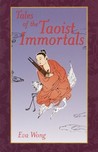
BOOK REVIEW: Tales of the Taoist Immortals by Eva Wong

Tales of the Taoist ImmortalsTales of the Taoist Immortals by Eva Wong
My rating: 3 of 5 stars

Amazon page


This book tells of the key events in the lives of forty Taoist immortals. While the title (specifically the word “tales”) might lead one to think that this is a book of stories, it is only so in the most general sense of the word “story.” Satisfying stories show a character confronted by barriers to obtaining some desired goal. That isn’t the case in the overwhelming majority of the “tales” in this book, and the few in which the individual is confronted with a challenge she usually uses her superpowers to magic the problem away. (To be fair, Taoist sages aren’t known for being ambitious and thus have few goals to chase after. There are more examples of individuals turning down high offices in these character sketches than there are characters attempting to obtain some objective.)

If you are looking to learn more about key figures in Chinese history and mythology, this book will serve your purpose through brief (2-3 page) character sketches that hit the highlights. However, if you are looking for something like the “Book of Chuang Tzu” with clever morality tales, that’s not at all what you’ll find in this book. There are a couple of exceptions, but they are rare nuggets.

Each of the 40 chapters provides one character sketch of life events with a brief bio at the end. The 40 chapters are divided into five parts by the class of individual being mentioned (i.e. the eight immortals, sages, magicians, diviners, and alchemists.) There is a line drawing (reminiscent of block print) for each of the chapters that depicts the immortal in action. The only ancillary matter is a brief introduction.

As I suggested, if one is looking for information about the lives of Taoist immortals, one may find this to be a good source—particularly if one doesn’t want to get bogged down in minutiae. The entire book is less than 200 pages. On the other hand, if one is looking for stories or morality tales, one will likely find this book leaves one wanting.

View all my reviews

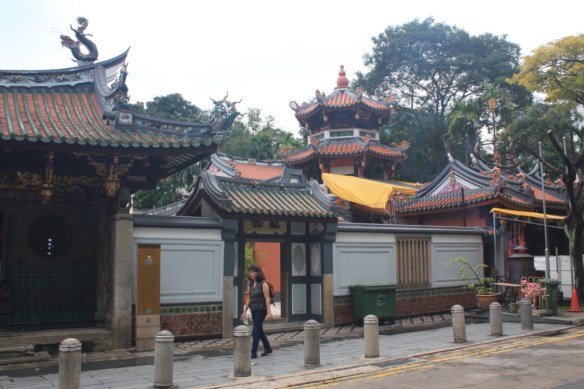
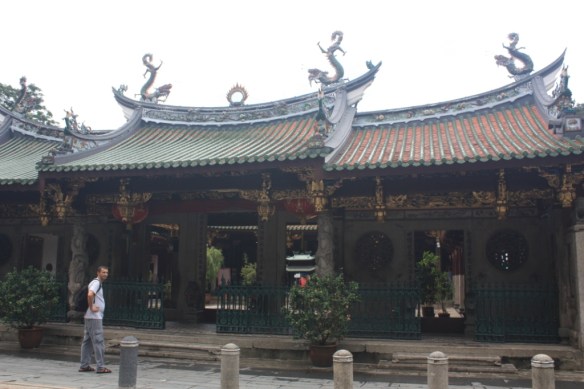
DAILY PHOTO: Thian Hock Keng

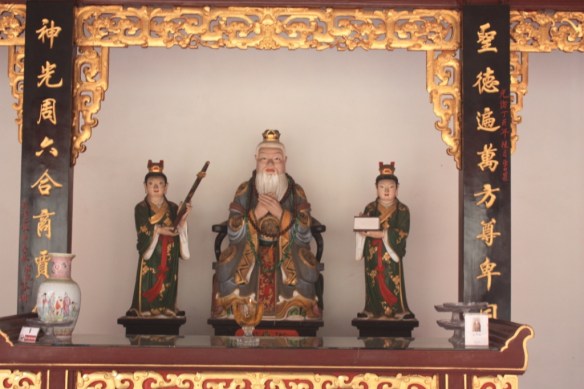
Confucius; Taken on October 29, 2016 in Singapore

Confucius; Taken on October 29, 2016 in Singapore

img_3549img_3548

This Chinese temple sits in the heart of Singapore’s Chinatown. It’s said to be the oldest Hokkien or Hoklo temple (i.e. Han Chinese) in Singapore. It’s a temple related to Han Chinese culture generally, rather than to a particular sect or religion. While the main deity is Mazu (a.k.a. Ma Cho Po,) a maritime goddess from Chinese folklore that is sometimes associated with Taoism, there is also a Confucian shrine as well as homages to several Buddhist Bodhisattvas (a Bodhisattva is one who has achieved enlightenment but sticks around to help others out of compassion.)

Paleo-Stressing: Acute v. Chronic Stress

"What happened to the good ole days when I ate you people--not lived in your cages?"

“What happened to the good ole days when I ate you people–not lived in your cages?”

Paleolithic dieting is all the rage these days. I’m no expert on the paleo-diet, but–as I understand it–this refers to the practice of eating the foods consumed by our pre-agrarian ancestors. The idea is that if one consumes the foods that our species is evolutionarily-optimized to eating, one will be healthier.  Whether one believes in the merits of the paleo-diet or not on the whole, it’s hard to argue that one wouldn’t be better off eating less highly-processed and highly-refined foods and more things that look like food at a glance.


Our diet isn’t all that has changed since the days of our pre-agrarian ancestors. Modernity has brought with it an entirely new way of experiencing stress. Eliminating or reducing stress is a common topic of discussion, but not all stress is created equal. There’s a necessary form of stress, a stress that makes one better, stronger, faster, and smarter. We don’t want to willy-nilly eliminate stress; we want to reduce the wrong type of stress.


Our ancestors—like animals–experienced brief periods of intense stress (e.g. saber-tooth tiger attacks), followed by longer periods in which they were free of deadlines, carpools, and after-school activities. Now, no one likes to have a saber-tooth tiger stalking them. It’s unpleasant. Modern humanity has gone to great lengths to eliminate those short bursts of terror, but not without cost. (If you don’t believe me read Robert Sapolsky’s Why Zebras Don’t Get Ulcers.)


Whether or not you believe that eliminating acute instances of terrifying stress is bad for mankind, it’s hard to argue that modernity’s leveling process didn’t eliminate stress, but instead resulted in a chronic stress on a smaller scale. People today have impossibly long daily to-do lists, and they have to accept trade-offs between work, family, and personal development.


It’s true that you don’t get eaten by a giant cat when you drop the ball, but life is so packed diverse events that one may feel like one is dropping some ball constantly. If your boss thinks you’re a model employee, then your kids are probably going to need therapy. If you have a contented home life, your boss may have his or her eyes open for someone who can give the firm consistently 70+ hour work weeks. If you feel you’re doing alright on both the work and family front, your body and / or mind is probably a train wreck.


Chronic [mini] stress may feel better than acute [catastrophic] stress, but it takes its tolls in various ways. First, with our sympathetic nervous system (fight-or-flight reaction) constantly engaged our body’s power to heal itself is reduced. When the parasympathetic nervous system is engaged, the body devotes resources to long-term goals like getting healthier, but in stress mode activities not relevant to immediate survival shut down. This is a great system if you have periodic life and death stress, but is not so good if you’re under constant stress.


Second, chronic stress reduces sleep, and sleep is essential to one’s mental and physical well-being. There are a wide variety of symptoms associated with sleep deprivation such as forgetfulness, decreased concentration, decreased alertness, reduced reasoning ability, diminished problem-solving capacity, and depression—all of which can diminish our physical health through accidents, ailments, suicide attempts, and lack of energy for exercise.


Third, chronic stress can make one fat, with all the health issues that result. Some people use food as a coping mechanism. Other people eat too fast or choose their food poorly because of time constraints or because they are not mindful of eating as their monkey minds churn at a mile a minute. Then there is the more convoluted and complex issue of cortisol–a hormone released under stress that is linked to weight gain in at least some cases. Even if you don’t have a problem on the calorie intake side, the stressed individual may not do so well on the calorie burning side—either because of a lack of time to exercise or a lack of energy.


Modern humans are uniquely suited to chronic stress because we are the only species that achieves the same physiological stress response by remembering and obsessing about a stressful event as experiencing it. Abandoning the modern approach to living isn’t an option most are willing to entertain; but there are ways to combat chronic stress.


Move – Meditate – Mindfully Breath: The bad news is you’ve got to shoehorn these activities into your schedule daily (or at least several times a week.) The good news is that they don’t need to take up a lot of your day. There are a number of systems that address all three components in one handy package such as Qi Gong, Yoga, and some martial arts. I don’t think it matters so much which one chooses as how one goes about one’s practice.


Movement strengthens and strategically stresses the body, but it also increases one’s bodily awareness so that one becomes aware of how stress is manifesting itself in one’s body. Meditation teaches one how to live in the present moment, and it trains one to recognize the seeds of negative thought and emotion earlier so that one can counter-act them. Obviously, breathing is essential to life, but learning to be aware of one’s breathing patterns and to “manually override” the breath patterns associated with harmful emotional states is a beneficial skill.


Massage / Bodywork: Whether self-administered or other-administered (the latter allowing greater distressing–particularly if the masseuse is skilled) massage is an activity, like movement, that can help one become aware of where one is physically holding one’s stress. These physical manifestations of stress can exacerbate the whole experience of stress. One should take time periodically to have bodywork done. A day rarely goes by in which I don’t work on my own neck, shoulders, head, or face, and I occasionally get professional Thai Yoga Bodywork done.


The Places that Scare You: Force yourself to go someplace (not necessarily literally a “place”) that scares you once in a while. This needn’t be skydiving or hand-gliding—but it could be. It may be a martial arts class in which one has to put on the gloves occasionally and go at it. It may be joining Tostmasters and having to give a speech in front of a crowd. It may be traveling to some backwater where you don’t know the language, but you want to learn. This is a very personal issue. (i.e. A Type-A personality he-man may not find that skydiving is outside his comfort zone. If so, sorry, skydiving doesn’t count, he may need to learn ballroom dancing, or something else that truly takes him outside being comfortable.) KEY POINT: The problem with hiding from all stressors is that it doesn’t result in a stress-free life, what happens is that smaller and smaller stressors loom bigger and bigger in one’s mind. Which brings us to…


Perspective:  One must put life’s challenges in perspective. Each person’s problems are important to them, and I don’t want to diminish anyone’s problems, but—come on—you’re not going to be eaten by a freaking saber-tooth tiger.

Tradition v. Modernity in Fitness and Movement Arts


TheScienceofYoga_BroadOne of my favorite professors (and I had a lot of them) was in the Religious Studies department of Indiana University in Indianapolis (IUPUI.) Among the lessons he taught us were the various forms of fallacious reasoning applicable to the discipline. He did so in a way that was both erudite and folksy, often in a humorous way.


While I don’t remember the formal names he gave these concepts or their technical definitions, I do remember the more colorful variations. One was the “firstist-is-bestist” fallacy in which it’s assumed that the old ways are inherently superior because bad ideas die out, and young ideas are at least as likely to be crap as not. This is sometimes called “appeal to tradition.” Over a sufficiently long time horizon this assumption may prove true (i.e. the time horizon beyond which Keynes warned we’d all be dead), but we know that wrong ideas can live on for centuries.


Another was the “outhouse” fallacy, which says that because pre-modern man didn’t have indoor plumbing they must have been complete idiots, and we should assume newer is better. This is sometimes called the “appeal to modernity.”  While there is some advantage to having access to the compiled knowledge of history, this doesn’t keep people from coming up with idiotic ideas regularly.


What made me think about these conflicting fallacies is that I’ve been reading a lot about the science of yoga–and other systems of movement–lately. Specifically, I was reading The Science of Yoga by William Broad. During the 20th century, yoga went from not giving a whit about science to trying to show that it wasn’t at all at odds with science–if not that it was grounded in science. (Note: this statement could be applied to many of the old ways—e.g. religions—which sought to prove themselves consistent with scientific evidence out of fear that–in the age of rationality–to be inconsistent with scientific observation would be death to old beliefs.) While the hucksters and con men seeking to bilk people out of money through shows of yoga “magic” have lost power (though some still exist and prey on the gullible regularly), this isn’t to say that science has yet won the day entirely.


Chapter two of Broad’s book discusses the findings of the scientific community on whether yoga has any merit as aerobic exercise. (The consensus is that it doesn’t.) Now, one would think that the whole yoga community would be pleased that academia has for the most part shown that yoga has a range of positive benefits that make it a worthwhile endeavor when practiced safely and conscientiously, but some have been unwilling to accept that yoga isn’t excellent cardio on top of all its unambiguous benefits. The established consensus is being ignored and a single seriously flawed study (small sample size, no control group, and—while peer-reviewed—the author was the journal editor) is cited, that one—of course—suggests that yoga meets all one’s cardio needs.


It’s easy to follow the incentives. For example, if one runs a yoga studio one would like to be able to say that yoga is a panacea for all of a person’s health needs. People are busy and lazy, and if someone else can sell them a silver bullet then they’ll lose business.  If one gives the matter thought, it becomes hard to imagine an exercise panacea. Consider a list of health goals that includes reduced stress, improved balance, greater flexibility, more strength, and enhanced cardiovascular capacity. One should see that some of these goals are at odds with each other. The first three goals—at which yoga excels–require holding a static position for a time while engaging in deep and controlled breathing. The fourth goal, strength enhancement, (which yoga achieves only in a limited way) requires repeated alternation of stressing and relaxing a muscle. And cardio, the fifth goal,–for which yoga is less than helpful–requires rapid and sustained motion so as to cause the heart to be stressed.


Of course, individuals have tried to rectify yoga’s cardio deficit by creating yoga styles that add speed and repetition. If one does five sun salutations per minute for 45 minutes, then—congratulations–you are now getting cardio and strength building. Unfortunately, you are now losing out on the first three goals of stress reduction, balance enhancement, and flexibility improvement. Those three things requiring holding poses while engaging in relaxed and controlled breathing. So the question is whether one is happy having sacrificed the benefits yoga does better than everything else in a desire to have yoga gain benefits that other exercise systems probably still do better.


The old systems of movement and exercise, be it yoga or chi kung, have shown themselves to have merit. However, the mechanisms by which that merit is achieved (or the nature of the merit) are often not what the system’s mythology suggests. There’s no need to fear science, but one should be ready to embrace what is shown true and set aside what is shown to be false.


On the other hand, this modern idea that we can have our cake and eat it too by throwing together disparate systems, which often have conflicting goals and modes of operation, needs to be reevaluated. All of these fads have been created where someone crams together tai chi and yoga or yoga and jazz dance or Zen meditation and parkour and they think they have the ultimate system based on a more complete picture of modernity, and what they’ve got is a muddle.


What we need is the tested merit of tradition without its voodoo, and the compiled knowledge of modernity without its hubris.


BOOK REVIEW: The Tao of Jeet Kune Do by Bruce Lee

Tao of Jeet Kune DoTao of Jeet Kune Do by Bruce Lee

My rating: 4 of 5 stars

Amazon page

Jeet Kune Dō (henceforth, JKD) is Bruce Lee’s “styleless style” of martial arts. Its literal meaning is “the way of the intercepting fist.” However, Lee cautions one against attaching too much significance to that name (or any name) in the book’s final chapter. Long before “Mixed Martial Arts” became a household word, Lee was constructing this fighting system that borrowed heavily from the Western traditions of boxing, fencing (conceptually speaking), and wrestling as well as from Kung-fu, Savate, and Judō/Jujutsu. While JKD employs techniques and concepts from these systems, Lee remained adamant that no good came of organized styles built on fixed forms. In fact, that might be said to be the central theme of the book. That is, each fighter should begin with sound fundamentals and build an approach that is ultimately his or her own.

The Tao of Jeet Kune Do is an outline of the martial art. In many ways, it looks like and reads like Lee’s personal notebook. It’s illustrated with crude (but effective) hand drawings of the type one would see in a personal journal, and they are annotated with hand-written notes. (My biggest criticism is that on the Kindle version the graphics are largely unreadable. I’d recommend you get the print edition if you can, which is large-format paperback as I recall.) The book combines a philosophy of martial arts with nitty-gritty discussion of the technical aspects of combat. The philosophical chapters bookend the technical ones.

As others have pointed out, there’s not much that is new in either the philosophical discussions or the technical ones. Lee’s value-added is in how he states these concepts, how he selects the concepts of value (informed largely by a love of simplicity and a hatred of dogma), and the weight lent to the lessons by Lee’s great success story—albeit in a life far too short. Lee was a man of charisma, and one who approached endeavors with gravitas.

Now, I can imagine some readers saying, “Why are you recommending a book on real fighting by a movie martial artist? Would you recommend a book on how to conduct gall bladder surgery from someone because they were on the first two seasons of ER? Would you take martial arts lessons from Keanu Reeves because his moves looked pretty nifty in The Matrix?”

I’ll admit that there is nothing about making kung-fu movies that makes one particularly competent to give advice on close-quarters combat. However, as I said, Lee seemed to devote himself entirely to everything he did. Consider the Bruce Lee physique, which seems so common place among actors today (no doubt in part chemical and in part owing to live-in Pilates coaches) was virtually unseen in the 70’s. Yeah, he probably had good genes, but he must have trained like a maniac as well. Lee’s constant mantra of “simplicity” lends him a great deal of credibility. (It should be noted that pragmatism is not a virtue in the movie-making industry.) Lee demonstrates that he’s given a lot of thought to the subject and done the training when he discusses technical concepts. For example, while he gives high praise to Western boxing and emulates boxing moves in some regards, he also notes that boxers are insufficiently cautious owing to the rules/equipment of their sport (a comment—it should be noted–that can be leveled against any sport martial art.)

The technical material is organized in four chapters. The chapter on “tools” deals with the techniques of striking, kicking, and grappling. A chapter on preparations explains Lee’s thoughts on faints, parries and manipulations. There is a chapter on mobility that discusses footwork and various types of evasions. The last technical chapter discusses the approaches to attack, focusing heavily on JKD’s five types of attack.

The Tao of Jeet Kune Do is undeniably repetitive, but that repetition has value in hammering home key concepts. It’s also consistent with the JKD philosophy of not getting into a great deal of complexity, but rather drilling home the basics. There’s an old martial arts adage that says, “One should not fear the man who knows 10,000 techniques as much as the one that has done one technique 10,000 times.” This seems apropos here. Besides, the concepts that are repeated are often worth memorizing. e.g. Simplify. Eliminate ego. Avoid fixed forms. Be natural. Don’t think about building up as much paring away.

I’d recommend this book for martial artists of any style. Non-martial artists may find the philosophical chapters interesting, but may not get much out of the list-intensive technical chapters.

View all my reviews

BOOK REVIEW: The Way of Chuang Tzu by Thomas Merton

The Way of Chuang TzuThe Way of Chuang Tzu by Thomas Merton

My rating: 5 of 5 stars

Amazon page

The Way of Chuang Tzu is Thomas Merton’s take on Chuang Tzu’s lessons of Taoism. One might ask why a person should learn about Taoism from a Trappist monk any more than one would learn the teachings of St. Francis of Assisi from a Zen monk. Maybe you should and maybe you shouldn’t, but I think Merton did a remarkable job in putting this book together and that there’s a lot to be learned from it. Some may find a fresh fusion in Merton’s approach to Chuang Tzu.

What I like most about this version of Chuang Tzu’s teachings is that Merton doesn’t foul it up with a bunch of analysis. Because the lessons are short and—admittedly, in some cases—arcane, there’s a temptation to write in a bunch of explanation and analysis—both to hit a page quota and to prove how smart the translator is. Ironically, some don’t seem to see the irony of rambling on in explication of Taoism—a philosophy that advocates simplicity and rebukes the wordy for their arrogance. Merton doesn’t fall into this trap. He offers a few pages of introduction as context for the reader, and then moves straight into 62 lessons of Chuang Tzu.

I’d say the introduction is useful, particularly for individuals without a great deal of background in Taoism. In it, Merton gives insight into potentially confusing topics like wu-wei (actionlessness), the yin/yang dichotomy, and the divergence of Taoists from Confucian scholars on the four-fold Ju philosophy of virtue. However, the intro can also be skipped if you do know a about Chinese philosophy, and don’t care to read a commentary on Taoism inflected with Trappist worldview. (Taoists may want to skip the intro if they’re prone to becoming infuriated by an outsider proposing that their life philosophy took a wrong turn along the way. Merton suggests that one shouldn’t confuse Chuang Tzu’s Taoism with what the system has become, the implication being that it was a sound philosophy and became voodoo hokum in modern times.) Merton does inevitably project some of his own worldview as a Christian monk into Chuang Tzu’s teachings. Some might find this to make for a refreshing commentary on it, and others may find it a bit off the mark on occasion.

Merton’s poetic background serves him well here as many of the lessons are in poetic form—partially or totally. Translating poetry is one of the most difficult linguistic tasks imaginable. Merton has the added challenge of never having read the original. He doesn’t read any Chinese languages. He did, however, consult four different translations in three different languages (English, French, and German.) This, of course, means that besides Merton being in the text, there’s a further seepage of Western framing into these Eastern teachings. I’ll leave it to the reader to decide whether this is a good or bad thing, and arguments could be made either way.

One of the strengths of Chuang Tzu’s lessons is his use of the narrative form. That is, the Taoist sage liked to use stories to impart his wisdom, like the wheelwright who insults the Emperor but then ends up teaching him a valued lesson. One of my favorites is the story about the Prince of Chu sending out high-ranking emissaries to appoint Chuang Tzu to a ministerial post. Chuang Tzu explains why he is turning down the offer by way of an allegory about a turtle.

Chuang Tzu also uses dialogue to get his point across in a way that is easy to follow and clear. A prime example of this is the discussion between Chuang Tzu and Hui Tzu about the happiness of fishes, which has an almost Socratic ring to it. The combination of story and dialogue makes Chuang Tzu’s lessons sometimes easier to follow than the Tao Te Ching of Lao Tzu. Lao Tzu tends to be more arcane by way of his use of short, declarative statements that are more vague and abstract (that could be a good thing, but given vast loss of cultural context it might be confusing as well.)

I’d recommend this book for anyone interested in Taoism. I enjoyed the Merton’s sparse approach, and think that he does a good job conveying Chuang Tzu’s lessons.

View all my reviews

Chi: The Power of What Isn’t

Every morning I start my day with chi kung (a.k.a. qi gong), and many days I do tai chi (tai qi.) For those who are unfamiliar, chi is usually defined as “life force” or “life energy.” However, defining chi is neither simple nor will one find a consensus agreement. Some say chi is  “breath,” at which point its existence becomes a much less controversial, but also less explicative, concept. Others would say that chi is much more broadly dispersed than the “living” so “life force” is an understated definition.

Chi Kung are exercises combining breathing, movement, meditation, visualization, and self-massage that are used to keep one healthy. Because yoga also contains these components (e.g. breathing, movement, and meditation; though with very different specifics) some have even been known to call chi kung “Taoist yoga.” The idea behind these exercises is that chi is lost through living (some activities more than others), and can become blocked in the channels through which it is believed to move. Various exercises are used to replenish and ensure healthy circulation of the chi. Tai chi is a series of martial arts forms that are also considered to have the effect of replenishing and / or enhancing chi.

Two questions may leap to mind, especially among those who know me as a skeptic. First, do you believe in chi–despite the lack of evidence that it exists? (When I mention this lack of evidence, I am obviously not defining chi as breath or bodily fluids, in which case the most rabid skeptic would have to acknowledge its existence. However, then an entirely different set of questions is raised about the vast and complicated nature of chi kung exercises needed to circulate oxygen, which travels through blood vessels and not through channels or meridians. In other words, there’s no reason not to abandon a lot of the Traditional Chinese Medicine (TCM) / Taoist conceptions of health if one considers a narrow definition of chi.) Second, if you don’t have any reason to believe that chi is a real thing, why bother with the exercises?

First, no, I don’t believe in chi as a substance or physical entity in the way that your average Taoist priest does. I don’t mock or ridicule those who do, and I acknowledge it could always turn out that they were right and I was wrong and that my current state of ignorance combined with an incorrect deference to Occam’s Razor led me astray.

However, I have a pretty high standard for believing a person, place, or thing exists. I need to be able to observe it.  If I can’t perceive it directly, but there is some indirect sign it exists, then that indirect sign needs to be the simplest possible explanation I can imagine given my current state of knowledge. (Yes, I realize that Occam’s Razor isn’t a law, it can always be that an unlikely explanation is the correct explanation. I also know the raft of indirect signs of chi, and, yes, I’m saying I can imagine simpler explanations than an energy source that is immeasurable but powerful enough have bodily effects.) While I don’t believe in chi (or meridians, or the yet undiscovered organ called the “triple heater”) as physical things, I do believe in conceptual chi which is an object of visualization.

Moving on to the second question, I practice these exercises because they make me healthier.

This, of course, raises another question, “How can these exercises be effective if chi is not real?”

Now I have to go Socratic on my hypothetical questioner. The Socratic dialogue goes like this:

S: Have you ever been to a scary movie?

A: Of course, I have. What kind of a troll has never seen a scary movie?

S: I’m Socrates. I’ll ask the damned questions around here, thank you very kindly.

So while you were watching said movies, did you ever get startled? That is, did your pulse ever pound a bit harder; did you ever take a gasping breath; did your hands ever grip the armrest with white knuckles; or did you ever get butterflies in your stomach?

A: Of course, that’s part of the horror movie watching experience.

S: So, then, you were under the impression that the events you were watching were actually happening, and that the killer might come out into the theater after you at any moment?

A: No, of course not. Don’t be absurd!

S: And yet this thing that was not real–that was just symbolic or conceptual–had actual physiological effects?

[At this point Socrates breaks into his superiority dance.]

I think visualizing chi flow has positive benefits both mentally and physically. The mental benefits may be clear. The physical benefits result from putting oneself in the moment and conducting activities (deep breathing and movement) that help one de-stress. This process of de-stressing helps one to be healthier. Does it matter that one does the exercises as they have been handed down from ancient China? Probably not, but I believe that trial and error (even without complete information about anatomy and physiology) yield some impressive results. Of course, there are many other systems (e.g. yoga) that can work equal wonders using an approach that is quite different in its detail. (I also don’t believe in Chakras, but can imagine great benefits from behaving as if they exist.)
MindOverMedicineI just started reading a book by a medical doctor named Lissa Rankin. Rankin’s book, entitled Mind Over Medicine, presents evidence from a large body of scientific literature suggesting the mind often plays a major role in wellness by way of mechanisms that aren’t yet fully understood, but which defy the traditional view of Western medicine.

Rankin was intrigued by the vast number of anecdotal cases of what doctors call “spontaneous remissions.” Spontaneous remissions are when a patient becomes healthy in a way that defies explanation (i.e. they had no treatment, they had insufficient treatment, and they had an illness for with the body’s immune system is normally believed incapable of doing the job on its own.) She wasn’t satisfied with these one-off stories involving placebos, fake surgeries, busted radiology equipment, faith healing, etc, but rather wanted to see what the scientific literature contained by way of scientific double-blind studies on the subject.

She found there was evidence to support mind over matter when it came to illness, and that there was a fledgling explanatory literature. She also learned that while there was a large database of spontaneous remissions, there had not yet been an attempt to determine whether there were common characteristics of those who showed the “placebo effect” (getting well while being in the placebo group of a double-blind study) or other spontaneous remissions.

My point is that there is good reason for skeptics to consider that there may be a lot more to health and well-being than our current paradigm suggests.