The shades of night were falling fast,
 As though an Alpine village passed
 A youth, who bore, 'mid snow and ice,
 A banner with the strange device,
     Excelsior!

His brow was sad; his eye beneath,
 Flashed like a falchion from its sheath,
 And like a silver clarion rung
 The accents of that unknown tongue,
     Excelsior!

In happy homes he saw the light
 Of household fires gleam warm and bright;
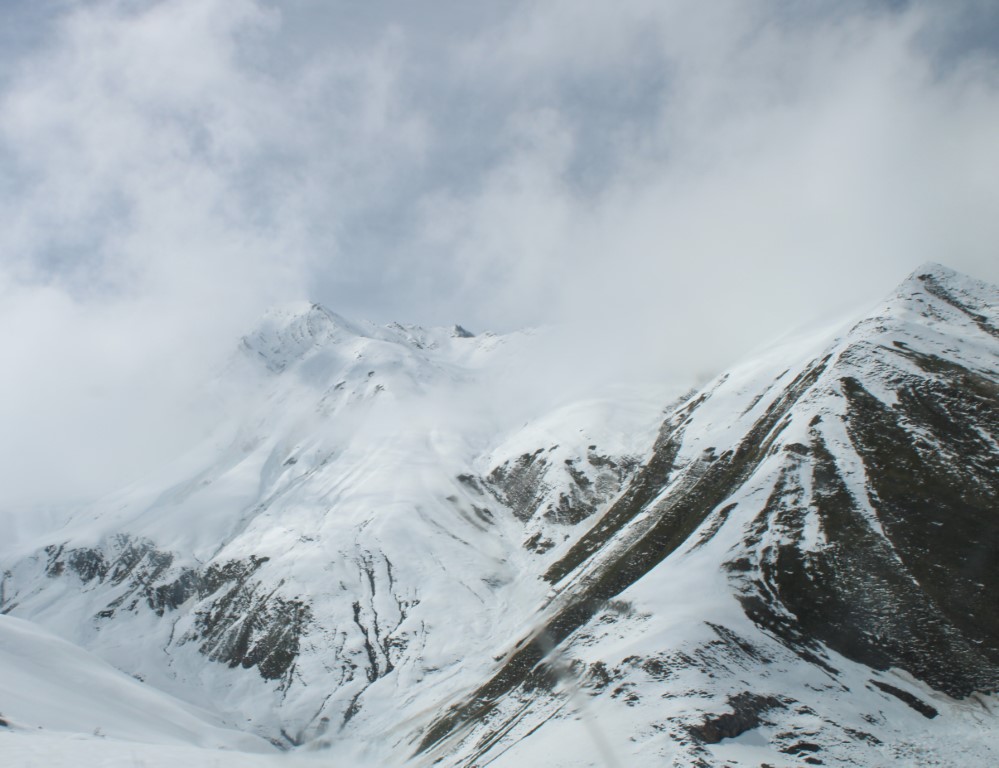
 Above, the spectral glaciers shone,
 And from his lips escaped the groan,
     Excelsior!

"Try not the Pass!" the old man said;
 "Dark lowers the tempest overhead,
 The roaring torrent is deep and wide!"
 And loud that clarion voice replied,
     Excelsior!

"Oh stay," the maiden said, "and rest
 Thy weary head upon this breast!"
 A tear stood in his bright blue eye,
 But still he answered, with a sigh,
     Excelsior!

"Beware the pine-tree's withered branch!
 Beware the awful avalanche!"
 This was the peasant's last Good-night,
 A voice replied, far up the height,
     Excelsior!

At break of day, as heavenward
 The pious monks of Saint Bernard
 Uttered the oft-repeated prayer,
 A voice cried through the startled air,
      Excelsior!

A traveller, by the faithful hound,
 Half-buried in the snow was found,
 Still grasping in his hand of ice
 That banner with the strange device,
     Excelsior!

There in the twilight cold and gray,
 Lifeless, but beautiful, he lay,
 And from the sky, serene and far,
 A voice fell like a falling star,
     Excelsior!
One may live a century --
 Short span though it may be:
  Joys are bitterly brief
  And sorrows are many.
 You may take a wine jug
  On your wisteria rounds:
   See flowers grow to the eves
   As sparse rains wet the grounds.
 And when the wine is gone,
  One strolls with cane and croons.
   We become wizened with age;
   South Mount, fair through countless moons.
NOTE: The late Tang Dynasty poet, Sikong Tu (a.k.a. Ssŭ-k‘ung T‘u,) wrote an ars poetica entitled Twenty-Four Styles of Poetry (二十四诗品.) It presents twenty-four poems that are each in a different tone, reflecting varied concepts from Taoist philosophy and aesthetics. Above is a crude translation of the twenty-third of the twenty-four poems. This poem’s Chinese title is 旷达, which has been translated as: “Illumed” [Giles,] “Big-hearted and Expansive [Barnstone and Ping,] “Expansive,” and “Open-minded.”
There be none of Beauty's daughters
   With a magic like thee;
 And like music on the waters
   Is thy sweet voice to me:
 When, as if its sound were causing
   The charmed ocean's pausing,
 The waves lie still and gleaming,
   And the lull'd winds seem dreaming:

And the midnight moon is weaving
   Her bright chain o'er the deep;
 Whose breast is gently heaving,
   As an infant's asleep;
 So the spirit bows before thee,
   To listen and adore thee;
 With a full but soft emotion,
    Like the swell of Summer's ocean.
Why make so much of fragmentary blue
  In here and there a bird, or butterfly,
  Or flower, or wearing-stone, or open eye,
  When heaven presents in sheets the solid hue?

Since earth is earth, perhaps, not heaven (as yet) ---
  Though some savants make earth include the sky;
  And blue so far above us comes so high,
  It only gives our wish for blue a whet.
With no god, but with spirit;
   With no mass of tiny things;
   Up on high, with the white clouds --
   Borne aloft on breezy wings.
 From afar all seems in place.
   When you arrive it's not there.
   Just like acting with the Way
   Leaves customs beyond repair.
 Chaotic mountain woodlands,
   Sweet green moss in the sunshine.
   Keep reciting your mantra,
   Till it's lost among the pines.
NOTE: The late Tang Dynasty poet, Sikong Tu (a.k.a. Ssŭ-k‘ung T‘u,) wrote an ars poetica entitled Twenty-Four Styles of Poetry (二十四诗品.) It presents twenty-four poems that are each in a different tone, reflecting varied concepts from Taoist philosophy and aesthetics. Above is a crude translation of the twenty-first of the twenty-four poems. This poem’s Chinese title is 超诣 and it’s been translated as “The Transcendental” and “Super”
In seed-time learn, in harvest teach, in winter enjoy.
Drive your cart and your plough over the bones of the dead.
The road of excess leads to the palace of wisdom.
Prudence is a rich ugly old maid courted by Incapacity.
He who desires, but acts not, breeds pestilence.
The cut worm forgives the plough.
Dip him in the river who loves water.
A fool sees not the same tree that a wise man sees.
He whose face gives no light shall never become a star.
Eternity is in love with the productions of time.
The busy bee has no time for sorrow.
The hours of folly are measured by the clock, but of wisdom no clock can measure.
All wholesome food is caught without a net or a trap.
Bring out number, weight, and measure in a year of dearth.
No bird soars too high if he soars with his own wings.
A dead body revenges not injuries.
The most sublime act is to set another before you.
If the fool would persist in his folly he would become wise.
Folly is the cloak of knavery.
Shame is Pride's cloak.
Prisons are built with stones of law, brothels with bricks of religion.
The pride of the peacock is the glory of God.
The lust of the goat is the bounty of God.
The wrath of the lion is the wisdom of God.
The nakedness of woman is the work of God.
Excess of sorrow laughs, excess of joy weeps.
The roaring of lions, the howling of wolves, the raging of the stormy sea, and the destructive sword, are portions of Eternity too great for the eye of man.
The fox condemns the trap, not himself.
Joys impregnate, sorrows bring forth.
Let man wear the fell of the lion, woman the fleece of the sheep.
The bird a nest, the spider a web, man friendship.
The selfish smiling fool and the sullen frowning fool shall be both thought wise that they may be a rod.
What is now proved was once only imagined.
The rat, the mouse, the fox, the rabbit watch the roots; the lion, the tiger, the horse, the elephant watch the fruits.
The cistern contains, the fountain overflows.
One thought fills immensity.
Always be ready to speak your mind, and a base man will avoid you.
Everything possible to be believed is an image of truth.
The eagle never lost so much time as when he submitted to learn of the crow.
The fox provides for himself, but God provides for the lion.
Think in the morning, act in the noon, eat in the evening, sleep in the night.
He who has suffered you to impose on him knows you.
As the plough follows words, so God rewards prayers.
The tigers of wrath are wiser than the horses of instruction.
Expect poison from the standing water.
You never know what is enough unless you know what is more than enough.
Listen to the fool's reproach; it is a kingly title.
The eyes of fire, the nostrils of air, the mouth of water, the beard of earth.
The weak in courage is strong in cunning.
The apple tree never asks the beech how he shall grow, nor the lion the horse how he shall take his prey.
The thankful receiver bears a plentiful harvest.
If others had not been foolish we should have been so.
The soul of sweet delight can never be defiled.
When thou seest an eagle, thou seest a portion of Genius. Lift up thy head!
As the caterpillar chooses the fairest leaves to lay her eggs on, so the priest lays his curse on the fairest joys.
To create a little flower is the labour of ages.
Damn braces; bless relaxes.
The best wine is the oldest, the best water the newest.
The head Sublime, the heart Pathos, the genitals Beauty, the hands and feet Proportion.
As the air to a bird, or the sea to a fish, so is contempt to the contemptible.
The crow wished everything was black, the owl that everything was white.
Exuberance is Beauty.
If the lion was advised by the fox, he would be cunning.
Improvement makes straight roads, but the crooked roads without Improvement are roads of Genius.
Sooner murder an infant in its cradle than nurse unacted desires.
Where man is not, nature is barren.
Truth can never be told so as to be understood and not to be believed.
Enough! or Too much.
* * * The ancient poets animated all sensible objects with Gods and Geniuses, calling them by the names and adorning them with properties of woods, rivers, mountains, lakes, cities, nations, and whatever their enlarged and numerous senses could perceive.
And particularly they studied the Genius of each city and country, placing it under its mental deity.
Till a system was formed, which some took advantage of and enslaved the vulgar by attempting to realize or abstract the mental deities from their objects.
Thus began Priesthood.
Choosing forms of worship from poetic tales.
And at length they pronounced that the Gods had ordered such things.
Thus men forgot that all deities reside in the human breast.
The head Sublime, the heart Pathos, the genitals Beauty, the hands and feet Proportion.
As the air to a bird, or the sea to a fish, so is contempt to the contemptible.
The crow wished everything was black, the owl that everything was white.
Exuberance is Beauty.
If the lion was advised by the fox, he would be cunning.
Improvement makes straight roads, but the crooked roads without Improvement are roads of Genius.
Sooner murder an infant in its cradle than nurse unacted desires.
Where man is not, nature is barren.
Truth can never be told so as to be understood and not to be believed.
Enough! or Too much.
* * * The ancient poets animated all sensible objects with Gods and Geniuses, calling them by the names and adorning them with properties of woods, rivers, mountains, lakes, cities, nations, and whatever their enlarged and numerous senses could perceive.
And particularly they studied the Genius of each city and country, placing it under its mental deity.
Till a system was formed, which some took advantage of and enslaved the vulgar by attempting to realize or abstract the mental deities from their objects.
Thus began Priesthood.
Choosing forms of worship from poetic tales.
And at length they pronounced that the Gods had ordered such things.
Thus men forgot that all deities reside in the human breast.











 Tiger Riding for Beginners