BOOK REVIEW: Seven Spiritual Laws of Superheroes by Deepak Chopra

The Seven Spiritual Laws of Superheroes: Harnessing Our Power to Change the WorldThe Seven Spiritual Laws of Superheroes: Harnessing Our Power to Change the World by Deepak Chopra

My rating: 3 of 5 stars

Amazon page

This is Deepak Chopra’s attempt to capitalize on society’s fascination with superheroes. By “capitalize” I’m not necessarily saying to “make money off of,” but perhaps to “use to his advantage in conveying his lessons.” [I’ll leave it to the reader to make judgments about the former.] There are books on the physics of superheroes, the philosophy of superheroes, and the mythology of superheroes, so why shouldn’t there be a book on the spiritual life of superheroes?

The book uses both the superheroes of mythology—i.e. Indian, Greek, Judeo-Christian, Muslim, and others—as well as the superheroes of comic books. While Chopra’s knowledge of the former is considerable, he enlists the co-authorship of his son Gotham (not named after Bruce Wayne’s hometown) to offer insight into the latter.

This book is also intended to capitalize (again, take that as you see fit) upon Chopra’s best-selling book, The Seven Spiritual Laws of Success, but without rehashing the same laws. The Seven Spiritual Laws of Superheroes format is as straightforward as its title. There are seven chapters, each corresponding to one of Chopra’s laws. Said laws address balance, transformation, power, love, creativity, intention, and transcendence.

As I read the book, there was something that rubbed me the wrong way about the writing. It wasn’t that I had major disagreement with Chopra’s ideas, but rather the way he was stating them. At first I thought this was the use of gratuitous assertion. He often began chapters with detailed statements about what superheroes are, do, believe, and understand without much—if any–substantiation of these claims. However, as I got into the first chapter I noticed that he would put one section in each chapter that discussed an example in-depth, offering at least anecdotal support for his claims.

This still left a bit of a bad taste in my mouth. It was because he used general statements like “superheroes know…” and “superheroes understand…,” and then provided a solitary example that fit his statement well, but leaving a vast cast of heroes that didn’t. It seemed a low form of inductive reasoning. In other words, he was attributing an enlightened way of thinking and acting to characters like Hulk and Wolverine.

Chopra and his supporters might make the claim that saying, “The Hulk understands X [insert any of the laws here]” doesn’t necessarily mean he understands them as an intellectual exercise, but rather that he shows this understanding through his behavior. Let me give a story that may make my meaning clearer.

An economist is giving a lecture on consumer behavior. Someone in the audience says, “Professor, how could consumers possibly behave in the way you suggest? Your theory requires complex Lagrangian optimization mathematics, which very few of them understand?”

The Professor replies, “Most of them don’t understand Newton’s work either, but they obey the Law of Gravity without fail.”

I thought about Chopra’s statements from this perspective, but concluded that his point was probably something entirely different. As an author of self-help books about the mind, when Chopra says “Superheroes understand X,” he’s not saying “Each and every superhero understands X,” but instead he’s saying, “If you want to be a superhero, you need to understand X.”

Accepting that that’s what Chopra meant, only one more qualm with the book remained. Laws can be clearly stated (OK, perhaps not tax law, but laws of physics—which seem to be more the kind of law he seeks to emulate), but Chopra’s discussion of his “laws” is vague and ill-defined. Each chapter begins with a large-font italics statement. I don’t know if this is supposed to be “the law” or not. It usually begins with a definition (some vaguely stated) and then statements that superheroes comport themselves in accordance with said definition. Maybe the unstated laws are supposed to be, “Superheroes live a life of balance,” and so on for the other chapters. As one trained as an economist, I’m well-aware of the wide-spread overuse of the term “law,” and maybe the ill-defined nature of Chopra’s laws is a recognition of this.

This book is written for Chopra’s usual audience of seekers of enlightenment. I don’t know that it’ll do well with hard-core science fiction or comic fans, and I don’t know that the Venn intersect of “spiritual self-help readers” and “comic book fans” is as big as Chopra would like. (But, I could be wrong.) Some of Chopra’s ideas about the potential spiritual ramifications of “quantum entanglement” are quite popular with sci-fi fans, but I’m not sure that that offers this book a clear audience. (It might. Chopra is a trained physician, and has some scientific bona fides—unlike many who share shelf space with him and who exist in a spiritual plane entirely unrelated to the world as we know it.)

All this being said, there are some thought-provoking ideas in this book, and the superhero and mythological examples help entertain and—in doing so—become the spoon of sugar that makes the medicine go down. Another testimonial is that I read most of this book in a single sitting, and I tend to jump from a chapter in one book to another book unless something really holds my interest.

View all my reviews

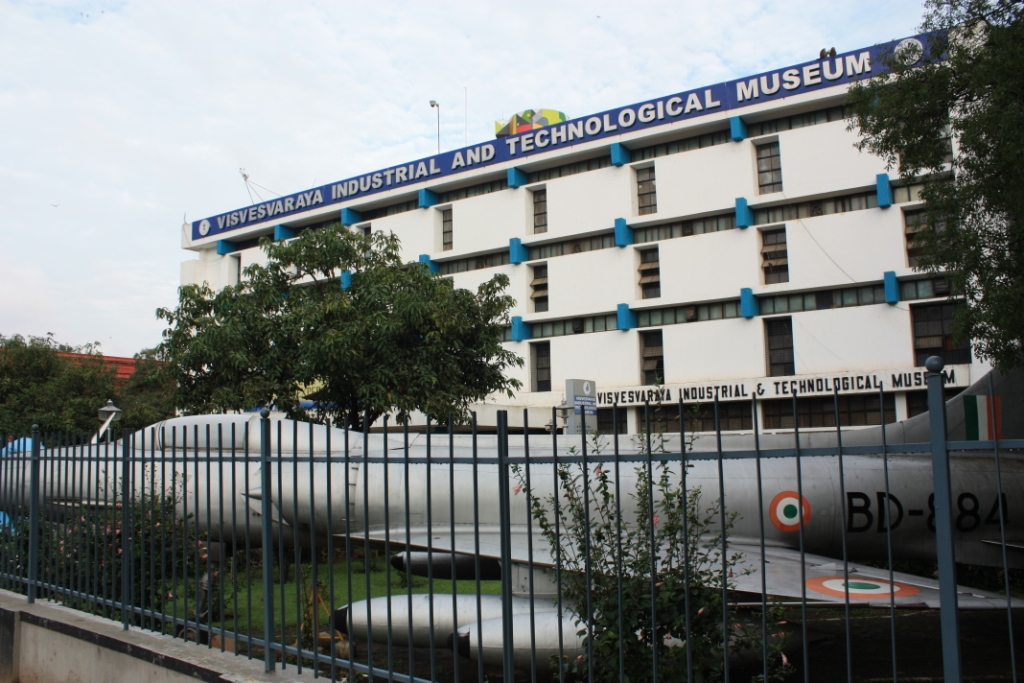
Visvesvaraya Industrial and Technological Museum

The plane is the HF-24, India's first indigenous figher jet (circa 1960's)

The plane is the HF-24, India’s first indigenous fighter jet (circa 1960’s)

I visited the Visvesvaraya Industrial and Technological Museum last week. I wasn’t sure what to expect. The admission fee is only 30 rupees (less than 50 cents in USD terms.) I ended up being pleasantly surprised. It took me back to childhood visits to Chicago’s Museum of Science and Industry. Granted it’s neither on the scale of the windy city’s museum nor as well-maintained, but it’s largely interactive and has some fascinating–if often retro–displays. It’s great for kids or adults who’d like to revisit the science that they’re forgetting, and to do so in a way that’s entertaining.

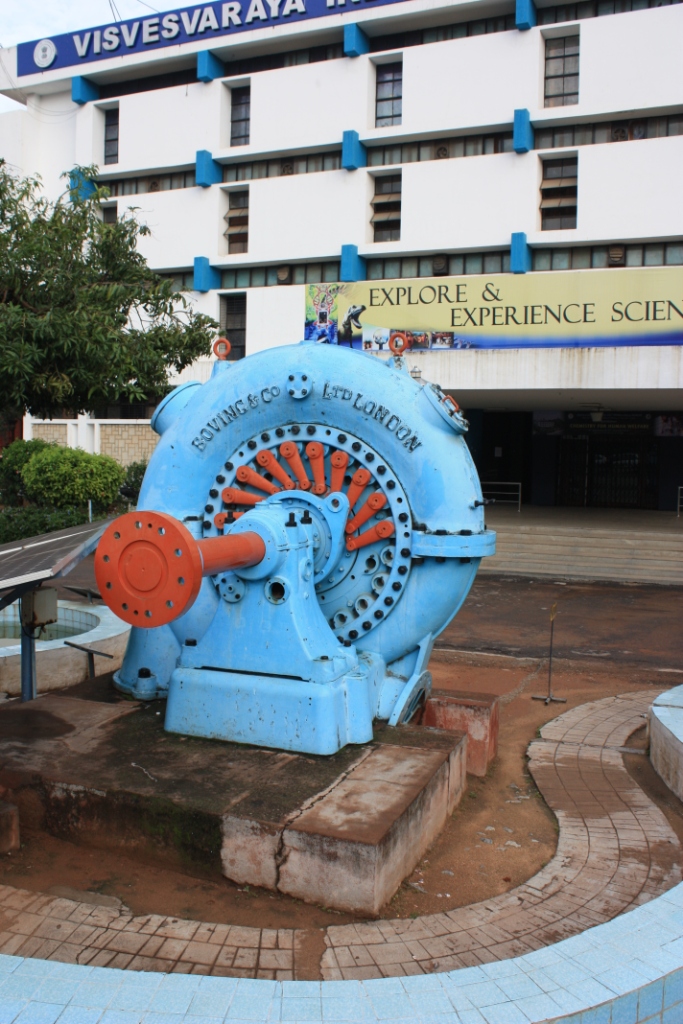
The museum consists of five exhibit halls and a few other stand-alone displays both inside and outside the building. Outside one will see an old locomotive, a copy of India’s first indigenously-built fighter jet, an Archimedes water drill, and a big steam turbine. One’s visit inside, unfortunately, begins inauspiciously with a solitary animatronic T-rex that looks a bit dog-eared.

Also on the ground floor, the first exhibit hall one visits is the Hall of Engines. This covers steam power, gasoline engines, turbines of various forms, as well as displays of human and animal powered technology. There are hand-crankable cut-away scale models that allow one to see how the various engine designs work. There are also cut-aways of some full-sized engines. Overhead there are a series of wire tunnels through which billiard-size balls circulate, having been hand-cranked up into the track by various mechanisms. This, I believe is intended to demonstrate gravity power, which it does in a whimsical Rube Goldberg-esque sort of way. There’s also a video on simple machines that looks like it was initially made for 1950’s school children in America.

There are two exhibit halls on the first floor (that’s the second floor to Americans), one that deals with electricity and another called “Fun with Science” that’s all hands-on exhibits intended to spark the interest of school-aged children. The former covers the basic science of electricity as well as looking at the various generation methods, including nuclear, wind, solar, hydroelectric, and fossil fuels.  The latter has interactive exhibits of the kind found in many a science or children’s museum. I would say the exhibits here are largely geared toward middle school and high school students. There is a small exhibit on the top floor that is aimed at young elementary school age students.

The second floor has a biotechnology exhibit hall as well as one that deals with space. The biotech hall covers basic biology, agriculture, and even beer brewing. The space hall discusses the history of space technology and particularly focuses on India’s Chandrayaan-1 moon-orbiting mission. (If you didn’t know that India had orbited the moon and delivered an impactor to the lunar surface, you are in good company. I had no idea either. But this was back in 2008-2009.)  Anyway, it was good to see some Indian focus. As I was traveling through the exhibit halls up to this point, it occurred to me that there wasn’t a great deal for the school children passing through this museum to take national pride in. There was a lot of material about discoveries made in places like Germany, America, and Japan, but not a lot of segments on contributions of national scientific heroes as one would expect at such a museum.

The third floor has a full-sized exhibit hall dedicated to electronics and computer technology, and part of one hall that is split between a small “Science for Children” exhibit geared toward young children (pre-school and the younger elementary grades) and a temporary exhibit on chemistry. The chemistry exhibit is the most reading-oriented exhibit, except for a couple of models and a touch screen interactive periodic table, it’s pretty much a poster exhibition. The hall of computers and electronics has many interesting exhibits, such as a cylinder supposedly containing the 42 million transistors that it takes to make up one Pentium 4 processor.

There’s a nice poster exhibit about the 2012 Nobel Prize Winners. I assume this will be updated sometime next month after the new winners have been announced.

All and all, I’d say this museum is a bargain at several times the price.

IMG_0189

BOOK REVIEW: Einstein’s Dreams by Alan Lightman

Einstein's DreamsEinstein’s Dreams by Alan Lightman

My rating: 4 of 5 stars

Amazon page

One might think that a novel written by a physicist would make for dreadful reading–and most of the time one would probably be correct. However, Lightman’s Einstein’s Dreams is a fascinating read. The arc of the book–what makes it a novel rather than a series of short scenes–is conveyed by a prologue, a few interludes, and an epilogue. These brief sections show an Albert Einstein as he went about life trying to work out his special theory of relativity.

In between the interludes are a series of written sketches that depict dreams that might have been had by Albert Einstein between April 14th and June 28th of 1905. Each of these dreams depicts an alternative universe in which time is not experienced as we experience it: that is, as an inexorably flowing river with a clearly defined arrow. In one dream, time is circular. In another, a lifetime is compressed into a day. In another, there is no flow of time; the world is a snapshot. In another, immortality is the norm. In the latter dreams of the book, we see a convergence on time as we know it–though in dream-like abstraction.

This short book is both creative and well-written. Lightman excels at creating scene through vivid description. His approach to structure is unique.

One thing that might have improved the book is if the author had been a little bolder. Lightman feels the need to explicitly state what is going on in each dream world. However, his description is strong enough that such discussion is generally anti-climactic–one already knows how time is working (or not working) in a given universe before the author states it explicitly. Thus, these explicit descriptions succeed only in taking one out of the dream.

View all my reviews

A [Different] Skeptic’s View of Traditional Chinese Medicine

Tai Chi Sculpture; Taken in Montreal

Tai Chi Sculpture; Taken in Montreal

I’m sick. I mean that literally for those readers who are saying, “Yes, I read your blog occasionally; I’m well aware that you’re a sick freak.”

I rarely get sick. I can usually knock colds out at the first sign of a scratchy throat with big does of zinc and remedies I’ll discuss below. I can’t remember the last time I had the flu. Let me say to any angry gods that I’m not bragging, so please don’t smite me. I hope I haven’t just fallen off some divine pestilence list (God: “Geewhiz, that boy hasn’t had the flu since like 2002, lets send him a doozy… plus throw in a side of locust plague.”) I’m just stating a fact; I’m blessed with a mighty immune system and a lack of those plague-bombs commonly called children.

However, before you, too, begin to wish evil upon me for my freakish good health, let me say that when I do get a full-bore cold, it’s a catastrophic train wreck. This is because I have a proclivity for sinusitis. That means that all those tiny little tubes by which mucus flows from one chamber to the next in my head so that it can eventually be expelled into a facial tissue become clogged up. This creates an effect similar to a trucker’s strike at a dildo factory. The phalli (phalluses?) keep coming off the line, but none of them are being shipped out, so soon everything is fucked. When I tap on the highest point on my head it sounds like one thumping on a perfectly ripe watermelon. GROSS CONTENT AHEAD: (If you’re disgusted easily, skip to the next paragraph.) So, last night my left side passages were so blocked that pus was oozing out around my left eye, and I began to have an earache as the pus tried to escape out my ear only to find my eardrum in the way. END GROSS-OUT ZONE.

So you might be expecting that I had a sleepless night and have a doctor’s appointment this morning. I’ve gone that route before. I know exactly what the doctor would do, she’d write a prescription or two: one for a round of antibiotics and one for something to reduce the pain. As a skeptic, this is the approach in which I should put my trust. They develop these medicines using the scientific method and double-blind studies.

What did I do? I diced up some ginger and made a steaming cup of ginger tea and, as it steeped, I ran through a couple qi gong exercises. Then, after drinking the tea, my passages opened up, I blew my nose and slept soundly for about four hours until it was time for me to get up and start my day. As a skeptic, Traditional Chinese Medicine (TCM) isn’t the horse on which I should put my money. It all revolves around chi (qi), life energy, a substance whose existence is to the best of my knowledge is completely unsupported by direct observation. It’s chocked full of archaic sounding treatments like “Immortal spanks the naughty dragon.” (Okay, I made that one up, but you get my point.) TCM proposes that the kidneys are integral to sexual health.

So why am I pressing acupressure points, doing qi gong (life energy exercises), and making homemade tea? The easy answer would be that, if I hadn’t, I probably would have gotten five non-consecutive minutes of sleep last night, and I’d, at best, now be sitting in a waiting room with my skull in my hands hoping to be squeezed in to a doctor’s busy schedule.  However, I have more of an explanation than that.

I don’t know much about medicine (either Western allopathic  or TCM.) So in the absence of knowledge about what one doesn’t know, one seeks analogy in what one does know.  First, everything I know makes me distrustful of the  “free lunch.” To my mind, the Western approach, in which I don’t have to do anything but pop pills periodically, is a free lunch scenario. If I to be active (or even consciously passive, i.e. restful) to achieve my cure, I’m inherently  more confident in it. In the martial arts, we groan at the sight of these “home-study black belt” courses. Any martial artist who is honest with himself or herself knows that the only way to develop the skills is by spending at least a couple of days a week in the dōjō and training outside the dōjō as well. One can’t learn martial arts like one learns music appreciation or business administration. As an economist, there’s always some hidden cost of the “free lunch.” So despite the vigorous use of the scientific method, I tend to be skeptical of Western medicine.  I’m skeptical because nothing worthwhile I’ve ever done could be achieved by just popping a pill, and I see little reason why achieving a healthy state should be any different. [If anyone knows of a pill for manuscript revision, I’d be willing to try it.]  (I’m particularly disconcerted by medicines like pain-killers that remove the symptoms while apparently doing nothing about the ailment itself.)

So I can’t say for sure whether the ginger tea, acupressure, and qi gong had anything to do with my passages opening up. It was, after all, a system under tension. GROSS-OUT BEGINS: At some point either the passage was going to open, my left eyeball was going to pop out of its socket, or my eardrum was going to rupture sending an avalanche of pus pouring onto my shoulder. GROSS-OUT COMPLETED. However, even if all the TCM approach did was to take my mind off of my misery while I was waiting, it did more for me than the pill-popping alternative.

Second, I also know a little something about systems, generically speaking. Another thing that appeals to me about TCM is its fundamental recognition that any problem will create feedback effects that reverberate through the system.  In other words, the root cause may not be anywhere near where the problem is first noted. Because of this, one may end up having to fix a dysfunction distant from the symptom in order to fix the problem. This seems consistent with other systems with which I am familiar.

I have some arthritis from a lifetime of beatings–most notably in my lower back and my ankles. It occurred to me that my back problem might be exacerbated–if not caused–by a problem with my right foot and ankle. I suspected the damaged ankle and flat foot might cause my pelvis to tilt and my lower back to be off kilter, thus wearing through the cartilage on the side of my back that gives me problems. Maybe this was, in fact, wrong. However, when I asked the specialist who diagnosed my ankle arthritis about this possibility, he looked at me like I was the biggest idiot in the world.  “You see, son, the ankle bone is connected to the shin bone and the shin bone is connected to the knee bone and the knee bone is connected to the thigh bone, the thigh bone is connected to the pelvic bone, and it’s not until this point that the pelvic bone is connected to the back bone. There’s like half a dozen things between those two problems. They couldn’t possible have anything to do with each other.”

Now let me be clear, I’m not dismissing Western medicine by any means. There are some things it does vastly better than TCM or Ayurvedic healing or any other holistic healing method. So if I show up in your Emergency Room with a piece of rebar sticking out of my skull, please don’t throw this back in my face. “Oh maybe you should massage the Valley of Harmony (LI-4), do some ‘Parting the Clouds,’ and drink a glass of lavender-infused carrot juice.”

Tulip 7

Night falls on Bangkok

Night falls on Bangkok

I’m speed-walking down the sidewalk off Sukhumvit Road like one of those elderly mall-walkers.  Like the mall-walkers, there’s an irony to my speedy step. I’m on vacation. I have no particular place to be, and no particular time by which I need to be there. Unlike the mall-walkers, my path is perilous. I have to weave around street-food vendors deepfrying springrolls or grilling satays (and fight my stomach’s urgings), evade the grasping taunts of idle tuk-tuk drivers, and wave off T-shirt vendors selling shirts featuring elephants, thaiboxers, and Singha beer.

I don’t know why I’m moving so quickly. It feels natural. It’s the pace of the city. To walk slow would be to swim against the current. If you want the truth, I walk fast because in the back of my mind, in the deep recesses of irrationality, I feel that if I slow down the city will collapse into me, forming a black-hole. It will start with a few tuk-tuk drivers, a beggar, a prostitute, and a few street vendors converging on me. They will create a gravity, attracting more vendors, beggars, drivers, and hookers. If I don’t walk fast, I fear that I will be crushed in the center of a dense mass of humanity.

Leaning against the marble wall of a bank façade, a master of timing, an Indian man blinks, touches his forehead, and grimaces–as if my approach causes him some sort of psychic pain. I brace myself for the scam. He steps away from the wall into my path, gently extending an arm.

He says, “Sometimes, you think too much.” He’s trying to convince me that he has insight into my soul by making a statement that, while perfectly correct, contains no information content whatsoever. He’s smooth in behavior and handsome of feature. I bet he makes a mint in his chosen profession.

An instantaneous battle rages inside of me. On the one hand, I’m an introvert– or perhaps a sociopath– something like that. Whatever my affliction, interacting with strangers is draining. On the other hand, I’m curious about everything. I know the man is a scam artist. It’s not that I was never on the turnip truck, but I fell off a couple of decades ago, and while it took me several bounces to come to a stop, I eventually became quasi-worldly. While I know he’s a scam artist, I don’t know what kind. I so desperately want to know that I stop.

After a greeting, he says, “I can tell your future. There are two women in your life, I can tell you how it will work out.” His speech is clear, and well-spoken, like he was born in Mumbai, but moved to Cincinnati when he was 15. He is, in all respects, a smooth operator.

However, he’s wrong already.  As I said, I’m not exactly a people person. It takes all my mental energy to even be monogamous, as opposed to nul-agamous. The idea that I’m maintaining two relationships would be a bit laughable to anyone who could really “see into my mind.” Whenever I hear about one of these guys who has two separate families, I always think, “How many hours a day did the good Lord grant you?” Because I can’t fathom living that way and not being in an utter state of exhaustion every minute of every day. I’d be a wreck.

However, I give him points for playing the odds. I’m a middle-aged man with a gray goatee walking down the street in Bangkok. I’m probably the only one fitting that description who hasn’t fallen desperately (and pathetically) in love with an “eighteen year old” bar girl who the man secretly thinks is 16, but who, in reality, is 29.

Incredulity must show in my face, because he changes tack. “Let me show you proof of my abilities.”

He extracts a flip-style pocket-notepad from the inner pocket of a tweed sport-coat that is grossly out-of-place in steamy Bangkok, but which lends credibility. He scribbles down something on a page so that I cannot see. He then tears off the strip of paper containing his writing. He wads the paper up.

“I want you to think of the English-language name of a flower. Have you got it?” he asks.

“Yeah,” I reply.

“Now think of a number between six and nine. Have you got it? Now think of them together.”

In my mind I see, Tulip 7.

He hands me the wadded up scrap. I unravel it. It reads, “Tulip 7.”

He then opens his day-planner and asks me to put in any amount that I feel is fair and he will tell me about my future.

What he doesn’t know is that I’m the exact wrong person to pitch his act to. As a skeptic, I make Descartes look like gullible. (After all, Descartes developed a “proof for the existence of God”–granted everyone deserves a nadir of thought, and that was clearly Descartes’.) The most fundamental thing that studying Economics and Political Science taught me was that humans are completely incapable of making meaningful predictions. I’d seen this guy’s act before from a guy named Professor Bruce Bueno de Mesquita, but instead of getting a few baht on the streets, the political scientist got millions of American tax dollars for convincing the CIA that he could tell the future.

As I walk away, he says, “You have an ailment. I can tell you about it.”

I think, Good one, that’s a true test of my powers of skepticism, and I continue to walk, thinking out how the mentalist scammer did his trick… and wondering if I have cancer.

BOOK REVIEW: Unbelievable by Stacy Horn

Unbelievable: Investigations into Ghosts, Poltergeists, Telepathy, and Other Unseen Phenomena from the Duke Parapsychology LaboratoryUnbelievable: Investigations into Ghosts, Poltergeists, Telepathy, and Other Unseen Phenomena from the Duke Parapsychology Laboratory by Stacy Horn

My rating: 3 of 5 stars

Amazon page

For 50 years a laboratory operated at Duke University that studied extra-sensory perception (ESP), ghosts, and other paranormal events. Today one can’t imagine an academic laboratory devoted to paranormal activity surviving, especially at such a prestigious university. Horn’s book takes one through the life of this lab. It describes phenomena debunked as either fraud or poor methodology, but it also discusses events and outcomes that have remained unexplained.

The central character in the book is J.B. Rhine, Director of the Duke Parapsychology Laboratory. Rhine was a botanist by training, but he developed an interest in parapsychology– eventually becoming the foremost expert in the, albeit dwarf, field.

When the lab opened in 1930, the universe of unknowns was much greater than when it closed in 1980. This was exemplified by Albert Einstein’s correspondence with Rhine, and the author of relativity’s attendance at a séance on one occasion. By 1980, having recorded some unexplained phenomenon, but having produced neither well-validated results nor explanations, the lab was looking increasingly like a boondoggle.

The phenomena studied included some that could be systematically studied  in the laboratory, as well as others that could only be observed in the field. The former being exemplified by the use of cards with shapes on them to study telepathy (as depicted by Bill Murray’s character in Ghostbusters.) The latter included the study of poltergeists or interviews of children about the lives of people who lived before their time (e.g. as Tibetan lamas are selected).

One of the questions confronting the investigators was whether those phenomena that could be studied in the lab were best studied there. While telepathy studies sometimes showed a weak but positive result, some thought that more robust results could only be attained under real world conditions.

In the 60’s, Timothy Leary came to call on Rhine. Leary, of course, thought hallucinogens were the key to unlocking the hidden powers of the mind. Rhine apparently took LSD on a couple of occasions before concluding that there was nothing but vivid chaos coming out of the experience. Still, there remained adherents to the notion that mind-altering drugs might unlock hidden potentials. Horn devotes several pages to the work of Sidney Gottlieb, the head of the CIA parapsychology program. It should be noted that the government programs were not stopped until the mid-90’s, fifteen years after Duke’s Parapsychology Lab shut down.

The last gasp of parapsychology was an attempt to determine if quantum entanglement might have any ramifications for ESP. Quantum entanglement is the situation in which two particles separated at great distance can influence each other instantaneously. Could the particles in two minds behave accordingly, and, if so, to what result?

View all my reviews

BOOK REVIEW: Secret Weapons by Cheryl Hersha, et al.

Secret WeaponsSecret Weapons by Cheryl Hersha

My rating: 3 of 5 stars

Amazon page

Secret Weapons is about two sisters who are trained in an MKULTRA-style behavior modification program to become femme fatales. This book was a rare find. I hadn’t heard of it before or seen it in my local bookstores, but I came across a copy at the Strand bookstore in New York (the “miles of books” place) on a trip several years ago.

Like Whitley Strieber’s Communion, this book leaves one engrossed but wondering what exactly one is reading. It is written as non-fiction, and not creative non-fiction that admits to blending elements of fiction into the fact. The writers are eager to convince the reader that this is not a hoax. About a quarter of the book is supporting documents to lend the book credibility. However, while I’m well aware of the “mind control” programs sponsored by the American government, this story doesn’t ring true to me. (In large part this is because we know the programs that operated were not nearly so successful as the one in Secret Weapons would have had to have been.) [I wrote a post about such programs that is available here. If you’d like to read some primary documents on the subject, this page at the National Security Archives has many of them.]

One might think that there are two possibilities: either it’s a true story or it’s a hoax. However, it’s a third possibility that makes this book so thought-provoking. What if the two sisters believe that the story is absolutely true, when–in fact–it wasn’t? How could this be? Their father is presented as an unsavory character. One possibility is that the father abused these girls and they created an elaborate backstory in their minds to cope with the fact that the one man who should have loved them, that they should have been able to trust, neither loved them nor was worthy of their trust.

Of course, another possibility is that it’s all true. While a lot of information did come out about Projects ARTICHOKE, BLUEBIRD, and MKULTRA, a lot was also shredded. The person working the shredder might have gone after the documentation of activities involving pedophilia first. If there is any activity that would have rightfully taken the situation from one of CIA employees being sent to country club federal prisons to them being strung up on the Capitol steps, it’s what’s depicted in this book.

Of course, it could all be a hoax as well. A story like this, if believed, elicits the publicity of the news media. That’s a powerful way to sell books.

I’ll leave the reader to decide which of the three possibilities they believe is most likely.

If you haven’t concluded this already, let me be explicit: This book contains disturbing descriptions (and even sketches.) It isn’t gratuitous to the story they are trying to convey, but if you have a weak stomach for such matters, I’d recommend you steer clear.

View all my reviews

Who Am I?

“I” am a collection of cells.
some  expressly invited by “my” genes
others are interlopers,  “my” guts their cross-town bus
but these interlopers defend “me”  daily
fending off worse marauders
thankfully
so “I” let them stay inside “me”
“my” greatest shame? “I” am a slave owner.
the  mitochondria in “my” cells  are trapped and  forced to serve “me”
all this begs one fundamental question,
am “I” really just a “me?”
or  a  whole society?

If “my” parts
needn’t be fully integrated
where do “I” end and “you” begin?
can “I” say that “I” have been everywhere?
well, everywhere on this tiny, spherical-ish speck of galactic dust?

TODAY’S RANT: Hyper-relativistic Mathematical Zones: or, When Will my Car be Done?

Albert Einstein theorized that distance and time are relative depending upon one’s speed. In everyday life we rarely notice this because of a little-known tenet of General Relativity that says, “Whenever one attempts to approach the speed  of light, there will be an octogenarian in the left-hand lane.”

Since the early 20th century, physicists have thought they were this close (author holds up hand with thumb and index fingers about 3/4 of a centimeter apart) to being able to explain the whole shebang. Figure out why very small things behave differently from very big things, and, Bob’s your uncle, we’ve got your Eureka moment.

I, however, think physicists will find that they have yet another hurdle to solve (mixed metaphor intended, smartypants.) This has to do with certain zones in which conventional measurements of space and time break down even when one is only moving at the speed the planet is revolving (24 hours/day, I think, no that sounds wrong somehow.)

I don’t think physics is quite prepared to explain why an hour in a mechanic’s shop is equal to about 4.33 hours on the outside. We’ve all experienced the inverted time-dilation effect of the Department of Motor Vehicles. According to Einsteinian relativity, time slows as one approaches the speed of light. However, time slows even more when one is in the slowest state of movement possible, the DMV line.

I won’t go into the distance contraction effects localized to the crotch region of men who wear wife-beaters and gold hood ornaments around their necks.

Are these just zones in which bistromathics trump mathematics (Sorry only readers of Douglas Adams’s Life, the Universe, and Everything will get that reference.)

Any Unified Field Theory must explain these phenomenon before I can accept it.

BOOK REVIEW: Physics of the Impossible by Michio Kaku

Physics of the Impossible: A Scientific Exploration into the World of Phasers, Force Fields, Teleportation, and Time TravelPhysics of the Impossible: A Scientific Exploration into the World of Phasers, Force Fields, Teleportation, and Time Travel by Michio Kaku

My rating: 5 of 5 stars

Michio Kaku is the master of pop physics writing. While you may find names like Brian Greene or Neil Degrasse Tyson more recognizable, if you haven’t read any of Kaku’s work, this is a good one with which to start.

This book examines the possibility (or lack thereof) of many technologies and scientific concepts prevalent in science fiction.

Why spend time reading about things impossible? It turns out that one’s definition of “impossible” matters greatly. Kaku divides the world of impossible into three classes. The first, and largest class by far, are those technologies that are impossible given today’s capabilities, but aren’t prohibited by the known laws of physics. This class includes technologies that one can readily imagine such as: robots, starships, and phasers. However, it also includes developments that one might think are firmly in the realm of sci-fi, such as: teleportation, telepathy, force fields, and psychokinesis.

Class II impossibilities are those that look impossible now, but which may prove possible as our knowledge increases. They include faster than light travel, time travel, and the existence of parallel universes. The first two require uncovering loopholes in prevailing Einsteinian paradigm. The second also begs the question of why we don’t have time tourists.

Class III impossibilities are those that violate the known, well-established laws of physics. Kaku only puts two items in this bin, perpetual motion and precognition.

Kaku’s book discusses a fascinating topic in a highly readable format and using good science.

View all my reviews